
In my research, I focus on the dynamic performance of electro-mechanical actuators (EMAs) used in aircraft control surface systems, particularly those incorporating a planetary roller screw mechanism as the primary motion conversion device. The planetary roller screw mechanism offers significant advantages over traditional ball screw mechanisms, including higher load capacity, improved efficiency, and greater durability, making it ideal for high-performance aerospace applications. This article delves into the modeling and simulation of such an EMA system, considering nonlinear factors like structural compliance, friction, and clearance, which critically influence its dynamic response. My goal is to provide a comprehensive analysis that can guide structural optimization and control strategy development for power-by-wire actuation systems.
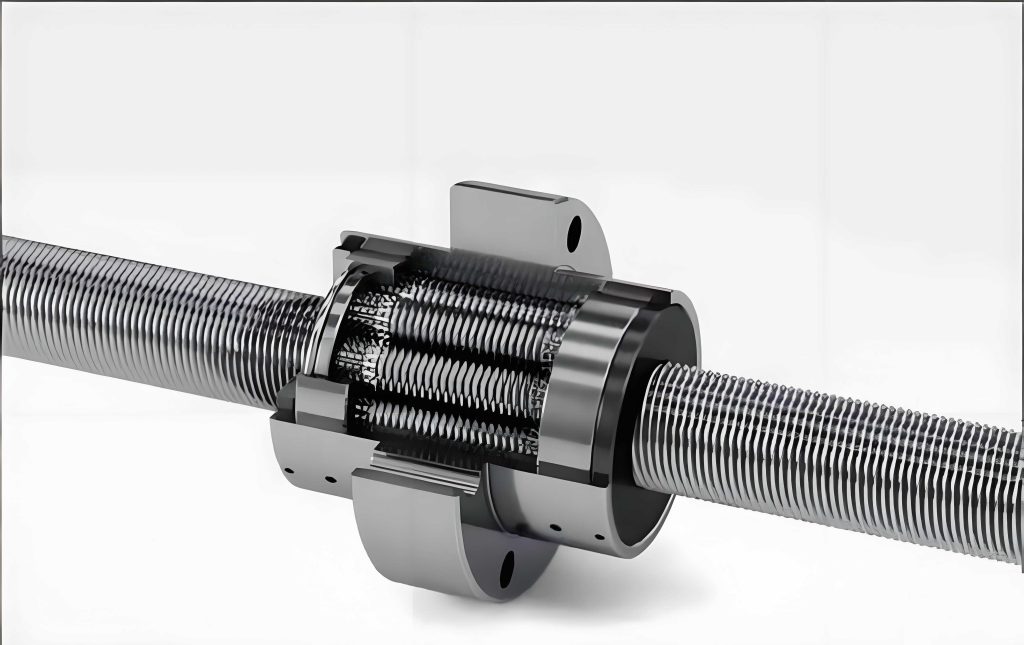
The core of my study is a standard planetary roller screw mechanism (SPRSM), which consists of a screw, a nut, and multiple rollers arranged planetarily. This configuration enables efficient conversion of rotary motion from a motor into linear motion of an output rod, driving control surfaces like rudders or elevators. The planetary roller screw mechanism’s design reduces sliding friction and enhances force transmission, but its dynamic behavior is complex due to mechanical interactions. I developed a detailed mathematical model of the entire EMA system, accounting for installation compliance and aerodynamic loads from the control surface. This model serves as the foundation for exploring how various parameters affect system performance.
My EMA system comprises several key components: a brushless DC motor, a controller with current, speed, and position loops, a gear reducer, and the planetary roller screw mechanism. The controller ensures precise motion control by regulating motor currents and velocities based on input commands from flight control computers. The planetary roller screw mechanism translates the rotational torque into linear force, acting against aerodynamic loads on the control surface. I modeled this system using a multi-domain approach, integrating electrical, mechanical, and control elements to capture realistic dynamics.
The mathematical representation of the EMA begins with the motor model. The motor’s electrical dynamics are described by a first-order transfer function relating armature current \(I_c\) to input voltage \(V_c\):
$$I_c = G_e (V_c – K_\omega \omega_m)$$
$$G_e = \frac{1/R_c}{L_c/R_c s + 1} = \frac{1/R_c}{\tau_e s + 1}$$
where \(\omega_m\) is the motor angular velocity, \(K_\omega\) is the back-EMF constant, \(R_c\) is winding resistance, \(L_c\) is inductance, and \(\tau_e\) is the electrical time constant. The motor torque \(T_m\) is given by:
$$T_m = K_c I_c$$
with \(K_c\) as the torque constant. Under saturation, the peak torque is \(T_{\text{peak}} = K_c I_{\text{lim}}\). The mechanical equation on the motor shaft includes inertia, friction, and load torque:
$$T_m = J_m \dot{\omega}_m + K_{mv} \omega_m + \frac{T_{\text{load}}}{i}$$
Here, \(J_m\) is the reflected inertia, \(K_{mv}\) is the friction coefficient, \(T_{\text{load}}\) is the load torque from the planetary roller screw mechanism, and \(i\) is the total gear ratio combining the reducer and the planetary roller screw mechanism’s lead.
The planetary roller screw mechanism model incorporates both translational and rotational dynamics, along with nonlinearities. The load torque relates to external force \(F_{\text{ext}}\) via the lead \(l\):
$$T_{\text{load}} = F_{\text{ext}} \frac{l}{2\pi}$$
Friction in the planetary roller screw mechanism is a critical nonlinearity. I modeled the overall friction force \(F_{\text{fric}}\) at the output rod as a function of velocity and external load:
$$F_{\text{fric}} = \left[ F_c + F_s e^{-\left|\frac{\omega_m}{\omega_s}\right|} + F_{\text{ext}} \left( c + d \text{sgn}(\omega_m F_{\text{ext}}) \right) \right] \text{sgn}(\omega_m)$$
where \(F_c\) is Coulomb friction, \(F_s\) is Stribeck friction, \(\omega_s\) is a reference speed, and \(c\) and \(d\) are coefficients for load dependence. The corresponding friction torque \(T_{\text{fric}}\) is:
$$T_{\text{fric}} = \left[ T_c + T_s e^{-\left|\frac{\omega_m}{\omega_s}\right|} + T_{\text{load}} \left( c + d \text{sgn}(\omega_m T_{\text{load}}) \right) \right] \text{sgn}(\omega_m)$$
This model accounts for variations in friction due to operational conditions, essential for accurate dynamic simulation of the planetary roller screw mechanism.
Clearance nonlinearity in the planetary roller screw mechanism, arising from axial gaps between components, is another key factor. I represented this using a dead zone model for the torsional angle \(\theta_d\) between motor and load sides:
$$T_m = k_s \theta_s = k_s D_\alpha(\theta_d)$$
$$\theta_s = \theta_d – \theta_b$$
with \(k_s\) as torsional stiffness, \(\theta_b\) as the backlash angle (limited by \(\alpha\), the half-clearance), and \(D_\alpha\) as the dead zone function:
$$D_\alpha(\theta_d) =
\begin{cases}
\theta_d – \alpha, & \theta_d > \alpha \\
0, & |\theta_d| \leq \alpha \\
\theta_d + \alpha, & \theta_d < -\alpha
\end{cases}$$
When damping is considered, the model extends to:
$$T_m =
\begin{cases}
k_s (\theta_d – \alpha) + c \dot{\theta}_d, & \theta_d > \alpha \\
0, & |\theta_d| \leq \alpha \\
k_s (\theta_d + \alpha) + c \dot{\theta}_d, & \theta_d < -\alpha
\end{cases}$$
This formulation captures the impact of clearance on system stability and precision in the planetary roller screw mechanism.
Structural compliance, including anchorage stiffness \(K_{Z1}\) (between EMA housing and airframe) and transmission stiffness \(K_{Z2}\) (between output rod and control surface), significantly affects dynamics. I modeled these as spring-damper systems in series with the mass of the control surface. The equivalent stiffness \(K_{\text{eq}}\) for the combined system is:
$$\frac{1}{K_{\text{eq}}} = \frac{1}{K_{Z1}} + \frac{1}{K_{Z2}} + \frac{1}{K_{Z3}}$$
where \(K_{Z3}\) is the stiffness between the nut and output rod in the planetary roller screw mechanism. This compliance introduces resonant modes that can degrade performance if not properly accounted for.
To analyze the dynamic characteristics, I conducted simulations under various conditions. The system parameters are summarized in the tables below, which provide a comprehensive overview of the EMA and planetary roller screw mechanism configuration.
| Parameter | Value | Unit |
|---|---|---|
| Winding Resistance | 1 | Ω |
| Winding Inductance | 0.01 | H |
| Back-EMF Constant | 0.25 | V/(rad/s) |
| Torque Constant | 0.179 | Nm/A |
| Rotor Inertia | 0.001 | kg·m² |
| Friction Coefficient | 0.002 | Nm/(rpm) |
| Parameter | Value | Unit |
|---|---|---|
| Proportional Gain | 143 | – |
| Voltage Limit | ±250 | V |
| Current Limit | ±70 | A |
| Gear Reduction Ratio | 3.33 | – |
| Gear Efficiency | 0.98 | – |
| Screw Nominal Diameter | 20 | mm |
| Screw Lead | 2 | mm |
| Planetary Roller Screw Contact Stiffness | 1×10⁸ | N/m |
| Planetary Roller Screw Contact Damping | 8,944 | N/(m/s) |
| Nut Mass | 3 | kg |
| Nut-Rod Connection Stiffness | 1×10⁸ | N/m |
| Nut-Rod Connection Damping | 8,944 | N/(m/s) |
| Output Rod Mass | 5 | kg |
| Anchorage Stiffness | 1.4×10⁷ | N/m |
| Anchorage Damping | 334 | N/(m/s) |
| Housing Mass | 20 | kg |
| Transmission Stiffness | 1.4×10⁷ | N/m |
| Transmission Damping | 3,347 | N/(m/s) |
| Control Surface Inertia | 20 | kg·m² |
| Control Surface Mass | 2,000 | kg |
My simulation results highlight the effects of clearance in the planetary roller screw mechanism. For step inputs with varying clearance values, the system response shows increased oscillation amplitude as clearance grows. For instance, with a clearance of 0.002 mm, the step response is relatively smooth, but at 0.05 mm, significant fluctuations occur, undermining stability. This underscores the importance of minimizing clearance in the planetary roller screw mechanism through design measures like preloading or anti-backlash gears.
Friction nonlinearity, modeled as described, introduces steady-state errors and affects transient response. Without friction compensation, the EMA exhibits larger tracking errors. However, by implementing a force closed-loop feedback with a low-pass filter, I reduced these errors. The filter transfer function is:
$$\omega_F = \frac{b_1 s + b_0}{a_1 s + a_0}$$
with \(b_0=1\), \(b_1=0\), \(a_1=1/(2\pi f)\), and \(a_0=1\). This approach mitigates friction-induced deviations, enhancing the precision of the planetary roller screw mechanism-based actuator.
Structural stiffness analysis reveals that both anchorage and transmission compliances influence dynamic performance. When both stiffnesses are low (e.g., \(1 \times 10^7\) N/m), the system exhibits pronounced oscillations with a resonant frequency around 7.75 Hz, derived from the mass-spring model:
$$f_{\text{res}} = \frac{1}{2\pi} \sqrt{\frac{K_{\text{eq}}}{m}}$$
where \(m\) is the control surface mass. Increasing stiffness to \(5 \times 10^8\) N/m or higher dampens these oscillations, leading to smoother responses. Notably, improving anchorage stiffness has a more significant effect on transient response than enhancing transmission stiffness. For optimal performance, I recommend designing the planetary roller screw mechanism support structures with stiffness on the order of \(10^8\) N/m, prioritizing anchorage compliance.
To validate the model, I simulated the EMA under a realistic control surface command profile. The displacement tracking error reached a maximum of 1.8 mm, with a relative error of 1.2%, demonstrating good accuracy. Compared to traditional hydraulic actuators, the planetary roller screw mechanism-based EMA offers advantages in weight, efficiency, and maintainability, though it may require more sophisticated control to match tracking performance in some scenarios.
In conclusion, my analysis of the electro-mechanical actuator with a planetary roller screw mechanism provides insights into key dynamic factors. The planetary roller screw mechanism’s nonlinearities, such as clearance and friction, must be addressed through mechanical design and control strategies. Structural stiffness, particularly anchorage compliance, plays a crucial role in system stability. The developed model serves as a valuable tool for optimizing future EMA systems, ensuring reliable operation in aerospace applications. Further work could explore advanced control algorithms or material enhancements for the planetary roller screw mechanism to push performance boundaries.