
In modern aircraft, the environmental control system (ECS) plays a critical role in ensuring crew comfort, equipment cooling, pressurization, and ventilation. With the trend toward all-electric aircraft systems, there is a growing need for reliable and efficient emergency supply devices that can operate under adverse conditions. This article presents the design and implementation of an emergency supply device for aircraft ECS, utilizing a planetary roller screw mechanism for actuation. We also detail the development of a loading tester to evaluate the device’s static and dynamic performance. The planetary roller screw is chosen for its high load capacity, durability, and precision, making it ideal for this application. Throughout this work, we focus on scheme selection, analytical calculations, design verification, and testing methodologies, with an emphasis on incorporating formulas and tables to summarize key findings.
The emergency supply device is designed to open an air inlet cover during ECS failure, providing emergency airflow. It consists of an electric actuator that converts rotary motion from a motor into linear motion via a planetary roller screw, which then drives a crank-slider mechanism to rotate the cover. The device includes sensors for position feedback and must maintain stability under power loss. The loading tester replicates operational loads to validate performance. We begin by discussing the design of the emergency supply device, covering executive mechanism selection, simulation analysis, and planetary roller screw design. Following that, we describe the loading tester’s mechanical and control systems. The integration of these components ensures a robust solution for aircraft ECS.
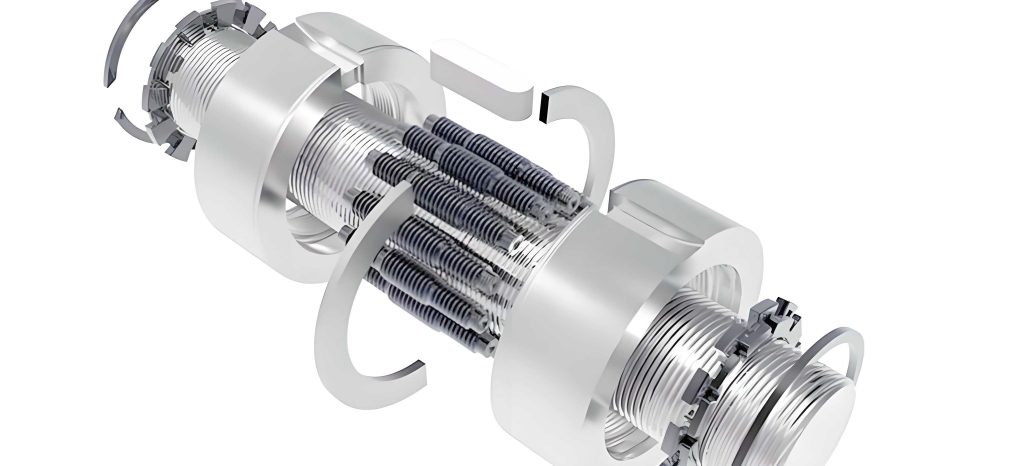
The planetary roller screw is a key innovation in this design, offering superior performance over traditional leadscrews or ball screws. It consists of a threaded screw, multiple rollers arranged planetarily, and a nut, enabling high-force transmission with minimal wear. Its advantages include high efficiency, long service life, and ability to handle heavy loads in harsh environments. In our device, the planetary roller screw translates rotary motion from a motor into linear displacement to actuate the air cover. We selected this mechanism after comparing various actuator types, such as electro-hydrostatic actuators (EHA) and electromechanical actuators (EMA), based on criteria like weight, volume, power density, and reliability. The planetary roller screw emerged as the optimal choice due to its compactness and high load-bearing capacity, which are essential for aircraft applications where space and weight are constrained.
To design the emergency supply device, we first established its technical requirements. The device must open and close the air cover within a specified time, withstand external loads (e.g., aerodynamic forces), and provide accurate position feedback. We defined parameters such as maximum load, stroke, speed, and efficiency. The following table summarizes the key specifications:
| Parameter | Symbol | Value | Unit |
|---|---|---|---|
| Maximum Load on Cover | F_load | 1400 | N |
| Safety Factor | SF | 2 | – |
| Required Stroke | L | 46.4 | mm |
| Operating Time | t | 10 | s |
| Average Speed | v_avg | 4.64 | mm/s |
| Planetary Roller Screw Efficiency | η_prs | 0.83 | – |
We performed a simulation analysis using ADAMS software to model the device’s mechanics. The system was treated as a crank-slider mechanism, where the planetary roller screw drives a slider connected to the air cover. The forces on the cover were analyzed in two extreme states: fully closed and fully open. When closed, the cover experiences maximum load due to aerodynamic pressure, which translates to a thrust force on the planetary roller screw. The static force equilibrium was derived using Newton’s laws. Let \( F_s \) be the screw thrust, \( F_{load} \) the external load, and \( \theta \) the cover angle. The relationship is given by:
$$ F_s = \frac{F_{load} \cdot L_{arm} \cdot \sin(\theta)}{r_{crank} \cdot \eta_{mech}} $$
where \( L_{arm} \) is the arm length, \( r_{crank} \) the crank radius, and \( \eta_{mech} \) the mechanical efficiency of the linkage. With a safety factor of 2, the maximum thrust was calculated as 4083 N. However, simulation refined this to 4015 N for equilibrium, as shown in the displacement curve. The motion simulation assumed a uniform opening over 10 seconds, yielding the screw’s axial displacement \( x(t) \) and velocity \( v(t) \). The kinematic equations are:
$$ x(t) = L \cdot \frac{t}{t_{total}} $$
$$ v(t) = \frac{dx}{dt} = \frac{L}{t_{total}} $$
where \( L = 46.4 \, \text{mm} \) and \( t_{total} = 10 \, \text{s} \). The velocity varied nonlinearly due to the mechanism’s geometry, with a maximum \( v_{max} = 5.53 \, \text{mm/s} \). This corresponds to a nut rotational speed \( n_n \) for the planetary roller screw:
$$ n_n = \frac{v_{max}}{p_z} $$
where \( p_z \) is the screw lead. The power required was computed as:
$$ P_s = F_s \cdot v_{max} = 4015 \cdot 5.53 = 22.2 \, \text{W} $$
Considering the planetary roller screw efficiency, the input power to the nut is:
$$ P_{in} = \frac{P_s}{\eta_{prs}} = \frac{22.2}{0.83} = 26.7 \, \text{W} $$
These results guided the planetary roller screw design. The screw must meet thrust, speed, and life requirements. We designed the screw, rollers, and nut based on standard calculations for load distribution, stress, and fatigue. The planetary roller screw parameters are listed below:
| Component | Parameter | Value | Unit |
|---|---|---|---|
| Screw | Diameter | 12 | mm |
| Screw | Lead | 4 | mm |
| Rollers | Number | 6 | – |
| Rollers | Diameter | 3 | mm |
| Nut | Length | 50 | mm |
| Material | Steel Grade | 42CrMo4 | – |
We performed several verification checks for the planetary roller screw. The tensile strength \( \sigma_t \) was assessed using:
$$ \sigma_t = \frac{F_s}{A_s} $$
where \( A_s \) is the screw’s cross-sectional area. The equivalent stress \( \sigma_{eq} \) according to von Mises criterion is:
$$ \sigma_{eq} = \sqrt{\sigma^2 + 3\tau^2} $$
with \( \tau \) as shear stress. Screw stability was evaluated via Euler’s buckling formula:
$$ F_{cr} = \frac{\pi^2 E I}{(K L)^2} $$
where \( E \) is Young’s modulus, \( I \) the moment of inertia, \( K \) the effective length factor, and \( L \) the unsupported length. Deformation under load was checked using:
$$ \delta = \frac{F_s L}{EA_s} $$
Thread strength considered shear and bending stresses. The critical speed \( n_{cr} \) to avoid resonance was calculated as:
$$ n_{cr} = \frac{60}{2\pi} \sqrt{\frac{k}{m}} $$
where \( k \) is stiffness and \( m \) mass. Fatigue life \( L_{10} \) in hours was estimated based on load cycles:
$$ L_{10} = \frac{10^6}{60 n_n} \left( \frac{C}{F_s} \right)^3 $$
where \( C \) is the dynamic load rating. All checks confirmed the planetary roller screw meets specifications with a safety margin. The design ensures reliable operation over 10,000 hours, surpassing typical aircraft demands.
The loading tester was developed to simulate static and dynamic loads on the emergency supply device. It consists of a mechanical frame, loading mechanisms, and a control system. The tester replicates forces experienced by the air cover during flight, such as aerodynamic pressure and inertia. We designed two loading methods: static and dynamic. Static loading applies constant torque to the cover via clamps, while dynamic loading uses a servo-electric actuator to apply varying forces. The mechanical scheme mimics the actual device’s mounting, with an equivalent cover made of similar material to distribute loads evenly. The following table outlines the tester’s key features:
| Component | Function | Specification |
|---|---|---|
| Static Load Frame | Apply constant torque | Max torque 100 Nm |
| Dynamic Load Actuator | Apply variable force | Force range 0-5000 N |
| Control System | Data acquisition and control | Sampling rate 1 kHz |
| Sensors | Measure force and displacement | Accuracy ±0.5% |
For static loading, we used a clamping mechanism that grips the cover’s upper and lower surfaces. The torque \( T \) is related to the applied force \( F_{clamp} \) and radius \( r \):
$$ T = F_{clamp} \cdot r $$
This allows testing under maximum load conditions. Dynamic loading involves a servo-electric actuator connected to the equivalent cover via a linkage. The force \( F_e \) required to simulate external loads is derived from equilibrium equations. If the external load has components \( F_1 \) and \( M_1 \), the equivalent force at point C on the cover is:
$$ F_e = \frac{F_1 \cdot d_1 + M_1}{d_2} $$
where \( d_1 \) and \( d_2 \) are distances from pivot points. The actuator’s force profile is programmed based on this relation, varying with cover angle \( \theta \). The motion equation for dynamic loading is:
$$ m \ddot{x} + c \dot{x} + kx = F_e(t) $$
where \( m \) is mass, \( c \) damping, \( k \) stiffness, and \( x \) displacement. The control system implements this in real-time.
The control system for the loading tester is based on a PC with data acquisition cards. It manages parameter setting, control algorithms, and data logging. The system includes a industrial computer, display, sensor interface boxes, drive controllers, and power supplies, housed in a single cabinet. Software algorithms generate control signals for the actuator and monitor feedback from sensors like load cells and encoders. The block diagram below summarizes the setup:
| Subsystem | Components | Role |
|---|---|---|
| Hardware | PC, DAQ cards, drivers | Signal processing and output |
| Software | LabVIEW or custom code | Control logic and UI |
| Sensors | Load cells, LVDTs, encoders | Measure force, position |
| Actuators | Servo-electric cylinder | Apply dynamic loads |
Testing procedures involve calibrating the system, running static load tests to verify holding capacity, and dynamic tests to assess response under varying conditions. Data is analyzed to compute performance metrics like error, hysteresis, and bandwidth. The planetary roller screw’s behavior is closely monitored during these tests, as it is central to the device’s function. Results show that the emergency supply device achieves smooth motion with minimal backlash, thanks to the precision of the planetary roller screw. The loading tester accurately replicates loads, enabling comprehensive validation.
In conclusion, we have successfully developed an emergency supply device for aircraft environmental control systems using a planetary roller screw mechanism. The device offers high reliability, compact design, and efficient operation under emergency conditions. The accompanying loading tester provides robust testing capabilities for static and dynamic performance evaluation. Our work demonstrates the advantages of planetary roller screws in aerospace applications, where high loads and precision are paramount. Future improvements could focus on optimizing the planetary roller screw for even higher speeds or integrating smart sensors for predictive maintenance. This development contributes to the advancement of all-electric aircraft systems, enhancing safety and performance.
The planetary roller screw proved instrumental in achieving the desired thrust and durability. Through simulation and testing, we validated that the device meets all functional requirements. The loading tester’s design allows for scalable testing of similar systems. Overall, this project underscores the importance of innovative mechanical components like the planetary roller screw in modern aviation technology.