
The pursuit of high-performance linear actuators, particularly for demanding applications such as humanoid robotics, has driven significant advancements in power transmission technology. Among various solutions, the planetary roller screw mechanism (PRSM) has emerged as a superior alternative to traditional ball screws, offering exceptional load capacity, precision, rigidity, and operational longevity. Its unique design distributes mechanical loads across multiple threaded rollers arranged planetarily between a central screw and an outer nut, leading to a higher number of contact points and thus greater durability under heavy loads. This paper focuses on the design and dynamic analysis of a specific, innovative variant known as the Inverted Recirculating Planetary Roller Screw (IRPRS). This configuration combines the structural compactness of an inverted design, where the nut acts as the rotating input, with the manufacturing simplicity and fine-pitch capability offered by a recirculating roller path featuring non-helical, annular groove threads on the rollers.
The core innovation of the IRPRS lies in its ability to integrate the motor directly with the nut housing, creating a highly compact actuator module ideal for space-constrained joints. Simultaneously, by employing rollers with simple ring grooves instead of complex helical threads, the manufacturing challenges and associated costs are significantly reduced. This work first details the fundamental geometry and structural design principles of this mechanism. Subsequently, a comprehensive dynamic model is developed and simulated to analyze contact forces, collision events during roller recirculation, and the influence of key operational and geometric parameters on its performance.
Geometric Relations and Structural Design
The Inverted Recirculating Planetary Roller Screw assembly comprises several key components: a central screw with a standard triangular thread profile, an outer nut with an internal matching thread profile, multiple planet rollers with annular grooves, a cam ring with a profiled boss for recirculation guidance, and a retainer or cage to maintain roller spacing. In this inverted configuration, the nut is rotationally driven, while the screw is constrained from rotating and provides linear output motion. The rollers engage with both the nut and the screw threads, translating the nut’s rotation into the screw’s translation. A critical feature is the presence of an unthreaded section on the screw, which allows rollers to disengage, be guided axially by the cam ring boss to “jump” one pitch, and re-engage with the next thread groove, enabling continuous motion.
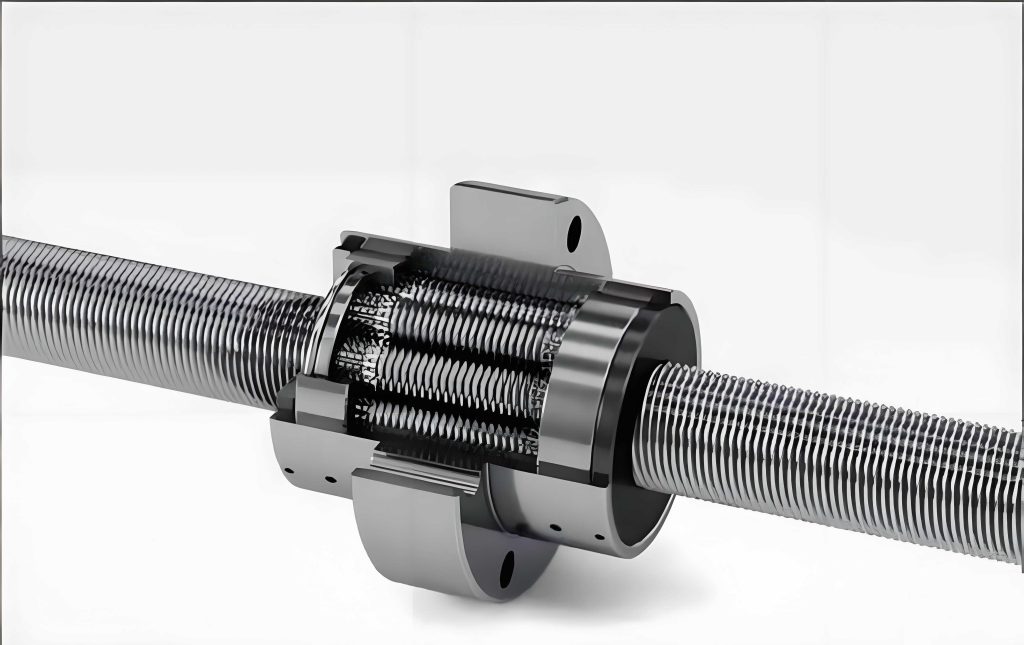
The fundamental geometric relationship governing the concentric arrangement of the screw, rollers, and nut is given by:
$$ d_s + 2d_r = d_n $$
where \(d_s\), \(d_r\), and \(d_n\) represent the pitch diameters of the screw, roller, and nut, respectively.
For proper meshing in a recirculating design, the screw and nut must have identical thread parameters:
$$ n_s = n_n, \quad p_s = p_n, \quad S_s = S_n $$
where \(n\) denotes the number of thread starts, \(p\) is the pitch, and \(S\) is the lead (\(S = n \cdot p\)).
The design of the unthreaded section on the screw is paramount for smooth recirculation. This section typically consists of three arc segments. The primary guiding segment (arc 2) has a radius \(R_{su2}\) calculated to accommodate the roller’s path during its axial shift. The required axial shift \(S\) for a roller to move to the adjacent thread is equal to the lead. The corresponding tangential travel \(B_1D’_1\) on arc 2 and its subtended central angle \(\beta_2\) are derived from the roller’s geometry and the thread half-angle \(\alpha/2\):
$$ R_{c1} = R_{su2} + \frac{d_{r1}}{2} $$
$$ \beta_2 = 2 \arcsin\left( \frac{S}{2 \tan(\alpha/2) R_{c1}} \right) $$
Here, \(d_{r1}\) is the roller’s major diameter and \(R_{c1}\) is the path radius of the roller center during this phase.
The total angular span \(\gamma\) of the unthreaded zone must be sufficient for the recirculation maneuver but less than the angular spacing \(\phi\) between adjacent rollers to prevent more than one roller from being in the zone simultaneously:
$$ \beta_2 + 2\beta_3 < \gamma < \phi = \frac{2\pi}{N} $$
where \(\beta_3\) is the angle subtended by the entry/exit arcs (arcs 1 and 3), and \(N\) is the total number of rollers.
The retainer must allow for both the rotation and the axial displacement of the rollers. Its slot length \(l_b\) must satisfy:
$$ l_b \geq l_r + S + 2e_b $$
where \(l_r\) is the effective length of the roller’s grooved section and \(e_b\) is a clearance allowance.
The cam ring features a helical boss with a defined slope angle \(\phi\). The boss geometry must guide the roller through the axial displacement \(S\) over its angular extent. The lead angle \(\lambda\) of the boss relative to the screw axis is:
$$ \lambda = \arctan\left( \frac{S}{\pi d_t} \right) $$
where \(d_t\) is the pitch diameter of the cam ring’s thread (matched to \(d_s\)).
Based on these principles, a complete set of design parameters for an IRPRS can be established, as summarized in Table 1.
| Component | Major Diameter (mm) | Pitch Diameter (mm) | Minor Diameter (mm) | Starts | Hand | Pitch (mm) | Quantity |
|---|---|---|---|---|---|---|---|
| Screw | 9.92 | 9.60 | 9.08 | 1 | Right | 1.0 | 1 |
| Roller | 4.95 | 4.50 | 4.13 | – | – | 1.0 (Groove Spacing) | 6 |
| Nut | 19.12 | 18.60 | 18.28 | 1 | Right | 1.0 | 1 |
| Cam Ring | 10.00 | 9.50 | 9.00 | 1 | Right | 1.0 | 1 |
Kinematic Model of the Inverted Recirculating Planetary Roller Screw
The kinematics of the planetary roller screw can be analyzed using the principles of planetary gear trains. In the inverted configuration, the nut (analogous to the sun gear) rotates with angular velocity \(\omega_n\). The screw (analogous to the ring gear) is translationally fixed in rotation (\(\omega_s = 0\)) but moves axially. The roller carrier (retainer) rotates with angular velocity \(\omega_c\), which is also the orbital or revolution speed of the rollers around the screw axis.
Considering the velocity diagram at the meshing points, the relationship between the nut speed and the carrier speed is derived as:
$$ \omega_c = \frac{d_{n2}}{d_c} \omega_n = \frac{d_{n2}}{(d_n – d_r)} \omega_n $$
where \(d_{n2}\) is the nut’s minor diameter and \(d_c\) is the orbital diameter of the roller centers.
Fixing the carrier to analyze the relative motion yields the transformed gear train ratio between the nut and a roller:
$$ i_{cn}^r = \frac{\omega_n – \omega_c}{\omega_r – \omega_c} = \frac{d_r}{d_n} $$
Solving for the roller’s absolute spin velocity \(\omega_r\) gives:
$$ \omega_r = \omega_c + (\omega_n – \omega_c) \frac{d_n}{d_r} $$
The linear translation speed \(v_s\) of the screw is directly related to the nut’s rotation and the thread lead:
$$ v_s = \pm \frac{n p \omega_n}{2\pi} $$
where the sign depends on the hand of rotation and thread.
These equations form the foundational kinematic model for the inverted planetary roller screw mechanism.
Dynamic Simulation and Analysis
To investigate the dynamic behavior, including contact forces and transient events during roller recirculation, a multi-body dynamics model of the IRPRS was developed using Adams software. The model incorporated all major components with appropriate material properties (GCr15 bearing steel). Joints and constraints were applied to reflect the actual mechanics: a fixed joint between the screw and cam ring, a cylindrical joint for the nut-retainer connection, a translational joint for the screw, and a revolute joint for the nut’s input rotation. Contact forces between all interacting surfaces (roller-screw, roller-nut, roller-cam boss, roller-retainer) were defined using a penalty-based method with a stiffness coefficient \(K = 1 \times 10^5\) N/mm, force exponent \(e = 1.5\), and damping. Friction was modeled using the Coulomb method with static and dynamic coefficients of 0.3 and 0.25, respectively. The nut was driven with a prescribed rotational velocity, and an axial force was applied to the screw to simulate the external load.
Kinematic Validation
The dynamic simulation was run, and the resulting velocities were compared to the theoretical kinematic model. As the rollers periodically enter the unthreaded recirculation zone, their spin velocity \(\omega_r\) exhibits characteristic dips. The average spin velocity in the engaged phases, the carrier revolution speed \(\omega_c\), and the screw linear velocity \(v_s\) were extracted from the simulation. Table 2 shows an excellent agreement between simulation results and theoretical predictions, with relative errors below 1.2%, validating the correctness of the model assembly and kinematic assumptions.
| Parameter | Theoretical Value | Simulated Average Value | Relative Error |
|---|---|---|---|
| Roller Spin Velocity, \(\omega_r\) (rad/s) | 25.97 | 25.68 | 1.12% |
| Carrier Velocity, \(\omega_c\) (rad/s) | 8.29 | 8.35 | 0.72% |
| Screw Translation Velocity, \(v_s\) (mm/s) | 2.00 | 1.995 | 0.25% |
Analysis of Contact and Collision Forces
The dynamic model enables a detailed study of internal forces. Two primary force categories are analyzed: 1) the axial component of the contact forces between the rollers and the screw/nut threads in the engaged section, and 2) the collision forces between the roller end and the sloping surface of the cam ring boss during recirculation. A series of simulations were conducted under varying operational conditions and geometric parameters, as defined in Table 3.
| Case Group | Nut Speed, \(\omega_n\) (rad/s) | Screw Load, \(F_s\) (N) | Boss Slope Angle, \(\phi\) (deg) | Purpose |
|---|---|---|---|---|
| 1, 2, 3 | 4π, 6π, 8π | 8000 | 45 | Effect of Speed |
| 3, 4, 5 | 8π | 8000, 6000, 4000 | 45 | Effect of Load |
| 5, 6, 7, 8 | 8π | 4000 | 45, 50, 55, 60 | Effect of Boss Angle |
1. Influence of Operational Conditions:
The axial contact force between a roller and the screw (or nut) during threaded engagement is predominantly governed by the external load. As expected from load distribution among multiple rollers, the average axial contact force is directly proportional to the applied screw load \(F_s\). For a 6-roller mechanism under pure axial load, the average force per engaged roller-screw pair approximates \(F_s / (N \cos \psi)\), where \(\psi\) is the thread helix angle. Variations in nut rotational speed had a negligible effect on the magnitude of these steady-state engaged contact forces.
In contrast, the collision force experienced by a roller when it contacts the cam ring boss during recirculation is highly sensitive to both speed and load. Figure X (simulation result) shows that the peak and range of this collision force increase significantly with higher nut rotational speeds and larger external loads. This is because the roller approaches the boss with kinetic energy related to its orbital and spin motion, and the impulse required to alter its axial momentum is influenced by the prevailing load condition.
2. Influence of Cam Ring Boss Slope Angle \(\phi\):
The slope angle of the cam ring boss is a critical design parameter for the recirculating planetary roller screw. Simulations with different \(\phi\) angles, holding speed and load constant, revealed a pronounced effect on the recirculation collision dynamics. As shown in Figure Y (simulation result), a steeper boss slope (larger \(\phi\)) dramatically reduces the magnitude of the collision force. For instance, increasing \(\phi\) from 45° to 60° reduced the collision force range from approximately 1040-1183 N to just 1.7-5.2 N. This reduction occurs because a steeper slope converts a larger portion of the roller’s tangential momentum into the required axial momentum over a shorter angular distance, resulting in a more gradual and less impulsive interaction. However, the boss angle cannot be increased arbitrarily; it is geometrically constrained by the need to provide sufficient angular length to accomplish the full axial travel \(S\) within the allowable unthreaded zone angle \(\gamma\).
Conclusion
This paper has presented a comprehensive design and dynamic analysis of an Inverted Recirculating Planetary Roller Screw mechanism. The geometric relationships governing the concentric assembly, thread parameter matching, and the critical design of the screw’s unthreaded recirculation zone have been derived and formulated. A kinematic model was established, accurately predicting the motion relationships between the nut, rollers, and screw, which was subsequently validated through multi-body dynamics simulation with errors less than 1.2%.
The dynamic simulation study yielded significant insights into the internal force behavior of this innovative planetary roller screw design. Key findings include:
- The axial contact forces on the threads during engagement are primarily determined by the external load and are largely insensitive to operational speed and the cam boss slope angle.
- The collision forces during the roller recirculation process are highly sensitive to both operational parameters and boss geometry. They increase with higher nut speeds and larger external loads.
- The cam ring boss slope angle \(\phi\) is a paramount design parameter for minimizing recirculation impact. A steeper slope (e.g., 60° versus 45°) can reduce collision forces by orders of magnitude, thereby reducing wear, noise, and vibration, and potentially enhancing the mechanism’s lifespan and smoothness of operation. The optimal angle is the maximum feasible value within the geometric constraints of the unthreaded zone.
This work provides a foundational framework for the design and optimization of inverted recirculating planetary roller screw mechanisms, balancing the benefits of compact integration, manufacturing simplicity, and dynamic performance. The methodology and results offer valuable guidance for engineers developing high-performance linear actuators for advanced robotic and precision mechanical systems.