
In this comprehensive discussion, I will delve into the intricate sliding behavior inherent to the Planetary Roller Screw (PRS), a superior motion-transforming mechanism. The capacity to convert rotary motion into precise linear thrust, and vice versa, with exceptional accuracy, stiffness, and load capacity makes the planetary roller screw indispensable in demanding fields such as aerospace, precision machine tools, and high-performance industrial automation. A critical aspect governing its efficiency, wear, and thermal performance is the relative sliding velocity at the contacting interfaces. My analysis will systematically build mathematical models for this sliding velocity, first under idealized rigid-body conditions and then incorporating the crucial effects of elastic deformation, followed by a detailed parametric investigation.
Fundamental Principles and Advantages
The planetary roller screw functions on a principle analogous to a planetary gear system. Its core components include a central screw, multiple threaded rollers distributed circumferentially, and a nut. A carrier or cage maintains the angular position of the rollers, and often an internal ring gear ensures the rollers remain parallel to the screw axis without axial migration.
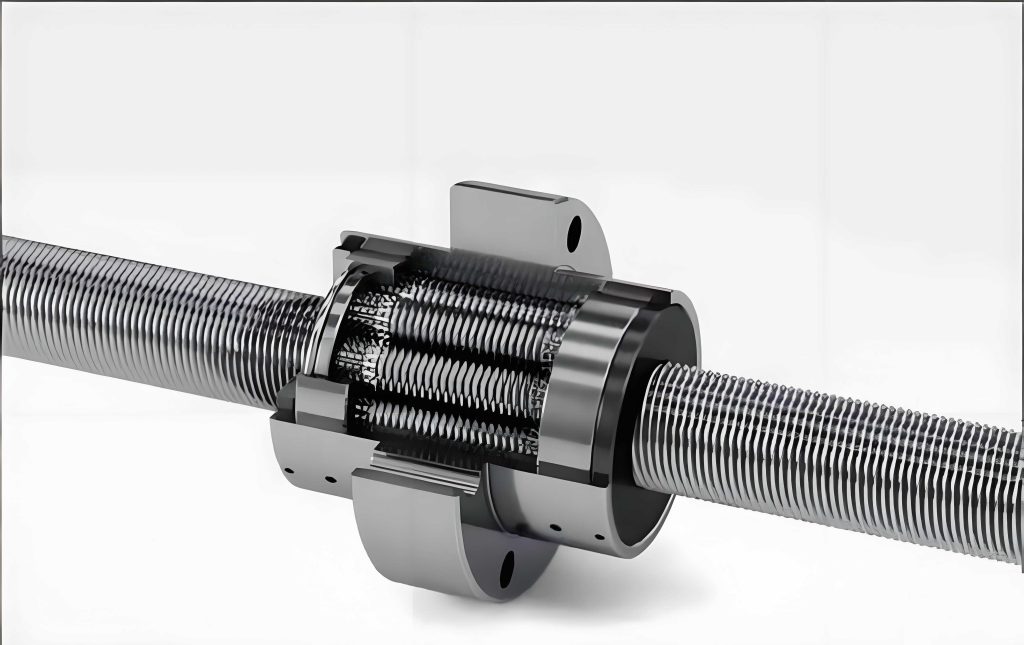
When the screw is rotated, it drives the rollers via threaded contact. These rollers, in turn, engage with the nut’s internal threads. Depending on the design (e.g., with a fixed or rotating nut), the output can be the linear motion of the nut or the screw. The key advantage over the conventional ball screw lies in the use of rollers. Instead of discrete ball contacts, the planetary roller screw features line contact along the threads, with all rollers sharing the load simultaneously. This results in a significantly larger contact area, leading to dramatically higher load capacity, rigidity, and longevity. The fundamental kinematic relationship between the screw angular velocity $\omega_s$ and the roller angular velocity $\omega_R$ is derived from their pitch diameters and is given by:
$$ \frac{\omega_S}{\omega_R} = \frac{2(r_S + r_R)}{r_S} $$
where $r_S$ and $r_R$ are the nominal pitch radii of the screw and roller, respectively. Another fundamental parameter is the screw lead angle $\alpha_S$, related to the screw pitch $P_S$ and its radius:
$$ \tan \alpha_S = \frac{P_S}{2\pi r_S} $$
Establishing the Kinematic Model
To analyze the sliding kinematics, a precise mathematical description of the contact geometry is essential. I will establish three coordinate systems to facilitate this analysis.
Coordinate Systems Definition
1. Global Coordinate System (xyz): This fixed system has its z-axis aligned with the axis of the screw. The unit vectors are $\mathbf{i}, \mathbf{j}, \mathbf{k}$.
2. Frenet Frame (tnb): This local coordinate system is attached to the helical contact path on the screw thread. The unit vector $\mathbf{t}$ is tangent to the helix, $\mathbf{n}$ is the normal, and $\mathbf{b}$ is the binormal.
3. Contact-Point Coordinate System (XYZ): This system is defined at the point of contact between the screw and a roller. The Z-axis is aligned with the common surface normal at the contact, the X-axis is within the tangent plane, and the Y-axis completes the right-handed system. Its unit vectors are $\mathbf{i}_P, \mathbf{j}_P, \mathbf{k}_P$.
The position vector $\mathbf{l}(\theta)$ for an arbitrary point on the screw’s contact helix, parameterized by the angle $\theta$, is expressed in the global frame as:
$$ \mathbf{l}(\theta) = r_S (\cos\theta \, \mathbf{i} + \sin\theta \, \mathbf{j} + \theta \tan\alpha_S \, \mathbf{k}) $$
Transformation matrices define the relationships between these frames, crucial for vector resolution during velocity analysis.
Relative Sliding Velocity: Rigid Body Model
Initially, I assume no elastic deformation, implying ideal point contact based on Hertzian theory. The velocity of the contact point on the screw, $\mathbf{v}_S$, resulting from the screw’s rotation $\boldsymbol{\omega}_S = \omega_S \mathbf{k}$ is:
$$ \mathbf{v}_S = \boldsymbol{\omega}_S \times \mathbf{l}(\theta) = r_S \omega_S (-\sin\theta \, \mathbf{i} + \cos\theta \, \mathbf{j}) $$
The velocity of the coincident point on the roller, $\mathbf{v}_R$, involves both the roller’s rotation and its planetary translation. Using the kinematic relation between $\omega_S$ and $\omega_R$, it can be derived as:
$$ \mathbf{v}_R = 2 r_R \omega_R (\sin\theta \, \mathbf{i} – \cos\theta \, \mathbf{j}) – r_S \omega_S \tan\alpha_S \, \mathbf{k} $$
The relative sliding velocity $\mathbf{v}_{SR}$ at the contact is simply the difference:
$$ \mathbf{v}_{SR} = \mathbf{v}_S – \mathbf{v}_R = -(r_S\omega_S + 2\omega_R r_R)\sin\theta \, \mathbf{i} + (r_S\omega_S + 2\omega_R r_R)\cos\theta \, \mathbf{j} + r_S\omega_S \tan\alpha_S \, \mathbf{k} $$
Its magnitude is a key performance indicator:
$$ |\mathbf{v}_{SR}| = \sqrt{ [ (r_S\omega_S + 2\omega_R r_R) ]^2 + (r_S\omega_S \tan\alpha_S)^2 } $$
This simplified model shows that the sliding magnitude is independent of the instantaneous circumferential position $\theta$, a result of symmetry in the ideal case. It highlights a direct dependence on the screw lead angle $\alpha_S$.
| Model Condition | Key Sliding Velocity Formula (Vector Form) | Primary Influencing Parameters |
|---|---|---|
| Without Elastic Deformation | $\mathbf{v}_{SR} = -(r_S\omega_S + 2\omega_R r_R)\sin\theta \, \mathbf{i} + \ldots$ | Screw lead angle ($\alpha_S$), angular velocities, radii. Independent of $\theta$ in magnitude. |
| With Elastic Deformation | Complex function of $\mathbf{x}_Q$, $\alpha_S$, $\beta$, $r_S$, $r_R$, $\omega_S$, $\omega_R$. | Screw lead angle ($\alpha_S$), contact angle ($\beta$), location within contact ellipse ($x_Q, y_Q$), elastic deformation ($\tilde{r}$). |
Relative Sliding Velocity: Model with Elastic Deformation
A more realistic model must account for elastic deformation under load. According to Hertzian contact theory, the nominal point contact expands into an elliptical contact area. My analysis now considers an arbitrary point $Q$ within this contact ellipse, located at coordinates $(x_Q, y_Q)$ in the contact-point coordinate system (X-Y plane).
The local deformation is characterized by an effective radius $\tilde{r}$ of the contact patch, related to the contact ellipse semi-major axis $a$ and the composite radius of curvature $R$:
$$ \frac{1}{R} = \frac{1}{2}\left( \frac{1}{r_R} + \frac{1}{r_S \sin\beta} \right), \quad \tilde{r} = R – \sqrt{R^2 – a^2} $$
Here, $\beta$ is the contact angle, defining the inclination of the contact normal relative to the radial plane. The position vector $\mathbf{l}_{QO}$ for point $Q$ must now include corrections due to this deformation. After rigorous coordinate transformations, the velocity of point $Q$ on the screw, $\mathbf{V}_{QS}$, and on the roller, $\mathbf{V}_{QR}$, are derived. Their difference yields the comprehensive sliding velocity vector within the contact patch, resolved in the Frenet frame:
$$
\begin{aligned}
\mathbf{V}_{SR} &= \mathbf{V}_{QS} – \mathbf{V}_{QR} \\
&= \left[ r_S\omega_S(1+\tan^2\alpha_S) + 2\omega_R r_R + (\omega_S-\omega_R)x_Q \sin\beta – (\omega_S-2\omega_R)\tilde{r} \cos\beta \right] \cos\alpha_S \, \mathbf{t} \\
&+ \left[ (\omega_S-\omega_R)(y_Q \cos\alpha_S – x_Q \sin\alpha_S \cos\beta) – (\omega_S – 2\omega_R) \tilde{r} \sin\alpha_S \sin\beta \right] \, \mathbf{n} \\
&+ \left[ -2\omega_R r_R – (\omega_S-\omega_R)x_Q \sin\beta + (\omega_S-2\omega_R)\tilde{r} \cos\beta \right] \sin\alpha_S \, \mathbf{b}
\end{aligned}
$$
This expression can be transformed into the contact-point coordinate system (XYZ) for more intuitive interpretation related to sliding and rolling directions. The complexity of this formula underscores the significant influence of elastic deformation and the contact angle $\beta$, factors absent in the rigid-body model.
Simulation and Parametric Influence Analysis
To quantify the effects of key geometric parameters, I performed simulations based on a representative planetary roller screw design. The fixed parameters for this case study are summarized below:
| Component | Nominal Diameter (mm) | Number of Thread Starts | Lead (mm) | Lead Angle, $\alpha_S$ | Contact Angle, $\beta$ |
|---|---|---|---|---|---|
| Screw | 25.00 | 5 | 10.0 | 7.26° | 45° |
| Roller | 8.33 | 5 | 2.0 | 7.26° | 45° |
| Nut | 41.66 | 1 | 10.0 | 7.26° | 45° |
For the simulation, a screw speed $\omega_S = 60\pi$ rad/min was used, with $\omega_R$ determined from the kinematic ratio. In the elastic deformation model, specific points across the contact ellipse were analyzed: $(x_Q, y_Q) = (0, 12.5), (8.84, 8.84), (12.5, 0), (8.84, -8.84), (0, -12.5)$ mm, assuming a calculated contact ellipse size.
Influence of the Screw Lead Angle ($\alpha_S$)
1. Without Elastic Deformation: The magnitude of the sliding velocity is given by $|\mathbf{v}_{SR}| = \sqrt{ C^2 + (r_S\omega_S \tan\alpha_S)^2 }$, where $C$ is constant for given speeds. As $\alpha_S$ increases, $\tan\alpha_S$ increases, leading to a direct increase in sliding speed. Simulation confirms this, showing a family of nearly identical curves for different $\theta$, verifying that the lead angle’s effect is uniform around the screw circumference in the ideal model.
2. With Elastic Deformation: The relationship becomes more complex as described by the full vector equation for $\mathbf{V}_{SR}$. Simulation results indicate that increasing $\alpha_S$ still generally leads to an increase in the magnitude of sliding velocity, but the effect is less pronounced and varies across different points $(x_Q, y_Q)$ within the contact ellipse. The sensitivity of sliding to $\alpha_S$ is moderated by the elastic contact conditions.
Design Implication: While a larger lead angle increases sliding velocity slightly (which could influence friction and wear), it also directly increases the mechanical lead and, consequently, the translational speed for a given rotary input. Since the nut-roller interface often exhibits near-pure rolling, the overall transmission efficiency of the planetary roller screw can still improve with a larger $\alpha_S$, provided the sliding losses at the screw-roller interface are managed.
Influence of the Contact Angle ($\beta$)
The contact angle $\beta$ is a critical design parameter that only appears in the elastic deformation model, as it defines the orientation of the contact normal. Its influence is profound. Simulation results, with $\alpha_S$ held constant at 7.26°, clearly demonstrate that as the contact angle $\beta$ increases, the magnitude of the relative sliding velocity $\mathbf{V}_{SR}$ decreases significantly across all sampled points within the contact ellipse.
Mechanism: The total relative motion at the interface comprises both rolling and sliding components. An increased contact angle $\beta$ favorably alters the geometry of contact, promoting a greater proportion of rolling motion relative to sliding. This reduction in sliding velocity directly implies lower frictional losses and less interfacial shear, which enhances the efficiency and likely the service life of the planetary roller screw.
| Parameter Variation | Effect on Sliding Velocity (Rigid Model) | Effect on Sliding Velocity (Elastic Model) | Overall Impact on PRS Performance |
|---|---|---|---|
| Increase in Lead Angle ($\alpha_S \uparrow$) | Sliding velocity increases. | Sliding velocity increases moderately; effect varies across contact patch. | Can improve overall efficiency due to higher lead, despite slight sliding increase. |
| Increase in Contact Angle ($\beta \uparrow$) | No effect (parameter not in model). | Sliding velocity decreases substantially. | Improves efficiency and potentially reduces wear by promoting rolling over sliding. |
Conclusions and Design Guidelines
My detailed analysis of the sliding characteristics in the planetary roller screw mechanism, spanning from idealized to elastohydrodynamic contact conditions, leads to the following conclusive points and recommendations for designers:
- Model Fidelity is Crucial: The rigid-body model provides a foundational understanding but fails to capture the significant influence of the contact angle $\beta$. For accurate performance prediction, especially under load, the elastic deformation model incorporating Hertzian contact mechanics is essential.
- Lead Angle ($\alpha_S$) Effects: The screw lead angle directly influences kinematic output and sliding. Its increase raises the relative sliding velocity, though this effect is more subdued when elastic deformation is considered. The primary benefit of a larger $\alpha_S$ is a higher lead, which improves the linear speed per unit rotation. Therefore, selecting $\alpha_S$ involves a trade-off between desired speed/mechanical advantage and the associated increase in interfacial sliding.
- Contact Angle ($\beta$) as a Key Optimizer: The contact angle emerges as a powerful parameter for performance enhancement. A larger contact angle $\beta$ effectively reduces the relative sliding velocity at the screw-roller interface. This reduction minimizes friction losses, lowers heat generation, and improves transmission efficiency. Maximizing $\beta$ within structural and geometrical constraints (e.g., thread profile strength, assembly clearance) should be a primary design objective for high-efficiency planetary roller screw systems.
- Synergistic Parameter Selection: For optimal performance, parameters should not be chosen in isolation. A concurrent increase in both the lead angle $\alpha_S$ (to achieve desired lead/speed) and the contact angle $\beta$ (to mitigate the associated sliding increase) can synergistically enhance the overall efficiency and performance envelope of the planetary roller screw. Advanced multi-objective optimization techniques can be employed to find the Pareto-optimal set of these parameters for specific application requirements.
This investigation underscores the complex yet manageable nature of sliding in precision roller screw drives. By leveraging the developed models to understand the roles of $\alpha_S$ and $\beta$, engineers can make informed decisions to push the boundaries of performance, efficiency, and reliability in applications demanding the superior capabilities of the planetary roller screw.