
In the evolving landscape of linear actuation, the transition towards electromechanical systems represents a significant trend, driven by advances in power electronics and control theory. Among these systems, the electric cylinder, a modular unit integrating a screw mechanism, stands out for its ability to precisely control linear motion parameters such as position, speed, and force. This study focuses on the structural dynamics and stiffness characteristics of a 90 kN electric cylinder designed for marine stabilization applications, specifically fin stabilizers. The core of this actuator is a planetary roller screw mechanism, renowned for its high load capacity, longevity, and efficiency. Following the initial structural design and component-level strength optimization, this paper employs finite element analysis (FEA) to investigate the global modal properties and axial static stiffness of the complete actuator assembly. These analyses are foundational for assessing vibrational behavior under operational excitations and for understanding positional accuracy under variable loads.
System Description and Finite Element Modeling
The subject of this analysis is a 90 kN bi-directional electric cylinder. Its primary function is to convert the rotary motion of a servo motor, transmitted via a synchronous belt drive with a 1.5:1 reduction ratio, into linear motion of a push rod. The key performance parameters are summarized in Table 1.
| Parameter | Value |
|---|---|
| Maximum Working Load | 90 kN (Push/Pull) |
| Maximum Working Speed | 230 mm/s (at 3450 rpm motor speed) |
| Total Mass | 139 kg (Mechanical Assembly) + 36 kg (Servo Motor) |
| Mounting Configuration | Lateral Trunnion (Pivot) Mounting |
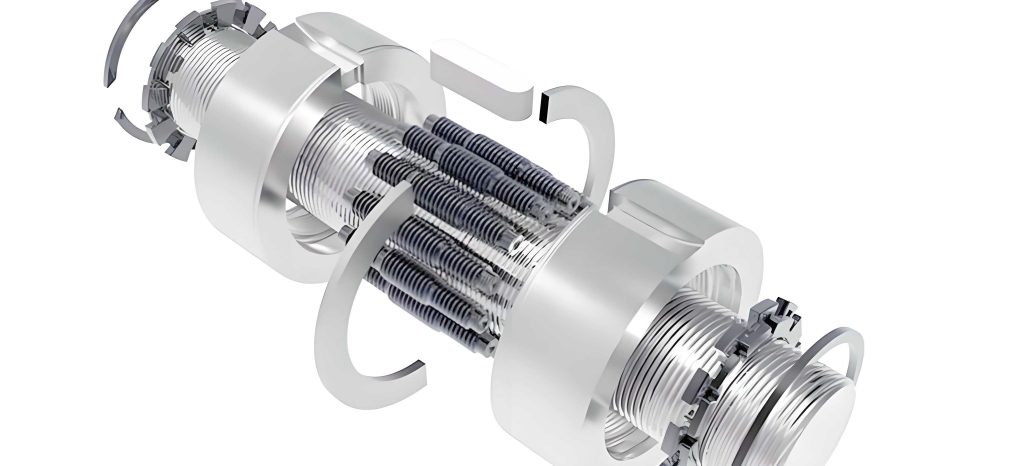
The actuator assembly, as shown in its extended and retracted states in the analysis model, comprises several major components: the main housing, front and rear bearing supports, the planetary roller screw assembly (including the screw, nut, and rollers), the hollow push rod, the outer cylinder tube, trunnion blocks for mounting, and the motor/pulley drive system.
A detailed finite element model was constructed to simulate the physical behavior accurately. The 3D geometry was simplified by removing minor fillets and chamfers to improve mesh quality without compromising structural integrity. The model was discretized using 3D solid elements. Realistic contact conditions were defined between all internal components (e.g., screw/roller, roller/nut, bearing interfaces) using a global automatic contact algorithm, subsequently refined based on actual assembly conditions. The material properties assigned to the primary components are listed in Table 2. The mounting condition was simulated by applying cylindrical constraints to the trunnion pins, restricting axial and radial translations while allowing rotation, mimicking the real pivot joint.
| Component | Material | Young’s Modulus (GPa) | Poisson’s Ratio | Density (kg/m³) | Yield Strength (MPa) |
|---|---|---|---|---|---|
| Main Housing, Cylinder Tube | 2A12 / 6005 Aluminum | 62 | 0.32 | 2800 | 235-255 |
| Support Plates, Bearing Housings, Trunnions, Studs | 42CrMo Alloy Steel | 205 | 0.30 | 7850 | 930 |
| Screw, Nut, Rollers | 43CrMo4 / 100Cr6 Steel | 205 | 0.30 | 7850 | 800-1700 |
| Push Rod | 16Mn Steel | 205 | 0.30 | 7850 | 345 |
Global Modal Analysis and Resonance Assessment
Modal analysis was performed to determine the inherent vibration characteristics (natural frequencies and mode shapes) of the electric cylinder structure. This is critical for identifying potential resonance conditions with excitation sources, primarily the rotational frequencies from the servo motor and the belt drive system. The excitation frequency range ($$f_{ex}$$) is defined by the motor’s operational speed range (0 to 3450 rpm) and the belt reduction ratio ($$i = 1.5$$). The frequency transmitted to the planetary roller screw is given by:
$$ f_{ex} = \frac{N_{motor}}{60 \cdot i} $$
where $$N_{motor}$$ is the motor speed in RPM. Thus, the excitation frequency range is 0 to 38.33 Hz (considering screw input). However, higher harmonics or motor/belt pulley imbalances could also act as excitations. For a conservative assessment, we consider the direct motor rotational frequency range (0 to 57.5 Hz) as a potential source.
Analyses were conducted for two critical stroke positions: push rod fully extended and fully retracted, as stiffness and mass distribution vary. The first 16 natural frequencies for both configurations are summarized in Table 3.
| Mode Order | Freq. – Extended (Hz) | Freq. – Retracted (Hz) | Primary Mode Shape Description |
|---|---|---|---|
| 1 | 7.20 | 7.30 | Global lateral bending of the cylinder assembly. |
| 2 | 40.23 | 39.37 | Second-order lateral bending/rocking on trunnions. |
| 3-10 | 60.6 – 61.0 | 60.6 – 61.0 | Clustered modes; local vibrations of support studs, housing panels, and belt guard. |
| 11-16 | 101.3 – 167.0 | 114.0 – 167.2 | Higher-order local modes (housing, covers, etc.). |
The fundamental mode (approx. 7.2 Hz) involves a low-frequency lateral sway of the entire actuator. The second mode (approx. 40 Hz) is a higher-order bending. Resonance risk is evaluated by calculating the avoidance ratio between the natural frequency ($$f_n$$) and the maximum excitation frequency ($$f_{ex_{max}} = 57.5$$ Hz). The avoidance ratio $$R_a$$ is defined as:
$$ R_a = \left| \frac{f_n – f_{ex_{max}}}{f_{ex_{max}}} \right| \times 100\% $$
Resonance Analysis:
- Mode 1: The frequency (7.2-7.3 Hz) lies within the excitation band. Motor operation near 432-438 rpm (screw input: 7.2-7.3 Hz) or 648-657 rpm (motor direct: 10.8-10.95 Hz, a potential harmonic) could excite this bending mode.
- Mode 2: The frequency (39.4-40.2 Hz) is also within the excitation band. Motor operation near 2360-2415 rpm (motor direct: 39.3-40.3 Hz) poses a resonance risk for this rocking/bending mode.
- Modes 3-10: With frequencies clustered around 60.7 Hz, the minimum avoidance ratio is $$R_a = |(60.6 – 57.5)| / 57.5 \approx 5.4\%$$. This is a very small margin. While not directly excited by the fundamental motor frequency at max speed, potential excitations from harmonics or structural imperfections necessitate attention. These modes primarily involve significant vibration of the longitudinal support studs and housing panels.
- Modes 11 and higher: All have frequencies above 100 Hz, resulting in avoidance ratios greater than 74%, effectively avoiding resonance with the primary excitation sources.
The analysis indicates that the support structure, particularly the long tie rods (studs) connecting the front and rear support plates, exhibits high vibration amplitudes in several mode shapes (3-10), identifying them as a potential area for structural damping optimization.
Axial Static Stiffness Analysis
The axial static stiffness of the electric cylinder is a paramount parameter defining its positional accuracy under load. It quantifies the elastic deformation of the entire mechanical chain under axial force. The stiffness ($$K$$) is calculated from the applied force ($$F$$) and the resulting net axial deformation ($$\delta$$), which is the difference in displacement between the push rod end and the fixed trunnion mounting point:
$$ K = \frac{F}{\delta} $$
Four load cases were simulated: 90 kN in tension and 90 kN in compression, with the push rod in both the fully retracted and fully extended positions. The axial deformation contours for these cases were analyzed to extract the total deflection. The results are presented in Table 4.
| Load Condition | Stroke Position | Axial Deformation, δ (µm) | Calculated Stiffness, K (N/µm) |
|---|---|---|---|
| Tension (90 kN) | Fully Retracted | 627.8 | 143.35 |
| Fully Extended | 722.5 | 124.57 | |
| Compression (90 kN) | Fully Retracted | 379.0 | 237.47 |
| Fully Extended | 526.2 | 171.04 |
Analysis of Stiffness Behavior:
- Stroke Position Dependency: For both tension and compression, the stiffness decreases as the push rod extends. When extended, the effective length of the planetary roller screw shaft under load increases. Since the screw’s axial stiffness is inversely proportional to its free length, this leads to a more compliant system. The stiffness reduction from retracted to extended is approximately 13% in tension and 28% in compression.
- Tension vs. Compression Asymmetry: The actuator is significantly stiffer in compression than in tension. The average compressive stiffness (≈204 N/µm) is about 52% higher than the average tensile stiffness (≈134 N/µm). This asymmetry stems from the load path difference:
- In compression, the load flows primarily through the stiff steel components: the push rod, the planetary roller screw nut and screw, the front bearing support, and the main steel support plates/trunnions.
- In tension, the load path critically involves the aluminum cylinder tube, which is pulled between the front support and the rear housing. The lower Young’s modulus of aluminum (62 GPa vs. 205 GPa for steel) makes this path less stiff, resulting in larger elastic deformations and thus lower overall tensile stiffness.
- Implication for Control: The relatively low and stroke-dependent stiffness, especially in tension, indicates that under variable external loads, the elastic deformation of the actuator itself can introduce non-negligible positional errors. For instance, under a full 90 kN tensile load, the deformation can exceed 700 µm. Therefore, for applications demanding high precision position control under varying loads, a full-closed-loop control strategy using an external position sensor (e.g., a magnetostrictive linear transducer) is essential to compensate for this structural compliance. This data is also crucial for the design and tuning of any force-feedback control loop.
Conclusion
This comprehensive finite element study has provided detailed insights into the dynamic and static structural characteristics of a 90 kN electric cylinder based on a planetary roller screw drive. The modal analysis revealed the first 16 natural frequencies and their corresponding mode shapes. Critically, it identified potential resonance risks at low motor speeds (exciting the ~7 Hz global bending mode) and at mid-range speeds around 2400 rpm (exciting the ~40 Hz rocking mode). Furthermore, a cluster of modes around 60.7 Hz, characterized by significant vibration in the support studs and housing, was found to have a very narrow margin to the maximum excitation frequency, highlighting these components as key targets for any future design iteration aimed at enhancing vibrational damping.
The axial static stiffness analysis quantified the actuator’s compliance, demonstrating a clear dependency on both stroke position and load direction. The asymmetry between tensile and compressive stiffness, attributable to the involvement of the aluminum cylinder tube in the tensile load path, and the reduction in stiffness with extension, due to the increasing unsupported length of the screw, were clearly characterized. The resulting deformation values, up to 0.72 mm under full load, underscore the necessity of implementing full-closed-loop position control in high-precision applications to achieve accurate positioning independent of load-induced elastic deflections. These findings form a vital foundation for the subsequent dynamic response analysis, structural optimization for vibration mitigation, and the development of advanced control strategies for this high-performance electromechanical actuator.