
As a researcher in the field of precision mechanical transmission, I have observed that the planetary roller screw mechanism serves as a core component in linear electro-mechanical actuators, and its technological level directly reflects a nation’s potential in precision manufacturing. Globally, advanced transmission systems are key for industrial powers to maintain competitive advantages, and the planetary roller screw, as a fundamental component in precision linear transmission, is indispensable for high-end equipment manufacturing. With the rapid development of high-end manufacturing and industrial machinery, the domestic market for transmission systems has become increasingly competitive, and users are placing higher demands on the transmission characteristics, service life, and reliability of planetary roller screw mechanisms.
The planetary roller screw mechanism is a mechanical transmission device that converts rotary motion into linear motion. It offers advantages such as high load capacity, high precision, and long service life, making it widely applicable in high-end fields like machine tools, automotive industry, semiconductor manufacturing, and aerospace. Its core components include rollers, screw, nut, internal gear ring, and cage. The rollers perform planetary motion between the screw and nut, engaging with both via thread teeth to transmit motion and force. The cage and internal gear ring play critical roles in positioning support and power transmission, respectively. A standard planetary roller screw mechanism is illustrated below.
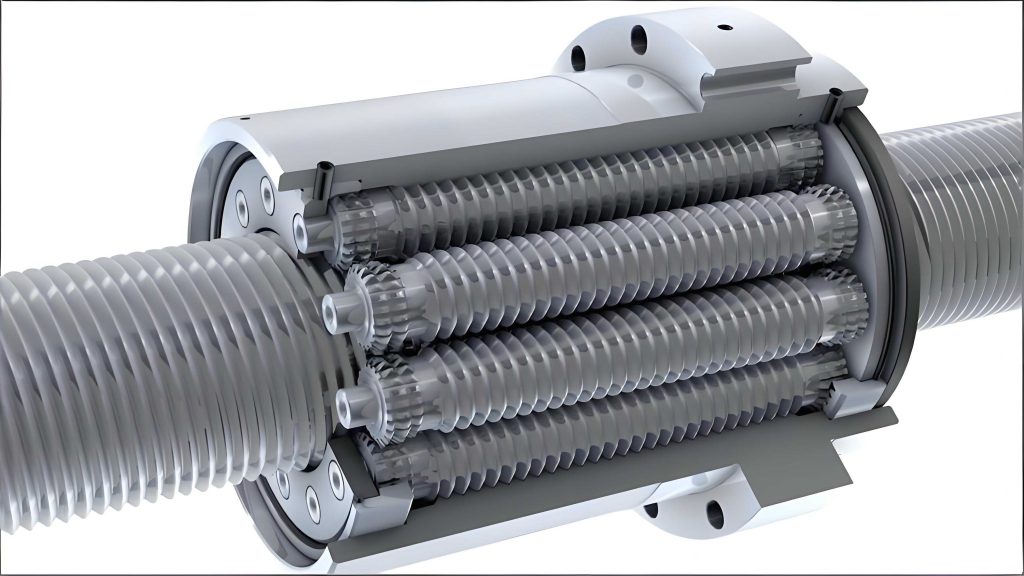
Currently, due to immature key technologies in design, machining, and manufacturing of domestic planetary roller screw mechanisms, there is a significant gap in transmission performance, such as transmission accuracy and efficiency, compared to foreign products. The highest transmission accuracy of foreign products can reach G1 grade, while domestic products only achieve G3 grade at best. In terms of transmission efficiency, domestic products are often about 10% lower than foreign products. Life cycle tests under the same specifications and conditions show that domestic products experience wear or even roller jamming earlier, resulting in much shorter service lives. Among these, unreasonable transmission characteristics are a primary cause. Therefore, domestic high-end planetary roller screw products still rely on imports, necessitating urgent efforts to enhance research and innovation to improve the competitiveness of domestic planetary roller screw mechanisms.
In this context, studying transmission characteristics is crucial for improving system transmission accuracy, efficiency, and service life. It helps optimize tooth profile parameters, reduce frictional losses, and address transmission performance under high-load and low-speed heavy-duty conditions, further advancing the development of high-end equipment manufacturing and meeting the urgent demand for high-end planetary roller screw products in modern industry.
Development Status of Planetary Roller Screw Products
Since the mid-20th century, planetary roller screw technology has evolved rapidly, gaining widespread application in manufacturing due to its high precision, high load capacity, and high stiffness. The overall development timeline is summarized in Table 1.
| Period | Key Milestones | Product Types | Major Applications |
|---|---|---|---|
| 1940s-1960s | Invention of basic structures: cyclic, inverted, standard, and differential planetary roller screw mechanisms. | Cyclic, Inverted, Standard | Initial concepts and patents; limited practical use. |
| 1970s-1990s | Commercial production by companies like SKF (Sweden), Rollvis (Switzerland), Moog (USA). | Standard, Inverted | Military applications: aircraft landing gear, missile launchers. |
| 2000s-2010s | Maturation of products; expansion into precision machinery, automotive, and industrial automation. | Standard, Differential | Machine tools, robotics, semiconductor equipment. |
| 2020s-present | Dominance by Schäffler Group (Germany) after acquisitions; surge in humanoid robot applications. | Inverted, Standard | Humanoid robot joints (arms, legs), high-precision actuators. |
From a global perspective, foreign markets have a head start. In the 1970s, companies such as SKF in Sweden, Rollvis and GSA in Switzerland, and Moog and Exlar in the United States began producing planetary roller screw products. Initially focused on military applications, these products gradually expanded to commercial fields. By 2017, GSA Switzerland acquired Rollvis, becoming the manufacturer with the most comprehensive range of planetary roller screw models. In 2022, the German Schäffler Group acquired Ewellix (the motion technology division of SKF) and took a controlling stake in GSA, effectively monopolizing about 70% of the high-end planetary roller screw market.
In contrast, domestic development started later. In the early 2000s, research was primarily conducted by academic institutions like Huazhong University of Science and Technology, Nanjing University of Science and Technology, Northwestern Polytechnical University, and Beijing Precision Electromechanical Control Equipment Research Institute. These studies focused on motion principles and parameter matching, leading to small-scale trial productions. After over a decade of theoretical research, companies such as Shaanxi Hanjiang Machine Tool, Qishan Northern Machinery, and Shandong Bote Precision began prototyping planetary roller screw mechanisms. However, issues like high costs, low yield rates, and poor service performance hindered market penetration. Since 2023, with the rise of humanoid robots and policy support, domestic companies like Hangzhou Xinjian Robotics, Hubei Kefeng Intelligent Transmission, and Lianyungang Sixs Robotics have invested in R&D, particularly for inverted planetary roller screw mechanisms used in robot joints, gradually achieving localization of core components.
Research Status on Transmission Characteristics of Planetary Roller Screw Mechanisms
Transmission characteristics are critical for evaluating the performance of planetary roller screw mechanisms. They can be categorized into contact characteristics, transmission efficiency, and transmission accuracy. Over the past decade, significant research has been conducted in these areas, employing methods such as differential geometry, Hertzian contact theory, finite element analysis (FEA), and experimental testing.
Contact Characteristics
Contact characteristics research is fundamental for enhancing the transmission performance of planetary roller screw mechanisms. It involves analyzing the contact behavior between the screw, rollers, and nut under various loads and conditions. Key parameters include contact stress, load distribution, and stiffness.
Based on differential geometry, researchers have developed models to describe the contact kinematics. For instance, the relative sliding velocities between screw-roller and roller-nut interfaces can be derived using conjugate contact conditions and coordinate transformations. Without geometric errors, the roller-nut interface exhibits no relative sliding, as shown in the velocity equation:
$$ v_{slide} = \omega \times r \cdot \sin(\alpha) $$
where $\omega$ is the angular velocity, $r$ is the contact radius, and $\alpha$ is the thread helix angle. However, these models often assume rigid bodies, limiting their accuracy under real loading conditions.
To address this, Hertzian contact theory has been applied to analyze elastic deformations and contact stresses. The maximum contact stress $\sigma_{max}$ in a planetary roller screw mechanism can be expressed as:
$$ \sigma_{max} = \sqrt{\frac{3F E^*}{2\pi R^2}} $$
where $F$ is the contact force, $E^*$ is the equivalent elastic modulus, and $R$ is the effective radius of curvature. Studies have shown that parameters like pitch, thread flank angle, and profile radius significantly influence local contact characteristics. For example, increasing the thread flank angle reduces contact stress but may affect load distribution.
Finite element analysis (FEA) has also been widely used to study contact characteristics. It allows for detailed simulation of stress distribution and deformation under complex loading, including axial, radial, and moment loads. However, FEA models are computationally intensive and require careful meshing of thread contacts. Table 2 summarizes key research findings on contact characteristics.
| Research Focus | Methods Used | Key Findings | Limitations |
|---|---|---|---|
| Load distribution among rollers | Differential geometry, machine learning | Predict load distribution coefficients; multi-error coupling affects uniformity. | Assumes rigid bodies; ignores elastic deformations. |
| Contact stress and stiffness | Hertzian contact theory, analytical models | Thread parameters (pitch, angle) impact stress; axial stiffness models developed. | Simplified to axial loads; radial loads and moments often neglected. |
| Elastic deformations and load sharing | FEA, experimental validation | Roller bending affects load distribution; contact areas deform under load. | High computational cost; complex contact modeling required. |
| Dynamic contact under combined loads | Analytical models, FEA | Radial loads and moments cause periodic contact force variations. | Limited to static or quasi-static conditions; dynamic effects underrepresented. |
Despite progress, existing research often overlooks the coupled effects of multiple loads and thermal influences. Future work should integrate these factors into comprehensive contact models for planetary roller screw mechanisms.
Transmission Efficiency
Transmission efficiency is a vital performance indicator for planetary roller screw mechanisms, reflecting the energy loss due to friction during motion. Research in this area focuses on friction mechanisms, efficiency testing, and structural optimization.
The friction torque in a planetary roller screw mechanism arises from both rolling and sliding friction at the thread contacts. The total friction torque $T_f$ can be modeled as:
$$ T_f = \sum_{i=1}^{n} (F_{r,i} \cdot \mu_r \cdot r_i + F_{s,i} \cdot \mu_s \cdot r_i) $$
where $n$ is the number of rollers, $F_{r,i}$ and $F_{s,i}$ are the rolling and sliding contact forces, $\mu_r$ and $\mu_s$ are the coefficients of rolling and sliding friction, and $r_i$ is the effective radius. Factors like contact angle, helix angle, and number of roller threads influence the proportion of sliding friction, thereby affecting efficiency.
Experimental studies have been conducted to measure transmission efficiency under various operating conditions. For example, efficiency test benches for standard and differential planetary roller screw mechanisms have been built, revealing that domestic products often exhibit lower efficiency (e.g., 70-80%) compared to foreign products (e.g., 85-90%). Efficiency varies with load and speed, as shown in Table 3.
| Load (N) | Screw Speed (rpm) | Efficiency (Domestic) (%) | Efficiency (Foreign) (%) | Key Factors |
|---|---|---|---|---|
| 1000 | 500 | 75 | 85 | Low load, moderate speed |
| 5000 | 1000 | 78 | 88 | Medium load, high speed |
| 10000 | 200 | 70 | 82 | High load, low speed |
| 20000 | 500 | 65 | 80 | Very high load, medium speed |
Structural optimization plays a key role in improving efficiency. Key design parameters include:
- Thread parameters: Helix angle $\beta$ and flank angle $\theta$ affect sliding friction. An optimal helix angle balances efficiency and stability. The efficiency $\eta$ can be approximated by:
$$ \eta = \frac{\tan(\beta)}{\tan(\beta + \phi)} $$
where $\phi$ is the friction angle.
- Roller characteristics: Number of rollers, diameter, surface roughness, and hardness influence load distribution and friction. More rollers reduce individual contact stress but may increase complexity.
- Axial clearance and preload: Proper preload minimizes backlash and vibration, enhancing efficiency. However, excessive preload increases friction.
Recent studies also explore lubrication effects. Mixed lubrication models consider fluid film formation between threads, reducing friction. The Stribeck curve describes the transition from boundary to hydrodynamic lubrication:
$$ \mu = a \cdot \left(\frac{\eta v}{p}\right)^b $$
where $\mu$ is the friction coefficient, $\eta$ is lubricant viscosity, $v$ is sliding velocity, $p$ is contact pressure, and $a$, $b$ are constants.
Despite advancements, challenges remain in accurately predicting efficiency under dynamic conditions and optimizing designs for specific applications of planetary roller screw mechanisms.
Transmission Accuracy
Transmission accuracy is a critical metric for planetary roller screw mechanisms, affecting positioning precision and repeatability in high-end systems. Research covers error modeling, compensation techniques, and dynamic accuracy analysis.
Transmission errors in planetary roller screw mechanisms stem from manufacturing errors, assembly errors, and operational errors. Manufacturing errors include thread pitch deviations, roller diameter variations, and profile inaccuracies. Assembly errors involve misalignments, eccentricities, and improper preload. Operational errors arise from elastic deformations, thermal expansions, and wear during service. The cumulative error $\Delta E$ can be expressed as:
$$ \Delta E = \sum \Delta E_{manufacturing} + \sum \Delta E_{assembly} + \sum \Delta E_{operational} $$
For instance, thread pitch error $\Delta p$ causes linear displacement error $\Delta x$ per revolution:
$$ \Delta x = n \cdot \Delta p $$
where $n$ is the number of active threads.
Error compensation techniques are essential for improving accuracy. These include structural compensation (e.g., optimizing tooth profiles) and control compensation (e.g., using servo systems with feedback sensors). Thermal compensation models predict thermal deformation based on temperature fields, adjusting parameters in real-time. Digital twin technology is emerging, enabling virtual simulation and online error correction for planetary roller screw mechanisms.
Dynamic accuracy analysis examines how transmission precision varies under load, speed, and temperature changes. Models incorporating elastic deformations show that accuracy degrades with increasing load due to thread deflections. Experimental tests on planetary roller screw mechanisms have demonstrated transmission errors as low as 1.5 µm under controlled conditions, but errors can escalate to 10-20 µm under high loads or thermal gradients.
Table 4 summarizes key factors affecting transmission accuracy and mitigation strategies.
| Error Type | Source | Impact on Accuracy | Mitigation Strategies |
|---|---|---|---|
| Manufacturing errors | Thread grinding inaccuracies, diameter tolerances | Directly causes positioning errors; reduces repeatability. | High-precision machining, tighter tolerances, quality control. |
| Assembly errors | Misalignment of rollers, eccentric screw/nut, improper preload | Induces uneven load distribution, increasing wear and error accumulation. | Precision assembly fixtures, alignment techniques, preload optimization. |
| Elastic deformations | Load-induced thread tooth bending, axial compression | Leads to nonlinear displacement errors, especially under variable loads. | Stiffness modeling, material selection, load distribution optimization. |
| Thermal errors | Friction heat, ambient temperature changes | Causes thermal expansion, altering thread geometry and contact conditions. | Thermal compensation models, cooling systems, low-friction designs. |
| Wear and lubrication | Surface wear over time, inadequate lubrication | Gradually increases backlash and reduces accuracy. | Wear-resistant materials, optimized lubrication regimes, periodic maintenance. |
Despite progress, achieving high transmission accuracy in planetary roller screw mechanisms remains challenging due to the complexity of error sources and their interactions. Future research should focus on integrated error modeling and real-time compensation systems.
Future Research Directions for Planetary Roller Screw Mechanisms
Based on current challenges, future research on planetary roller screw mechanisms should prioritize high-precision modeling, advanced manufacturing processes, and new materials and lubrication technologies. These directions aim to enhance transmission characteristics, reliability, and competitiveness.
High-Precision Modeling
Future models for planetary roller screw mechanisms must evolve to incorporate multi-physics coupling, integrating dynamics, statics, thermal effects, and wear. Nonlinear analyses should explore dynamic behaviors under high loads and speeds, including friction variations and transient responses. Multi-scale modeling and FEA can elucidate the impact of thread tooth micro-geometry and material microstructure on transmission performance. For instance, a coupled thermo-mechanical model could predict accuracy degradation under operational conditions.
Key equations for such models include the dynamic motion equation:
$$ J \ddot{\theta} + C \dot{\theta} + K \theta = T_{in} – T_{friction} $$
where $J$ is inertia, $C$ is damping, $K$ is stiffness, $\theta$ is angular displacement, $T_{in}$ is input torque, and $T_{friction}$ is friction torque. Additionally, load distribution among rollers should be optimized using equalization design methods to improve transmission characteristics and service life.
Advanced Manufacturing Processes
Cost reduction for domestic planetary roller screw products hinges on optimizing manufacturing processes. Challenges include improving grinding accuracy, surface quality, and error control.
- Grinding precision: Thread grinding, especially for long-length nuts with multi-start internal threads, requires advancements. Current grinding units struggle to achieve G3-grade accuracy. Developing new grinding units and internal thread grinders is crucial.
- Surface quality: Enhancing surface roughness and waviness through fine grinding, heat treatment, and laser polishing can reduce friction and wear in planetary roller screw mechanisms.
- Process error control: Implementing advanced monitoring and automated correction systems can minimize errors from thermal deformation, vibration, and tool wear, ensuring consistency in pitch diameter and thread flank angles.
Table 5 outlines potential process improvements.
| Process Aspect | Current Limitations | Future Solutions | Expected Impact |
|---|---|---|---|
| Thread grinding | Low accuracy for internal threads; high cost. | Development of high-precision internal grinders; adaptive control systems. | Achieve G2 or better accuracy; reduce production cost by 20-30%. |
| Surface finishing | Inconsistent roughness leads to friction variations. | Laser surface texturing; superfinishing techniques. | Improve transmission efficiency by 5-10%; extend service life. |
| Error compensation | Manual adjustments; slow response to errors. | Real-time sensor feedback; AI-based error prediction. | Reduce assembly errors by 50%; enhance product consistency. |
New Materials and Lubrication
Material innovation and lubrication are vital for enhancing the performance of planetary roller screw mechanisms. Future research should focus on:
- Functional coatings: Developing coatings like diamond-like carbon (DLC) or nanocomposites to improve wear resistance and reduce friction. The wear rate $W$ can be modeled as:
$$ W = k \cdot \frac{F \cdot v}{H} $$
where $k$ is a material constant, $F$ is load, $v$ is sliding velocity, and $H$ is hardness.
- High-strength alloys: Utilizing materials with high fatigue strength and thermal stability, such as advanced steels or titanium alloys, to withstand extreme conditions in planetary roller screw mechanisms.
- Smart lubrication systems: Integrating sensors and control algorithms to monitor lubrication status and adjust lubricant supply dynamically. This can optimize film formation and reduce energy loss.
For example, a minimal quantity lubrication (MQL) system could be adapted for planetary roller screw mechanisms, providing precise lubricant delivery while minimizing environmental impact.
Conclusion
In summary, transmission characteristics of planetary roller screw mechanisms have garnered significant attention from researchers worldwide. However, studies on contact characteristics, transmission efficiency, and accuracy are still in the exploratory stage, lacking a mature technical system and production capabilities for high-end products. Driven by demand, future research should focus on high-precision modeling, advanced manufacturing processes, and new materials and lubrication. Multi-physics coupling models and intelligent algorithms will enhance dynamic accuracy; ultra-precision machining and smart inspection will reduce manufacturing errors; and high-temperature resistant materials with smart lubrication will improve wear resistance, stiffness, and thermal stability. These advancements will significantly boost the transmission performance and reliability of planetary roller screw mechanisms, promoting their widespread application in high-end equipment manufacturing. As technology progresses, we can anticipate further optimization in the design, manufacturing, and control of planetary roller screw mechanisms, leading to higher dynamic accuracy and reliability, and providing more opportunities for innovation and high-quality development in advanced manufacturing.