
The planetary roller screw mechanism represents a pivotal advancement in precision linear actuation, finding indispensable applications across aerospace, robotics, and high-load industrial machinery due to its superior load capacity, stiffness, and longevity compared to conventional ball screws. At its core, the fundamental performance of a planetary roller screw is governed by the intricate meshing interactions and contact mechanics between its three primary components: the central screw, the multiple planetary rollers, and the surrounding nut. Traditional or “standard” designs typically employ a thread profile where the screw and nut have straight or inclined flanks, while the roller features a convex circular arc. This configuration results in a convex-to-flat or convex-to-inclined-plane contact, which, while functional, imposes significant contact stresses that can limit the ultimate load capacity and fatigue life of the mechanism.
To transcend these limitations and push the boundaries of performance, this analysis proposes and investigates a novel thread profile design: the convex-concave contact planetary roller screw. The central innovation lies in re-engineering the thread profiles of the screw and the nut. Instead of straight flanks, their profiles are designed with a concave circular arc. The roller retains its traditional convex circular arc profile. This reconfigured geometry transforms the contact interface from a convex-flat pair to a convex-concave pair. The primary hypothesis is that this modified contact geometry favorably alters the principal curvatures at the contact point, leading to a larger effective contact area under load, reduced Hertzian contact stress, and consequently, a significant enhancement in the mechanism’s load-bearing capability and operational lifespan.
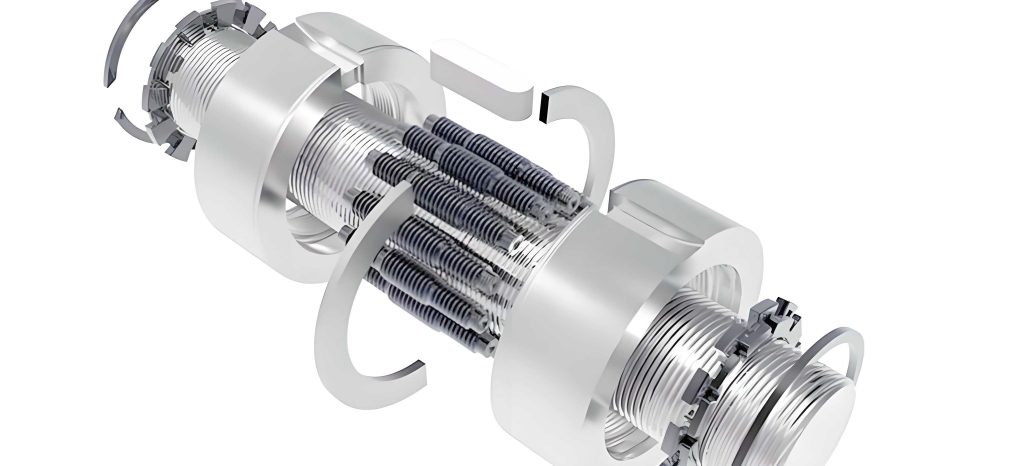
The pursuit of a higher-performance planetary roller screw necessitates a rigorous foundational model. The analysis begins with the establishment of a comprehensive spatial meshing model based on gear geometry theory. A coordinate system is defined to describe the spatial relationship between the screw, a representative roller, and the nut. The global coordinate system \(O-XYZ\) is fixed, with the Z-axis aligned with the screw’s axis. Component-specific coordinate systems \(o_s-x_sy_sz_s\), \(o_r-x_ry_rz_r\), and \(o_n-x_ny_nz_n\) are attached to the screw, roller, and nut, respectively, accounting for their rotations and translations. The thread surface of any component \(i\) (where \(i = s, r, n\)) can be generically described by a position vector \(\mathbf{Q}_i\) as a function of surface parameters, incorporating its lead \(L_i\) and specific profile geometry.
The thread profile geometry is the critical differentiator. For the convex-concave planetary roller screw, the profiles in the axial plane are defined as follows. Let \(R_s\), \(R_r\), and \(R_n\) represent the radii of the circular arcs for the screw, roller, and nut profiles, respectively. Here, \(R_r > 0\) (convex), while \(R_s < 0\) and \(R_n < 0\) (concave). The flank angle is denoted by \(\alpha\), and the half-thread thickness at the pitch diameter by \(c_i\).
Screw Profile (Concave): The center of the screw’s concave arc \(o_{se}\) has coordinates derived from its geometry:
$$ x_{so} = r_s + R_s \sin \alpha $$
$$ z_{so} = c_s + R_s \cos \alpha $$
where \(r_s\) is the screw’s pitch radius. Any point \((r_{Ps}, z_s)\) on the profile curve satisfies:
$$ z_s = z_{so} – \sqrt{R_s^2 – (r_{Ps} – x_{so})^2} $$
The resulting thread surface equation for the screw is:
$$ F_s(r_{Ps}, \theta_s) = \rho_s \left[ z_{so} – \sqrt{R_s^2 – (r_{Ps} – x_{so})^2} \right] + \frac{\theta_s L_s}{2\pi} $$
where \(\rho_s = +1\) for the upper flank and \(\rho_s = -1\) for the lower flank; \(\theta_s\) is the angular parameter.
Roller Profile (Convex): The center of the roller’s convex arc \(o_{re}\) is located at:
$$ x_{ro} = 0 $$
$$ z_{ro} = -R_r \cos \alpha + c_r $$
The profile curve and surface equation are:
$$ z_r = z_{ro} + \sqrt{R_r^2 – (r_{Pr} – x_{ro})^2} $$
$$ F_r(r_{Pr}, \theta_r) = \rho_r \left[ z_{ro} + \sqrt{R_r^2 – (r_{Pr} – x_{ro})^2} \right] + \frac{\theta_r L_r}{2\pi} $$
with \(\rho_r = \pm 1\) for its upper/lower flanks.
Nut Profile (Concave): Similarly, for the nut’s concave arc center \(o_{ne}\):
$$ x_{no} = r_n – R_n \sin \alpha $$
$$ z_{no} = -R_n \cos \alpha + c_n $$
$$ z_n = z_{no} + \sqrt{R_n^2 – (r_{Pn} – x_{no})^2} $$
$$ F_n(r_{Pn}, \theta_n) = \rho_n \left[ z_{no} + \sqrt{R_n^2 – (r_{Pn} – x_{no})^2} \right] + \frac{\theta_n L_n}{2\pi} $$
Continuous meshing in a planetary roller screw requires the contacting thread surfaces to remain tangent under motion. Accounting for a potential axial clearance \(e_{12}\), the tangency condition between two surfaces \(\Pi_1\) and \(\Pi_2\) is given by:
$$ \mathbf{\Gamma}_2(u_2, \theta_2) = \mathbf{\Gamma}_1(u_1, \theta_1) + \mathbf{\Delta}_{12} $$
$$ \mathbf{n}_2 = \mu_{12} \mathbf{n}_1 $$
where \(\mathbf{\Delta}_{12} = [0, 0, e_{12}]^T\), and \(\mathbf{n}\) is the surface normal vector. Applying this to the screw-roller pair yields the system of meshing equations:
$$ \begin{aligned}
r’_s \cos \theta’_s &= -r’_r \cos \theta’_r \\
r’_s \sin \theta’_s &= r’_r \sin \theta’_r \\
T^z_s &= T^z_r + e_{sr} \\
\mathbf{n}_s &= \frac{\mathbf{n}_s \cdot \mathbf{n}_r}{|\mathbf{n}_r|^2} \mathbf{n}_r
\end{aligned} $$
Here, \(r’_s, \theta’_s, r’_r, \theta’_r\) are the contact point coordinates (radius and angle) on the screw and roller surfaces in the global system, \(e_{sr}\) is the axial clearance, and \(T^z\) represents the Z-coordinate of the contact point derived from the surface equations \(F_i\). A similar set of equations is derived for the nut-roller pair. This system of nonlinear equations is solved numerically (e.g., using the Newton-Raphson method) to determine the exact contact point locations and inherent axial clearances for a given unloaded geometry of the convex-concave planetary roller screw.
The load-bearing characteristics are analyzed by modeling the force distribution across the multiple engaged thread teeth when an axial load \(F_a\) is applied to the nut (or screw). The model integrates Hertzian contact theory for the local deformation at each contact point and a system-wide deformation compatibility condition.
Under load, the normal force \(F_{n,i}\) at the i-th engaged thread pair causes elastic deformation. For the convex-concave contact, the principal curvatures at the contact ellipsoid are modified. For the screw-roller contact:
$$ \rho_{11} = \frac{1}{R_r}, \quad \rho_{12} = \frac{1}{R_r} $$
$$ \rho_{21} = -\frac{1}{R_s}, \quad \rho_{22} = \frac{2 \cos \alpha_s \cos \lambda_s}{d_m – 2R_s \cos \alpha_s} $$
where \(d_m\) is the pitch diameter of the roller’s orbit and \(\lambda_s\) is the screw’s lead angle at the contact radius. The total curvature sum is \(\sum \rho = \rho_{11} + \rho_{12} + \rho_{21} + \rho_{22}\). The contact deformation \(\delta\) and the maximum contact stress \(\sigma_{max}\) are given by:
$$ \delta_{sr} = C_{sr} F_{n}^{2/3}, \quad \sigma_{max} = \frac{3F_n}{2\pi a b} $$
where the semi-major and semi-minor axes \(a\) and \(b\) of the contact ellipse are:
$$ a = m_a \left( \frac{3F_n E^*}{2 \sum \rho} \right)^{1/3}, \quad b = m_b \left( \frac{3F_n E^*}{2 \sum \rho} \right)^{1/3} $$
\(C_{sr}\) is the contact compliance derived from Hertz theory, \(E^*\) is the equivalent elastic modulus, and \(m_a, m_b\) are coefficients dependent on the curvature difference.
Deformation compatibility enforces that the combined axial displacement of the screw and roller structures must be equal for consecutive contact points along the same load path. This displacement includes: 1) Hertzian contact deformation \(\delta\), 2) axial tensile/compressive deformation of the screw and roller shafts \(\tau\), and 3) bending and shear deformation of the thread teeth themselves \(\sigma^{thread}\). The thread tooth deflection is a sum of five components: bending (\(\sigma_1\)), shear (\(\sigma_2\)), tilting at the root (\(\sigma_3\)), shear at the root (\(\sigma_4\)), and radial expansion/compression (\(\sigma_5\)). The compatibility equation for the i-th screw-roller contact can be expressed as:
$$ \frac{F_{a,i} – F_{a,i-1}}{C_{RS}} + \frac{F_N – \sum_{j=1}^{i-1} F_{a,j}}{K_{SB}} + \frac{F_{a,i} – F_{a,i-1}}{K_{ST}} = \frac{\sum_{j=1}^{i-1} F_{a,j} – \sum_{j=1}^{i-1} F_{a-n,j}}{K_{RB}} + \frac{F_{a,i} – F_{a,i-1}}{K_{RST}} $$
Here, \(F_{a,i}\) is the axial load carried by the i-th screw-roller thread pair, \(F_N\) is the total axial load on one roller, \(K_{SB}, K_{RB}\) are axial stiffnesses of screw and roller segments, and \(K_{ST}, K_{RST}\) are the thread tooth bending stiffnesses for screw and roller. A parallel set of equations governs the nut-roller side. Solving this complete system yields the load distribution \(F_{n,i}\) across all engaged teeth for a given total axial load \(F_a\) on the planetary roller screw.
The influence of key geometric parameters on the meshing point location, axial clearance, and ultimately the contact stress distribution is systematically evaluated for the convex-concave planetary roller screw. A base set of parameters is used: screw pitch diameter \(d_s = 21 \text{mm}\), roller pitch diameter \(d_r = 7 \text{mm}\), nut pitch diameter \(d_n = 35 \text{mm}\), screw/nut number of starts = 5, roller number of starts = 1, number of rollers = 10.
| Parameter | Variation Range | Primary Effect on Meshing (Screw-Roller Side) | Effect on Axial Clearance \(e_{sr}\) |
|---|---|---|---|
| Flank Angle \(\alpha\) | 30° to 75° | Contact point moves closer to line-of-centers and towards screw tooth crest as \(\alpha\) increases. Roller contact radius is more sensitive. | Increases monotonically with \(\alpha\). Negative clearance (interference) occurs at low \(\alpha\) (~30°). |
| Pitch \(P\) | 0.5 mm to 3.0 mm | Contact point shifts away from line-of-centers as \(P\) increases. Location remains near the pitch cylinder. | Minor variation. Not a dominant factor for clearance. |
| Roller Convex Radius \(R_r\) | 3 mm to 50 mm | Contact point moves slightly towards screw tooth root as \(R_r\) increases. | Decreases very slightly with increasing \(R_r\). |
| Screw/Nut Concave Radius \(R_s, R_n\) | (1.0 to 3.0)\(\times R_r\) | Negligible effect on contact point location. | Almost no effect. |
While parameters like the concave radii \(R_s, R_n\) have minimal effect on the unloaded meshing geometry, they profoundly impact the load-bearing performance. The flank angle \(\alpha\) significantly influences load distribution; a larger \(\alpha\) reduces the axial force component from the normal contact force, leading to higher normal forces and thus higher contact stresses for the same total axial load. The pitch \(P\) (and corresponding lead angle \(\lambda\)) affects load distribution uniformity. A smaller pitch results in a more uniform distribution of contact stress across the engaged threads, reducing the peak stress on the first few load-bearing teeth. Increasing the number of active thread teeth \(M\) on the roller reduces the average stress per tooth but can exacerbate distribution non-uniformity.
The decisive advantage of the convex-concave planetary roller screw is revealed by comparing its contact stress under load with that of a standard design. For a standard planetary roller screw, \(R_s, R_n \to \infty\) (straight flanks). For a fair comparison, both designs are subjected to the same axial load (e.g., 30 kN) and have identical major dimensions (pitch diameters, pitch, flank angle).
| Contact Type | Screw-Roller Max Contact Stress | Nut-Roller Max Contact Stress | Stress Reduction vs. Standard | Mechanism |
|---|---|---|---|---|
| Standard (Straight Flank) | ~3.2 GPa | ~3.1 GPa | Baseline | Convex-to-flat contact, high curvature sum. |
| Convex-Concave (\(R_s = R_n = 1.10 R_r\)) | ~2.0 GPa | ~1.9 GPa | ~38% | Convex-concave pairing reduces total curvature \(\sum \rho\), enlarging contact ellipse. |
| Convex-Concave (\(R_s = R_n = 1.06 R_r\)) | ~1.6 GPa | ~1.5 GPa | ~50% | Further reduction in curvature sum, leading to even lower stress. |
| Convex-Concave (\(R_s = R_n = 2.00 R_r\)) | ~2.5 GPa | ~2.4 GPa | ~22% | Larger concave radius reduces the geometric advantage, stress reduction is less pronounced. |
The results demonstrate a compelling trend: the convex-concave contact geometry in a planetary roller screw can dramatically reduce the maximum Hertzian contact stress. The reduction is most significant when the concave radii of the screw and nut are only slightly larger than the convex radius of the roller. This configuration minimizes the sum of principal curvatures \(\sum \rho\) at the contact, which, according to Hertz theory \(\left( a, b \propto (\sum \rho)^{-1/3} \right)\), results in a larger contact area for the same normal load. The stress, being proportional to \(F_n/(ab)\), therefore decreases substantially. This directly translates to a higher static load capacity and, crucially, a greatly extended fatigue life, as pitting and spalling failures are driven by cyclic contact stress.
However, the design is subject to practical constraints. Excessively small concave radii (approaching the convex radius) risk introducing meshing interference and complicate manufacturing and assembly. Furthermore, a very tight convex-concave fit might increase sliding friction and reduce efficiency. Therefore, an optimal design must balance the stress-reducing benefit against manufacturability, assembly tolerance, and efficiency. A ratio \(R_s / R_r\) (and \(R_n / R_r\)) in the range of 1.05 to 1.15 appears to offer an excellent compromise, providing a dramatic reduction in contact stress (40-50%) while maintaining practical feasibility.
In conclusion, the transformation from a standard to a convex-concave contact paradigm in planetary roller screw design offers a fundamental and powerful pathway to enhance performance. The established spatial meshing and load distribution models provide the analytical tools to precisely quantify this improvement. The convex-concave geometry effectively reshapes the contact mechanics, leading to a more favorable stress state. This innovation paves the way for the development of a new generation of planetary roller screw mechanisms that are not only stronger and more durable but also capable of enabling more compact, reliable, and high-performance actuation systems for the most demanding technological applications.