
The planetary roller screw mechanism (PRSM) is a high-performance mechanical actuator that converts rotary motion into linear motion or vice versa. Its core components include a central screw, multiple threaded rollers distributed circumferentially, and a nut. The engagement of the helical threads among these three parts facilitates motion transmission. Compared to the traditional ball screw mechanism, the planetary roller screw offers significantly higher load capacity, greater stiffness, longer service life, and superior resistance to shock loads due to its multi-contact-point design involving line contacts. These advantages have led to its widespread application in demanding fields such as aerospace, robotics, heavy-duty machine tools, and oil drilling equipment.
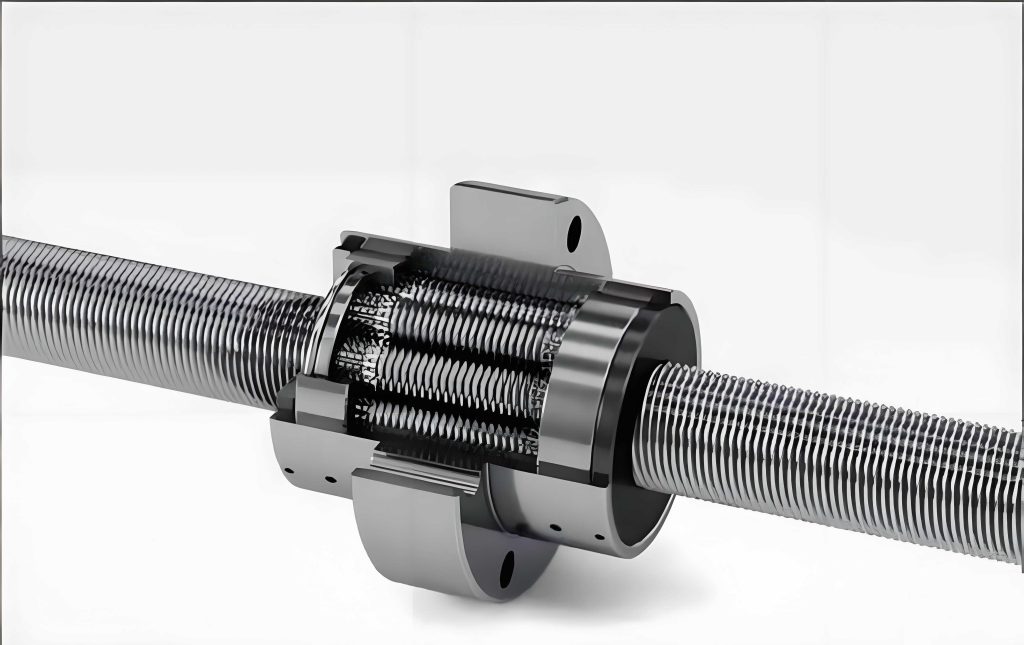
During operation, the transmission of force through a planetary roller screw generates high contact stresses at the thread interfaces between the screw and rollers, and between the rollers and the nut. Under increasing external axial load, these contact regions transition from elastic to plastic deformation. Excessive plastic deformation adversely affects positioning accuracy, backlash, running smoothness, and ultimately leads to failure. Therefore, accurately determining the rated static load—the maximum axial load the mechanism can withstand without incurring permanent deformation beyond an acceptable limit—is a fundamental requirement for reliable design, selection, and application of planetary roller screw drives.
Currently, there is no unified international standard for calculating the rated static load of a planetary roller screw. Researchers and engineers often adapt calculation principles from analogous components like ball screws and rolling bearings, or employ theories from elastoplastic mechanics. This has resulted in multiple calculation methodologies with sometimes significantly divergent results, creating uncertainty in practical engineering. This article systematically elaborates on four established calculation methods, compares their results through parametric studies, validates them against finite element analysis (FEA), and proposes an improved method for enhanced accuracy.
1. Fundamental Hertz Contact Theory for Planetary Roller Screws
The contact between the screw thread and the roller thread in a planetary roller screw is typically a point contact that forms an elliptical area under load, governed by Hertzian contact theory. For a contact pair subjected to a normal force $$Q$$, the maximum contact pressure $$\sigma_{max}$$ at the center of the ellipse and the mutual approach (deformation) $$\delta$$ of the two bodies are critical parameters.
The principal radii of curvature for the screw (body 1) and roller (body 2) at the contact point must be defined. Let $$\rho_{11}$$ and $$\rho_{12}$$ be the principal curvatures of the roller thread surface, and $$\rho_{21}$$ and $$\rho_{22}$$ be the principal curvatures of the screw thread surface. The sum of the principal curvatures, $$\Sigma\rho$$, is given by:
$$
\Sigma\rho = \rho_{11} + \rho_{12} + \rho_{21} + \rho_{22}
$$
The semi-major axis $$a$$ and semi-minor axis $$b$$ of the contact ellipse are calculated as:
$$
a = m_a \left[ \frac{3Q}{2\Sigma\rho} \left( \frac{1-\mu_1^2}{E_1} + \frac{1-\mu_2^2}{E_2} \right) \right]^{1/3}, \quad b = m_b \left[ \frac{3Q}{2\Sigma\rho} \left( \frac{1-\mu_1^2}{E_1} + \frac{1-\mu_2^2}{E_2} \right) \right]^{1/3}
$$
where $$E_1, E_2$$ are the Young’s moduli and $$\mu_1, \mu_2$$ are the Poisson’s ratios of the screw and roller materials, respectively. The coefficients $$m_a$$ and $$m_b$$ depend on the ellipticity parameter, which is related to the principal curvature difference. The equivalent modulus $$E’$$ is defined as:
$$
\frac{2}{E’} = \frac{1-\mu_1^2}{E_1} + \frac{1-\mu_2^2}{E_2}
$$
The maximum Hertz contact stress is:
$$
\sigma_{max} = \frac{3Q}{2\pi a b}
$$
And the normal approach (deformation) is:
$$
\delta = \frac{K(e)}{\pi m_a} \left( \frac{3}{2E’} \right)^{2/3} \left( 2Q \Sigma\rho \right)^{1/3}
$$
where $$K(e)$$ is the complete elliptic integral of the first kind. For a planetary roller screw, the normal force $$Q$$ on a single thread contact is related to the total axial load $$F_a$$ by the number of active rollers $$n$$, the number of engaged threads per roller $$z$$, the thread profile half-angle $$\alpha$$, and the lead angle $$\lambda$$:
$$
Q = \frac{F_a}{n z \cos\alpha \cos\lambda}
$$
These Hertz equations form the foundation for all subsequent rated static load calculations for the planetary roller screw.
2. Overview of Four Rated Static Load Calculation Methods
The rated static load is defined as the axial load that causes a specific, acceptable level of permanent deformation in the most critically loaded contact. The four methods differ primarily in their criterion for defining this “acceptable” limit. A comparative summary is presented in Table 1.
| Method | Basis / Standard | Fundamental Criterion | Key Formula for Axial Rated Static Load (Fmax) | Remarks |
|---|---|---|---|---|
| Method 1 | Ball Screw Standard | Plastic deformation reaches 0.01% of the equivalent roller “ball” diameter. | $$F_{1max} = 55.48 R \left[ (\rho_{11}+\rho_{21})(\rho_{12}+\rho_{22}) \right]^{-1/2} n z \cos\alpha \cos\lambda$$ | Uses Palmgren’s empirical formula. Tends to give the highest load values. |
| Method 2 | Rolling Bearing Standard | Maximum Hertz contact stress reaches a reference value (e.g., 4200 MPa for “ball” type contact). | $$F_{2max} = n z \sigma_{ref}^2 \frac{2\pi}{3} a b \cos\alpha \cos\lambda$$, where $$\sigma_{ref}=4200\,MPa$$. | Directly adapted from bearing catalog ratings. Simpler, based on extensive bearing test data. |
| Method 3 | Yield Limit Criterion | Maximum Hertz contact stress equals the material’s yield strength under a multiaxial stress state. | $$F_{3max} = n z \left( \frac{\sigma_s}{3 k_{st}} \right)^2 \frac{2\pi}{3} a b \cos\alpha \cos\lambda$$, where $$k_{st} \approx 0.30-0.33$$. | Based on von Mises yield criterion under point contact. Represents the onset of yield, not a service limit. |
| Method 4 | Elastic-Plastic Linear Hardening Model | Total permanent deformation (elastic + plastic + hardening) reaches 0.01% of the roller’s effective diameter. | $$F_{4max} = \left[ F_{nE} + \frac{1}{6} k_P d_{eff} \times 10^{-4} ( 3E’ \delta_{EL}^{1/2} + 2E’_H \sqrt{d_{eff}} \times 10^{-2} ) \right] n z \cos\alpha \cos\lambda$$ | Most complex model. Accounts for material strain hardening after initial yield. |
2.1 Method 1: Adaptation from Ball Screw Standard
This method directly transplants the rated static load definition from ball screw standards to the planetary roller screw. The criterion is that the permanent plastic deformation at the contact reaches 0.0001 times the diameter of the rolling element. For a planetary roller screw, the roller is treated as an equivalent “ball,” and its diameter is taken as the diameter of the roller’s thread arc, $$d_R / \cos\alpha$$. The empirical relation between plastic deformation $$\delta_p$$ and load $$Q$$ from Palmgren’s work is used:
$$
\delta_p = 1.3 \times 10^{-7} \frac{Q^2}{2R(\rho_{11}+\rho_{21})(\rho_{12}+\rho_{22})}
$$
Setting $$\delta_p = 0.0001 \times (2R)$$ and solving for the total axial load yields the formula for $$F_{1max}$$ in Table 1. This method is straightforward but may overestimate capacity as it ignores the specific geometry and load-sharing nuances of the planetary roller screw.
2.2 Method 2: Adaptation from Rolling Bearing Standard
Rolling bearing standards define the basic static load rating as the load that produces a maximum contact stress of 4200 MPa at the center of the most heavily loaded rolling element contact (for ball bearings). Given the similar contact mechanics, this is a popular approach for planetary roller screw analysis. The calculation is direct: one computes the contact ellipse parameters $$a$$ and $$b$$ for a chosen reference stress $$\sigma_{ref}=4200$$ MPa, determines the corresponding normal force $$Q_{ref}$$ from the Hertz stress equation, and then scales it to the total axial load. The governing equation is essentially the inverse of the Hertz stress formula:
$$
Q_{ref} = \sigma_{ref}^2 \frac{2\pi}{3} a b
$$
$$
F_{2max} = Q_{ref} \cdot n z \cos\alpha \cos\lambda
$$
This method benefits from being rooted in a vast amount of experimental bearing data, providing a practical and conservative estimate for the planetary roller screw.
2.3 Method 3: Yield Limit Criterion Based on Elastoplastic Mechanics
This theoretical method defines the rated load as the load causing the initial yield beneath the contact surface. According to the von Mises yield criterion under Hertzian contact, yielding initiates when the maximum orthogonal shear stress reaches about 0.3 times the material’s uniaxial yield strength $$\sigma_s$$. This occurs at a depth below the surface. Relating this to the maximum surface Hertz stress gives:
$$
\sigma_{max, yield} = \frac{\sigma_s}{3 k_{st}}
$$
where $$k_{st}$$ is a coefficient between 0.30 and 0.33. Using this stress as the limiting value $$\sigma_{3max}$$, the calculation proceeds identically to Method 2, substituting $$\sigma_{ref}$$ with $$\sigma_{3max}$$ to obtain $$F_{3max}$$. This method predicts the onset of plasticity, which is a more severe limit than a service-based allowable deformation, typically resulting in lower calculated load values.
2.4 Method 4: Elastic-Plastic Linear Hardening Model
This is the most sophisticated model, incorporating post-yield material behavior. It uses a linear strain-hardening model for the material. The total normal force on a contact $$F_{\Sigma}$$ is decomposed into a component from an idealized elastic-perfectly plastic model $$F_{nI}$$ and an additional component $$F_{nH}$$ due to strain hardening:
$$
F_{\Sigma} = F_{nI} + F_{nH}
$$
The idealized force $$F_{nI}$$ itself has an elastic part $$F_{nE}$$ (same as in Method 3) and a plastic part $$F_{nP}$$:
$$
F_{nI} = F_{nE} + F_{nP}
$$
The plastic part is derived from contact mechanics for a growing plastic zone:
$$
F_{nP} = \frac{1}{2} k_P E’ \delta_{EL}^{1/2} (\delta – \delta_{EL})
$$
The hardening force is:
$$
F_{nH} = \frac{1}{3} \left( \frac{\pi m_a}{K(e)} \right)^{3/2} E’_H \left( \frac{1}{\Sigma\rho} \right)^{1/2} \delta_E^{3/2}
$$
In these equations, $$\delta_{EL}$$ is the deformation at initial yield, $$\delta_E$$ is the plastic deformation component, $$k_P$$ is a plastic contact modulus, and $$E’_H$$ is an equivalent hardening modulus. The rated load condition is defined as the total permanent deformation ($$\delta_E$$) reaching 0.01% of the roller’s effective diameter. Solving this system of equations for the axial load gives the complex formula for $$F_{4max}$$ shown in Table 1.
3. Parametric Analysis of the Four Calculation Methods
To understand the influence of key planetary roller screw geometric parameters and to compare the trends predicted by the four methods, a parametric study is conducted. The analysis focuses on the load per engaged thread. The base parameters for a nominal planetary roller screw are: Screw Pitch Diameter = 20 mm, Roller Arc Radius = 4.6 mm, Lead = 2 mm, Thread Half-Angle $$\alpha = 45^\circ$$. Material properties for GCr15 bearing steel are used: $$E = 212$$ GPa, $$\mu = 0.29$$, $$\sigma_s = 1617$$ MPa.
Effect of Screw Pitch Diameter: Increasing the screw pitch diameter increases the roller arc radius proportionally (for a fixed thread angle), leading to a larger radius of curvature at the contact. This reduces contact stress for a given load, thereby increasing the rated static load across all methods. Method 1 shows the most aggressive increase, while Methods 3 and 4 show a nearly linear, more modest increase. Method 2’s increase is also significant but less steep than Method 1.
Effect of Roller Arc Radius: Directly increasing the roller arc radius (independent of pitch diameter) flattens the contact geometry, increasing the contact ellipse size and reducing stress. Consequently, all four methods predict a higher rated load with a larger arc radius. The relative ranking of the methods remains consistent: Method 1 > Method 2 > Method 4 > Method 3.
Effect of Lead (Pitch): The lead primarily affects the lead angle $$\lambda$$. A larger lead increases $$\lambda$$, which reduces the $$\cos\lambda$$ factor in the axial load conversion formula ($$F_a = Q \cdot n z \cos\alpha \cos\lambda$$). Therefore, for the same permissible contact condition (same $$Q$$), the allowable axial load $$F_a$$ decreases slightly as lead increases. All methods exhibit this mild decreasing trend.
Effect of Thread Half-Angle $$\alpha$$: The thread half-angle affects the load conversion via the $$\cos\alpha$$ term. A larger $$\alpha$$ reduces $$\cos\alpha$$, directly reducing the axial load capacity for the same permissible normal contact force $$Q$$. The impact is more pronounced than that of the lead angle. All methods show a clear decrease in rated load with increasing thread half-angle. This suggests that from a pure static load perspective, a smaller thread angle (e.g., a sharper “V” shape) is beneficial, though other factors like manufacturability and dynamic load distribution must be considered.
The key observation from this parametric study is the consistent and substantial disparity in the absolute values predicted by the different methods. Method 1 typically yields values approximately twice as high as Method 2, while Methods 3 and 4 yield values significantly lower (often less than half of Method 2’s values). This highlights the critical need for validation to determine which criterion is most appropriate for the planetary roller screw.
4. Finite Element Model for Validation
To validate and compare the four analytical methods, a nonlinear finite element analysis (FEA) model is developed. Modeling a full planetary roller screw assembly is computationally prohibitive. Therefore, a simplified yet representative model is constructed with the following assumptions: 1) Load is perfectly shared among all rollers and among all engaged threads of each roller. 2) The screw-roller contact is more critical than the roller-nut contact for static failure. 3) A single screw-roller thread pair can be analyzed in isolation.
The model consists of one segment of a screw thread and one segment of a roller thread, with their profiles in contact. Far-field geometry is removed to reduce mesh size. The material model for GCr15 is defined with elastic properties (E=212 GPa, μ=0.29) and a multilinear plastic stress-strain curve derived from experimental data to accurately capture yielding and hardening. Contact between the threads is defined using a surface-to-surface formulation with finite sliding and a penalty friction coefficient (e.g., 0.1).
| Model Designation | Screw Pitch Diameter (mm) | Lead (mm) | Roller Arc Diameter (mm) | Key Purpose |
|---|---|---|---|---|
| PRSM-A | 10.5 | 0.8 | 4.95 | Small size validation |
| PRSM-B | 19.5 | 1.0 | 9.19 | Medium size validation |
| PRSM-C | 30.0 | 2.0 | 14.14 | Large size validation |
| PRSM-D | 39.0 | 3.0 | 18.38 | Extra-large size validation |
The boundary conditions are applied as follows: The roller is fixed in all degrees of freedom. The screw is constrained in all directions except for translation along its axis. An axial displacement (or directly an axial force) is applied to the screw to simulate loading. A series of simulations are run for each model, applying increasing axial loads. For each load step, the simulation is run, then the load is removed (by deactivating the load step) to compute the residual permanent deformation on the roller thread surface.
The FEA-rated static load is defined according to the ball screw/roller bearing philosophy: the axial load that causes a maximum permanent plastic deformation of 0.0001 times the roller’s effective (arc) diameter on the most stressed contact. An iterative process is used to find this specific load for each of the four planetary roller screw models (A, B, C, D). The model’s validity in the elastic regime is first confirmed by comparing contact stress and deformation results against classical Hertz solutions for low loads, showing excellent agreement (errors <5% for stress, <8% for deformation).
5. Results Comparison, Discussion, and Method Improvement
The rated static loads calculated by the four analytical methods (F1max, F2max, F3max, F4max) are compared against the benchmark FEA results (FFEA) for the four model sizes. The percentage error for each method is computed as $$(F_{method} – F_{FEA}) / F_{FEA} \times 100\%$$.
| Model | FEA Result, FFEA (N) | Method 1, F1max (N) [Error] | Method 2, F2max (N) [Error] | Method 3, F3max (N) [Error] | Method 4, F4max (N) [Error] |
|---|---|---|---|---|---|
| PRSM-A | ~116.5 | ~215 [ +84.5% ] | ~141.5 [ +21.5% ] | ~48 [ -58.8% ] | ~52 [ -55.4% ] |
| PRSM-B | ~335 | ~615 [ +83.6% ] | ~354 [ +5.7% ] | ~121 [ -63.9% ] | ~135 [ -59.7% ] |
| PRSM-C | ~916 | ~1680 [ +83.4% ] | ~1085 [ +18.5% ] | ~370 [ -59.6% ] | ~420 [ -54.1% ] |
| PRSM-D | ~1635 | ~3080 [ +88.4% ] | ~2005 [ +22.6% ] | ~685 [ -58.1% ] | ~780 [ -52.3% ] |
| Average Absolute Error | – | ~85.0% | ~17.1% | ~60.1% | ~55.4% |
Discussion of Results:
- Method 1 (Ball Screw Standard): Consistently and significantly overestimates the rated static load by an average of 85%. The formula, derived for point contact of spheres, does not account for the specific geometry and constraints of the threaded line contact in a planetary roller screw, leading to non-conservative predictions.
- Method 2 (Rolling Bearing Standard): Shows the best agreement with FEA results. The errors range from +5.7% to +22.6%, with an average overestimation of about 17.1%. This indicates that the 4200 MPa contact stress criterion, while originally for ball bearings, provides a reasonably accurate and slightly conservative estimate for the planetary roller screw when the same deformation limit (0.01% of rolling element diameter) is applied. The correlation validates the fundamental mechanical similarity.
- Method 3 (Yield Limit): Severely underestimates the load capacity by about 60% on average. This is expected because the criterion marks the very onset of subsurface yield, not a serviceable deformation limit. A planetary roller screw can safely carry loads beyond this point without functional failure.
- Method 4 (Hardening Model): Also underestimates capacity, though slightly less than Method 3 (average error ~55%). The complexity of the model and the difficulty in accurately determining the post-yield hardening parameters for the specific material condition likely contribute to its deviation from the FEA benchmark.
Proposed Improved Calculation Method
Since Method 2 demonstrates the best performance but still has an average error of 17%, an improvement is proposed. The error is largely systematic and positive (overestimation). This suggests that the reference contact stress of 4200 MPa, while close, might be slightly high for the threaded contact geometry of a planetary roller screw when targeting the 0.01% deformation limit.
Analyzing the FEA results, the actual maximum Hertz contact stress corresponding to the FEA-rated load (i.e., when permanent deformation hits 0.01% of roller diameter) is calculated for each model. These stresses are found to be consistently higher than the yield-initiation stress from Method 3 but somewhat lower than 4200 MPa, clustering around an average of approximately 4400 MPa.
Therefore, the improved method is defined as a modification of Method 2:
The rated static load of a planetary roller screw is the axial load that produces a maximum Hertz contact stress of 4400 MPa at the most heavily loaded screw-roller thread contact.
The calculation formula is identical to that of Method 2, but with $$\sigma_{ref} = 4400$$ MPa:
$$
F_{improved} = n z (4400 \times 10^6)^2 \frac{2\pi}{3} a b \cos\alpha \cos\lambda
$$
Applying this improved stress criterion reduces the average calculation error against the FEA benchmark from 17.1% to approximately 8.9%, significantly enhancing prediction accuracy while retaining the simplicity and practical foundation of the bearing standard approach. This provides engineers with a reliable and straightforward tool for sizing and selecting planetary roller screw actuators.
6. Conclusion
This article presented a comprehensive comparative analysis of four existing methodologies for calculating the rated static load of a planetary roller screw mechanism. The methods, based on ball screw standards, rolling bearing standards, yield limit criteria, and an elastic-plastic hardening model, were detailed and contrasted. A parametric study revealed that while all methods follow similar trends with respect to geometric parameters (increasing with screw diameter and roller arc radius, decreasing with thread angle and lead), they predict vastly different absolute load values.
Nonlinear finite element analysis, validated against Hertz theory, was used to establish a benchmark based on the practical deformation limit of 0.01% of the roller’s effective diameter. The comparison showed that the method adapted from rolling bearing standards (using a 4200 MPa reference stress) agreed most closely with FEA results, with an average error of 17%. Methods based on the ball screw standard greatly overestimated capacity, while methods based on yield inception considerably underestimated it.
An improved calculation method was proposed by calibrating the reference contact stress. Setting the limiting Hertz stress to 4400 MPa within the rolling bearing standard framework reduced the average error to about 9%, offering a significantly more accurate and practical formula. This improved method balances theoretical soundness with engineering practicality, providing valuable support for the reliable design and application of planetary roller screw mechanisms across various industries.