
In the development of modern industrial and defense systems, the demand for high-performance linear actuators is paramount. As a core component of electric linear motion systems, the electric cylinder, which converts rotary motor power into precise linear force and position control, has seen rapidly expanding applications. This work focuses on the mechanical design and analysis of a 90 kN servo electric cylinder utilizing a planetary roller screw as its primary transmission mechanism. The initial design, based on classical analytical formulas for component selection and sizing, indicated that while the structure met basic strength requirements, the load distribution was non-uniform, revealing potential weak points, particularly in the bolted connections of the trunnion mounting plate. Therefore, this study employs a comprehensive finite element analysis (FEA) methodology to verify the strength of key components identified through force path analysis, assess parts not easily calculable by classical methods, and propose and validate an optimized structural design to improve load sharing and overall reliability.
Force Path and Critical Component Identification
The electric cylinder’s primary function is to generate a bi-directional axial force of 90 kN. Understanding the complete load path is essential for identifying components subjected to significant stresses. The device consists of a servo motor driving a planetary roller screw assembly via a synchronous belt system. The rotary motion of the screw is converted into linear motion of the nut, which is directly coupled to the push rod.
The force chain analysis for two operational modes is as follows:
- Tensile Loading (90 kN Pull): The load path originates from the push rod, transmits through the push rod flange bolts into the planetary roller screw nut assembly. The axial force is then carried by the screw thrust bearing, its front support housing, the main cylinder tube, the front end cap, and finally into the main structural frame consisting of support studs, trunnion plate bolts, and dowel pins, before exiting through the trunnion assembly itself.
- Compressive Loading (90 kN Push): The load path is shorter. Force from the push rod goes into the planetary roller screw assembly, through the thrust bearing to its rear support housing, then into the rear fixed plate. From there, it is transferred directly into the same main frame (support studs, trunnion plate bolts, dowel pins) and out via the trunnion.
This analysis clearly shows that the tensile loading condition subjects more components to the full load, making it the more critical and demanding case for strength assessment. The critical components identified for detailed FEA include:
- Push rod assembly and its flange bolts.
- Main structural frame components: Front end cap, cylinder tube, rear fixed plate, support studs.
- Trunnion plate connection system: Front and rear mounting bolts, dowel pins, and the trunnion plate/ear assembly itself.
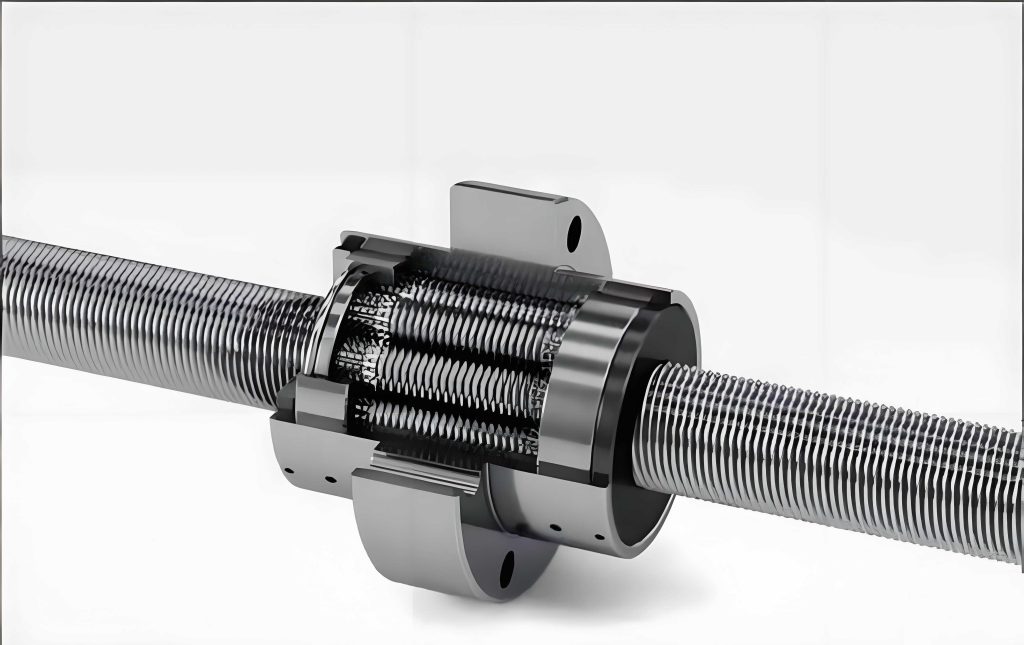
The planetary roller screw assembly and the support bearings were sized and verified using manufacturer catalogs and classical mechanical design formulas; the FEA serves as a critical verification and a tool for analyzing the more complex housing and connection stresses.
Finite Element Model Development and Analysis Setup
Geometric Modeling and Simplification
To balance computational accuracy with efficiency, the assembly was decomposed into two quarter-symmetry models, each containing the relevant critical components. Non-essential small features like fillets and chamfers were suppressed. A critical modeling decision involved the representation of threaded connections. To accurately simulate bolt load transfer, the threaded sections were modeled using an equivalent diameter $$D_{eq}$$ derived from the tensile stress area of the thread, rather than the nominal diameter. For a metric thread, this can be approximated as:
$$D_{eq} = D – 0.6495 \cdot P$$
where $$D$$ is the nominal major diameter and $$P$$ is the pitch. This approach provides a more realistic stiffness and stress distribution in the bolt shank under preload and operational load.
Material Properties
The materials for key components were selected for high strength and durability, typical for high-load actuator applications. Their properties, essential for FEA input, are summarized in Table 1.
| Component | Material / Grade | Yield Strength (MPa) | Tensile Strength (MPa) | Young’s Modulus (MPa) | Poisson’s Ratio | Density (kg/m³) |
|---|---|---|---|---|---|---|
| Fixed Plate, Bearing Housings, End Cap, Trunnion, Studs, Dowel Pins | 42CrMo | 930 | 1080 | 2.05e5 | 0.30 | 7850 |
| Cylinder Tube | 6005 Aluminum | 235 | 260 | 0.62e5 | 0.32 | 2800 |
| Push Rod Assembly | 16Mn | 345 | 630 | 2.05e5 | 0.30 | 7850 |
| All Bolts & Screws | 12.9 Grade | 1080 | 1200 | 2.05e5 | 0.30 | 7850 |
Contact Definitions, Constraints, and Load Steps
Realistic interaction between parts was modeled using surface-to-surface contact elements. A friction coefficient of 0.1 was applied to all relevant contacting surfaces, such as between flanges, plates, and housing interfaces. Symmetry boundary conditions were applied to the quarter-model cut planes. The trunnion shaft was constrained with a cylindrical support, allowing rotation but restricting radial and axial displacement, simulating a pinned connection.
The loading sequence was crucial to replicate actual assembly and operation. For the push rod model, two load steps were used: first applying the bolt preloads, then applying a quarter of the 90 kN operational load (22.5 kN). For the main frame (support structure) model, three load steps were necessary:
- Apply preload to the long support studs that clamp the cylinder assembly.
- Apply preload to the front and rear trunnion plate bolts.
- Apply the 22.5 kN operational load.
The bolt preload force $$F_{preload}$$ was calculated based on a target preload torque $$T$$ using the standard formula:
$$T = K \cdot D \cdot F_{preload}$$
where $$K$$ is the nut factor (accounting for friction) and $$D$$ is the nominal bolt diameter. The applied preload values were significant, ensuring joint integrity under separation forces.
Meshing
The geometry was discretized using a combination of tetrahedral and hexahedral 3D solid elements, with mesh refinement in areas of high stress concentration, such as around bolt holes, fillets, and contact regions. This ensured solution accuracy for stress evaluations.
Initial Design FEA Results and Discussion
The finite element analysis of the initial design under the 90 kN tensile and compressive loads provided detailed von Mises stress distributions. The key results for the critical components are consolidated in Table 2. The safety factor is calculated as the component’s yield strength divided by the maximum von Mises stress found in the model.
| Critical Component | Yield Strength (MPa) | Tensile Load Case | Compressive Load Case | ||||
|---|---|---|---|---|---|---|---|
| Max Stress (MPa) | Safety Factor | Assessment | Max Stress (MPa) | Safety Factor | Assessment | ||
| Push Rod Flange Bolts | 1080 | 594.4 | 1.82 | Safe | 580.8 | 1.86 | Safe |
| Push Rod Tube | 345 | 79.6 | 4.34 | Safe | 77.3 | 4.46 | Safe |
| Push Rod Flange | 345 | 181.3 | 1.90 | Safe | 177.0 | 1.95 | Safe |
| Rear Trunnion Bolts | 1080 | 796.0 | 1.36 | Marginal | 802.5 | 1.35 | Marginal |
| Front Trunnion Bolts | 1080 | 597.7 | 1.81 | Safe | 585.8 | 1.84 | Safe |
| Dowel Pins | 930 | 203.7 | 4.57 | Safe | 178.8 | 5.20 | Safe |
| Trunnion Plate/Ear | 930 | 550.5 | 1.69 | Marginal | 637.0 | 1.46 | Marginal |
| Cylinder Tube | 235 | 105.0 | 2.24 | Safe | 44.2 | 5.32 | Safe |
| Support Studs | 930 | 237.9 | 3.91 | Safe | 248.7 | 3.74 | Safe |
| Front End Cap | 930 | 390.4 | 2.38 | Safe | 369.5 | 2.52 | Safe |
| Rear Fixed Plate | 930 | 517.2 | 1.80 | Safe | 413.7 | 2.25 | Safe |
The analysis confirmed several findings from the classical calculation stage but also revealed critical insights. The push rod assembly and its connections showed acceptable safety margins. However, the load path through the main frame highlighted a significant issue: the connection between the trunnion plate and the primary cylinder structure (end cap and fixed plate) was highly reliant on friction and shear in the dowel pins generated by bolt preload. The results showed a pronounced imbalance:
- The rear trunnion bolts were consistently the most highly stressed components in the entire assembly, with safety factors as low as 1.35-1.36. This is considered marginal for a dynamically loaded application where preload relaxation, fatigue, and dynamic factors are concerns.
- The front bolts saw lower stress because the dowel pins shared a portion of the shear load. The trunnion plate itself also showed high stress concentrations near the bolt holes, with safety factors below 1.7.
- This uneven distribution indicated that the design was not efficiently transferring the high axial force from the planetary roller screw assembly into the mounting trunnion. The reliance on bolt-clamp friction, which can be variable and susceptible to loss under vibration or thermal cycles, presented a reliability risk.
Proposed Structural Optimization and Validation
To address the identified weakness and improve load distribution, a targeted structural modification was proposed. The core concept was to introduce a direct mechanical interference (a shear key) between the trunnion plate and the primary load-bearing housings, thereby bypassing the bolts as the primary load path for axial force and using them primarily to maintain clamp-up.
Optimization Design
The trunnion plate was redesigned with a 3 mm internal step (ledge) on its inner circumference. This ledge is designed to sit directly against machined faces on the front end cap and the rear fixed plate. When the cylinder is under tension, the ledge on the front side bears directly against the end cap. Under compression, the ledge on the rear side bears directly against the fixed plate. The bolts and dowel pins then function to pre-load and align the joint, while the axial force is carried predominantly through the shear strength of the stepped interface in direct compression.
An important detail in the design was accounting for the pre-compression of the cylinder tube from the support stud preload. To ensure the step makes contact before the operational load is applied, its axial length was reduced by the estimated elastic compression of the tube (approximately 0.2 mm), guaranteeing a positive mechanical stop.
FEA of the Optimized Design
The quarter-symmetry FEA model was updated to incorporate the new stepped geometry. Additional frictional contact pairs were defined between the new step surfaces and the corresponding faces on the end cap and fixed plate. All other parameters—material properties, mesh settings, load steps (preloads followed by operational load), and boundary conditions—remained identical to the analysis of the initial design, ensuring a direct and fair comparison.
Results of Optimized Design and Comparative Assessment
The FEA results for the optimized structure demonstrated a remarkable improvement. The maximum stresses in nearly all critical components of the support frame were significantly reduced. Table 3 provides a direct comparison between the initial and optimized designs under both tensile and compressive 90 kN loading.
| Critical Component | 90 kN Tensile Load Case | 90 kN Compressive Load Case | ||||||
|---|---|---|---|---|---|---|---|---|
| Initial Max Stress (MPa) | Optimized Max Stress (MPa) | Safety Factor (Optimized) | Stress Reduction | Initial Max Stress (MPa) | Optimized Max Stress (MPa) | Safety Factor (Optimized) | Stress Reduction | |
| Rear Trunnion Bolts | 796.0 | 441.4 | 2.45 | -44.5% | 802.5 | 546.9 | 1.97 | -31.9% |
| Front Trunnion Bolts | 597.7 | 405.9 | 2.66 | -32.1% | 585.8 | 402.0 | 2.69 | -31.4% |
| Dowel Pins | 203.7 | 92.7 | 10.03 | -54.5% | 178.8 | 81.4* | >11.4 | -54.5% |
| Trunnion Plate | 550.5 | 557.4 | 1.67 | +1.3% | 637.0 | 448.0 | 2.08 | -29.7% |
| Cylinder Tube | 105.0 | 87.6 | 2.68 | -16.6% | 44.2 | 32.2 | 7.29 | -27.1% |
| Support Studs | 237.9 | 229.3 | 4.06 | -3.6% | 248.7 | 233.3 | 3.99 | -6.2% |
| Front End Cap | 390.4 | 278.2 | 3.34 | -28.7% | 369.5 | 321.1 | 2.90 | -13.1% |
| Rear Fixed Plate | 517.2 | 375.7 | 2.48 | -27.4% | 413.7 | 293.5 | 3.17 | -29.1% |
*Note: Stress value is approximate based on reported reduction percentage.
The optimization was unequivocally successful:
- Bolt Stress Reduction: The most critical improvement was seen in the rear trunnion bolts. Their maximum stress dropped by approximately 45% in tension and 32% in compression. The safety factor increased from a marginal ~1.36 to a robust 2.45 in tension and nearly 2.0 in compression. The front bolts showed similar significant reductions.
- Improved Load Path: The introduction of the direct step interface successfully created a parallel, stiffer load path. The dowel pin stresses were halved, confirming they were relieved of a major portion of the shear load. The stresses in the end cap and fixed plate were reduced by 13-29%, indicating a more uniform pressure distribution.
- Trunnion Plate Behavior: In the tensile case, the maximum stress location shifted to the root of the new step, with a value similar to the initial design. However, this is a compressive stress concentration in a thick region, which is generally less critical than the high tensile stress in a bolt. More importantly, in the compressive case, the trunnion plate stress dropped significantly. The overall load sharing across the joint became vastly more uniform and predictable.
- Enhanced Reliability: The design no longer relies critically on maintained frictional force from bolt preload to transfer the primary axial load from the planetary roller screw actuator. The step provides a positive mechanical stop, making the force transmission inherently more robust against vibration, thermal cycling, and potential preload loss, thereby increasing the overall reliability and fatigue life of the electric cylinder.
Conclusion
This study undertook a systematic strength evaluation and structural optimization of a 90 kN electric cylinder driven by a planetary roller screw. Beginning with a force chain analysis to identify critical load-bearing components, the research employed advanced nonlinear finite element analysis to validate classical calculations and probe areas of complex stress, such as bolted joint interfaces. The initial FEA confirmed functional strength but exposed a critical vulnerability: an over-reliance on bolt preload friction in the trunnion mounting connection, leading to high, uneven stresses and marginal safety factors in key bolts.
In response, a simple yet highly effective design optimization was proposed and analyzed. By incorporating a small stepped feature on the trunnion plate to create a direct compressive load path into the main housing, the structural performance was dramatically improved. The FEA validation demonstrated substantial reductions in maximum stress—particularly in the critically loaded bolts—and a marked increase in safety factors across nearly all components. The modified design ensures a more uniform, reliable, and robust load distribution from the high-force planetary roller screw mechanism to the mounting structure. This optimization enhances the operational safety, durability, and performance confidence of the electric cylinder for demanding applications, providing a validated engineering solution that moves beyond minimal compliance to achieve a balanced and resilient design.