
As a novel precision linear actuator, the Planetary Roller Screw Mechanism (PRSM) is renowned for its superior load capacity, high positioning accuracy, and excellent resistance to shock. Its core transmission relies on the precise meshing of threads on the screw, multiple planetary rollers, and the nut. The machining quality of these threads, particularly the precision grinding of small-pitch hardened profiles, is a critical bottleneck that directly determines the overall mechanism’s performance in terms of load distribution, travel accuracy, transmission efficiency, and service life. Currently, there exists a significant performance gap between domestically produced PRSM prototypes and leading international products, largely attributed to challenges in ensuring machining and inspection accuracy. This work conducts a systematic, first-person investigation into the thread machining errors of typical PRSM products from both domestic and international manufacturers. The study encompasses precision measurement, statistical evaluation, comparative analysis, and discussion on the root causes of observed anomalies, aiming to provide foundational support for process optimization and quality enhancement in domestic PRSM manufacturing.
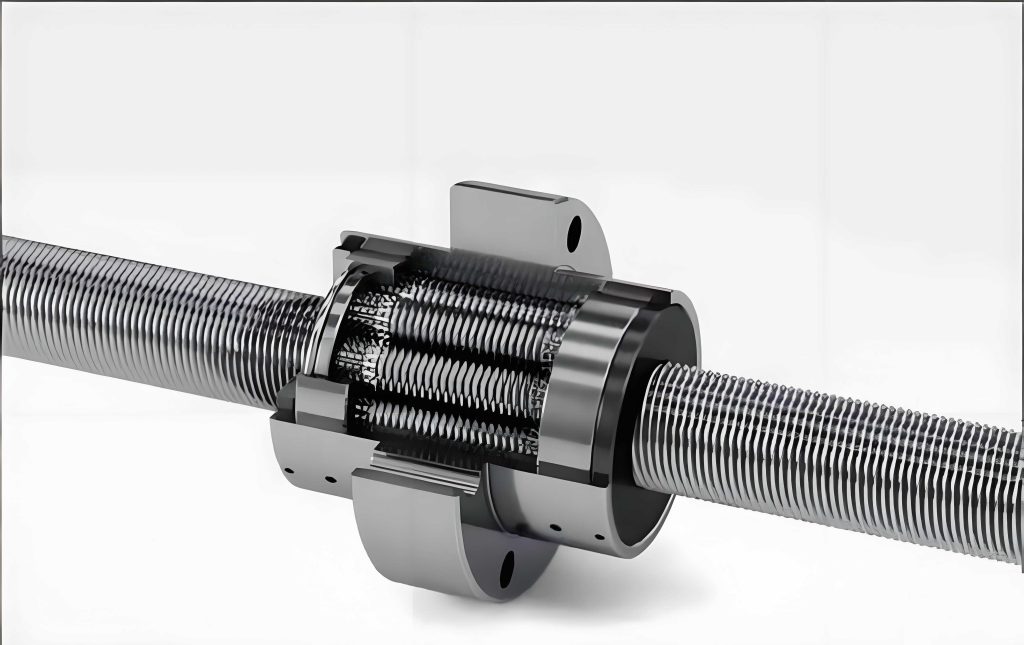
The fundamental structure of a standard planetary roller screw consists of a central screw, a set of planetary rollers (typically 6 to 12) arranged circumferentially, a nut, an internal gear ring, and a retainer. The screw and nut feature multi-start linear thread profiles, while each roller has a single-start, circular-arc thread profile. Motion is transmitted through the meshing of these threads, converting the screw’s rotation into the nut’s linear translation. The exceptional performance of the planetary roller screw makes it indispensable in advanced fields such as aerospace, defense, industrial robotics, and medical equipment. The manufacturing of these components, primarily from hardened steel like GCr15, involves complex heat treatment and precision grinding processes. Internal thread grinding, especially for the nut, presents greater difficulties due to the slender grinding quill’s susceptibility to chatter and deflection, impacting final accuracy.
Precision Measurement and Error Evaluation Methodology
Accurate assessment of thread geometry is the prerequisite for any meaningful error analysis. A high-precision coordinate measuring machine (CMM) was employed for contact-scanning of the axial thread profiles. For each component (screw, roller, nut), profiles were scanned at four angular positions (0°, 90°, 180°, 270°) relative to its datum axis, established from precision-machined reference surfaces (e.g., journal ends for the screw and roller, outer cylinder for the nut). A probe with a 0.1 mm stylus radius was used at a controlled scanning speed and high sampling density to capture detailed profile point clouds \(A_i(x_i, y_i, z_i)\).
The raw point cloud data requires preprocessing before evaluation. A gradient threshold method is first applied to segment the profile into distinct regions: crest, left flank, right flank, and root. The threshold \(S_t\) is derived from the nominal thread angle \(\alpha\):
$$S_t = \frac{\tan(90^\circ – \alpha/2)}{2}$$
The point cloud is then corrected for any skewness by aligning the flank lines. Finally, an axis-to-normal transformation is performed on the corrected axial point cloud \(A’_i(x’_i, y’_i, z’_i)\) to obtain the corresponding normal-sectional profile point cloud \(A”_i(x”_i, y”_i, z”_i)\), which is crucial as the design specifications are defined in the normal plane. The transformation for a given lead angle \(\lambda\) is:
$$
\begin{bmatrix}
x”_i \\
y”_i \\
z”_i
\end{bmatrix} =
\begin{bmatrix}
1 & 0 & 0 \\
0 & \cos \lambda & \sin \lambda \\
0 & -\sin \lambda & \cos \lambda
\end{bmatrix}
\begin{bmatrix}
x’_i \\
y’_i \\
z’_i
\end{bmatrix}
$$
For precise error quantification, the processed point cloud for each thread flank is fitted using a least-squares cubic spline. The optimal coefficients \(\theta_j\) of the polynomial \(f(x_i) = \theta_0 x_i^3 + \theta_1 x_i^2 + \theta_2 x_i + \theta_3\) are found by minimizing the sum of squared errors \(s = \sum_{i=1}^{n} |f(x_i) – y_i|^2\). This method provides high fitting accuracy, essential for subsequent error evaluation.
Key thread error parameters are evaluated based on the fitted profiles, referencing standard definitions:
- Pitch Diameter Error (\(\Delta d_{Xi}\)): The deviation of the actual pitch diameter (the diameter of an imaginary coaxial cylinder where the width of the thread groove equals the width of the thread ridge) from its nominal value. Here, \(X = S, R, N\) denotes Screw, Roller, and Nut, respectively, and \(i\) is the thread number sequence.
- Pitch Error (\(\Delta p_{Xi}\)) & Cumulative Pitch Error (\(\Delta p_{\sum Xi}\)): The deviation of the measured axial distance between corresponding points on adjacent threads from the nominal pitch. The cumulative error is the maximum deviation of the actual accumulated pitch over a specified length from its nominal value.
- Eccentricity Error (\(\epsilon_{Xi}\)): The distance between the axis of the thread form (determined from the four scanned profiles) and the component’s datum axis established from its reference surfaces.
- Thread Angle Error (\(\Delta \beta_{XL_i}, \Delta \beta_{XR_i}\)): The deviation of the left and right flank angles, measured at the pitch line, from the nominal angle (typically 45° for PRSM).
Five representative PRSM samples were analyzed, including one from the international leader GSA (A-2506) and four from different domestic manufacturers (B-1806, C-3005, D-1505, E-2005). Their key structural parameters are summarized in the table below.
| Model ID | Screw Pitch Dia. (mm) | Roller Pitch Dia. (mm) | Nut Pitch Dia. (mm) | Pitch (mm) | Number of Rollers | Number of Starts (Screw/Nut) |
|---|---|---|---|---|---|---|
| A-2506 (GSA) | 23.94 | 8.00 | 40.00 | 1.2 | 11 | 5 |
| B-1806 | 18.82 | 6.30 | 31.50 | 1.2 | 10 | 5 |
| C-3005 | 29.95 | 10.00 | 50.00 | 1.0 | 10 | 5 |
| D-1505 | 14.94 | 5.00 | 25.00 | 1.0 | 10 | 5 |
| E-2005 | 19.45 | 6.50 | 32.50 | 1.0 | 10 | 5 |
Statistical Analysis and Comparative Results of Thread Errors
The error data extracted from hundreds of scanned profiles were statistically analyzed. Kernel density estimation was used to visualize distributions, and the median value along with the interquartile range (IQR) were chosen as robust metrics to represent central tendency and dispersion, minimizing the influence of outliers.
Pitch Diameter Errors
The pitch diameter is a fundamental parameter affecting mesh fit, backlash, and load distribution in a planetary roller screw. The statistical results are summarized below.
| Component | A-2506 (GSA) | B-1806 | C-3005 | D-1505 | E-2005 |
|---|---|---|---|---|---|
| Screw | -5.6 ± 4.0 | 0.8 ± 8.5 | -1.5 ± 24.3 | -7.5 ± 15.0 | -4.5 ± 11.0 |
| Nut | -4.0 ± 5.0 | 10.5 ± 5.5 | 12.0 ± 4.0 | 21.0 ± 7.0 | 13.0 ± 6.0 |
The international sample (A-2506) exhibited the smallest error magnitude and bandwidth for both screw and nut, with distributions close to normal. Domestic screws showed error bandwidths typically 2-3 times larger. For nuts, while some domestic samples had comparable bandwidths, their median error magnitudes were significantly higher (≥10 μm vs. -4 μm for GSA), indicating a particular challenge in controlling the absolute size during internal thread grinding. Analysis of pitch diameter progression along the screw axis revealed a prevalent “taper” error in several samples, where the diameter gradually increased from the grinding start point to the end. This is primarily attributed to progressive wear of the grinding wheel during the machining process, reducing the effective depth of cut. The relationship can be conceptually described by a wear function: the actual depth of cut \(a_{p}(z)\) at axial position \(z\) is less than the nominal command \(a_{p0}\) due to wheel wear \(\delta_w(z)\): \(a_{p}(z) = a_{p0} – \delta_w(z)\). This directly translates into an increasing pitch diameter \(d(z)\) along \(z\).
Pitch and Cumulative Pitch Errors
Pitch errors directly influence the kinematic accuracy and smoothness of motion in the planetary roller screw. The findings are presented in the following table.
| Component | A-2506 (GSA) | B-1806 | C-3005 | D-1505 | E-2005 |
|---|---|---|---|---|---|
| Screw Pitch Error | ~0 ± 2.0 | ~0 ± 2.2 | ~0 ± 11.0 | -0.5 ± 4.5 | ~0 ± 5.0 |
| Nut Pitch Error | 1.2 ± 2.1 | 0.5 ± 4.0 | -0.2 ± 4.0 | 0.2 ± 3.5 | -0.5 ± 4.0 |
| Cumulative Error (Screw) | 3.4 μm | 2.9 μm | 10.8 μm | 6.5 μm | 5.8 μm |
| Cumulative Error (Nut) | 1.0 μm | 3.3 μm | 4.0 μm | 9.0 μm | 4.5 μm |
A significant observation was the periodic fluctuation of pitch in multi-start threads. The pitch error often exhibited a pattern repeating every \(N\) threads, where \(N\) is the number of starts. This is a clear indicator of indexing error during the grinding process. If the rotary indexing between machining successive thread starts has an error \(\Delta \phi\), it causes a phase shift in the helical path, manifesting as a periodic axial displacement error \(\Delta z_{index}\) in the pitch sequence: \(\Delta z_{index} = \frac{P \cdot \Delta \phi}{2\pi}\), where \(P\) is the lead. This error source was markedly smaller in the international sample. The cumulative pitch error over the effective thread length was also significantly lower for the GSA component.
Eccentricity Errors
Eccentricity, or the misalignment between the thread axis and the component’s datum axis, is a critical source of vibration, uneven load distribution, and reduced travel accuracy in a planetary roller screw. The results are compelling.
| Component | A-2506 (GSA) | B-1806 | C-3005 | D-1505 | E-2005 |
|---|---|---|---|---|---|
| Screw | 0.8 ± 1.5 | 2.2 ± 5.0 | 3.5 ± 10.0 | 14.6 ± 12.0 | 4.5 ± 8.0 |
| Nut | 5.5 ± 2.4 | 2.0 ± 3.0 | 2.5 ± 2.5 | 21.0 ± 15.0 | 2.8 ± 3.0 |
The international screw showed exceptional concentricity. Domestic samples displayed notably larger eccentricity magnitudes and variability. For nuts, the challenge of internal grinding is again evident, with one domestic sample (D-1505) showing extreme values. Potential root causes include inaccuracies in the workpiece’s center holes (for screws/rollers), misalignment of machine tool centers, insufficient rigidity or chatter of the long grinding quill during internal thread machining, and excessive radial grinding force causing workpiece deflection. The eccentricity error \(\epsilon\) directly introduces a first-order harmonic component into the mechanism’s travel error.
Thread Angle Errors
Deviations from the nominal 45° thread angle affect contact stress distribution and can lead to asymmetric performance during reversal in a planetary roller screw.
| Component | A-2506 (GSA) | B-1806 | C-3005 | D-1505 | E-2005 |
|---|---|---|---|---|---|
| Screw | ~0 ± 0.4 | 0.1 ± 0.6 | -0.1 ± 0.5 | 0.2 ± 0.5 | 0.1 ± 0.9 |
| Nut | 0.1 ± 0.3 | 0.05 ± 0.6 | -0.1 ± 0.7 | -0.3 ± 1.1 | 0.2 ± 0.6 |
The GSA sample maintained angle errors very close to zero with a tight distribution. Domestic samples had comparable median errors but with broader dispersion, indicating less consistent flank grinding. A systematic bias was often observed where the left flank angle consistently differed from the right flank angle within the same component. This asymmetry stems from differing grinding conditions (e.g., force, wheel contact geometry) on the two flanks during the single-point grinding process. The roller threads, due to their small size and convex circular-arc profile, generally exhibited the largest angle errors among all components.
Discussion on Anomalies and Process Optimization Strategies
The comparative analysis clearly delineates the performance gap. The international planetary roller screw sample demonstrated superior control across all error types, with smaller magnitudes, tighter distributions (lower variability), and error patterns closer to ideal random distributions. Domestic samples showed larger systematic errors (e.g., nut pitch diameter, eccentricity), greater variability, and distinct non-random error patterns like significant taper and periodic pitch fluctuation.
These anomalies point directly to specific weaknesses in the manufacturing process chain:
- Grinding Wheel Wear Management: The observed pitch diameter taper is a direct consequence of uncontrolled wheel wear. Strategy: Employ more wear-resistant wheel materials, implement more frequent and precise dressing cycles, use multi-rib wheels for multi-start threads to distribute wear, and finish with a spark-out pass (zero infeed).
- Machine Tool Geometric and Dynamic Accuracy: The periodic pitch error signals indexing inaccuracy. The large cumulative pitch and eccentricity errors suggest issues with lead screw accuracy, axis straightness, and spindle alignment. Strategy: Regular calibration and maintenance of machine tool geometry, feedback systems (encoders, scales), and the indexing mechanism.
- Workpiece Fixturing and Rigidity: High eccentricity, especially for rollers and long screws, often originates from poor center hole quality, misaligned machine centers, or excessive grinding force causing deflection. Strategy: Use precision center hole grinding, verify and align machine centers, employ steady rests for long components, and optimize grinding parameters to reduce radial forces.
- Internal Thread Grinding Challenges: The generally worse performance of nuts highlights the difficulty of internal grinding. Strategy: Use high-stiffness, damped grinding quills made from advanced materials (e.g., carbide), optimize quill overhang, and carefully select stable grinding parameters to avoid chatter.
- Grinding Wheel Profile and Dressing: Thread angle errors and asymmetries are tied to the accuracy and maintenance of the wheel’s profile. Strategy: Utilize precise diamond roll dressing, ensure accurate wheel profile generation based on thread geometry, and monitor wheel condition through in-process or post-process gauging for corrective dressing.
The relationship between key grinding parameters and resulting errors can be framed for optimization. For instance, to minimize taper, one must control the volumetric wear rate of the wheel, which is influenced by the specific grinding energy \(e_c\) and material removal rate \(Q_w\). A simplified model for wear volume \(V_w\) over time \(t\) is \(V_w \propto e_c \cdot Q_w \cdot t\). Reducing the infeed rate \(f_r\) (lowering \(Q_w\)) and optimizing wheel speed \(v_s\) and workpiece speed \(v_w\) can mitigate this.
Conclusion
This first-person investigation provides a comprehensive, data-driven comparison of thread machining errors in planetary roller screw mechanisms. The empirical evidence confirms a significant disparity in manufacturing precision between the leading international product and current domestic prototypes. The gap is most pronounced in controlling pitch diameter (especially for nuts), eccentricity, and cumulative pitch errors, while trends like pitch periodic error and thread angle asymmetry reveal specific process deficiencies. The analysis links common anomalies such as diameter taper and periodic pitch variation directly to root causes like grinding wheel wear, machine tool indexing error, and fixturing issues. Based on these findings, targeted process optimization strategies are proposed, focusing on wheel management, machine tool accuracy, workpiece rigidity, and internal grinding techniques. Implementing these strategies is essential for advancing the precision grinding capability for planetary roller screw threads, which is a critical step towards achieving the performance and reliability required for high-end applications and enabling domestic substitution in advanced mechanical systems.