
Planetary roller screw mechanisms (PRSMs) represent a pivotal advancement in precision linear actuation technology, offering superior load capacity, high rigidity, and extended operational life compared to conventional ball screws. These attributes stem from their multi-point contact rolling engagement and efficient force transmission through multiple threaded rollers. Consequently, PRSMs have become indispensable in demanding applications such as aerospace flight control systems, robotic actuators, and high-performance machine tools. The dynamic performance of a PRSM, particularly its vibration characteristics under operational loads, is a critical determinant of system precision, reliability, and noise emission. Therefore, developing a comprehensive dynamic model that accurately captures the intricate mechanical interactions within a PRSM is fundamental for performance prediction, design optimization, and proactive health management.
Our study focuses on addressing a significant gap in existing PRSM dynamic analyses: the insufficient consideration of the time-varying nature of meshing stiffness in both the gear and thread pairs, coupled with key nonlinear factors like clearance and friction. We propose a novel “torsional-translational-axial” lumped parameter dynamic modeling approach. This model explicitly incorporates time-varying meshing stiffness, nonlinear backlash, and friction damping to provide a more realistic simulation of the mechanism’s vibrational behavior. The modeling framework is established using the lumped mass method, and the system of differential equations is derived rigorously using d’Alembert’s principle. A critical component of our work is the detailed extraction of stiffness parameters: the time-varying meshing stiffness for the gear pair is derived using the potential energy method applied to a cantilever beam model of the unique threaded-gear tooth profile, while the axial thread pair stiffness is synthesized using the direct stiffness method combined with Hertzian contact theory. The complete dynamic model is solved numerically using the Runge-Kutta method. Its accuracy is validated by comparing its kinematic transmission ratio with established rigid-body models and by correlating predicted vibration frequencies with theoretical mesh frequencies. Furthermore, we analyze the influence of thread clearance on the axial vibration characteristics of the nut. The developed model provides a powerful and efficient tool for investigating the dynamic signature of PRSMs, laying a vital theoretical foundation for future research into fault feature analysis and intelligent diagnostic strategies.
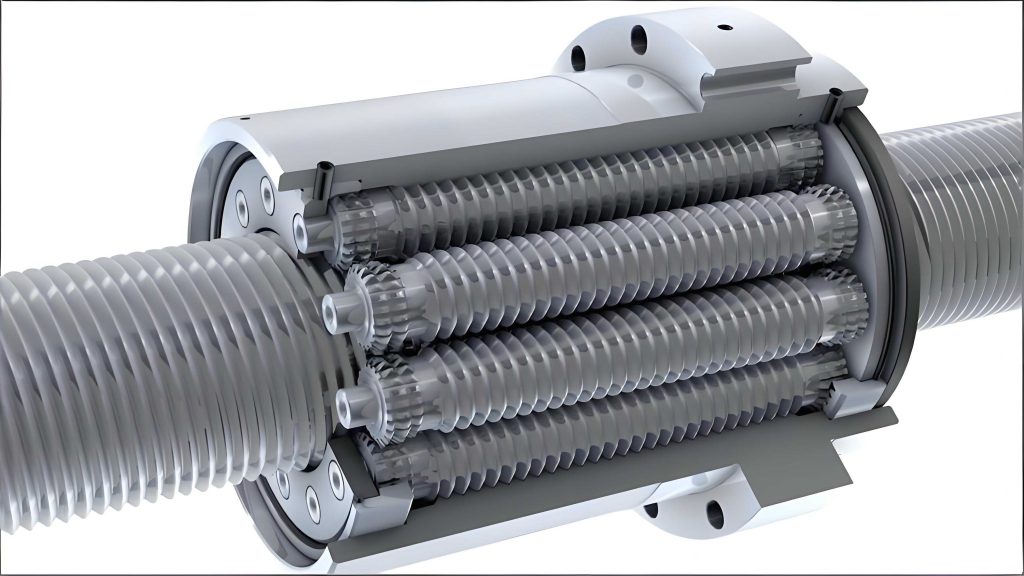
1. Lumped Parameter Dynamic Modeling of the Planetary Roller Screw
The core of a standard planetary roller screw consists of a central screw, a set of threaded rollers distributed around it, a nut with internal threads and gear teeth (often an integrated ring gear), and a carrier that maintains the angular position of the rollers. The screw rotates but is constrained axially. This rotation, via the thread helices, drives the rollers to rotate about their own axes and revolve around the screw axis, while simultaneously causing the nut to translate axially without rotation. The gear engagement between the ends of the rollers and the nut’s internal ring gear ensures proper kinematic synchronization, preventing roller skew and maintaining alignment.
1.1 Model Framework and Assumptions
To construct the dynamic model, we treat each major component—screw, nut, carrier, and each individual roller—as a lumped mass with multiple degrees of freedom (DOF). Each component is assigned three translational DOFs (\(x, y, z\)) and one torsional DOF (\(\theta\)) about its axis, except where constrained. The interactions between components are modeled using spring-damper elements representing supporting stiffness/damping and meshing stiffness/damping. The model explicitly includes:
- Supporting stiffness (\(K_{sj}, K_{Nj}, K_{pj}, K_{cp}\)) and damping (\(C_{sj}, C_{Nj}, C_{pj}, C_{cp}\)) at bearings and joints.
- Time-varying meshing stiffness \(\widetilde{K}_m(t)\) for the roller-ring gear pair.
- Axial meshing stiffness for the screw-roller (\(K_{sca}\)) and roller-nut (\(K_{Nca}\)) thread contacts.
- Nonlinear forces accounting for thread friction and backlash in all engagements.
The following assumptions are made to render the model tractable while preserving essential physics:
- All forces are decomposed and analyzed in the radial, circumferential (tangential), and axial directions.
- All rollers are identical in geometry and material properties and are symmetrically spaced.
- The nut and ring gear are considered a single rigid body.
- The carrier is modeled as a rigid structure supporting the rollers.
1.2 Analysis of Nonlinear Excitation and Relative Displacements
The dynamic excitation within the planetary roller screw arises primarily from the periodically varying meshing forces in the gear and thread pairs. These forces are modulated by the changing line of action, time-varying stiffness, and nonlinearities like clearance and friction.
1.2.1 Meshing Line Orientation
As the carrier rotates, the angular position of each roller \(i\) changes, altering the direction of meshing forces in the global coordinate system. The phase angle for roller \(i\) is:
$$\phi_i = \frac{2\pi}{n_r}(i-1) + \theta_p$$
where \(n_r\) is the number of rollers and \(\theta_p\) is the carrier rotation. The angles of the meshing lines relative to the x-axis are:
$$\gamma_{si} = \Psi_{Nti} = \frac{\pi}{2} + \phi_i$$
for the screw-roller and roller-nut thread engagements, and
$$\Psi_{Ngi} = \frac{11}{18}\pi + \phi_i$$
for the roller-ring gear engagement, where \(\alpha_0\) is the gear pressure angle. This angular variation directly affects the projection of meshing forces onto the x and y coordinates.
1.2.2 Meshing Forces and Relative Displacements
The meshing forces are modeled as spring-damper systems with nonlinear displacement functions \(f(\delta, b)\) that account for backlash \(b\).
Screw-Roller Thread Pair: The force is decomposed into axial (\(F_{sa}\)), tangential (\(F_{sd}\)), and radial (\(F_{sr}\)) components. The axial force is:
$$F_{sai} = K_{sca} \cdot f(\delta_{saci}, b_s) + C_{sca} \cdot \dot{\delta}_{saci}$$
The tangential force includes both the normal contact force \(F_{Rsi}\) and the Coulomb friction force \(f_{Rsi}\):
$$F_{sdi} = f_{Rsi} \cdot \cos(\lambda_s) + F_{Rsi} \cdot \cos(\beta/2) \cdot \sin(\lambda_s)$$
where \(\lambda_s\) is the thread lead angle and \(\beta\) is the thread profile angle. The radial component is:
$$F_{sri} = F_{sai} \cdot \tan(\beta/2)$$
The normal contact force relates to the axial force as:
$$F_{Rsi} = \frac{F_{sai}}{\cos(\beta/2) \cdot \cos(\lambda_s)}$$
Roller-Nut Thread Pair: Friction in this interface is neglected as it is primarily a rolling contact. The forces are:
$$F_{Nai} = K_{Nca} \cdot f(\delta_{Naci}, b_N) + C_{Nca} \cdot \dot{\delta}_{Naci}$$
$$F_{Ndi} = F_{Nai} \cdot \tan(\lambda_N)$$
$$F_{Nri} = F_{Nai} \cdot \tan(\beta/2)$$
Gear Pair: The force between the roller-end gear and the ring gear is:
$$F_{Nci} = \widetilde{K}_m(t) \cdot f(\delta_{Nci}, b_g) + C_m \cdot \dot{\delta}_{Nci}$$
The relative displacements at the meshing points are crucial. They are functions of the components’ linear and angular displacements and the lead \(L_p\) of the thread:
$$\delta_{saci} = \frac{\theta_s}{2\pi} L_p – z_{ci}$$
$$\delta_{Naci} = z_{ci} – z_N$$
$$\delta_{Nci} = (x_N – x_{ci})\cos\Psi_{Ngi} – (y_N – y_{ci})\sin\Psi_{Ngi} + r_{Nb}\theta_N – r_{cb}\theta_{ci} – r_{pb}\theta_p\cos\alpha_0$$
The nonlinear displacement function \(f(\delta, b)\) for a backlash \(2b\) is defined as:
$$
f(\delta, b) =
\begin{cases}
\delta – b, & \delta > b \\
0, & |\delta| \le b \\
\delta + b, & \delta < -b
\end{cases}
$$
1.3 System of Differential Equations
Applying d’Alembert’s principle to each component’s free-body diagram yields the complete system of equations of motion. The equations for the nut, screw, carrier, and each roller \(i\) are given below. The summations run over all \(n_r\) rollers. Damping terms are proportional to relative velocities.
Nut-Ring Gear:
$$
\begin{aligned}
m_N \ddot{x}_N + C_N \dot{x}_N &+ C_{pN}(\dot{x}_N-\dot{x}_p) + K_N x_N + K_{pN}(x_N – x_p) = \sum_{i=1}^{n_r} \left[ F_{Nri}\cos\phi_i – F_{Nci}\cos\Psi_{Ngi} + F_{Ndi}\cos\Psi_{Nti} \right] \\
m_N \ddot{y}_N + C_N \dot{y}_N &+ C_{pN}(\dot{y}_N-\dot{y}_p) + K_N y_N + K_{pN}(y_N – y_p) = \sum_{i=1}^{n_r} \left[ F_{Nri}\sin\phi_i – F_{Nci}\sin\Psi_{Ngi} – F_{Ndi}\sin\Psi_{Nti} \right] \\
J_N \ddot{\theta}_N + C_{Nd} \dot{\theta}_N &+ C_{pNd} r_p (\dot{\theta}_N – \dot{\theta}_p) + K_{Nd} \theta_N = -r_{Nb}\sum_{i=1}^{n_r} F_{Nci} + r_N \sum_{i=1}^{n_r} F_{Ndi} \\
m_N \ddot{z}_N &+ C_{Na} \dot{z}_N = F_a + \sum_{i=1}^{n_r} F_{Nai}
\end{aligned}
$$
Screw:
$$
\begin{aligned}
m_s \ddot{x}_s + C_s \dot{x}_s + K_s x_s &= -\sum_{i=1}^{n_r} \left[ F_{sdi}\cos\gamma_{si} + F_{sri}\cos\phi_i \right] \\
m_s \ddot{y}_s + C_s \dot{y}_s + K_s y_s &= -\sum_{i=1}^{n_r} \left[ F_{sdi}\sin\gamma_{si} + F_{sri}\sin\phi_i \right] \\
J_s \ddot{\theta}_s + C_{sd} \dot{\theta}_s &= T_s – r_s \sum_{i=1}^{n_r} F_{sdi}
\end{aligned}
$$
Carrier:
$$
\begin{aligned}
m_p \ddot{x}_p &+ C_{pN}(\dot{x}_p – \dot{x}_N) + \sum_{i=1}^{n_r} C_{cp}\left[ \dot{x}_p – r_{pb}\sin\phi_i \dot{\phi}_i – \dot{x}_{ci} \right] + K_{pN}(x_p – x_N) \\
&+ \sum_{i=1}^{n_r} K_{cp}\left[ x_p + r_{pb}\cos\phi_i – x_{ci} \right] = 0 \\
m_p \ddot{y}_p &+ C_{pN}(\dot{y}_p – \dot{y}_N) + \sum_{i=1}^{n_r} C_{cp}\left[ \dot{y}_p + r_{pb}\cos\phi_i \dot{\phi}_i – \dot{y}_{ci} \right] + K_{pN}(y_p – y_N) \\
&+ \sum_{i=1}^{n_r} K_{cp}\left[ y_p + r_{pb}\sin\phi_i – y_{ci} \right] = 0 \\
J_p \ddot{\theta}_p &+ C_{pNd} r_p (\dot{\theta}_p – \dot{\theta}_N) – r_{pb} \sum_{i=1}^{n_r} K_{cp}\left[ x_p + r_{pb}\cos\phi_i – x_{ci} \right]\sin\phi_i \\
&+ r_{pb} \sum_{i=1}^{n_r} K_{cp}\left[ y_p + r_{pb}\sin\phi_i – y_{ci} \right]\cos\phi_i = 0
\end{aligned}
$$
Roller i (i=1,…, n_r):
$$
\begin{aligned}
m_c \ddot{x}_{ci} &+ C_{cp}\left[ \dot{x}_{ci} – \dot{x}_p + r_{pb}\sin\phi_i \dot{\phi}_i \right] + K_{cp}\left[ x_{ci} – x_p – r_{pb}\cos\phi_i \right] = \\
&F_{Nci}\cos\Psi_{Ngi} + F_{sdi}\cos\gamma_{si} + F_{sri}\cos\phi_i – F_{Nri}\cos\phi_i – F_{Ndi}\cos\Psi_{Nti} + m_c \omega_p^2 r_{pb} \cos\phi_i \\
m_c \ddot{y}_{ci} &+ C_{cp}\left[ \dot{y}_{ci} – \dot{y}_p – r_{pb}\cos\phi_i \dot{\phi}_i \right] + K_{cp}\left[ y_{ci} – y_p – r_{pb}\sin\phi_i \right] = \\
&F_{Nci}\sin\Psi_{Ngi} + F_{sdi}\sin\gamma_{si} + F_{sri}\sin\phi_i – F_{Nri}\sin\phi_i + F_{Ndi}\sin\Psi_{Nti} + m_c \omega_p^2 r_{pb} \sin\phi_i \\
J_c \ddot{\theta}_{ci} &= r_{cb} F_{Nci} – r_c (F_{sdi} + F_{Ndi}) \\
m_c \ddot{z}_{ci} &= F_{sai} – F_{Nai}
\end{aligned}
$$
where the term \(m_c \omega_p^2 r_{pb}\) represents the centrifugal force on the roller due to its revolution around the screw axis.
2. Extraction of Time-Varying Meshing Stiffness
The dynamic response of the planetary roller screw is profoundly influenced by the periodic fluctuation in the stiffness of its gear and thread meshes. Accurately modeling this time-varying stiffness is therefore paramount.
2.1 Gear Pair Time-Varying Meshing Stiffness Model
The gear pair between the roller ends and the ring gear is an internal spur gear mesh. Its stiffness varies periodically as the contact moves along the tooth profile and as pairs of teeth enter and leave engagement. The total mesh stiffness \(\widetilde{K}_m(t)\) for a single tooth pair is the series combination of the Hertzian contact stiffness \(k_h\), the bending stiffness \(k_b\), shear stiffness \(k_s\), and axial compressive stiffness \(k_a\) of both the pinion (roller gear) and the gear (ring gear), along with the fillet foundation stiffness \(k_f\).
$$
\widetilde{K}_m^{single}(t) = \frac{1}{\frac{1}{k_h} + \frac{1}{k_{bp}} + \frac{1}{k_{sp}} + \frac{1}{k_{ap}} + \frac{1}{k_{fp}} + \frac{1}{k_{bg}} + \frac{1}{k_{sg}} + \frac{1}{k_{ag}} + \frac{1}{k_{fg}}}
$$
The stiffnesses \(k_b, k_s, k_a\) for a tooth are calculated using the potential energy method, modeling the tooth as a non-uniform cantilever beam rooted at the fillet circle. The relevant integrals are:
$$
\frac{1}{k_b} = \int_{x_A}^{x_m} \frac{[x_m – x \cos\alpha_m – y_m \sin\alpha_m]^2}{E I_x} dx, \quad \frac{1}{k_s} = \int_{x_A}^{x_m} \frac{1.2 \cos^2\alpha_m}{G A_x} dx, \quad \frac{1}{k_a} = \int_{x_A}^{x_m} \frac{\sin^2\alpha_m}{E A_x} dx
$$
where \(E\) and \(G\) are Young’s and shear moduli, \(A_x\) and \(I_x\) are the area and moment of inertia of the tooth cross-section at distance \(x\), and \(\alpha_m\) is the pressure angle at the meshing point.
A unique feature of the planetary roller screw roller gear is its threaded-tooth design, where the effective face width \(L_a(x)\) varies linearly along the tooth height from the tip (\(x_A\)) to a point near the root (\(x_B\)):
$$
L_a(x) = \frac{L}{x_A – x_B} (x – x_B), \quad x \in [x_A, x_B]
$$
This results in a more pronounced decrease in stiffness as the contact point moves toward the tooth root compared to a standard gear. The stiffness contributions are calculated by incorporating this variable width into the expressions for \(A_x\) and \(I_x\). The overall time-varying mesh stiffness is obtained by superimposing the stiffness of all tooth pairs in contact according to the gear contact ratio. For the multi-roller system, the mesh stiffness for each roller pair is phase-shifted by \(\Delta\phi_c = 2\pi/n_r\). The following table summarizes the key parameters and stiffness components for the gear pair model.
| Parameter / Component | Symbol | Description / Calculation Basis |
|---|---|---|
| Hertzian Contact Stiffness | \(k_h\) | Derived from Hertz contact theory for cylinders. |
| Bending Stiffness | \(k_b\) | Potential energy method, variable cross-section cantilever beam. |
| Shear Stiffness | \(k_s\) | Potential energy method, variable cross-section. |
| Axial Compression Stiffness | \(k_a\) | Potential energy method, variable cross-section. |
| Fillet Foundation Stiffness | \(k_f\) | Modeled as stiffness of a supporting structure at the tooth root. |
| Effective Face Width | \(L_a(x)\) | Varies linearly from tip to a point on the flank: \(L_a(x) = \frac{L}{x_A – x_B} (x – x_B)\). |
| Contact Ratio | \(\varepsilon\) | Determines the number of tooth pairs in contact (1 or 2). |
| Phase Shift between Rollers | \(\Delta\phi_c\) | \(\Delta\phi_c = 2\pi / n_r\), causes staggered meshing. |
2.2 Thread Pair Axial Meshing Stiffness Model
The axial stiffness of a planetary roller screw thread pair is a critical parameter governing its load distribution and axial deformation. The stiffness of a single engaged thread turn is modeled as a series combination of: 1) the Hertzian contact stiffness between the roller and screw/nut threads (\(K_c\)), 2) the bending and shear stiffness of the screw, nut, and roller thread teeth themselves (\(K_{tooth}\)), and 3) the tensile/compressive stiffness of the screw, nut, and roller shaft sections (\(K_b\)).
$$
\frac{1}{K_{pair}} = \frac{1}{K_{c}} + \frac{1}{K_{tooth,s}} + \frac{1}{K_{tooth,r}} + \frac{1}{K_{tooth,N}} + \frac{1}{K_{b,s}} + \frac{1}{K_{b,r}} + \frac{1}{K_{b,N}}
$$
The Hertzian contact deformation \(\delta\) for the thread profiles is calculated based on the normal load \(F_n\), the principal curvatures, and material properties:
$$
\delta = \delta^* \left[ \frac{3F_n}{2\sum\rho} \left( \frac{1-\nu_c^2}{E_c} + \frac{1-\nu_R^2}{E_R} \right) \right]^{2/3} \sqrt{\frac{\sum\rho}{2}}
$$
The axial component of this deformation gives the contact stiffness. The thread tooth stiffness is derived by modeling the thread tooth as a radially loaded, tapered annular plate. The shaft stiffness is given by the elementary formula \(K_b = EA / L\). The overall axial stiffness for the entire planetary roller screw mechanism is a parallel-series combination: the stiffness from all \(n_r\) rollers add in parallel, and for each roller, the stiffnesses of the \(n\) engaged thread turns add in series.
$$
K_{sca} = \left( \sum_{j=1}^{n} \frac{1}{K_{pair,s}^{(j)}} \right)^{-1} \times n_r, \quad \text{and similarly for } K_{Nca}
$$
3. Model Validation and Vibration Characteristic Analysis
The proposed dynamic model for the planetary roller screw was implemented and solved numerically in a computational environment using a Runge-Kutta (ode4) integration scheme. Key parameters used for simulation are listed below.
| Component / Parameter | Symbol | Value | Unit |
|---|---|---|---|
| Screw Pitch Circle Radius | \(r_s\) | 9.75 | mm |
| Roller Pitch Circle Radius | \(r_c\) | 3.25 | mm |
| Nut/Ring Gear Pitch Circle Radius | \(r_N\) | 16.25 | mm |
| Thread Profile Angle | \(\beta\) | 90 | ° |
| Number of Rollers | \(n_r\) | 7 | – |
| Number of Thread Starts | \(n\) | 5 | – |
| Pitch | \(p\) | 2 | mm |
| Viscous Friction Coefficient (Screw-Roller) | \(\mu_{sc}\) | 25 | N·s/m |
| Screw Mass / Moment of Inertia | \(m_s\) / \(J_s\) | – / 58 | kg / kg·mm² |
| Nut Mass / Moment of Inertia | \(m_N\) / \(J_N\) | 20 / – | kg / kg·mm² |
| Roller Mass / Moment of Inertia | \(m_c\) / \(J_c\) | 0.014 / 0.077 | kg / kg·mm² |
| Carrier Mass / Moment of Inertia | \(m_p\) / \(J_p\) | 0.016 / 2.95 | kg / kg·mm² |
3.1 Kinematic Validation
To validate the basic kinematic correctness of our model, we simulated the transient and steady-state response under a constant screw input speed \(\dot{\theta}_s = 1 \text{ rad/s}\) and a nut axial load \(F_a = 100 \text{ N}\). The output was characterized by the speed ratio between the carrier and the screw, \(\dot{\theta}_p / \dot{\theta}_s\). The results showed close agreement with the response from a established rigid-body dynamic model from literature. The response settled to a steady state after approximately 0.05 ms, with the steady-state ratio fluctuating around a mean value of 0.37, confirming the model’s fidelity in capturing the fundamental motion transmission of the planetary roller screw.
3.2 Vibration Frequency Characteristics
To investigate dynamic characteristics, we set the screw input speed to \(\dot{\theta}_s = 100 \text{ rad/s}\) (\( \approx 955 \text{ rpm}\)). The simulated axial and circumferential vibration accelerations of the nut were analyzed. The Fast Fourier Transform (FFT) of the steady-state circumferential vibration signal revealed a dominant frequency component at \(f_{Nd} = 377 \text{ Hz}\). This frequency corresponds precisely to the theoretical gear meshing frequency of the mechanism. The carrier rotational frequency \(f_p\) derived from the screw speed and the steady-state speed ratio is approximately 5.8 Hz. With the ring gear tooth number \(z_2 = 65\), the meshing frequency is:
$$
f_m = f_p \times z_2 = 5.8 \times 65 \approx 377 \text{ Hz}
$$
This match validates the model’s ability to accurately capture the dynamic excitations arising from the periodic gear meshing action within the planetary roller screw. The circumferential vibration exhibited a much stronger response at this meshing frequency compared to the axial vibration, indicating that the gear pair dynamics dominate the nut’s rotational vibration.
3.3 Influence of Thread Clearance on Vibration
Thread clearance is a critical parameter that degrades with wear and directly impacts dynamic performance. We analyzed the nut’s axial vibration response for three different uniform thread clearance values (\(b_s = b_N = 10, 20, 30 \mu m\)). The results are summarized in the table below.
| Clearance (µm) | Acceleration Amplitude Range (mm/s²) | Dominant Vibration Frequency (Hz) | Trend |
|---|---|---|---|
| 10 | -830 to 1100 | 590 | Baseline |
| 20 | -710 to 1200 | 538 | Increased amplitude, decreased frequency |
| 30 | -610 to 1280 | 507 | Further increased amplitude, further decreased frequency |
The analysis clearly demonstrates that increasing thread clearance leads to two primary effects: 1) an increase in the peak-to-peak amplitude of the axial vibration acceleration, and 2) a decrease in the dominant axial vibration frequency. This frequency shift is a significant dynamic signature of deteriorating meshing conditions. To further corroborate the model’s prediction, a finite element analysis (FEA) simulation of the planetary roller screw with a 30 µm clearance was conducted. The FEA predicted a dominant axial vibration frequency of 488 Hz, which is within 5% of our model’s prediction of 507 Hz. This close agreement provides strong validation for the model’s accuracy in predicting dynamic behavior influenced by clearance.
4. Conclusion
In this study, we have developed and validated a comprehensive nonlinear dynamic model for the planetary roller screw mechanism that explicitly incorporates the time-varying meshing stiffness of both gear and thread pairs, along with essential nonlinearities such as backlash and friction. The “torsional-translational-axial” lumped parameter model, derived using d’Alembert’s principle, successfully captures the complex multi-body interactions within the mechanism.
The key contributions and findings are as follows:
- Model Accuracy and Validation: The proposed model accurately reproduces the kinematic transmission ratio of the PRSM, matching established rigid-body model results. More importantly, it correctly predicts the dominant vibration frequency, which aligns with the theoretical gear meshing frequency, thereby validating its dynamic fidelity.
- Dynamic Signature Analysis: The model effectively reveals that the gear meshing action is the primary source of excitation for the nut’s circumferential vibration. It provides a detailed account of displacement, velocity, and acceleration across all degrees of freedom, offering a rich dataset for dynamic analysis.
- Impact of Thread Clearance: The analysis quantitatively demonstrates that increased thread clearance, a common result of wear, leads to increased vibration amplitude and a measurable decrease in the system’s characteristic vibration frequency. This provides a potential diagnostic indicator for health monitoring.
- Stiffness Modeling: The detailed methodologies for extracting the time-varying gear mesh stiffness (using the potential energy method with a variable-width tooth model) and the thread pair axial stiffness (using a combined direct stiffness and Hertzian contact approach) are critical components that enhance the model’s physical realism.
The developed model serves as a powerful and efficient theoretical tool for investigating the dynamic behavior of planetary roller screw mechanisms under various operating conditions and health states. It lays a solid foundation for future work focused on fault simulation, feature extraction, and the development of model-based diagnostic algorithms for intelligent health management of these high-precision actuation systems.