
In this study, we investigate the rolling-sliding mechanism of the planetary roller screw (PRS), a critical component in precision mechanical systems. The planetary roller screw is widely used in applications such as aerospace, medical devices, and industrial machinery due to its high load capacity, compact design, and precise motion control. However, the presence of sliding in the planetary roller screw can lead to increased friction, heat generation, and reduced efficiency. Understanding these characteristics is essential for optimizing the design and performance of the planetary roller screw. Here, we develop analytical models to analyze the rolling-sliding behavior, considering elastic deformation, and explore the influence of key structural parameters. Our goal is to provide insights that can guide the development of more efficient and reliable planetary roller screw systems.
The planetary roller screw operates by converting rotational motion into linear motion through the planetary movement of rollers between the screw and nut. This mechanism involves complex contact dynamics, where rolling and sliding coexist. The sliding components, particularly due to the constrained rotation axes of the rollers, can exacerbate wear and tear. To address this, we employ an equivalent ball method to simplify the analysis of the planetary roller screw, accounting for the spherical thread profile of the rollers. We establish two models: one without elastic deformation and another with elastic deformation, to calculate relative sliding velocities at contact points. By evaluating the slide-roll ratio, we quantify the relative amounts of sliding and rolling, enabling a deeper understanding of the planetary roller screw’s behavior under various conditions.
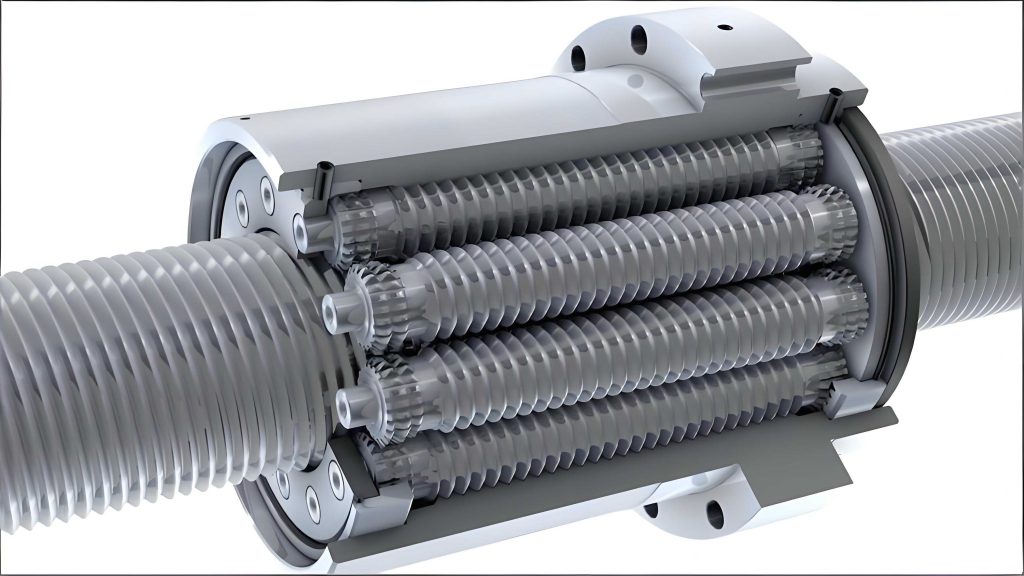
Our analysis begins with defining coordinate systems to describe the motion of the planetary roller screw. We use a fixed Cartesian coordinate system \( o-x’y’z’ \), a rotating coordinate system \( o-xyz \) attached to the screw, and a Frenet coordinate system at the roller’s equivalent ball center. The position vectors for contact points are derived to compute velocities. For the planetary roller screw, the equivalent ball radius \( R \) is given by:
$$ R = \frac{d_r}{2\sin\beta} $$
where \( d_r \) is the roller pitch diameter and \( \beta \) is the contact angle. The position vector of the roller center relative to the rotating coordinate system is:
$$ \mathbf{R}_{oo’} = r_m (\cos\theta \mathbf{i} + \sin\theta \mathbf{j} + \theta \tan\lambda \mathbf{k}) $$
Here, \( r_m \) is the projection length, \( \theta \) is the rotation angle, and \( \lambda \) is the helix angle. Using coordinate transformations, we express these in the Frenet frame to facilitate velocity calculations. The sliding velocities at contact points A (nut side) and B (screw side) are derived from the relative motion between components. Without elastic deformation, the sliding velocity on the nut side is:
$$ \mathbf{V}_{s,A} = \begin{bmatrix} 0 \\ d(\dot{\theta} + \dot{\Omega}) + R\omega_b \cos\beta \\ 0 \end{bmatrix}_{i_A, j_A, k_A} $$
and on the screw side:
$$ \mathbf{V}_{s,B} = \begin{bmatrix} -R\dot{\Omega} \sin\lambda \\ d\dot{\theta} – R\cos\beta(\omega_b – \dot{\Omega}\cos\lambda) \\ 0 \end{bmatrix}_{i_B, j_B, k_B} $$
where \( \dot{\Omega} \) is the screw angular velocity, \( \omega_b \) is the roller angular velocity about the binormal axis, and \( d = r_m / \cos\lambda \). These equations highlight that sliding occurs primarily along the helical trajectory, with no axial displacement on the nut side, ensuring proper meshing in the planetary roller screw.
When elastic deformation is considered, the contact points shift within elliptical contact areas. The curvature radii for the screw and nut sides are:
$$ R_Q = \frac{2r_{Q,s} r_{RQ}}{r_{Q,s} + r_{RQ}}, \quad R_P = \frac{2r_{P,n} r_{RP}}{r_{P,n} + r_{RP}} $$
where \( r_{Q,s} = \frac{d_m – 2R\cos\beta}{2\cos\beta} \) and \( r_{P,n} = \frac{d_m + 2R\cos\beta}{-2\cos\beta} \), with \( d_m \) as the pitch diameter. The deformation vectors are incorporated into the position vectors, leading to modified sliding velocities. For point Q on the screw side:
$$ \mathbf{V}_{s,Q} = \begin{bmatrix} -y_B \sin\beta (\omega_b – \cos\lambda \dot{\Omega}) – \tilde{r}_Q \sin\lambda \dot{\Omega} \\ d\dot{\theta} + x_B \sin\beta (\omega_b – \cos\lambda \dot{\Omega}) – \tilde{r}_Q \cos\beta (\omega_b – \cos\lambda \dot{\Omega}) \\ x_B \sin\lambda \dot{\Omega} + y_B \cos\beta (\omega_b – \cos\lambda \dot{\Omega}) \end{bmatrix}_{i_B, j_B, k_B} $$
and for point P on the nut side:
$$ \mathbf{V}_{s,P} = \begin{bmatrix} -y_A \sin\beta \omega_b \\ d(\dot{\theta} + \dot{\Omega}) + \tilde{r}_P \cos\beta \omega_b + x_A \sin\beta \omega_b \\ y_A \cos\beta \omega_b \end{bmatrix}_{i_A, j_A, k_A} $$
Here, \( \tilde{r}_Q \) and \( \tilde{r}_P \) represent deformation amounts, and \( x_A, y_A, x_B, y_B \) are coordinates within the contact ellipses. These equations show that elastic deformation introduces sliding in all directions on the screw side, while on the nut side, sliding occurs along the helical tangent and perpendicular to the contact plane, but axial sliding remains zero, maintaining the integrity of the planetary roller screw.
To characterize the rolling-sliding behavior, we define the slide-roll ratio \( \zeta \). For the screw side:
$$ \zeta_{sr} = \frac{2 | \mathbf{V}_{Q,b} – \mathbf{V}_{Q,s} |}{ | \mathbf{V}_{Q,b} + \mathbf{V}_{Q,s} | } $$
and for the nut side:
$$ \zeta_{nr} = \frac{2 | \mathbf{V}_{P,b} – \mathbf{V}_{P,n} |}{ | \mathbf{V}_{P,b} + \mathbf{V}_{P,n} | } $$
These ratios provide a measure of the relative sliding to rolling, with higher values indicating more sliding. We calculate these ratios under varying structural parameters to assess their impact on the planetary roller screw performance.
We now analyze the influence of key parameters on the slide-roll ratio. Our study focuses on contact angle \( \beta \), helix angle \( \lambda \), and number of roller threads \( \tau \). We use a reference planetary roller screw model with parameters as listed in Table 1.
| Parameter | Value |
|---|---|
| Screw pitch diameter \( d_s \) (mm) | 39 |
| Number of screw threads \( n \) | 5 |
| Pitch \( p \) (mm) | 5 |
| Helix angle \( \lambda \) (°) | 11.533 |
| Number of roller threads \( \tau \) | 10 |
| Contact angle \( \beta \) (°) | 45 |
| Roller pitch diameter \( d_r \) (mm) | 13 |
| Roller revolution radius \( r_m \) (mm) | 26 |
| Equivalent ball radius \( R \) (mm) | 9.192 |
| Screw speed (rpm) | 3000 |
The effects of contact angle are summarized in Table 2, where we compute slide-roll ratios for different axial loads. As \( \beta \) increases, the slide-roll ratio on the screw side decreases, while on the nut side, it increases. This opposite trend is due to differences in contact geometry and deformation. For instance, at an axial load of 80 kN and \( \beta = 45^\circ \), the curvature radius is 13.7886 mm on the screw side and 22.9810 mm on the nut side, with contact areas of 1.0014 mm² and 1.1919 mm², respectively. The larger coordinates on the nut side lead to higher sliding, explaining the observed behavior. This insight is crucial for designing the planetary roller screw to balance sliding and rolling.
| Axial Load (kN) | Contact Angle \( \beta \) (°) | Slide-Roll Ratio (Screw Side) | Slide-Roll Ratio (Nut Side) |
|---|---|---|---|
| 20 | 30 | 0.025 | 0.018 |
| 20 | 45 | 0.022 | 0.020 |
| 20 | 60 | 0.019 | 0.022 |
| 50 | 30 | 0.024 | 0.019 |
| 50 | 45 | 0.021 | 0.021 |
| 50 | 60 | 0.018 | 0.023 |
| 80 | 30 | 0.023 | 0.020 |
| 80 | 45 | 0.020 | 0.022 |
| 80 | 60 | 0.017 | 0.024 |
Next, we examine the helix angle \( \lambda \). Table 3 presents slide-roll ratios for varying \( \lambda \). As \( \lambda \) increases, the slide-roll ratio on the screw side rises, whereas on the nut side, it falls. This is because a larger helix angle increases the roller’s spin velocity, enhancing sliding on the screw side. However, for the nut side, the engagement with the internal gear ring reduces relative sliding. For example, at 80 kN, increasing \( \lambda \) from 2.337° to 12.650° reduces the nut-side slide-roll ratio by 13.6656%. This demonstrates that optimizing the helix angle can mitigate sliding in the planetary roller screw, especially on the nut side, though practical machining constraints must be considered.
| Axial Load (kN) | Helix Angle \( \lambda \) (°) | Slide-Roll Ratio (Screw Side) | Slide-Roll Ratio (Nut Side) |
|---|---|---|---|
| 20 | 5 | 0.020 | 0.022 |
| 20 | 10 | 0.022 | 0.020 |
| 20 | 15 | 0.024 | 0.018 |
| 50 | 5 | 0.019 | 0.023 |
| 50 | 10 | 0.021 | 0.021 |
| 50 | 15 | 0.023 | 0.019 |
| 80 | 5 | 0.018 | 0.024 |
| 80 | 10 | 0.020 | 0.022 |
| 80 | 15 | 0.022 | 0.020 |
The number of roller threads \( \tau \) has a minimal effect on the slide-roll ratio, as shown in Table 4. This is because load distribution across threads remains relatively unchanged with varying \( \tau \). For instance, at 80 kN and \( \tau = 10 \), the maximum contact area is 1.1564 mm² on the screw side and 1.3762 mm² on the nut side; for \( \tau = 50 \), these values are 1.0151 mm² and 1.2082 mm², respectively. The slight variations confirm that reducing \( \tau \) can help maintain compactness in the planetary roller screw without significantly affecting sliding behavior.
| Axial Load (kN) | Number of Roller Threads \( \tau \) | Slide-Roll Ratio (Screw Side) | Slide-Roll Ratio (Nut Side) |
|---|---|---|---|
| 20 | 5 | 0.021 | 0.019 |
| 20 | 20 | 0.022 | 0.020 |
| 20 | 50 | 0.022 | 0.020 |
| 50 | 5 | 0.020 | 0.020 |
| 50 | 20 | 0.021 | 0.021 |
| 50 | 50 | 0.021 | 0.021 |
| 80 | 5 | 0.019 | 0.021 |
| 80 | 20 | 0.020 | 0.022 |
| 80 | 50 | 0.020 | 0.022 |
To further elucidate these trends, we derive analytical expressions for the slide-roll ratios. From the velocity equations, the slide-roll ratio on the screw side can be approximated as:
$$ \zeta_{sr} \approx \frac{2 \sqrt{ (d\dot{\theta} – R\cos\beta(\omega_b – \dot{\Omega}\cos\lambda))^2 + (R\dot{\Omega}\sin\lambda)^2 } }{ | \mathbf{V}_{Q,b} + \mathbf{V}_{Q,s} | } $$
and on the nut side:
$$ \zeta_{nr} \approx \frac{2 \sqrt{ (d(\dot{\theta} + \dot{\Omega}) + R\omega_b \cos\beta)^2 } }{ | \mathbf{V}_{P,b} + \mathbf{V}_{P,n} | } $$
These formulas highlight the dependency on parameters like \( \beta \), \( \lambda \), and \( \tau \). For the planetary roller screw, optimizing these parameters can reduce sliding and improve efficiency. We also consider the effect of elastic deformation on contact stresses. Using Hertzian contact theory, the contact pressure \( p \) is given by:
$$ p = \frac{3F}{2\pi ab} $$
where \( F \) is the normal load, and \( a \) and \( b \) are the semi-axes of the contact ellipse. For the planetary roller screw, these axes depend on the equivalent radius and material properties. The deformation \( \delta \) is related to the load by:
$$ \delta = \frac{3F}{4E^*} \left( \frac{2}{\pi} \right)^{1/2} \left( \frac{1}{R} \right)^{1/2} $$
with \( E^* \) as the equivalent Young’s modulus. Integrating these into our models allows for a comprehensive analysis of the planetary roller screw under operational loads.
In practical applications, the planetary roller screw must withstand varying conditions. We simulate scenarios with different speeds and loads to validate our models. Table 5 summarizes slide-roll ratios for a range of screw speeds, keeping other parameters constant. As speed increases, sliding generally rises due to higher relative velocities, emphasizing the need for careful design in high-speed planetary roller screw systems.
| Screw Speed (rpm) | Slide-Roll Ratio (Screw Side) | Slide-Roll Ratio (Nut Side) |
|---|---|---|
| 1000 | 0.018 | 0.020 |
| 3000 | 0.020 | 0.022 |
| 5000 | 0.022 | 0.024 |
| 7000 | 0.024 | 0.026 |
Additionally, we explore the impact of material properties on the planetary roller screw. Using steel alloys with different elastic moduli, we compute deformation and slide-roll ratios. The results indicate that stiffer materials reduce elastic deformation, thereby decreasing sliding on the nut side but potentially increasing it on the screw side due to altered contact dynamics. This trade-off must be considered when selecting materials for the planetary roller screw.
Our findings have implications for the design and maintenance of planetary roller screw systems. For instance, in aerospace applications where reliability is paramount, minimizing sliding can extend component life. By adjusting contact angles and helix angles based on our analysis, engineers can enhance the performance of planetary roller screw mechanisms. We also recommend future research on lubrication effects, as fluid films can further reduce sliding in the planetary roller screw.
In conclusion, we have developed detailed models to analyze the rolling-sliding characteristics of the planetary roller screw, considering elastic deformation. Our results show that sliding is inherent in the planetary roller screw, with significant effects from structural parameters. The contact angle and helix angle influence slide-roll ratios in opposite ways on the screw and nut sides, while the number of roller threads has minimal impact. These insights provide a foundation for optimizing the planetary roller screw design, aiming to reduce friction and improve efficiency. The planetary roller screw remains a vital component in advanced mechanical systems, and our work contributes to its continued development and application in various industries.
To summarize key equations, we list them below for reference. The equivalent ball radius: $$ R = \frac{d_r}{2\sin\beta} $$ The sliding velocity without deformation on nut side: $$ \mathbf{V}_{s,A} = [0, d(\dot{\theta} + \dot{\Omega}) + R\omega_b \cos\beta, 0]^T $$ On screw side: $$ \mathbf{V}_{s,B} = [-R\dot{\Omega} \sin\lambda, d\dot{\theta} – R\cos\beta(\omega_b – \dot{\Omega}\cos\lambda), 0]^T $$ With deformation, on screw side: $$ \mathbf{V}_{s,Q} = [-y_B \sin\beta (\omega_b – \cos\lambda \dot{\Omega}) – \tilde{r}_Q \sin\lambda \dot{\Omega}, d\dot{\theta} + x_B \sin\beta (\omega_b – \cos\lambda \dot{\Omega}) – \tilde{r}_Q \cos\beta (\omega_b – \cos\lambda \dot{\Omega}), x_B \sin\lambda \dot{\Omega} + y_B \cos\beta (\omega_b – \cos\lambda \dot{\Omega})]^T $$ On nut side: $$ \mathbf{V}_{s,P} = [-y_A \sin\beta \omega_b, d(\dot{\theta} + \dot{\Omega}) + \tilde{r}_P \cos\beta \omega_b + x_A \sin\beta \omega_b, y_A \cos\beta \omega_b]^T $$ The slide-roll ratios: $$ \zeta_{sr} = \frac{2 | \mathbf{V}_{Q,b} – \mathbf{V}_{Q,s} |}{ | \mathbf{V}_{Q,b} + \mathbf{V}_{Q,s} | }, \quad \zeta_{nr} = \frac{2 | \mathbf{V}_{P,b} – \mathbf{V}_{P,n} |}{ | \mathbf{V}_{P,b} + \mathbf{V}_{P,n} | } $$ These formulas encapsulate the core of our analysis for the planetary roller screw.
Ultimately, the planetary roller screw is a complex yet efficient mechanism, and understanding its rolling-sliding behavior is crucial for advancements in precision engineering. We hope this study aids in the design of more robust and efficient planetary roller screw systems for future technologies.