
As a power transmission component capable of converting rotary motion into precise linear motion, the planetary roller screw represents a significant advancement over traditional ball screws. This mechanism combines the principles of planetary gear systems with threaded engagement, offering superior load capacity, rigidity, positional accuracy, and operational longevity. Its robust performance under extreme conditions makes it indispensable in high-demand sectors such as aerospace, defense, and heavy industrial automation. This article presents a detailed analysis of the standard planetary roller screw configuration, focusing on its kinematic relationships, followed by a comprehensive three-dimensional finite element analysis (FEA) to investigate contact stresses under operational loads. The influence of critical design parameters, namely the thread profile angle and pitch, on contact stress distribution is thoroughly examined to provide actionable insights for design optimization and selection.
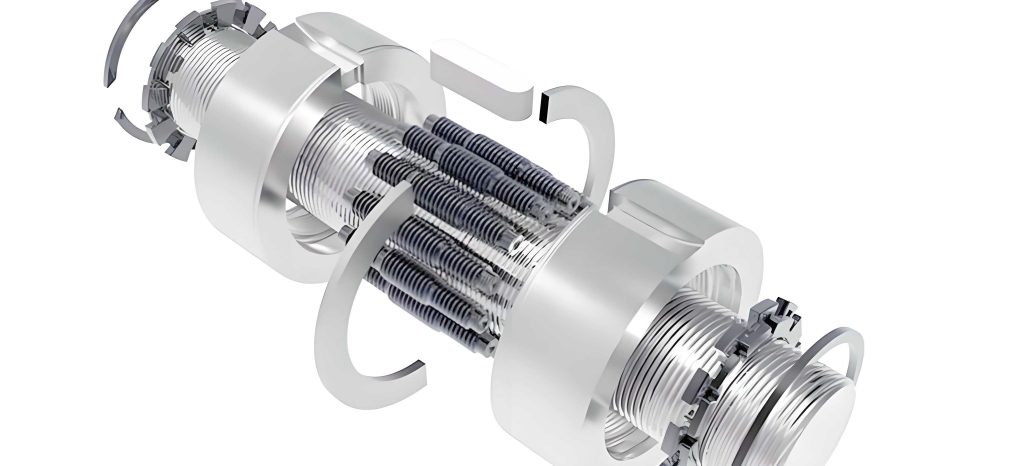
The core components of a standard planetary roller screw assembly include the central screw, multiple planetary rollers, an outer nut, an internal gear ring (often integrated with the nut), a retainer or cage to maintain roller spacing, and securing elements like circlips. In the most common operational mode, the screw acts as the rotational input. The nut, typically connected to the load, is constrained to linear translation. The planetary rollers are the key mediating elements. They engage simultaneously with the screw and the nut threads and are guided by the retainer. Their motion is compound: they rotate about their own axes (spin) and also revolve around the central screw axis (orbit), analogous to planets in a solar gear system, while moving axially with the nut. This unique kinematic arrangement is the foundation of the planetary roller screw’s high-performance characteristics.
Kinematic Analysis of the Planetary Roller Screw
A fundamental understanding of the motion relationships within the planetary roller screw is prerequisite for correct design and analysis. We define the following key parameters:
- $d_S$, $d_R$, $d_N$: Pitch diameters of the screw, roller, and nut threads, respectively. Their fundamental geometric relationship is $d_N = d_S + 2d_R$.
- $\omega_S$, $\omega_R$, $\omega_P$: Angular velocities of the screw, the roller about its own axis, and the retainer (planet carrier) about the screw axis. The nut’s angular velocity $\omega_N$ is typically zero.
- $p_S$, $p_R$, $p_N$: Thread pitches of the screw, roller, and nut. For proper meshing, these must be equal: $p_S = p_R = p_N = p$.
- $n_S$, $n_R$, $n_N$: Number of thread starts for the screw, roller, and nut. Conventionally, rollers have a single-start thread, so $n_R = 1$.
Angular Velocity Relationships
The angular velocity relationships can be derived using the standard method for planetary gear trains. Applying a reversal rotation of $-\omega_P$ to the entire assembly (bringing the retainer to a standstill) simplifies the analysis. The transformed angular velocities are shown in Table 1.
| Component | Original Angular Velocity | Transformed Angular Velocity |
|---|---|---|
| Screw | $\omega_S$ | $\omega_S – \omega_P$ |
| Roller (Spin) | $\omega_R$ | $\omega_R + \omega_P$ |
| Nut | $0$ | $\omega_P$ |
| Retainer (Carrier) | $\omega_P$ | $0$ |
In the transformed system, the retainer is fixed. The velocity ratio between the screw (now input) and the nut (now output) is governed by the effective gear ratios through the rollers. Considering the meshing at the screw-roller and roller-nut interfaces, we can write:
$$\frac{\omega_S – \omega_P}{\omega_P} = \frac{d_R}{d_S} \cdot \frac{d_N}{d_R} = \frac{d_N}{d_S}$$
and for the roller spin relative to the carrier:
$$\frac{\omega_R + \omega_P}{\omega_P} = \frac{d_N}{d_R}$$
Solving these equations along with the geometric relation $d_N = d_S + 2d_R$ yields the theoretical angular velocities of the retainer and the roller spin:
$$\omega_P = \frac{d_S}{2(d_S + d_R)} \omega_S \tag{1}$$
$$\omega_R = \frac{d_S}{2d_R} \omega_S \tag{2}$$
It is crucial to note that these are ideal values assuming pure rolling at all thread contacts. In practice, the presence of sliding can cause the actual $\omega_R$ and $\omega_P$ to be slightly lower.
Thread Hand and Number of Starts Relationship
A critical design constraint for the planetary roller screw is ensuring zero net relative axial displacement between the rollers and the nut, and a stable, non-slipping relationship between the rollers and the screw. This dictates specific relationships for thread hand (direction) and the number of starts.
1. Roller-Nut Meshing Condition:
The axial displacement of the roller relative to the nut, $L_{RN}$, must be zero over any time period $t$. This displacement has two components:
- Displacement due to the roller’s spin relative to a stationary nut: $\frac{(\omega_R + \omega_P)t}{2\pi} \cdot n_R p$.
- Displacement due to the nut’s motion relative to a stationary roller: $\pm \frac{\omega_P t}{2\pi} \cdot n_N p$. The sign depends on thread hand: ‘+’ for opposite hands, ‘−’ for the same hand.
Thus,
$$L_{RN} = \frac{(\omega_R + \omega_P)t}{2\pi} p \pm \frac{\omega_P t}{2\pi} n_N p \tag{3}$$
Setting $L_{RN} = 0$ and using $n_R=1$ necessitates the ‘−’ sign, proving that the roller and nut threads must have the same hand. Substituting equations (1) and (2) into the simplified condition yields the required number of starts for the nut:
$$n_N = \frac{d_S}{d_R} + 2 \tag{4}$$
2. Roller-Screw Meshing Condition:
For stable power transmission without unpredictable slip, the relative axial displacement between roller and screw, $L_{RS}$, must be independent of the uncertain retainer speed $\omega_P$ (due to sliding). This displacement is:
$$L_{RS} = \frac{(\omega_S – \omega_P)t}{2\pi} n_S p \pm \frac{(\omega_R + \omega_P)t}{2\pi} p \tag{5}$$
Substituting equations (1) and (2) gives:
$$L_{RS} = \frac{\omega_S t}{2\pi} n_S p + \frac{\omega_P t}{2\pi} p \left[ -n_S \pm \left( \frac{d_S}{d_R} + 2 \right) \right] \tag{6}$$
The first term is determined by the screw input. To make $L_{RS}$ independent of $\omega_P$, the coefficient of $\frac{\omega_P t}{2\pi} p$ must be zero. This requires choosing the ‘+’ sign in the bracket, which means the roller and screw threads must have the same hand. This leads to the condition for the screw starts:
$$n_S = \frac{d_S}{d_R} + 2 \tag{7}$$
Comparing (4) and (7) shows the fundamental design rule: $n_S = n_N = d_S/d_R + 2$, and all three components (screw, roller, nut) must have threads of the same hand. The resulting axial displacement of the nut (and rollers) per screw revolution is the familiar lead, $L = n_S p$.
Gear Meshing at the Roller Ends
The gear train formed by the roller end gears and the internal ring gear (fixed to the nut) is non-load-bearing and primarily serves to synchronize the orbital motion of the rollers. Its design must satisfy several conditions:
- Speed Ratio Match: The gear ratio must match the kinematic ratio from the thread meshing to ensure pure rolling at the roller ends.
$$\frac{z_N}{z_R} = \frac{d_N}{d_R} \tag{8}$$
where $z_N$ and $z_R$ are the tooth numbers of the ring gear and roller gear, and $m$ is the module. - Interference Avoidance: The roller gear addendum diameter must not interfere with the screw root diameter.
$$m(z_R + 2h_a^*) \le d_{Ra} \tag{9}$$
where $d_{Ra}$ is the roller thread major diameter and $h_a^*$ is the addendum coefficient. - Minimum Tooth Number: To prevent undercutting in generated gears, the roller gear must meet the minimum tooth condition.
$$z_R \ge \frac{2h_a^*}{\sin^2\alpha} \tag{10}$$
where $\alpha$ is the gear pressure angle. If standard gears cannot satisfy this, design alternatives like profile-shifted (modified) gears or special pressure angles must be considered.
Finite Element Modeling and Analysis
To accurately assess the structural integrity and contact behavior of the planetary roller screw under load, a three-dimensional finite element model was developed. The analysis focuses on the contact stresses at the screw-roller and roller-nut thread interfaces, which are the primary load paths.
Model Construction and Simplification
Based on the kinematic design rules, a planetary roller screw was designed with the primary thread parameters listed in Table 2. The corresponding gear parameters are listed in Table 3.
| Parameter | Screw | Nut | Roller |
|---|---|---|---|
| Pitch Diameter (mm) | 30 | 50 | 10 |
| Major Diameter (mm) | 30.8 | 51.0 | 10.8 |
| Minor Diameter (mm) | 29.0 | 49.2 | 9.0 |
| Pitch, $p$ (mm) | 2 | 2 | 2 |
| Number of Starts, $n$ | 5 | 5 | 1 |
| Profile Angle (deg) | 90 | 90 | 90 |
| Parameter | Roller Gear | Ring Gear |
|---|---|---|
| Number of Teeth, $z$ | 20 | 100 |
| Module, $m$ (mm) | 0.5 | 0.5 |
| Pressure Angle, $\alpha$ (deg) | 20 | 20 |
| Addendum Coefficient | 1 | 1 |
| Dedendum Coefficient | 1.35 | 1.35 |
The full CAD model was simplified for computational efficiency: non-structural features like chamfers and small holes were removed, and only the engaged section of the screw was retained. The planetary roller screw possesses cyclic symmetry. With 10 rollers evenly spaced, a 36° sector (1/10th of the model) was analyzed. Consequently, the applied axial load on the nut flange was scaled to 15 kN, representing 1/10th of a total 150 kN load. This sector model was imported into ANSYS Workbench for analysis.
Material, Meshing, and Contact Definitions
All primary load-bearing components (screw, rollers, nut) were assigned the properties of hardened bearing steel GCr15, known for its high wear resistance and strength: Elastic Modulus $E = 200$ GPa, Poisson’s Ratio $\nu = 0.3$, Yield Strength $\sigma_s \approx 1,740$ MPa. An automated meshing algorithm with refinement in contact regions was used, resulting in a predominantly hex-dominant mesh of suitable density for contact stress resolution.
Three critical contact pairs were defined with “Frictional” contact behavior, allowing for separation and sliding:
- Screw Thread ↔ Roller Thread
- Roller Thread ↔ Nut Thread
- Roller End Gear ↔ Ring Gear
This simulates the real mechanical interaction more accurately than bonded contact. The ring gear and nut were “Bonded” together. Contacts involving the retainer (roller-retainer, retainer-ring gear) were defined as “Frictionless”, as the retainer primarily provides guidance without significant load transfer.
Boundary Conditions and Loading
The following constraints were applied to reflect the actual working conditions of the planetary roller screw:
- Nut: A “Displacement” constraint allowing movement only along its axis (Z-direction). A 15 kN axial force was applied to its flange face.
- Roller: A “Cylindrical Support” constraint on its axis, freeing rotation about Z and translation along Z.
- Retainer: A “Cylindrical Support” constraint, freeing rotation about Z and translation along Z.
- Screw: One end was fixed (“Fixed Support”). The other end had a “Displacement” constraint allowing only axial (Z) movement, simulating a simple support.
- Symmetry: “Frictionless Support” was applied to the sector faces of all components, allowing free deformation in-plane while constraining motion normal to the symmetry plane.
The model was then solved using a static structural solver with non-linear contact capabilities enabled.
Results and Parametric Study
Contact Stress Distribution
The finite element solution reveals the detailed stress state within the planetary roller screw assembly. The maximum equivalent (von Mises) stress at the screw-roller thread contact was found to be 1491.4 MPa, located on the screw thread flank. Similarly, the maximum stress at the roller-nut contact was 1499.5 MPa, located on the roller thread flank. Both values are safely below the material’s yield strength, confirming the design’s adequacy for the 150 kN load.
A significant observation is the non-uniform load distribution across successive thread teeth. As shown in the stress contours, the first engaged thread tooth at the load-entry side (left end of the nut in the model) bears the highest stress. The stress magnitude decreases progressively for subsequent teeth along the axial direction. This load distribution pattern, resulting from the elastic deformation of the components, is consistent for both the screw and nut threads and is a critical factor in the fatigue life of the planetary roller screw.
Influence of Thread Profile Angle
To investigate the effect of thread profile angle on contact performance, a parametric study was conducted. Holding the pitch constant at $p=2$ mm, FEA simulations were performed for profile angles of 60°, 70°, 80°, 90°, and 100°. The resulting maximum contact stresses are summarized in Table 4.
| Contact Pair | Maximum Equivalent Stress (MPa) | ||||
|---|---|---|---|---|---|
| Profile Angle | 60° | 70° | 80° | 90° | 100° |
| Screw-Roller | 1505.1 | 1353.9 | 1557.4 | 1491.4 | 1418.5 |
| Roller-Nut | 1245.7 | 1386.7 | 1330.5 | 1499.5 | 1584.6 |
The data indicates that a 70° profile angle yields the lowest overall contact stresses for the screw-roller pair, while the 90° angle offers a reasonably low and balanced stress level for both contact interfaces. Angles of 60°, 80°, and 100° lead to peak stresses exceeding 1500 MPa in at least one contact pair. Furthermore, prior research links profile angle to mechanical efficiency, with larger angles generally promoting higher efficiency. Therefore, balancing contact strength (lower stress) and transmission efficiency (higher angle), the 90° profile angle is a standard and optimal choice for the planetary roller screw design.
Influence of Thread Pitch
The thread pitch directly affects the lead, the number of engaged threads for a given length, and the contact geometry. A second parametric study was performed with a fixed 90° profile angle, varying the pitch $p$ from 1.5 mm to 3.5 mm. The results are presented in Table 5.
| Contact Pair | Maximum Equivalent Stress (MPa) | ||||
|---|---|---|---|---|---|
| Pitch, $p$ (mm) | 1.5 | 2.0 | 2.5 | 3.0 | 3.5 |
| Screw-Roller | 1345.3 | 1491.4 | 1638.3 | 1726.7 | 2159.0 |
| Roller-Nut | 1262.1 | 1499.5 | 1681.4 | 1595.1 | 1716.5 |
A clear trend is evident: the maximum contact stress increases with increasing pitch. This is primarily because, for a fixed axial length of engagement, a larger pitch reduces the total number of load-bearing thread turns. Consequently, the load is distributed over fewer contact points, increasing the stress concentration on each individual thread flank. This analysis underscores the trade-off in planetary roller screw design: while a larger pitch provides a greater lead (faster linear speed per screw revolution), it detrimentally impacts the load-carrying capacity and contact stress levels. Designers must carefully balance these factors based on application requirements for speed, load, and life.
Conclusion
This study provides a comprehensive framework for analyzing and optimizing the standard planetary roller screw. The kinematic analysis conclusively establishes the fundamental design rule: for stable and efficient operation, the screw, rollers, and nut must all have threads of the same hand, and the number of thread starts must satisfy $n_S = n_N = d_S/d_R + 2$. The developed three-dimensional finite element model successfully captures the complex contact mechanics within the assembly under load, revealing stress concentrations and non-uniform load distribution along the threads.
The parametric studies offer vital practical guidance. The thread profile angle significantly influences contact stress, with a 90° angle presenting a favorable compromise between contact strength and mechanical efficiency. The thread pitch has a pronounced effect on load capacity; increasing pitch leads to higher contact stresses by reducing the number of load-bearing threads, highlighting a key design trade-off between speed and load capacity.
In summary, the methodologies and results presented here serve as a valuable reference for engineers engaged in the design, analysis, and selection of planetary roller screws for high-performance mechanical systems. Future work could extend this analysis to dynamic loading conditions, thermal effects, and the fatigue life prediction of the planetary roller screw components.