
In the pursuit of high-precision mechanical systems, I have extensively studied the planetary roller screw, a critical component that offers superior performance over traditional screw mechanisms. This article delves into the motion characteristics and parameter selection of the planetary roller screw, providing a comprehensive analysis from a first-person perspective as an engineer and researcher. The planetary roller screw is increasingly vital in applications demanding compactness, high load capacity, stiffness, and reliability, such as aerospace, robotics, and precision machining. Through this work, I aim to elucidate the underlying principles, derive key equations, and present practical guidelines for designing these mechanisms.
The planetary roller screw operates on a unique principle where rolling friction replaces sliding friction, significantly enhancing efficiency. Compared to ball screws, the planetary roller screw boasts advantages like higher load capacity (up to 20 times greater for small leads), longer life, reduced vibration, lower noise, and ease of disassembly between the nut and screw. These benefits stem from its use of rollers with larger effective contact radii, which I will explore in detail. To set the stage, consider the basic structure: it consists of a screw with multi-start triangular threads, a nut with similar threads, and multiple rollers that engage both the screw and nut. The rollers feature double-arc threads and are equipped with external gears at their ends, meshing with internal gear rings on the nut to maintain alignment and synchronize motion. A guide ring spaces the rollers evenly, preventing interference.
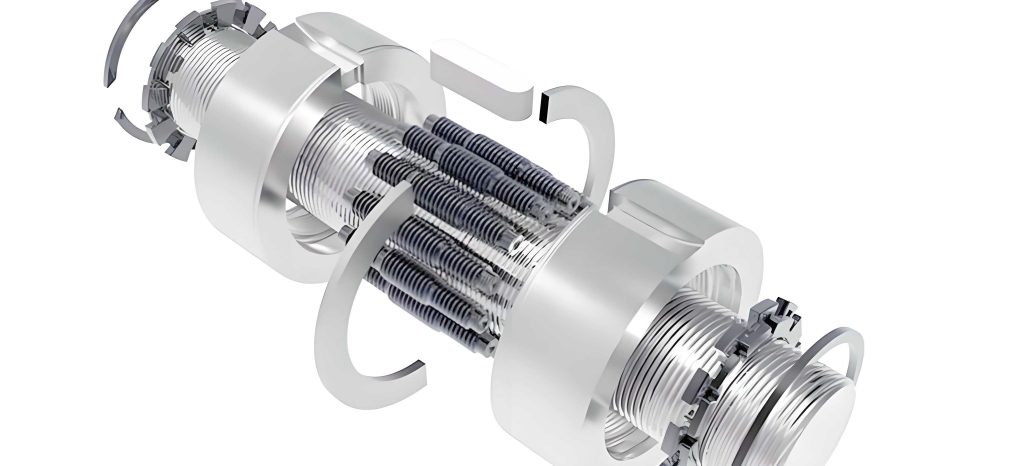
This image illustrates the typical configuration of a planetary roller screw assembly, highlighting its compact and efficient design.
To understand the motion characteristics of the planetary roller screw, I begin by analyzing its kinematic relationships. Assume the screw rotates with an angular velocity $\omega$, while the nut is fixed against rotation. Let $d_s$, $d_r$, and $d_n$ denote the pitch diameters of the screw, roller, and nut at their contact points, respectively. The roller’s pitch diameter for revolution is $d_m = d_s + d_r$. Define $k = d_s / d_r$ as the diameter ratio. The roller’s revolution angular velocity is $\omega’$, and its rotation angular velocity about its own axis is $\omega_r$. From geometric compatibility at the contact points, I derive the fundamental motion equations.
First, consider the velocity relationship at the screw-roller interface. The linear velocity at the screw thread must match that at the roller thread due to rolling without slip. This yields:
$$ \omega’ \frac{d_m}{2} = \omega \frac{d_s}{4} $$
Solving for $\omega’$, I obtain:
$$ \omega’ = \frac{\omega d_s}{2 d_m} = \frac{\omega d_s}{2(d_s + d_r)} = \frac{\omega k}{2(k+1)} \quad \text{(1)} $$
Next, at the roller-nut interface, a similar condition applies:
$$ \omega_r \frac{d_r}{2} = \omega’ \frac{d_n}{2} $$
Substituting $\omega’$ from equation (1) and noting that $d_n = n_n d_r$ where $n_n$ is the number of starts on the nut, I derive:
$$ \omega_r = \frac{\omega k (k+2)}{2(k+1)} \quad \text{(2)} $$
This equation assumes the nut and roller have the same hand of helix; for opposite hands, a sign change applies, but I will focus on the typical same-hand configuration for the planetary roller screw.
The axial displacement of the roller relative to the nut per screw revolution is crucial for synchronization. Denote $s$ as the pitch of the threads (lead per start). For one screw revolution, the relative axial displacement $H_1$ is given by:
$$ H_1 = \frac{\omega’}{\omega} n_n s \mp \frac{\omega_r}{\omega} s $$
Using equations (1) and (2), I simplify this to:
$$ H_1 = \frac{k s}{2} \left[ \frac{n_n}{k+1} \mp \frac{k+2}{k+1} \right] \quad \text{(3)} $$
For the planetary roller screw to function efficiently, the roller and nut should have no relative axial motion, i.e., $H_1 = 0$. Setting equation (3) to zero leads to:
$$ n_n = \pm (k+2) $$
Since $n_n$ and $k$ are positive integers, I take the positive sign, indicating the same hand of helix. Thus:
$$ n_n = k+2 = \frac{d_s + 2d_r}{d_r} = \frac{d_n}{d_r} \quad \text{(4)} $$
Similarly, the axial displacement of the roller relative to the screw per screw revolution, $H_2$, is derived from:
$$ H_2 = \frac{\omega_r}{\omega} s \mp \frac{\omega’ n_s s}{\omega} \pm n_s s $$
where $n_s$ is the number of starts on the screw. Substituting equations (1) and (2):
$$ H_2 = \frac{k+2}{2(k+1)} (k \mp n_s) s \quad \text{(5)} $$
To avoid slip between the screw and roller, $H_2$ should be constant and equal to the screw’s lead. Setting the variable terms to zero yields:
$$ \frac{\omega_r}{\omega} s \mp \frac{\omega’ n_s s}{\omega} = 0 $$
This leads to $H_2 = \pm n_s s$. Solving for $n_s$, I get:
$$ n_s = \pm (k+2) $$
Again, taking the positive sign for same hand of helix:
$$ n_s = k+2 = \frac{d_n}{d_r} \quad \text{(6)} $$
From equations (4) and (6), I conclude that for optimal performance of the planetary roller screw, the screw, nut, and roller must have the same hand of helix, and the number of starts on both the screw and nut should equal $k+2$. This ensures synchronized motion without relative sliding, a key feature of the planetary roller screw design.
The arrangement of rollers in the planetary roller screw is governed by geometric constraints. Let $\theta$ be the angular spacing between adjacent rollers. After rotating by $\theta$, the axial displacement of the nut thread contact point relative to the roller must match that of the screw thread contact point, modulo the pitch. This condition is expressed as:
$$ \frac{\theta}{2\pi} n_n s \mp \frac{\theta}{2\pi} n_s s = E s $$
where $E$ is an integer. When $n_n = n_s$, as derived above, the left-hand side vanishes, implying $E = 0$ for any $\theta$. Therefore, the number of rollers is not mechanically restricted and can be chosen based on spatial limitations to maximize load capacity. The maximum number of rollers, $N_{\text{max}}$, is approximately:
$$ N_{\text{max}} \approx \frac{\pi d_m}{d_r} = \frac{\pi (d_s + d_r)}{d_r} $$
In practice, I select a slightly lower number to account for assembly and tolerances.
To summarize the kinematic relationships, I present Table 1, which lists key parameters and their interdependencies for the planetary roller screw.
| Parameter | Symbol | Formula | Description |
|---|---|---|---|
| Screw pitch diameter | $d_s$ | Design choice | Diameter at screw-roller contact |
| Roller pitch diameter | $d_r$ | Design choice | Diameter at roller threads |
| Nut pitch diameter | $d_n$ | $d_n = n_n d_r$ | Diameter at nut-roller contact |
| Diameter ratio | $k$ | $k = d_s / d_r$ | Ratio of screw to roller diameters |
| Number of screw starts | $n_s$ | $n_s = k+2$ | Must equal $k+2$ for no slip |
| Number of nut starts | $n_n$ | $n_n = k+2$ | Must equal $k+2$ for no slip |
| Roller revolution diameter | $d_m$ | $d_m = d_s + d_r$ | Pitch diameter for roller orbit |
| Screw angular velocity | $\omega$ | Input | Rotation speed of screw |
| Roller revolution angular velocity | $\omega’$ | $\omega’ = \omega k / [2(k+1)]$ | Angular speed of roller around screw |
| Roller rotation angular velocity | $\omega_r$ | $\omega_r = \omega k (k+2) / [2(k+1)]$ | Spin speed of roller about its axis |
| Axial lead per screw revolution | $L$ | $L = n_s s$ | Nut displacement per screw turn |
The load distribution in a planetary roller screw under axial force is complex due to multiple contact points. I analyze the forces assuming a symmetric structure. Let $F_N$ be the load on the $N$-th thread of engagement, where $N = 1, 2, \dots, f$, with $f$ being the total number of engaged threads. The contact angle between the roller and screw/nut is typically 45° to optimize stress distribution. Based on Hertzian contact theory and equilibrium, the load distribution can be modeled by a system of nonlinear equations. For a planetary roller screw with $f$ threads, the generalized form is:
$$ \frac{F_N^{2/3}}{\sin \theta_0} + k_2 F_N = \frac{F_{N-1}^{2/3}}{\sin \theta_0} + k_2 F_{N-1} – k_1 \sin \theta_0 \sum_{i=N}^{f} F_i \quad \text{for } N = 2, 3, \dots, f $$
with boundary conditions depending on the total axial load $F_a$. Here, $\theta_0 = 45^\circ$ is the contact angle, and $k_1$, $k_2$ are constants derived from material properties and geometry. This system must be solved iteratively to obtain $F_N$. The friction forces at these contacts, $f_N = \mu F_N$ with $\mu$ as the coefficient of friction, drive the planetary motion of the rollers. For design purposes, I often use simplified empirical formulas or finite element analysis to estimate load capacity and life.
Selecting the basic design parameters for a planetary roller screw involves careful consideration of geometric and performance requirements. I outline the step-by-step process below, emphasizing the planetary roller screw’s unique features.
1. Screw Parameters: The screw diameter $d_s$ is chosen based on load and stiffness needs. The thread profile is a 90° triangular shape, usually multi-start with right-hand helix. The lead $L$ is determined by the desired axial speed: $L = n_s s$, where $s$ is the pitch. From earlier, $n_s = k+2$, so $L = (k+2) s$.
2. Roller Parameters: The roller diameter $d_r$ is selected to achieve the desired $k$ ratio. Typically, $k$ ranges from 3 to 10 for balanced performance. The roller thread has a double-arc profile with radius $R$ to ensure a 45° contact angle. From geometry:
$$ R = \frac{d_r}{2 \sin 45^\circ} = \frac{d_r}{\sqrt{2}} $$
The roller is single-start with right-hand helix, matching the screw and nut. The roller length must accommodate the engaged threads and gear ends.
3. Nut Parameters: The nut has the same thread profile and hand as the screw. Its number of starts $n_n = k+2$, so the nut pitch diameter is $d_n = n_n d_r = (k+2) d_r$. The nut body houses the internal gear rings and guide ring.
4. Number of Rollers: As discussed, the number of rollers $N_r$ can be maximized for load sharing. I use:
$$ N_r \leq \frac{\pi d_m}{d_r} = \frac{\pi (d_s + d_r)}{d_r} $$
In practice, I choose $N_r$ as an integer slightly less than this, often between 5 and 12, depending on size constraints.
5. Gear Parameters: The gears on the roller ends and the internal gear rings are critical for maintaining alignment. Let $Z_r$ be the number of teeth on each roller gear, and $Z_n$ be the number of teeth on the internal gear ring. The module $m$ is chosen based on torque and space. From kinematic analysis of the gear train (simplified as a planetary system), I derive the relationship:
$$ Z_n = (k+2) Z_r \quad \text{(7)} $$
This ensures that the roller axes remain parallel to the screw axis during operation. For example, if $k=4$ and I choose $Z_r=10$, then $Z_n = (4+2) \times 10 = 60$. The gear design must account for manufacturing tolerances to minimize backlash.
To aid parameter selection, I provide Table 2, which summarizes key formulas and typical values for a planetary roller screw design.
| Parameter | Symbol | Design Equation | Typical Range | Notes |
|---|---|---|---|---|
| Diameter ratio | $k$ | $k = d_s / d_r$ | 3–10 | Higher $k$ increases load capacity but may reduce speed |
| Screw starts | $n_s$ | $n_s = k+2$ | 5–12 | Must be integer; determines lead |
| Nut starts | $n_n$ | $n_n = k+2$ | Same as $n_s$ | Ensures synchronization |
| Pitch | $s$ | $s = L / n_s$ | 1–5 mm | Smaller $s$ for precision, larger for speed |
| Roller contact radius | $R$ | $R = d_r / \sqrt{2}$ | Derived from $d_r$ | Ensures 45° contact angle |
| Number of rollers | $N_r$ | $N_r \approx \pi (d_s + d_r)/d_r$ | 5–12 | Maximize for load sharing |
| Roller gear teeth | $Z_r$ | Chosen based on module $m$ | 10–20 | Module $m$ from strength calculations |
| Internal gear teeth | $Z_n$ | $Z_n = (k+2) Z_r$ | 60–240 | From equation (7) |
| Lead | $L$ | $L = n_s s$ | 5–60 mm | Axial travel per screw revolution |
The performance of a planetary roller screw can be further optimized through dynamic analysis. I consider factors like inertia, damping, and thermal effects. The axial stiffness $K_a$ of the planetary roller screw is approximated by:
$$ K_a = \frac{N_r E A_e}{L_e} $$
where $E$ is the Young’s modulus, $A_e$ is the effective contact area per roller, and $L_e$ is the effective load path length. For precise applications, I also compute the critical speed $n_c$ to avoid resonance:
$$ n_c = \frac{60}{2\pi} \sqrt{\frac{K_a}{m_{\text{eq}}}} $$
where $m_{\text{eq}}$ is the equivalent mass of the moving parts.
Efficiency is another key metric for the planetary roller screw. The mechanical efficiency $\eta$ can be estimated from:
$$ \eta = \frac{1 – \mu \tan \lambda}{1 + \mu \cot \lambda} $$
where $\lambda$ is the lead angle, given by $\lambda = \arctan(L / (\pi d_s))$. For a well-designed planetary roller screw, $\eta$ often exceeds 90%, thanks to rolling friction.
In comparison to ball screws, the planetary roller screw offers distinct advantages, as summarized in Table 3. This comparison underscores why I prefer planetary roller screws for demanding applications.
| Feature | Planetary Roller Screw | Ball Screw |
|---|---|---|
| Load capacity | High (∝ $d_r^2$) | Moderate (∝ $d_b^{1.8}$) |
| Life expectancy | Longer due to larger contact area | Shorter, prone to fatigue |
| Stiffness | High, multiple rollers share load | Lower, fewer contact points |
| Noise and vibration | Low, smooth rolling action | Higher, especially at high speeds |
| Compactness | Excellent for small leads (1-2 mm) | Limited by ball size |
| Efficiency | >90% | 85–95% |
| Cost | Higher due to complexity | Lower, more standardized |
To illustrate the design process, I present a case study. Suppose I need a planetary roller screw for a precision actuator with an axial load of 10 kN, lead of 10 mm, and screw diameter around 20 mm. I choose $d_s = 20$ mm and $k=5$. Then, $d_r = d_s / k = 4$ mm. The number of starts: $n_s = n_n = k+2 = 7$. The pitch $s = L / n_s = 10 / 7 \approx 1.429$ mm. The nut diameter $d_n = n_n d_r = 7 \times 4 = 28$ mm. For rollers, I select $N_r = 8$ (within $ \pi (20+4)/4 \approx 18.8$). The contact radius $R = d_r / \sqrt{2} \approx 2.828$ mm. For gears, with module $m=0.5$ mm, I pick $Z_r=15$, so $Z_n = (5+2) \times 15 = 105$. This yields a functional planetary roller screw design.
Advanced topics in planetary roller screw analysis include thermal expansion effects, lubrication requirements, and wear prediction. The thermal growth $\Delta L$ under temperature change $\Delta T$ is:
$$ \Delta L = \alpha L \Delta T $$
where $\alpha$ is the coefficient of thermal expansion. Proper lubrication with grease or oil is essential to minimize wear; I recommend viscosity grades based on speed and load. Wear life can be estimated using the modified Archard equation for rolling contacts.
In conclusion, the planetary roller screw is a sophisticated mechanism that offers superior performance in high-precision, high-load applications. Through this analysis, I have derived the fundamental motion equations, such as $\omega’ = \omega k / [2(k+1)]$ and $\omega_r = \omega k (k+2) / [2(k+1)]$, and established design rules like $n_s = n_n = k+2$ and $Z_n = (k+2) Z_r$. The use of tables and formulas, as presented, aids in systematic parameter selection. By leveraging the planetary roller screw’s advantages—high load capacity, stiffness, and longevity—engineers can develop more efficient and reliable mechanical systems. Future work may focus on optimizing materials, integrating sensors, and exploring miniature planetary roller screw designs for micro-scale applications.
Throughout this article, I have emphasized the importance of the planetary roller screw in modern engineering. The keyword ‘planetary roller screw’ encapsulates a technology that continues to evolve, driven by demands for precision and efficiency. I hope this comprehensive guide serves as a valuable resource for designers and researchers working with these remarkable mechanisms.