
The transmission of motion and force within precision mechanical systems is a fundamental engineering challenge, particularly in demanding sectors such as marine engineering, aerospace, and robotics. Among the solutions available, the planetary roller screw mechanism stands out as a premier technology for converting rotary motion into high-force linear actuation. Characterized by their high power density, stiffness, and reliability, standard planetary roller screw designs have been extensively studied and deployed. However, a specialized variant known as the differential planetary roller screw offers distinct structural and performance advantages, though its complex load-sharing behavior under heavy axial loads remains a critical area for investigation. This article presents a comprehensive analytical and numerical study focused on developing a high-fidelity load distribution model for the differential planetary roller screw. By accounting for its unique thread engagement characteristics and the stiffness contributions from all critical components, including the introduction of a novel shaft segment influence factor, we establish a refined theoretical framework. The model is subsequently used to analyze the impact of key design and operational parameters, and its validity is rigorously confirmed through detailed finite element simulations.
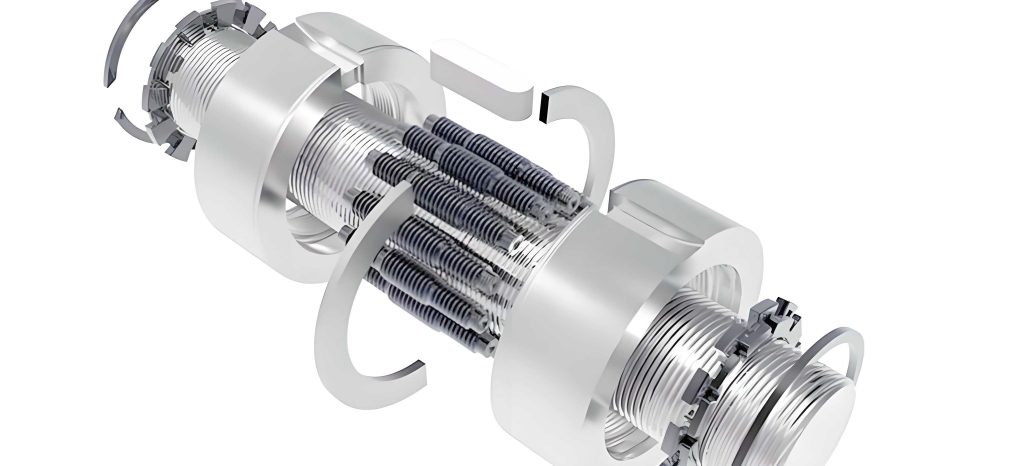
The fundamental architecture of a differential planetary roller screw departs significantly from its standard counterpart. It primarily consists of a central screw, a surrounding nut, multiple threaded rollers, and a carrier that maintains the rollers’ planetary arrangement. A key distinguishing feature is the elimination of gear meshes (e.g., ring gears). Instead, the rollers feature a three-segment thread profile: two end segments with a specific lead angle that engage with the screw’s threaded profile, and a central segment with a zero-lead (annular groove) profile that engages with corresponding grooves inside the nut. This configuration creates a differential effect, where the axial translation per screw revolution is determined by the lead difference between the screw and the roller threads. The engagement between the screw and roller is a spatial, crossed-axis thread contact, while the engagement between the nut and the roller is akin to a series of interlocking rings. This unique geometry directly influences how contact forces are distributed across the multiple loaded threads, making conventional load distribution models for standard screws or bearings inadequate.
To establish a baseline for analysis, we begin with the force equilibrium for the entire differential planetary roller screw assembly. Assuming an idealized scenario with perfect manufacturing and no assembly errors, and with the nut fixed against rotation, a static axial load \(T\) is applied to the screw. This load is distributed through the \(m\) rollers. Each roller engages with \(z_S\) threads on the screw side and \(z_N\) threads on the nut side. The sum of axial force components from all contact points must balance the external load:
$$
\sum_{i=1}^{m \cdot z_S} F_{Sa,i} = T \quad \text{and} \quad \sum_{i=1}^{m \cdot z_N} F_{Na,i} = T
$$
Here, \(F_{Sa,i}\) and \(F_{Na,i}\) represent the axial force at the i-th contact point on the screw-roller and nut-roller interfaces, respectively. Due to the threaded contact geometry, these axial forces arise from normal contact forces. For the screw-roller interface with thread lead angle \(\lambda\) and thread profile angle \(\alpha\), the relationships between axial (\(F_{Sa}\)), radial (\(F_{Sr}\)), and normal (\(F_{Sn}\)) force components are:
$$
F_{Sr} = F_{Sn} \sin \alpha, \quad F_{Sa} = F_{Sn} \cos \alpha \cos \lambda, \quad \text{where } \lambda = \arctan\left(\frac{P}{\pi d}\right)
$$
For the nut-roller interface, which has a zero lead angle, the relationships simplify to:
$$
F_{Nr} = F_{Nn} \sin \alpha, \quad F_{Na} = F_{Nn} \cos \alpha
$$
The core of predicting load distribution lies in understanding the system’s compliance. The total axial deflection at any loaded thread arises from three primary sources in series: 1) Hertzian contact deformation at the interface, 2) tensile/compressive deformation of the shaft segments (screw, roller, nut) between load points, and 3) structural bending and shear deformation of the thread teeth themselves. The stiffness model is therefore built by combining these elements.
1. Contact Deformation and Stiffness: Based on Hertzian contact theory for elliptical point contact, the normal approach \(\delta\) is related to the normal force \(F_n\). For the screw-roller side, the axial deflection \(l_{S,mj}\) and axial contact stiffness \(K_{S,mj}\) for the j-th thread on the m-th roller are derived as:
$$
l_{S,mj} = \frac{\delta_{S,mj}}{\cos \alpha \cos \lambda}, \quad K_{S,mj} = \frac{3 F_{S,mj}^{1/3} (\sin \alpha \cos \lambda)^{5/3}}{2 K_S}
$$
where \(K_S\) is a constant dependent on material properties and contact geometry. Similarly, for the nut-roller side:
$$
l_{N,mj} = \frac{\delta_{N,mj}}{\sin \alpha}, \quad K_{N,mj} = \frac{3 F_{N,mj}^{1/3} (\sin \alpha)^{5/3}}{2 K_N}
$$
2. Shaft Segment Deformation and Stiffness: The axial stiffness of a shaft segment (screw ‘S’, roller ‘R’, or nut ‘N’) of length equal to the axial pitch \(T_p\) and effective cross-sectional area \(A_p\) is given by:
$$
K_{p,a} = \frac{E_p A_p}{T_p}, \quad p = S, R, N
$$
3. Thread Tooth Structural Deformation and Stiffness: A loaded thread tooth experiences complex deformation modes: bending (\(\delta_1\)), shear (\(\delta_2\)), tooth root inclination (\(\delta_3\)), tooth root shear (\(\delta_4\)), and radial expansion/contraction (\(\delta_5\)). Formulas for these deflections based on cantilever beam and thick-walled cylinder theories are employed. The total axial compliance of a thread tooth is the sum \(\delta_{pmj}^{total} = \sum_{x=1}^{5} \delta_{x,pmj}\), leading to a thread tooth structural stiffness:
$$
K_{T,pmj} = \frac{F_{a,pmj}}{\delta_{pmj}^{total}}
$$
With the stiffness model established, we formulate the load distribution. The fundamental principle is displacement compatibility: the combined axial deformation from the contact point back to a common reference must be equal for all actively loaded threads on a given side (screw or nut).
Load Distribution on the Nut-Roller Side: Considering the nut side, which resembles a stack of loaded rings, the difference in axial deflection between adjacent (i-1 and i) loaded threads is related to the deformation of the intervening shaft segments (roller and nut material). An iterative formula for the axial load on the i-th nut thread, \(F_{Na,i}\), is derived:
$$
F_{Na,i}^{2/3} = F_{Na,i-1}^{2/3} + \left( \frac{nP}{\sin \alpha} \right) \left( \frac{1}{E_R A_R} + \frac{1}{E_N A_N} + \frac{1}{K_{N,i-1}} + \frac{1}{K_{T,N(i-1)}} \right) \sum_{n=i}^{z} \omega_n
$$
Here, \(n\) is an index, \(P\) is the screw lead, and \(\omega_n\) represents the contact force component at the n-th point in the summation.
Load Distribution on the Screw-Roller Side: The screw side is more complex due to the differential planetary roller screw’s segmented roller design. The load distribution must be calculated separately for the two screw-engaged segments on each roller. Critically, the loaded nut-roller segment located between these two screw-engaged segments influences the deflection of the second screw segment. To account for this, we introduce a Shaft Segment Influence Factor, \(M\). This factor \(M\) corrects the theoretical model by incorporating the additional compliance (or constraint) introduced by the central nut-engaged portion of the roller. The load distribution for the second screw segment is therefore:
$$
F_{Sa,i}^{2/3} = F_{Sa,i-1}^{2/3} + M \cdot \left( \frac{nP}{\sin \alpha \cos \lambda} \right) \left( \frac{1}{E_R A_R} + \frac{1}{E_S A_S} + \frac{1}{K_{S,i-1}} + \frac{1}{K_{T,S(i-1)}} \right) \sum_{n=i}^{z} \omega_n
$$
The value of \(M\) is calibrated through comparison with finite element results and embodies the coupling effect between the nut and screw side engagements unique to the differential planetary roller screw architecture.
To quantify the unevenness of load sharing, we define a Load Distribution Non-uniformity Coefficient, \(\eta\), for each contact point:
$$
\eta = \frac{L’}{\bar{L’}}
$$
where \(L’\) is the load at a specific contact point and \(\bar{L’}\) is the average load across all contact points on that side. An \(\eta > 1\) indicates a point carrying more than the average load, typically leading to higher contact stresses and potential early failure.
We analyze two key influencing factors using the developed model. The following table summarizes the parameters used for the analysis:
| Parameter | Symbol | Value / Range |
|---|---|---|
| Screw Lead | \(P\) | 3 mm |
| Number of Rollers | \(m\) | 5, 6, 7, 8, 9 |
| Thread Profile Angle | \(\alpha\) | 90° |
| Applied Axial Load | \(T\) | 1000 to 8000 kN |
1. Influence of the Number of Rollers (m): Increasing the number of rollers in a planetary roller screw theoretically increases load capacity. However, our model shows it also exacerbates load distribution non-uniformity. As \(m\) increases from 5 to 9, the \(\eta\) for the most heavily loaded (first) thread increases significantly, especially on the screw-roller side. The nut-roller side shows a more moderate increase in non-uniformity. This is attributed to the increased statistical probability of load misalignment and the complex interplay of stiffness paths with more load-introducing points.
2. Influence of the Applied Axial Load (T): The non-uniformity coefficient \(\eta\) also increases with the magnitude of the applied load \(T\), but the rate of increase diminishes at higher loads. This non-linear behavior stems from the non-linear Hertzian contact stiffness (\(K \propto F^{1/3}\)). As load increases, the contact stiffness increases, making the load distribution slightly more even. Crucially, the screw-roller side consistently demonstrates higher non-uniformity than the nut-roller side across all load levels. This can be explained by: a) the higher axial stiffness of the nut body compared to the slender screw, b) the screw’s helical thread causing skewed load paths and bending moments, and c) the greater flexibility of the nut’s internal thread teeth allowing for more conforming deformation.
To validate the theoretical load distribution model for the differential planetary roller screw, a three-dimensional finite element analysis (FEA) is conducted. A model with 6 rollers (\(m=6\)) is constructed using the parameters listed previously. Due to cyclic symmetry, a 60° sector (1/6 model) is analyzed to reduce computational cost while maintaining accuracy. The nut is fixed, and an axial force equivalent to 3000 N per sector (18,000 N total) is applied to the screw. Contact pairs are defined between all engaging thread surfaces with a finite sliding formulation. The mesh consists of over 600,000 C3D8R elements.
The FEA results reveal the stress concentration and load distribution patterns. The maximum von Mises stress is located on the first engaged thread tooth on the nut side, followed closely by stresses on the screw and roller. More importantly, the contact pressure or force extracted from the interfaces allows for a direct calculation of the non-uniformity coefficient \(\eta\) for each engaged thread. The comparison between the FEA results and the predictions from our analytical model (with the shaft segment influence factor \(M\) applied) is shown in the conceptual plot below.
The trend is clear: the analytical model successfully captures the exponential decay in load from the first, most heavily loaded thread to the subsequent threads. The agreement is excellent for the nut-roller side. For the screw-roller side, the FEA-predicted non-uniformity is slightly higher than the model prediction. This discrepancy is attributed to simplifications in the analytical model, such as not fully accounting for the constraining effect of the roller carrier/cage, which slightly alters the load path in the real assembly. Nevertheless, the introduction of the factor \(M\) significantly improved the correlation compared to a model without it, confirming its utility in modeling the coupled nature of the differential planetary roller screw.
This study has developed a refined analytical model for predicting the load distribution in a differential planetary roller screw mechanism. The model integrates Hertzian contact compliance, axial shaft stiffness, and detailed thread tooth bending stiffness into a displacement compatibility framework. A key contribution is the introduction of a shaft segment influence factor \(M\) to correctly model the interaction between the nut-engaged and screw-engaged segments of the roller, a feature critical to the differential planetary roller screw but not present in standard designs.
The analysis leads to several important conclusions for the design and application of planetary roller screws, particularly the differential type:
- The structural coupling in a differential planetary roller screw is significant. The introduced shaft segment influence factor \(M\) is essential for achieving an accurate load distribution prediction on the screw-roller side, improving model fidelity.
- Both increasing the number of rollers and increasing the applied axial load lead to a less uniform distribution of load among the threads. The first engaged thread consistently bears the highest load, making it the most likely site for fatigue or wear initiation.
- Load distribution is inherently more uneven on the screw-roller side than on the nut-roller side. This asymmetry must be considered during design, potentially requiring different material treatments or geometry optimizations for the screw and nut threads.
- The non-linear contact stiffness provides a stabilizing effect, causing the rate of increase in load non-uniformity to diminish as the total applied load rises.
- The finite element validation confirms the overall accuracy of the theoretical model’s trends, with minor deviations attributable to secondary constraints not included in the analytical formulation.
This model provides a powerful tool for engineers to optimize the design of differential planetary roller screw mechanisms, enabling the prediction of maximum contact stresses, life estimation, and informed decisions regarding the number of rollers and thread parameters to achieve target performance and reliability goals in high-demand applications.