
As a precision transmission component that converts rotary motion to linear motion, the planetary roller screw mechanism (PRSM) is renowned for its high load capacity, stiffness, and accuracy. Its performance is crucial in demanding applications such as aerospace and defense systems, where it may experience extreme loads ranging from normal operation to severe overloads. Understanding its deformation behavior across different loading regimes—elastic, plastic, and failure—is therefore essential for reliable design and application. This article delves into a comprehensive analysis of the PRSM’s performance under these varying conditions, establishing theoretical models, presenting simulation data, and correlating findings with experimental results.
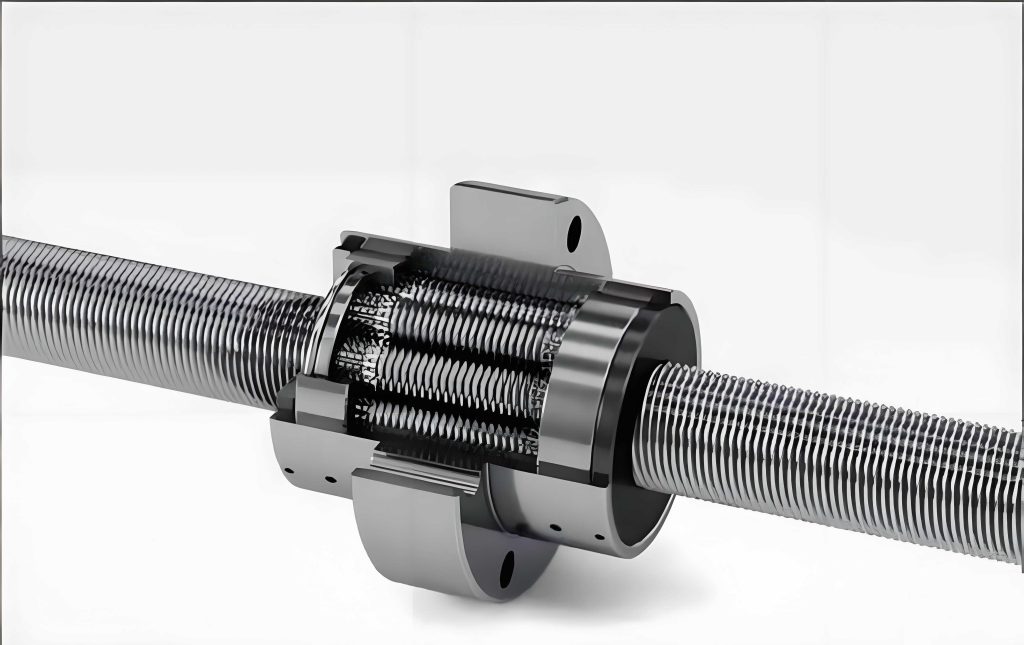
The fundamental structure of a standard planetary roller screw consists of a central screw, multiple threaded rollers arranged planetarily, a surrounding nut, and a carrier/ring gear assembly. The load is transmitted through the meshing threads between the screw, rollers, and nut. Under an axial load, the system undergoes complex deformations, which can be categorized into three distinct phases: the light-load elastic phase, the heavy-load plastic phase, and the high-overload limit phase.
1. Axial Stiffness Modeling in the Light-Load Elastic Stage
In the elastic stage, where loads are within the material’s yield limit, the overall deformation is recoverable. The axial stiffness of the planetary roller screw is a key performance metric, determined by the combined effect of Hertzian contact deformation, axial compression of the threaded sections, and bending/shearing deformation of individual thread teeth. A critical aspect is the non-uniform load distribution among the engaged threads.
The total axial deformation \(\delta_{total}\) under a light axial load \(F_a\) can be expressed as the sum of these components:
$$\delta_{total} = \delta_{hertz} + \delta_{compression} + \delta_{thread-flex}$$
The Hertzian contact deformation \(\delta_{hertz}\) at a single screw-roller or nut-roller contact point is given by:
$$\delta = \frac{2K(e)}{\pi m_a} \left[ \frac{3}{32} \left( \frac{1-\mu_1^2}{E_1} + \frac{1-\mu_2^2}{E_2} \right)^2 \Sigma \rho \right]^{1/3} Q^{2/3}$$
where \(Q\) is the normal contact force, \(K(e)\) is the complete elliptic integral of the first kind, \(\mu\) and \(E\) are Poisson’s ratio and Young’s modulus, and \(\Sigma\rho\) is the sum of principal curvatures.
However, due to manufacturing imperfections and system compliance, the load is not shared equally among all engaged threads of the planetary roller screw. The load distribution follows an exponential decay pattern from the load-applying end. For a planetary roller screw with \(N\) rollers and \(Z\) engaged threads per roller, the load on the \(j\)-th tooth of the \(i\)-th roller, \(Q_{ij}\), can be modeled by a recursive relationship derived from compatibility conditions. The axial component \(F_{xij}\) from this contact is:
$$F_{xij} = Q_{ij} \sin\beta \cos\alpha$$
where \(\beta\) is the thread contact angle and \(\alpha\) is the lead angle.
The axial contact stiffness for this tooth pair, considering only Hertzian deformation, is derived as:
$$K_{xij} = \frac{dF_{xij}}{dl_{xij}} = \frac{3 F_{xij}^{1/3}}{2 K_x} (\cos\alpha \sin\beta)^{5/3}$$
Here, \(K_x\) is a contact coefficient specific to the screw-roller or nut-roller interface.
The deformation of the thread teeth themselves, including bending, shear, root tilting, and radial expansion effects, contributes significantly to the overall compliance. The total axial deflection \(\delta_{T}\) of a single thread tooth under load \(F_{ij}\) can be modeled as a sum of five components:
$$
\begin{aligned}
\delta_{T} &= \delta_{bend} + \delta_{shear} + \delta_{root-tilt} + \delta_{root-shear} + \delta_{radial} \\
&= \frac{(1-\mu^2)}{E} F_{ij} \left[ \frac{3}{4} \cot^3\beta \left(1 – \left(2-\frac{b}{a}\right)^3 + 2\ln\frac{a}{b}\right) – 3\left(\frac{c}{a}\right)^3 \tan\beta \right] \\
&\quad + \frac{(1+\mu)}{E} \cdot \frac{6F_{ij}}{5} \cot\beta \ln\frac{a}{b} \\
&\quad + \frac{(1-\mu^2)}{E} \cdot \frac{12c F_{ij}}{\pi a^2} \left( c – \frac{b}{a}\tan\beta \right) \\
&\quad + \frac{(1-\mu^2)}{E} \cdot \frac{2F_{ij}}{\pi} \left[ \frac{P}{a} \ln\left( \frac{P+a/2}{P-a/2} \right) + \frac{1}{2}\ln\left( \frac{4P^2}{a^2} – 1 \right) \right] \\
&\quad + \frac{(1-\mu^2)}{E} \cdot \frac{\tan^2\beta}{2} \cdot \frac{d_0}{P} \cdot F_{r}
\end{aligned}
$$
where \(a\), \(b\), \(c\) are thread root, pitch, and crest thicknesses, \(P\) is the pitch, \(d_0\) is the equivalent diameter, and \(F_r\) is the radial component of the load.
Finally, the axial compression of the screw, nut, and roller shafts between loaded threads acts like a series of springs. The stiffness of one pitch-length segment for each component is:
$$K_{b,s} = \frac{E_s A_s}{P}, \quad K_{b,n} = \frac{E_n A_n}{P}, \quad K_{b,r} = \frac{2E_r A_r}{P}$$
where \(A_s, A_n, A_r\) are the effective cross-sectional areas.
Combining all these elements—Hertzian contact stiffness \(K_{xij}\), thread tooth flexural stiffness \(K_{Tij}\), and shaft compression stiffness \(K_b\)—in series and parallel according to the system geometry yields the comprehensive axial stiffness model for the planetary roller screw in the elastic regime:
$$
\frac{1}{K_Z} = \frac{1}{\sum_{i=1}^{N} \sum_{j=1}^{Z} \frac{K_{sij}K_{nij}}{K_{sij}+K_{nij}}} + \frac{1}{Z K_{b,s}} + \frac{1}{Z K_{b,n}} + \frac{1}{2ZN K_{b,r}} + \frac{1}{K_{b,sw}} + \frac{1}{\sum_{i=1}^{N} \sum_{j=1}^{Z} \frac{K_{Tsij}K_{Tnij}K_{Trij}}{(K_{Tsij}+K_{Tnij})K_{Trij} + 2K_{Tsij}K_{Tnij}}}
$$
where \(K_{b,sw}\) is the stiffness of the unthreaded screw shaft section.
2. Analysis of the Heavy-Load Plastic Stage and Static Load Rating
When the axial load on the planetary roller screw exceeds the elastic limit of the material, permanent plastic deformation begins. This marks the onset of the heavy-load plastic stage. A critical design parameter here is the static load rating \(C_{0a}\), defined as the axial load that produces a specified total permanent deformation (usually 0.0001 times the screw diameter) at the most heavily stressed contact point.
For the planetary roller screw, the calculation must account for the non-uniform load distribution and manufacturing precision. Drawing an analogy to ball screws, a precision coefficient \(f_a\) is introduced to represent the reduction in effectively load-bearing threads due to pitch errors and other inaccuracies. The simplified axial stiffness, dominated by Hertzian contact, is:
$$K_{zj} = \frac{3}{2} \frac{F^{1/3}}{K_s + K_n} (N Z M)^{2/3} (\cos\alpha \sin\beta)^{5/3}$$
where \(M\) is a load distribution factor. Incorporating the precision coefficient gives the design stiffness:
$$K_{zd} = f_a K_{zj}$$
This allows for the definition of an effective number of load-bearing threads \(Z_d\):
$$Z_d = f_a^{3/2} Z$$
The static load rating formula for the planetary roller screw can then be derived, considering the geometry and material properties:
$$C_{0ad} = \frac{27.74 (f_a^{3/2} Z) N \cos\alpha\ d_{or}^2}{8\cos\beta\ \sin\beta} \cdot \frac{4\sin\beta – \cos\beta}{\cos\beta}$$
This formula highlights the key parameters influencing the load capacity of the planetary roller screw.
2.1 Sensitivity Analysis of Static Load Rating
To understand which parameters most significantly affect the static load capacity of the planetary roller screw, a sensitivity analysis is conducted. The relative sensitivity \(r\) of the rating \(C_{0ad}\) to a parameter \(X\) is defined as:
$$r = \frac{C_{max} – C_{min}}{X_{max} – X_{min}}$$
where \(C_{max}\) and \(C_{min}\) are the maximum and minimum ratings when parameter \(X\) varies within its practical range \([X_{min}, X_{max}]\), while other parameters are held constant at nominal values. The analysis for a typical planetary roller screw design yields the following results:
| Parameter | Parameter Interval | Relative Sensitivity (r) |
|---|---|---|
| Precision Coefficient \(f_a\) | (0.5, 0.6) | 347,068 |
| Number of Rollers \(N\) | (5, 15) | 10,031 |
| Number of Threads per Roller \(Z\) | (20, 30) | 3,940.8 |
| Contact Angle \(\beta\) | (40°, 50°) | 655.5 |
| Lead Angle \(\alpha\) | (4°, 5°) | 84 |
The table clearly shows that the precision grade (through \(f_a\)) has the most profound impact on the static load rating of the planetary roller screw. This underscores the importance of high-quality manufacturing. The number of rollers \(N\) is the next most influential design parameter, followed by the number of engaged threads \(Z\). The contact angle \(\beta\) has a moderate effect, while the lead angle \(\alpha\) has the least influence within typical ranges.
2.2 Finite Element Analysis of Plastic Deformation
To visualize and quantify plastic deformation, a nonlinear finite element analysis (FEA) is performed on a planetary roller screw model with parameters shown in the table below. The calculated static load rating \(C_{0a}\) for this model is 100 kN.
| Parameter | Value | Parameter | Value |
|---|---|---|---|
| Screw Pitch Diameter \(d\) (mm) | 19.5 | Number of Threads per Roller \(Z\) | 28 |
| Lead \(L\) (mm) | 5 | Material | GCr15 Bearing Steel |
| Roller Pitch Diameter \(r\) (mm) | 6.5 | Precision Grade | 5 |
The FEA simulation applies an axial load equal to the static load rating (100% \(C_{0a}\)). The results show permanent plastic deformation localized at the thread contacts. The maximum plastic deformation values from the simulation are:
- Screw thread (Screw-Roller side): 4.137 μm
- Roller thread (Screw-Roller side): 3.7458 μm
- Roller thread (Nut-Roller side): 2.115 μm
- Nut thread (Nut-Roller side): 1.9545 μm
This sums to a total calculated plastic deformation of approximately 11.95 μm for the planetary roller screw assembly under its rated static load.
A further simulation at an extreme overload of 285% \(C_{0a}\) (285 kN) reveals severe plastic flow. The thread profiles near the crest show significant indentation, and the deformation is highly non-uniform along the engaged length, with the greatest plastic strain occurring at the thread closest to the load application point, confirming the load distribution theory.
3. Experimental Verification and Load Limit Identification
A vertical loading test bench was used to experimentally validate the deformation behavior of the planetary roller screw across all stages. The test involves progressively increasing the maximum applied axial load \(F_a\) in steps, recording the load-deformation curve during both loading and unloading phases, and measuring the residual plastic deformation after each cycle.
3.1 Light-Load Elastic Stage Results
For maximum loads up to 45 kN (45% of \(C_{0a}\)), the load-deformation curves were fully reversible, with the unloading path returning to the origin. This confirms purely elastic behavior. The experimental axial stiffness values in this range were compared with the theoretical model predictions. The relative error between the theoretical and experimental stiffness was found to be within 6%, validating the accuracy of the comprehensive stiffness model for the planetary roller screw in the elastic regime.
3.2 Heavy-Load Plastic Stage Results
When the maximum load exceeded 50 kN (50% \(C_{0a}\)), the unloading curve no longer returned to zero, indicating the onset of permanent plastic deformation. The accumulated plastic deformation increased with each higher load step. At the rated static load of 100 kN (100% \(C_{0a}\)), the measured total accumulated plastic deformation was 12.77 μm. This compares favorably with the FEA-predicted value of 11.95 μm, yielding a relative error of 6.84%. The slight discrepancy is attributed to the idealized perfect contact assumption in the FEA model, whereas real-world machining errors in the planetary roller screw cause some threads to bear less or no load.
3.3 High-Overload Limit Stage and Failure
As testing continued into the high-overload stage, a critical phenomenon was observed. At approximately 233 kN (233% \(C_{0a}\)), the loading curve exhibited a distinct “knee point” or inflection. Beyond this point, the slope of the curve decreased markedly, meaning significantly larger deformation occurred for small increments in load. This indicates widespread yielding and plastic flow. At 285 kN (285% \(C_{0a}\)), the slope of the loading curve approached infinity (near-vertical), representing a state where strain increases without a corresponding increase in stress—a classic indication of impending structural failure or severe functional loss.
Post-test inspection of the planetary roller screw sample at this point revealed severe functional degradation. The mechanism exhibited complete transmission seizure and could not be turned by hand. Visual examination of the screw thread flanks showed deep indentation marks near the thread crests, with the severity of indentation increasing along the engaged length from one end to the other. This pattern visually corroborates the non-uniform load distribution predicted by theory and the severe plastic deformation seen in the 285% \(C_{0a}\) FEA simulation. Therefore, for this specific planetary roller screw, the ultimate functional load limit is identified as 285 kN.
4. Conclusion
This study provides a phased analysis of the deformation and load-bearing characteristics of the planetary roller screw mechanism. In the light-load elastic stage, a comprehensive axial stiffness model was developed, incorporating non-uniform thread load distribution, Hertzian contact, thread tooth flexure, and shaft compression. This model showed strong agreement (within 6% error) with experimental stiffness measurements.
For the heavy-load plastic stage, a static load rating formula was derived by introducing a precision coefficient to account for manufacturing errors. Sensitivity analysis revealed that manufacturing precision and the number of rollers are the most significant factors affecting the static load capacity of a planetary roller screw. Finite element analysis at the rated load (100% \(C_{0a}\)) predicted a total plastic deformation of 11.95 μm, which closely matched the experimentally measured value of 12.77 μm (6.84% error).
Finally, in the high-overload stage, experimental testing identified the functional load limit. The load-deformation curve exhibited a characteristic knee point followed by a region where the slope approached infinity, indicating catastrophic loss of stiffness. This was accompanied by visible severe thread indentation and complete mechanical seizure of the planetary roller screw. The experiments confirmed that the designed planetary roller screw could sustain loads up to 285% of its rated static capacity before functional failure, providing critical data for safety factors in extreme applications.