
In modern precision engineering, the planetary roller screw has emerged as a critical component for converting rotational motion into linear motion with high efficiency, accuracy, and cost-effectiveness. Widely applied in aerospace, maritime, and precision machining industries, the performance of planetary roller screws directly impacts the reliability and precision of mechanical systems. However, ensuring the quality and performance of these screws requires rigorous testing under dynamic conditions. Existing test systems often rely on static measurement methods, which are prone to operational complexities and high accidental errors. To address this, I have developed a dynamic test system for evaluating the comprehensive performance of planetary roller screws, integrating thermal error compensation to enhance measurement accuracy. This article details the design principles, hardware and software implementation, and experimental analysis of this system, with a focus on thermal error compensation techniques that significantly improve positioning accuracy.
The core of my research lies in the dynamic testing of planetary roller screws, which involves measuring parameters such as positioning accuracy, noise, temperature rise, vibration, limiting speed, and acceleration under high-speed operating conditions. Traditional test benches often overlook the effects of thermal expansion on positioning accuracy, leading to significant errors in performance evaluation. My system incorporates real-time thermal error measurement and compensation, leveraging data acquisition and curve fitting to model the relationship between temperature rise and axial elongation. By employing a servo-controlled platform with multiple sensors, including laser interferometers, infrared temperature sensors, and vibration analyzers, the test bed enables comprehensive performance assessment. The integration of a programmable logic controller (PLC) and LabVIEW-based software facilitates automated testing and data analysis, ensuring repeatability and minimizing human error.
To begin, the design of the comprehensive performance dynamic test system for planetary roller screws is grounded in the need for accurate and efficient evaluation. The system operates on the principle of converting electrical energy from a servo motor into mechanical motion, where the rotary motion of the planetary roller screw drives the nut along the axial direction. Key sensors are strategically placed to capture real-time data: a laser interferometer measures positioning accuracy, infrared sensors monitor temperature at the screw ends and nut, accelerometers and vibration sensors track dynamic responses, and a noise sensor assesses acoustic emissions. The hardware setup includes a servo motor system with a PROFINET-based communication protocol, ensuring precise control and synchronization. The servo drive, model CU320-2PN, interfaces with a PLC via RJ45 Ethernet, while a water-cooling system manages thermal loads during prolonged tests. This configuration allows for high-speed operation up to 380 mm/s with accelerations of 2g, simulating realistic working conditions for planetary roller screws.
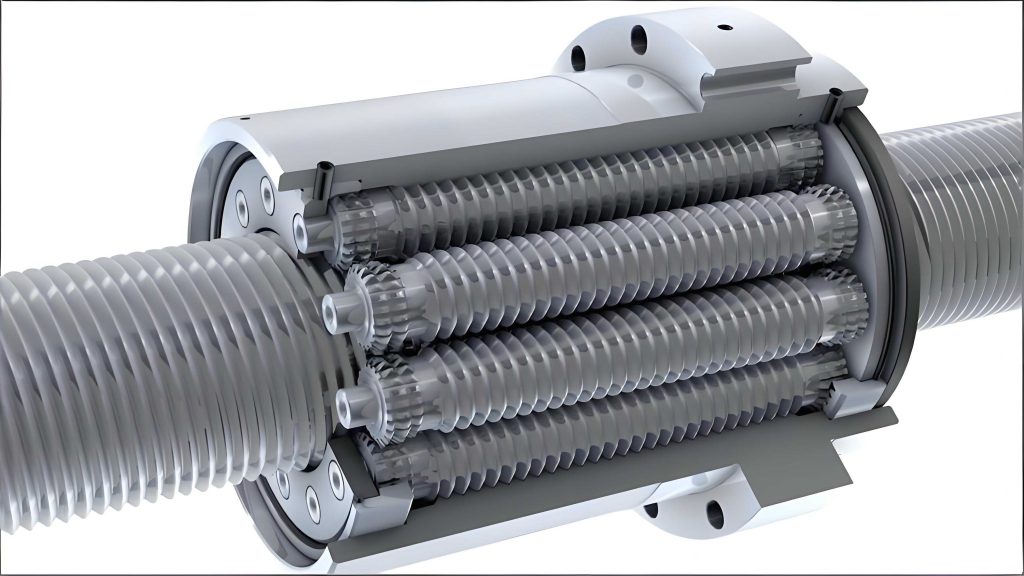
The servo system design is crucial for maintaining stability and accuracy. It comprises a power filter, a book-type power module, and a book-type motor module, all connected to an absolute encoder (AM22DQ) for feedback. The addition of an SMC-30 encoder for a circular grating ensures precise angular measurement, which is essential for correlating rotational position with linear displacement. The control architecture uses a PLC to send motion commands, enabling programmable test sequences such as reciprocating movements over defined travel ranges. This hardware foundation supports the dynamic testing of planetary roller screws, allowing for the collection of multifaceted performance data. Below is a summary of the key hardware components and their functions in the test system:
| Component | Function | Specifications |
|---|---|---|
| Servo Motor | Drives the planetary roller screw | AM22DQ encoder, water-cooled |
| Servo Drive | Controls motor motion | CU320-2PN, PROFINET interface |
| Laser Interferometer | Measures linear displacement | High precision for accuracy tests |
| Infrared Temperature Sensors | Monitors thermal changes | Placed at bearings and nut |
| Vibration Sensors | Captures dynamic responses | Axial and radial measurements |
| Noise Sensor | Assesses acoustic performance | Filters background noise |
| Data Acquisition Card | Interfaces sensors with PC | Supports multiple input channels |
Thermal error compensation is a pivotal aspect of my test system, as the planetary roller screw experiences axial elongation due to frictional heating during operation. This thermal deformation can introduce significant errors in positioning accuracy, especially in high-speed applications. To mitigate this, I implemented a data acquisition system that measures both temperature rise and axial displacement. Two methods were evaluated: an automatic continuous sampling approach and an interrupt-driven method that synchronizes data collection with the screw’s motion. The latter proved more accurate by reducing random errors, as it triggers measurements only when the nut returns to a reference position, confirmed by a circular grating signal. The acquisition program, developed in LabVIEW, initializes by clearing the grating counter and sampling 50 data points to establish a baseline. After the planetary roller screw completes five reciprocating cycles, the program again samples the same position, comparing the data to compute the elongation.
The data processing involves plotting temperature change against axial elongation and fitting a curve using the least squares method. This relationship is modeled linearly, as thermal expansion in planetary roller screws often follows a proportional trend. The fitting equation is expressed as:
$$ L = a + bT $$
where \( L \) is the axial elongation, \( T \) is the temperature rise, and \( a \) and \( b \) are coefficients determined from the data. The coefficients are calculated using the following formulas:
$$ a = \frac{\sum T_i^2 \sum L_i – \sum T_i \sum T_i L_i}{n \sum T_i^2 – (\sum T_i)^2} $$
$$ b = \frac{n \sum T_i L_i – \sum T_i \sum L_i}{n \sum T_i^2 – (\sum T_i)^2} $$
Here, \( T_i \) and \( L_i \) represent the temperature rise and elongation at the \( i \)-th measurement point, respectively, and \( n \) is the number of data samples. The goodness of fit is evaluated using the coefficient of determination \( R^2 \), given by:
$$ R^2 = 1 – \frac{\sum (L_i – \hat{L}_i)^2}{\sum (L_i – \bar{L})^2} $$
where \( \hat{L}_i \) is the predicted elongation from the model, and \( \bar{L} \) is the mean elongation. In my experiments, the fitting yielded \( R^2 = 0.9496 \), indicating a strong correlation. The derived equation was:
$$ L = 0.0128T + 0.0096 $$
This shows that for every 1°C increase in temperature, the planetary roller screw elongates by 0.0128 mm, with an initial offset of 0.0096 mm due to pre-existing conditions. This model forms the basis for real-time compensation during accuracy testing, where the measured elongation is subtracted from the displacement readings to correct for thermal effects.
For the comprehensive performance evaluation, I conducted a series of experiments to assess positioning accuracy, noise, temperature rise, vibration, speed, and acceleration. The accuracy test involved selecting five target positions along the effective travel of the planetary roller screw, with the nut moving reciprocally five times. The parameters for these tests are summarized below:
| Target Position Code | Set Displacement (mm) |
|---|---|
| 1 | 20 |
| 2 | 40 |
| 3 | 60 |
| 4 | 80 |
| 5 | 100 |
The laser interferometer recorded the actual positions, and the data was analyzed to compute bidirectional positioning accuracy, repeatability, and backlash. Without compensation, the errors were significant, but after applying the thermal error compensation, all metrics improved by over 30%. The results are presented in the following table:
| Measurement Item | Before Compensation (μm) | After Compensation (μm) | Improvement Percentage (%) |
|---|---|---|---|
| Bidirectional Positioning Accuracy | 62.07 | 37.66 | 39.33 |
| Bidirectional Repeatability | 18.74 | 12.41 | 33.77 |
| Backlash | 28.32 | 15.26 | 46.11 |
This demonstrates the efficacy of the thermal compensation system in enhancing the precision of planetary roller screw testing. The reduction in errors is crucial for applications requiring high positional accuracy, such as in aerospace and precision machining.
In high-speed testing, the planetary roller screw was operated at a linear velocity of 380 mm/s with an acceleration of 2g. The servo system’s performance was monitored through speed and acceleration waveforms, captured using encoders and data acquisition software. The graphs showed stable motion profiles with minimal deviations, confirming the system’s ability to maintain controlled dynamics under demanding conditions. Temperature measurements revealed a gradual increase over time, with the rear bearing temperature rising from 22.95°C to 25.15°C and the nut temperature from 21.97°C to 23.91°C, while the front bearing remained relatively stable. This thermal behavior underscores the importance of continuous monitoring in planetary roller screw applications.
Noise assessment involved measuring background noise and actual operational noise. The background noise \( dB1 \) was determined by sampling 50 points and applying a median average filter. The operational noise \( dB2 \) was then compared to \( dB1 \), with adjustments made based on the difference: if the difference exceeded 10 dB(A), \( dB2 \) was taken directly; if between 6 and 8 dB(A), 1 dB was subtracted; and if between 8 and 10 dB(A), 0.5 dB was subtracted. This method ensured accurate noise evaluation, which is vital for applications where acoustic emissions are critical, such as in medical or office equipment using planetary roller screws.
Vibration analysis was conducted at various speeds: 150, 200, 250, 300, and 350 mm/s. The vibrations were measured in axial, radial horizontal, and radial vertical directions. The results indicated a slight increase in vibration with speed, but the changes were minimal. For instance, axial vibration increased by only about 3 mm/s² when speed rose from 150 to 350 mm/s. This suggests that the planetary roller screw maintains structural integrity and low vibration levels even at higher speeds, though factors like surface wear and clearance between components may contribute to gradual changes. The data is summarized below:
| Speed (mm/s) | Axial Vibration (mm/s²) | Radial Horizontal Vibration (mm/s²) | Radial Vertical Vibration (mm/s²) |
|---|---|---|---|
| 150 | 5.2 | 4.8 | 5.0 |
| 200 | 5.5 | 5.0 | 5.3 |
| 250 | 5.8 | 5.2 | 5.5 |
| 300 | 6.1 | 5.5 | 5.8 |
| 350 | 6.3 | 5.7 | 6.0 |
The software interface for the test system, developed in LabVIEW, provides a user-friendly platform for configuring tests, monitoring real-time data, and analyzing results. It includes modules for setting parameters such as screw lead, number of starts, travel range, and test type. The data logging feature allows for storage and retrieval of historical tests, facilitating trend analysis and quality control. The integration of thermal error compensation into this software enables automatic adjustment of positioning data, reducing the need for manual intervention and minimizing human error.
In conclusion, the dynamic test system for planetary roller screws that I designed offers a comprehensive solution for evaluating performance under high-speed conditions. By incorporating thermal error compensation, the system significantly improves positioning accuracy, with compensation leading to over 30% enhancement in key metrics. The use of multiple sensors and a robust servo control system ensures reliable measurement of noise, temperature, vibration, speed, and acceleration. This test bed is invaluable for manufacturers and users of planetary roller screws, providing a tool for quality assurance and performance optimization. Future work could focus on extending the compensation model to include nonlinear thermal effects or integrating machine learning for predictive error correction. Overall, this research contributes to advancing the testing technology for planetary roller screws, bridging gaps with international standards and supporting their application in precision industries.
The development of this test system highlights the importance of dynamic testing in capturing real-world behavior of planetary roller screws. Traditional static methods often fail to account for thermal and dynamic variations, leading to incomplete assessments. My approach addresses these limitations by combining hardware precision with software intelligence. The planetary roller screw, as a key component in motion control systems, benefits from such detailed evaluation, ensuring that it meets the stringent requirements of modern engineering applications. Through continuous refinement and validation, this test bed can serve as a benchmark for the industry, promoting higher quality and reliability in planetary roller screw production.