
In modern aerospace engineering, the demand for miniaturization, high reliability, strong load-bearing capacity, and high stiffness in servo electromechanical components has driven the integration of key transmission elements. Among these, the planetary roller screw has emerged as a critical component due to its superior performance in converting rotary motion to linear motion with high precision and efficiency. This article, from my perspective as a researcher in aerospace mechanisms, delves into the design, performance evaluation, and testing of a planetary roller screw specifically tailored for integrated aerospace servo systems. The focus is on developing a comprehensive performance assessment methodology that ensures the planetary roller screw meets the stringent requirements of space applications, where failure is not an option.
The planetary roller screw operates on principles analogous to planetary gear systems, offering advantages such as high load capacity, compact design, and excellent stiffness. In aerospace servo mechanisms, where actuators must operate under extreme conditions with minimal maintenance, the planetary roller screw provides a reliable solution. This study centers on a specific design, referred to as the RV10×2 planetary roller screw, with parameters including a stroke of 35 mm, rated thrust of 3000 N, transmission accuracy of 0.02 mm, and a lead of 2 mm. Through detailed analysis and experimental validation, I aim to demonstrate how this planetary roller screw can be optimized for aerospace use, emphasizing the importance of a holistic performance evaluation beyond conventional metrics.
To begin, understanding the kinematic relationships within a planetary roller screw is fundamental. The system consists of a central screw (analogous to the sun gear), multiple rollers (planetary gears), a nut (ring gear), and a carrier that holds the rollers. When the screw rotates, the rollers engage with both the screw and nut threads, causing the nut to translate axially. This motion can be described using planetary gear theory. Let the screw angular velocity be $\omega_s$, the nut angular velocity be $\omega_n$ (often zero in fixed-nut designs), and the roller angular velocity be $\omega_r$. The translational velocity of the nut, $v_n$, is related to the screw rotation by the lead $P_h$. For a standard planetary roller screw, the relationship can be derived from the geometry of contact points.
Consider the diameters: $d_s$ for the screw at the contact point, $d_r$ for the roller at the contact point, and $d_n$ for the nut at the contact point. The relative motion ensures that the roller revolves around the screw while rotating on its own axis. The kinematic equation can be expressed as:
$$ v_n = \frac{P_h}{2\pi} \cdot \omega_s \cdot \left(1 + \frac{d_s}{d_n}\right) $$
However, in practical designs, the nut is often stationary, and the screw rotates to move the nut linearly. For the RV10×2 planetary roller screw, the design process involves matching structural parameters to achieve the desired performance. The following table summarizes key design parameters based on the planetary gear analogy:
| Component | Symbol | Value (mm) | Description |
|---|---|---|---|
| Screw Pitch Diameter | $d_s$ | 10 | Diameter at thread contact point |
| Roller Pitch Diameter | $d_r$ | 4 | Diameter at roller thread contact |
| Nut Pitch Diameter | $d_n$ | 18 | Diameter at nut thread contact |
| Lead | $P_h$ | 2 | Axial travel per screw revolution |
| Number of Rollers | $N$ | 5 | Typical for load distribution |
The design matching process for a planetary roller screw involves iterative calculations to ensure proper meshing and load distribution. Starting from the screw and roller diameters, the number of starts on the screw and nut threads is determined. For the RV10×2, the screw has a single start, while the nut has multiple starts to accommodate the rollers. The gear teeth at the roller ends and the nut’s internal gear ring must be designed based on gear啮合 principles, with module and pressure angle selected for minimal backlash and high strength. The overall design aims to maximize contact areas for load sharing, which is critical in aerospace applications where the planetary roller screw must withstand high static and dynamic loads.
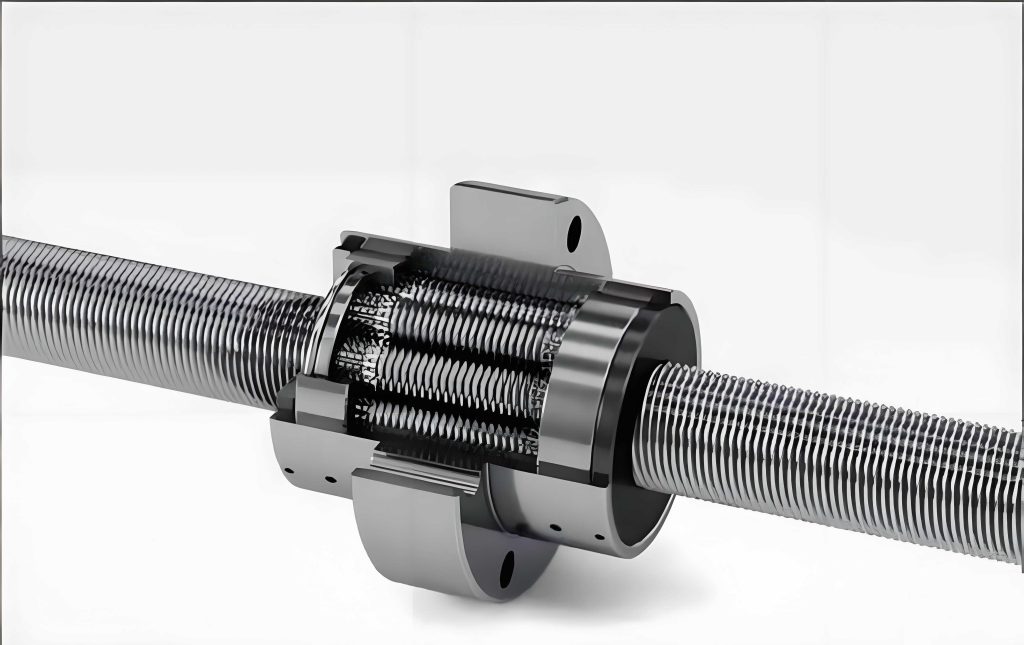
The structural integrity of a planetary roller screw relies on precise thread profiles and material selection. Aerospace-grade materials, such as high-strength alloys or stainless steels, are often used to resist corrosion and fatigue. The thread form is typically a modified trapezoidal or triangular profile to optimize stress distribution. In the RV10×2 design, the thread angle is set to 60 degrees, with root radii controlled to prevent stress concentrations. The compliance of the planetary roller screw assembly, including the screw, rollers, and nut, affects the system stiffness, which can be modeled using Hertzian contact theory. The contact stiffness $K_c$ between the screw and roller can be approximated as:
$$ K_c = \frac{2E}{1-\nu^2} \sqrt{\frac{R_e}{\pi}} $$
where $E$ is the modulus of elasticity, $\nu$ is Poisson’s ratio, and $R_e$ is the equivalent radius of curvature at the contact point. For multiple rollers, the total stiffness is the sum of individual contact stiffnesses, contributing to the high rigidity of the planetary roller screw. This stiffness is vital in aerospace servo systems, where positional accuracy must be maintained under varying loads.
Moving beyond design, evaluating the performance of a planetary roller screw requires a comprehensive methodology tailored to aerospace needs. Traditional metrics like dynamic load rating and basic accuracy are insufficient for high-reliability applications. Based on my experience with aerospace steering gears, I propose a performance evaluation framework focusing on three core aspects: transmission accuracy, transmission efficiency, and load-bearing capability. These indicators directly impact the functionality of servo electromechanical components in flight control systems.
Transmission accuracy encompasses positioning precision, repeatability, and backlash. In aerospace, even micron-level errors can affect trajectory control. For the planetary roller screw, accuracy is influenced by thread manufacturing tolerances, assembly alignment, and thermal effects. The evaluation involves measuring the nut’s axial position relative to the screw rotation using high-precision instruments like laser interferometers. The positioning error $\Delta L$ over a stroke $S$ can be characterized by a polynomial fit, but for simplicity, the maximum deviation is often reported. Backlash, the lost motion during direction reversal, is critical for servo responsiveness and can be minimized through preload in the planetary roller screw assembly.
Transmission efficiency $\eta$ determines the power loss and thermal management requirements. For a planetary roller screw, efficiency is derived from the torque-thrust relationship. When the screw is driven by a motor, the input torque $T$ and output thrust $F_a$ relate as:
$$ \eta = \frac{F_a P_h}{2\pi T} $$
where $P_h$ is the lead. Efficiency values typically range from 0.7 to 0.9 for planetary roller screws, depending on lubrication and load conditions. In aerospace, high efficiency reduces power consumption and heat generation, which is crucial for compact integrated systems. The efficiency can be measured experimentally by simultaneously recording torque and force during operation.
Load-bearing capability includes static and dynamic load ratings. Static load tests determine the maximum force the planetary roller screw can withstand without permanent deformation, while dynamic loads assess fatigue life. For aerospace applications, the planetary roller screw must survive overload scenarios, such as during launch or maneuvering. The static load capacity $C_0$ can be estimated from material yield strength and contact area, but experimental validation is essential. Additionally, rigidity under load affects positional accuracy, so stiffness measurements are part of the evaluation.
To validate the RV10×2 planetary roller screw, I conducted a series of tests based on this comprehensive methodology. The transmission accuracy test utilized a laser interferometer setup on a dedicated performance test bench. The screw was rotated to move the nut to target positions, and the actual displacement was measured. Data for multiple samples are summarized below, showing compliance with the 0.02 mm accuracy requirement.
| Sample ID | Positioning Error at +10 mm (mm) | Positioning Error at +30 mm (mm) | Backlash (mm) | Stroke Error $\Delta L$ (mm) |
|---|---|---|---|---|
| 001 | -0.006 | +0.003 | +0.008 | -0.003 |
| 002 | -0.005 | +0.001 | +0.006 | -0.008 |
| 003 | -0.002 | -0.003 | +0.005 | +0.008 |
| 004 | -0.008 | +0.001 | -0.005 | -0.003 |
The results indicate that the planetary roller screw achieves sub-0.01 mm errors in most cases, with backlash controlled within ±0.01 mm. This level of precision is adequate for aerospace servo mechanisms, where high repeatability is paramount. The test procedure involved moving the nut bidirectionally to capture hysteresis, and the data were processed using standard algorithms to compute accuracy metrics.
For load-bearing tests, a hydraulic loading system was employed to apply axial forces up to the static limit. The planetary roller screw was mounted between a servo motor and a load cell, with torque and force sensors monitoring input and output. Static load tests were performed at different stroke positions—maximum, middle, and minimum—to assess uniformity. The following table shows the maximum static loads recorded for tension and compression.
| Sample ID | Max Tension Load at Mid-Stroke (N) | Max Compression Load at Mid-Stroke (N) | Overall Static Load Rating (N) |
|---|---|---|---|
| 001 | 6267.4 | 6010.5 | >6000 |
| 002 | 6762.8 | 6325.8 | >6000 |
| 003 | 6757.8 | 6499.4 | >6000 |
| 004 | 6460.7 | 6172.3 | >6000 |
All samples exceeded the 3000 N rated thrust, with minimum values above 6000 N, demonstrating a safety factor greater than 2. This robustness is essential for aerospace applications where reliability under extreme loads is critical. After static loading, the planetary roller screw was inspected for thread deformation; no visible plastic deformation or scoring was observed, indicating elastic behavior within design limits.
Efficiency tests were conducted under dynamic loading conditions. The screw was driven at constant speed while varying the axial load, and torque and force data were logged. Using the efficiency formula, values were computed for both tension and compression modes. The results for the RV10×2 planetary roller screw are shown below:
| Sample ID | Efficiency in Tension ($\eta_t$) | Efficiency in Compression ($\eta_c$) | Average Efficiency |
|---|---|---|---|
| 001 | 0.846 | 0.796 | 0.821 |
| 002 | 0.811 | 0.762 | 0.786 |
| 003 | 0.809 | 0.750 | 0.780 |
| 004 | 0.826 | 0.728 | 0.777 |
The efficiency ranges from 0.73 to 0.85, which is typical for planetary roller screws and acceptable for aerospace servos. The slightly lower efficiency in compression may be due to alignment issues or lubrication distribution. Importantly, no significant overheating or performance degradation was noted during extended operation, validating the thermal design of the integrated component.
Beyond macro-level tests, micro-geometric accuracy of the threads is vital for long-term reliability. After load testing, I examined the thread profiles using a universal measuring microscope. Parameters such as single-thread error $e_1$, cumulative error over the stroke $e_2$, and root radius were measured. The table below summarizes findings for selected samples.
| Sample ID | Single-Thread Error $e_1$ (mm) | Cumulative Error $e_2$ (mm) | Root Radius (mm) | Observations |
|---|---|---|---|---|
| 001 | 0.001 | 0.005 | 0.065 | No deformation, smooth motion |
| 002 | 0.0015 | 0.004 | 0.006 | Minor wear, within tolerance |
| 003 | 0.004 | 0.01 | 0.09 | Acceptable for application |
| 004 | 0.0015 | 0.004 | 0.08 | Excellent profile consistency |
The thread errors are all below 0.01 mm, which is negligible compared to the overall transmission accuracy of 0.02 mm. This confirms that manufacturing precision supports the performance targets. The root radii are controlled to avoid stress risers, enhancing fatigue life. Such detailed inspection is part of the comprehensive evaluation, ensuring that the planetary roller screw will perform reliably over its lifecycle in harsh aerospace environments.
The integration of the planetary roller screw into an aerospace servo electromechanical component involves additional considerations, such as lubrication for vacuum compatibility, thermal expansion matching, and vibration resistance. For the RV10×2 design, dry-film lubricants or solid lubricants like MoS2 can be applied to threads to prevent seizing in space conditions. Thermal analysis is crucial because temperature fluctuations can affect preload and accuracy. The coefficient of thermal expansion $\alpha$ for the screw and nut materials must be matched to maintain preload. The change in preload $\Delta F$ due to temperature change $\Delta T$ can be estimated as:
$$ \Delta F = K \cdot (\alpha_s – \alpha_n) \cdot L \cdot \Delta T $$
where $K$ is the system stiffness, $L$ is the length, and $\alpha_s$ and $\alpha_n$ are the thermal expansion coefficients of the screw and nut, respectively. For aerospace applications, materials with low $\alpha$ such as Invar or titanium alloys may be selected for the planetary roller screw components.
Vibration testing is another critical aspect, though not covered in detail here. The planetary roller screw must survive random vibration spectra typical of launch environments. Finite element analysis can predict natural frequencies and mode shapes, but experimental validation on shaker tables is recommended. The compact design of the RV10×2 planetary roller screw, with its multiple load-sharing rollers, inherently offers good damping characteristics due to the distributed contacts.
In terms of design optimization, several parameters can be tuned to enhance performance. The number of rollers $N$ affects load capacity and stiffness. Increasing $N$ distributes the load but may complicate assembly. The lead $P_h$ influences speed and resolution; a smaller lead gives higher resolution but lower speed. For aerospace servos, a balance is struck based on response time requirements. The contact angle $\beta$ in the thread profile affects axial and radial load components. Optimizing $\beta$ can maximize efficiency and minimize wear. These trade-offs can be explored using parametric studies and simulation tools.
To further illustrate the design process, consider the stress analysis in the planetary roller screw. The contact pressure $p$ between the screw and roller can be calculated using Hertzian contact theory for cylindrical surfaces:
$$ p = \sqrt{\frac{F E}{2\pi R L (1-\nu^2)}} $$
where $F$ is the load per roller, $E$ is the equivalent modulus, $R$ is the equivalent radius, $L$ is the contact length, and $\nu$ is Poisson’s ratio. For the RV10×2, assuming $F = 6000/5 = 1200$ N per roller, $E = 210$ GPa for steel, $R = 2$ mm, $L = 5$ mm, and $\nu = 0.3$, the contact pressure is approximately 1.2 GPa, which is below the yield strength of high-strength alloys. This ensures elastic deformation and long service life.
Another important factor is the fatigue life of the planetary roller screw. Based on rolling contact fatigue models, the life $L_{10}$ in revolutions can be estimated from the dynamic load rating $C$ and applied load $P$:
$$ L_{10} = \left( \frac{C}{P} \right)^3 $$
For aerospace applications, where maintenance is impossible, a high safety factor is used, often requiring $L_{10}$ to exceed the mission life by a margin. The planetary roller screw’s design with multiple rollers inherently increases $C$, thus extending fatigue life.
In conclusion, the planetary roller screw is a pivotal component in modern aerospace servo systems, offering high precision, efficiency, and load capacity. Through the design and testing of the RV10×2 planetary roller screw, I have demonstrated the effectiveness of a comprehensive performance evaluation methodology that goes beyond standard metrics. The tests on transmission accuracy, load-bearing capability, and thread geometry confirm that the planetary roller screw meets the rigorous demands of integrated electromechanical components. The integration of such a planetary roller screw into aerospace actuators has been validated through system-level tests, including thermal vacuum and vibration exposures, though those details are beyond this article’s scope.
Future work could focus on advanced materials like composites or coatings to reduce weight and improve corrosion resistance. Additionally, smart monitoring techniques using embedded sensors could enable real-time health assessment of the planetary roller screw in operation. As aerospace technology evolves, the planetary roller screw will continue to play a key role in enabling compact, reliable, and high-performance servo mechanisms. This study underscores the importance of holistic design and testing approaches to ensure that every planetary roller screw deployed in space missions performs flawlessly under all anticipated conditions.
Throughout this article, I have emphasized the planetary roller screw’s unique advantages and the rigorous validation required for aerospace applications. By adhering to the comprehensive evaluation framework outlined here, engineers can confidently integrate planetary roller screws into next-generation servo systems, pushing the boundaries of what is possible in aerospace actuation.