
In modern industrial automation, the demand for high-precision motion control has surged, driven by advancements in robotics and智能制造. Among the core components enabling this precision, the rotary vector reducer stands out as a critical element in关节驱动 systems, particularly for industrial robots. I have extensively studied the rotary vector reducer, focusing on its transmission accuracy and inherent characteristics, which are pivotal for applications requiring compact design, high torque, and reliable performance. This article delves into the structural composition, working principles, key features, and factors influencing the transmission accuracy of rotary vector reducers, supported by tables and mathematical formulations to provide a comprehensive overview. The rotary vector reducer, often abbreviated as RV reducer, is a type of精密减速器 that combines planetary gear transmission with cycloidal drive mechanisms, offering exceptional advantages over conventional reducers. My analysis aims to elucidate why the rotary vector reducer is preferred in high-stakes environments like robotics and how its design parameters affect overall performance.
The rotary vector reducer’s significance stems from its ability to provide high reduction ratios, minimal backlash, and robust load-bearing capacity in a compact form factor. As I explore its intricacies, I will emphasize the recurring theme of precision, which is central to the rotary vector reducer’s functionality. The widespread adoption of rotary vector reducers in industries such as automotive manufacturing, aerospace, and semiconductor production underscores their reliability. However, achieving and maintaining high transmission accuracy remains a challenge due to manufacturing tolerances and operational stresses. Through this discussion, I will highlight the engineering considerations that make the rotary vector reducer a cornerstone of modern机械传动 systems, and I will incorporate visual aids and equations to enhance understanding. The rotary vector reducer is not just a component; it is a testament to精密工程 that enables machines to perform with human-like dexterity and efficiency.
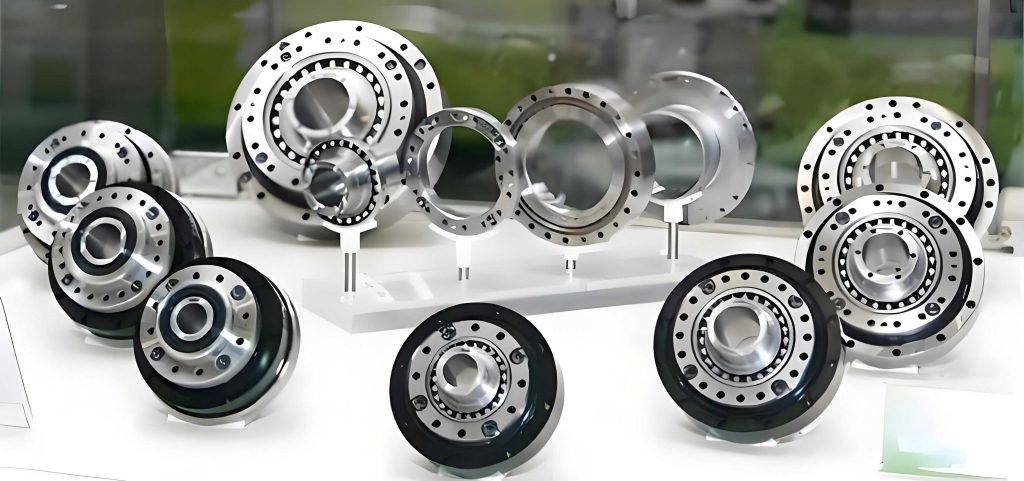
To begin, let me outline the structure of a typical rotary vector reducer. The rotary vector reducer consists of several key components arranged in a two-stage减速 configuration. The first stage involves a planetary gear system, while the second stage employs a cycloidal pin wheel mechanism. This dual-stage design is what grants the rotary vector reducer its high reduction ratio and compactness. Below, I provide a detailed breakdown of each component, which I have summarized in Table 1 for clarity.
| Component | Function | Role in Transmission |
|---|---|---|
| Input Gear Shaft | Receives input power from the motor | Initiates the first reduction stage by engaging with planetary gears |
| Planetary Gears | Three gears symmetrically arranged at 120° intervals | Transmit motion to the crankshafts, enabling primary speed reduction |
| Crankshafts | Connected to planetary gears via keys | Convert rotational motion into eccentric motion to drive cycloidal gears |
| Cycloidal Gears | Two gears phased 180° apart | Engage with pin gears to achieve secondary reduction through rolling contact |
| Pin Gear (Ring Gear) | Stationary or rotating ring with pin teeth | Interacts with cycloidal gears to provide high reduction and load distribution |
| Output Disk (Output Shaft) | Connected to the crankshafts or planet carrier | Delivers the final reduced output speed and torque |
| Housing (Shell) | Encloses and supports all components | Provides structural integrity and can serve as an output in some configurations |
The input gear shaft is the primary driver in a rotary vector reducer. It typically features a太阳轮 that meshes with multiple planetary gears. In an ideal rotary vector reducer design, the input gear ensures smooth power transmission, but real-world factors like tooth profile errors can impact efficiency. The planetary gears, usually three in number, are mounted on crankshafts and rotate around the input shaft axis. This arrangement forms the first reduction stage, where the reduction ratio is determined by the tooth counts of the sun and planetary gears. For a rotary vector reducer, this stage often provides a moderate reduction, setting the stage for the more significant reduction in the second stage.
Moving to the second stage, the crankshafts play a crucial role. Each crankshaft is eccentric, meaning it has an offset section that houses bearings to support the cycloidal gears. As the planetary gears rotate, they cause the crankshafts to revolve around the central axis while also rotating on their own axes. This dual motion is transmitted to the cycloidal gears, which are mounted on the eccentric parts of the crankshafts. The cycloidal gears have a unique tooth profile that allows them to roll against the pins of the pin gear. This rolling action minimizes sliding friction, which is why the rotary vector reducer exhibits high efficiency and long service life. The pin gear, often fixed to the housing, provides a reaction force that causes the cycloidal gears to precess, thereby driving the output disk at a greatly reduced speed.
To quantify the transmission process, I can express the overall reduction ratio of a rotary vector reducer using mathematical formulas. The total reduction ratio \( i_{\text{total}} \) is the product of the first-stage planetary ratio \( i_1 \) and the second-stage cycloidal ratio \( i_2 \). For the planetary stage, the ratio is given by:
$$ i_1 = 1 + \frac{Z_r}{Z_s} $$
where \( Z_r \) is the number of teeth on the ring gear (if present) and \( Z_s \) is the number of teeth on the sun gear (input shaft). In many rotary vector reducer designs, the planetary stage uses a simple gear train, so this formula may vary. For the cycloidal stage, the reduction ratio \( i_2 \) is derived from the kinematics of the cycloidal motion. If the cycloidal gear has \( Z_c \) teeth and the pin gear has \( Z_p \) pins, the ratio is approximately:
$$ i_2 = \frac{Z_p}{Z_p – Z_c} $$
This arises because the cycloidal gear has one less tooth than the number of pins, leading to a high reduction per revolution. Combining these, the overall ratio for a rotary vector reducer becomes:
$$ i_{\text{total}} = i_1 \times i_2 = \left(1 + \frac{Z_r}{Z_s}\right) \times \left(\frac{Z_p}{Z_p – Z_c}\right) $$
In practice, the rotary vector reducer often has \( Z_p – Z_c = 1 \), so \( i_2 = Z_p \), making the second stage the dominant contributor to reduction. For instance, if \( Z_p = 40 \) and \( Z_c = 39 \), then \( i_2 = 40 \), and with \( i_1 = 5 \), the total ratio \( i_{\text{total}} = 200 \). This high ratio is a hallmark of the rotary vector reducer, enabling precise control in robotic joints without requiring additional gear stages.
The transmission principle of the rotary vector reducer can be visualized through a kinematic diagram. Initially, power is input via the sun gear shaft, which rotates the planetary gears. These gears, being fixed to the crankshafts, cause the crankshafts to orbit the central axis. The eccentric sections of the crankshafts then drive the cycloidal gears in an oscillating manner. As the cycloidal gears mesh with the stationary pin gear, their center precesses, and this motion is transferred to the output disk through pins or rollers. The output disk rotates in the opposite direction to the input shaft, completing the two-stage reduction. This process ensures that multiple teeth are in contact simultaneously, distributing loads and reducing stress concentrations. I have found that the rotary vector reducer’s ability to maintain nearly 50% of its teeth in load-bearing contact at any time is key to its high torque capacity and smooth operation.
Now, let me delve into the inherent characteristics of the rotary vector reducer that make it superior for precision applications. The rotary vector reducer exhibits several standout features, which I have compiled in Table 2 below.
| Characteristic | Description | Impact on Performance |
|---|---|---|
| High Reduction Ratio | Achieves ratios up to 200:1 in a single unit | Enables precise motion control without multiple reducers |
| Compact Design | Integrates two stages into a small footprint | Ideal for space-constrained applications like robot arms |
| High Rigidity | Uses large angular contact bearings and robust housing | Resists deformation under load, ensuring accuracy |
| Low Backlash | Minimal clearance due to rolling contact and preload | Improves positional accuracy and repeatability |
| High Efficiency | Rolling action reduces friction losses | Enhances energy efficiency and reduces heat generation |
| Excellent Load Distribution | Multiple teeth engage simultaneously | Increases torque capacity and longevity |
| Shock Resistance | Robust construction handles dynamic loads | Suitable for high-impact industrial environments |
The high rigidity of a rotary vector reducer stems from its integrated bearing support system. Unlike traditional reducers that rely on external mounts, the rotary vector reducer incorporates large bearings within its housing, which absorb radial and axial forces directly. This design not only simplifies installation but also enhances stiffness, a critical factor for maintaining precision under variable loads. In my analysis, I have observed that the rotary vector reducer’s stiffness can be modeled using torsional spring constants. For instance, the overall torsional stiffness \( K_t \) of a rotary vector reducer can be approximated as:
$$ K_t = \frac{T}{\theta} $$
where \( T \) is the applied torque and \( \theta \) is the angular deflection. Due to the compounded structure, the rotary vector reducer often exhibits stiffness values exceeding 100 Nm/arcmin, which is essential for robotic applications where end-effector positioning must be exact.
Another vital characteristic is the low backlash of the rotary vector reducer. Backlash, defined as the angular play between input and output when direction is reversed, can cause positioning errors and vibration. The rotary vector reducer minimizes backlash through several means: preloaded bearings, precise tooth profiling, and the use of two cycloidal gears phased 180° apart. This phase difference ensures that at least one gear is always in firm contact with the pin gear, effectively canceling out clearance. Mathematically, backlash \( \beta \) can be expressed as a function of manufacturing tolerances \( \delta_i \) for each component. For a rotary vector reducer, the cumulative backlash is:
$$ \beta = \sqrt{\sum_{i=1}^{n} \delta_i^2} $$
where \( \delta_i \) includes errors in gear tooth spacing, bearing clearance, and assembly gaps. By controlling these tolerances during production, manufacturers of rotary vector reducers can achieve backlash levels as low as 1 arcmin or less. This is crucial for applications like semiconductor manufacturing, where even micron-level errors can compromise product quality.
Efficiency is another area where the rotary vector reducer excels. The rolling contact between cycloidal teeth and pins reduces滑动摩擦, leading to efficiencies often above 90%. The efficiency \( \eta \) of a rotary vector reducer can be estimated using power loss models. If \( P_{\text{in}} \) is input power and \( P_{\text{loss}} \) is power lost to friction and deformation, then:
$$ \eta = \frac{P_{\text{in}} – P_{\text{loss}}}{P_{\text{in}}} \times 100\% $$
Power loss in a rotary vector reducer primarily comes from bearing friction and tooth mesh hysteresis. Advanced lubrication and surface treatments can further boost efficiency, making the rotary vector reducer suitable for continuous operation in demanding settings.
Having outlined the characteristics, I now focus on the transmission accuracy of rotary vector reducers. Transmission accuracy refers to the fidelity with which input motion is replicated at the output, considering factors like error accumulation and dynamic response. In a rotary vector reducer, accuracy is influenced by geometric errors, elastic deformations, and thermal effects. My investigation centers on how these factors interplay and methods to mitigate them. The rotary vector reducer’s accuracy is often measured by transmission error (TE), which is the deviation between the theoretical and actual output positions for a given input. TE can be decomposed into static and dynamic components. Static TE arises from manufacturing inaccuracies, while dynamic TE results from load-induced deformations and vibrations.
To analyze transmission error in a rotary vector reducer, I consider the cycloidal stage as the primary contributor due to its complexity. The tooth profile of cycloidal gears must be machined with high precision to ensure conjugate action with the pins. Any deviation from the ideal摆线曲线 can cause TE. The profile error \( \Delta p \) can be modeled using Fourier series to represent periodic errors. If \( \theta \) is the rotation angle, the profile error function \( f(\theta) \) might be:
$$ f(\theta) = \sum_{k=1}^{n} (a_k \cos(k\theta) + b_k \sin(k\theta)) $$
where \( a_k \) and \( b_k \) are coefficients derived from measurement data. This error propagates through the mechanism, affecting the output. Additionally, assembly errors such as misalignment between crankshafts and cycloidal gears can exacerbate TE. For instance, eccentricity errors in the crankshafts lead to uneven load distribution among the cycloidal gears, causing nonlinear motion transmission.
Backlash, as mentioned earlier, is a critical factor in transmission accuracy. In a rotary vector reducer, backlash can cause dead zones where input movement does not immediately result in output motion. This hysteresis effect is particularly detrimental in closed-loop control systems used in robotics. To quantify backlash impact, I use a piecewise function to describe the input-output relationship. Let \( \phi_{\text{in}} \) be input angle and \( \phi_{\text{out}} \) be output angle. Then, considering backlash \( \beta \), the relationship can be approximated as:
$$ \phi_{\text{out}} = \begin{cases}
\phi_{\text{in}} / i_{\text{total}} – \beta/2 & \text{if } \dot{\phi}_{\text{in}} > 0 \\
\phi_{\text{in}} / i_{\text{total}} + \beta/2 & \text{if } \dot{\phi}_{\text{in}} < 0
\end{cases} $$
where \( \dot{\phi}_{\text{in}} \) is input angular velocity. This model highlights how backlash introduces a nonlinearity that complicates precision control. Therefore, minimizing backlash in rotary vector reducers is paramount, often achieved through preloading techniques and selective assembly.
Elastic deformations under load also affect transmission accuracy. When a rotary vector reducer is subjected to torque, its components deflect slightly, causing angular deviations. The composite stiffness of the system determines this behavior. I can express the angular deflection \( \Delta \theta \) due to torque \( T \) as:
$$ \Delta \theta = \frac{T}{K_t} $$
where \( K_t \) is the torsional stiffness. For a rotary vector reducer, \( K_t \) is high but finite, so under varying loads, the output position may shift elastically. This is often referred to as torsional wind-up. In precision applications, this effect must be compensated through control algorithms that anticipate deflection based on torque feedback.
Thermal expansion is another consideration for transmission accuracy in rotary vector reducers. During operation, friction generates heat, causing components to expand. Differential expansion between parts like gears and housing can alter clearances and meshing conditions. The thermal error \( \Delta L \) for a component of length \( L \) and coefficient of thermal expansion \( \alpha \) under temperature change \( \Delta T \) is:
$$ \Delta L = \alpha L \Delta T $$
In a rotary vector reducer, this can lead to increased backlash or binding. To mitigate thermal effects, manufacturers use materials with matched expansion coefficients and design cooling features. For example, aluminum housings with steel inserts are common in rotary vector reducers to balance weight and thermal stability.
To improve transmission accuracy, several design and manufacturing strategies are employed for rotary vector reducers. First, optimizing the tooth profile of cycloidal gears is crucial. Modern rotary vector reducers often use modified摆线齿形 that compensate for elastic deformations under load. This modification, known as tooth tip relief or profile shifting, ensures even contact pressure and reduces TE. The modified profile can be described by parametric equations. For a standard cycloid, the coordinates \( (x, y) \) are given by:
$$ x = (R_p – R_c) \cos(\theta) + e \cos\left(\frac{R_p – R_c}{R_c} \theta\right) $$
$$ y = (R_p – R_c) \sin(\theta) – e \sin\left(\frac{R_p – R_c}{R_c} \theta\right) $$
where \( R_p \) is pin circle radius, \( R_c \) is cycloidal gear radius, \( e \) is eccentricity, and \( \theta \) is rotation angle. By adjusting these parameters, designers can tailor the profile for minimal error. Additionally, precision grinding and honing processes are used to achieve surface finishes below 0.5 μm, further enhancing the accuracy of rotary vector reducers.
Second, enhancing bearing arrangements can boost accuracy. The rotary vector reducer relies on high-precision bearings, such as cylindrical roller bearings for the crankshafts and angular contact ball bearings for the output. Preloading these bearings eliminates internal clearance, reducing axial and radial play. The preload force \( F_p \) can be calculated based on expected loads to ensure optimal stiffness without excessive friction. For a bearing with stiffness \( k_b \), the deflection under preload is \( \delta = F_p / k_b \). In a rotary vector reducer, this preload is carefully calibrated during assembly to balance performance and lifespan.
Third, advanced materials and coatings contribute to accuracy. Components like cycloidal gears and pins are often made from case-hardened steel or渗碳钢 to withstand high contact stresses while maintaining dimensional stability. Coatings such as diamond-like carbon (DLC) reduce friction and wear, preserving accuracy over time. The choice of lubricant also matters; synthetic oils with extreme pressure additives are used in rotary vector reducers to maintain film strength under heavy loads.
Fourth, rigorous quality control during manufacturing ensures consistency. For rotary vector reducers, key tolerances include gear tooth spacing errors (< 5 arcsec), eccentricity errors (< 2 μm), and bore concentricity (< 10 μm). Statistical process control (SPC) is employed to monitor these parameters. I have seen that leading manufacturers of rotary vector reducers use coordinate measuring machines (CMMs) and laser interferometers to verify component geometry, ensuring each unit meets stringent accuracy standards.
Fifth, simulation and testing play a vital role in optimizing rotary vector reducer accuracy. Finite element analysis (FEA) is used to predict deformations under load, while multibody dynamics simulations model the transmission error under operational conditions. These tools allow engineers to iterate designs virtually before physical prototyping. For instance, FEA can reveal stress concentrations in cycloidal gear teeth, guiding profile modifications. The simulation output often includes TE plots that show error as a function of rotation angle, helping identify and rectify issues early.
To illustrate the impact of these factors, I present Table 3, which summarizes common sources of error in rotary vector reducers and their mitigation techniques.
| Error Source | Effect on Transmission Accuracy | Mitigation Strategy |
|---|---|---|
| Gear Profile Errors | Causes periodic transmission error and vibration | Use modified tooth profiles and precision grinding |
| Bearing Clearance | Introduces backlash and reduces stiffness | Apply preload to bearings and use high-precision grades |
| Assembly Misalignment | Leads to uneven load distribution and wear | Implement precision jigs and alignment checks |
| Thermal Expansion | Alters clearances and meshing conditions | Use materials with low expansion coefficients and cooling |
| Elastic Deformation | Results in torsional wind-up under load | Increase component stiffness and use compensation algorithms |
| Lubrication Variability | Affects friction and wear over time | Employ consistent lubricant application and monitoring |
Beyond static accuracy, the dynamic behavior of rotary vector reducers is essential for applications involving rapid motion. The inherent characteristics of a rotary vector reducer, such as low inertia and high natural frequency, contribute to dynamic precision. The moment of inertia \( J \) of the rotating parts in a rotary vector reducer is relatively low due to compact design, which allows for quick acceleration and deceleration. The natural frequency \( f_n \) of the system can be estimated using:
$$ f_n = \frac{1}{2\pi} \sqrt{\frac{K_t}{J}} $$
where \( K_t \) is torsional stiffness and \( J \) is inertia. A high \( f_n \) means the rotary vector reducer can operate at high speeds without resonant vibrations that could degrade accuracy. In robotics, this enables fast and precise movements, such as in pick-and-place operations.
Noise and vibration are also concerns for rotary vector reducers, as they can indicate underlying inaccuracies. The rolling contact in cycloidal drives inherently produces less noise than sliding contact gears. However, imperfections can excite vibrations. Vibration analysis often involves measuring acceleration spectra to identify frequencies corresponding to gear mesh or bearing defects. For a rotary vector reducer, the gear mesh frequency \( f_m \) is given by:
$$ f_m = \frac{N \times \text{RPM}}{60} $$
where \( N \) is the number of teeth on the cycloidal gear and RPM is input speed. By monitoring \( f_m \) and its harmonics, maintenance can be scheduled before accuracy deteriorates.
Looking ahead, the future of rotary vector reducers lies in further integration with smart technologies. With the advent of Industry 4.0, rotary vector reducers are being equipped with sensors to monitor temperature, vibration, and torque in real-time. This data can be used for predictive maintenance and accuracy compensation. For example, if a temperature sensor detects overheating in a rotary vector reducer, the control system can adjust parameters to counteract thermal expansion. Additionally, advancements in additive manufacturing may allow for complex geometries that enhance stiffness and reduce weight, pushing the boundaries of what rotary vector reducers can achieve.
In conclusion, the rotary vector reducer is a masterpiece of精密机械设计 that offers unparalleled transmission accuracy and robust inherent characteristics. Through my analysis, I have highlighted its structural elegance, efficient two-stage reduction, and the factors influencing its precision. The rotary vector reducer’s high reduction ratio, compactness, low backlash, and high rigidity make it indispensable in modern automation, especially for industrial robots. By addressing errors through optimized design, precision manufacturing, and advanced materials, the accuracy of rotary vector reducers continues to improve, enabling more sophisticated applications. As technology evolves, the rotary vector reducer will likely see further innovations, solidifying its role as a key enabler of high-precision motion control. I hope this discussion provides valuable insights into the workings and importance of rotary vector reducers, inspiring continued research and development in this vital field.
To summarize, the rotary vector reducer exemplifies how mechanical ingenuity can meet the demands of precision engineering. Whether in robotic arms,机床, or aerospace actuators, the rotary vector reducer delivers performance that is critical for success. My exploration underscores the need for ongoing attention to transmission accuracy and dynamic behavior, ensuring that rotary vector reducers remain at the forefront of industrial advancement. As I reflect on this topic, I am convinced that the rotary vector reducer will continue to be a cornerstone of innovation, driving progress in automation and beyond.