
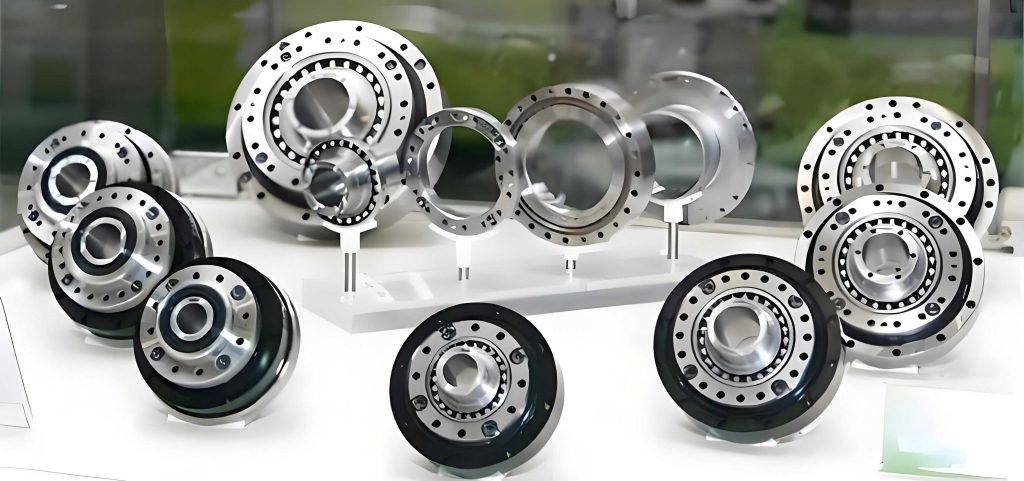
In the field of precision robotics and heavy-duty machinery, the rotary vector reducer plays a critical role due to its high transmission efficiency, compact size, and ability to handle significant torque loads. As a type of cycloidal pin-wheel reducer, the rotary vector reducer incorporates a two-stage reduction mechanism: the first stage involves involute spur gear transmission, and the second stage employs a double cycloidal pin-wheel transmission. This design ensures smooth operation, high precision, and durability, making it ideal for applications in industrial robots and automated systems. However, the complex manufacturing processes and proprietary technologies surrounding rotary vector reducers have hindered their widespread development, posing a challenge to the advancement of smart manufacturing. In this article, I will delve into the transmission mechanics of rotary vector reducers, focusing on reduction ratio calculation, meshing force analysis, and parameter influence assessment using the osculating value method. My goal is to provide a comprehensive understanding that can aid in the optimization and design of these essential components.
The rotary vector reducer typically consists of an input shaft connected to a central gear, which meshes with planetary gears mounted on crankshafts. These crankshafts drive two cycloidal gears that engage with a fixed pin wheel, leading to output rotation through a W-mechanism. The arrangement of dual cycloidal gears at 180° offsets helps balance eccentric inertial forces, ensuring stable operation. Understanding the transmission characteristics begins with calculating the reduction ratio, which defines the relationship between input and output speeds. I will use a relative motion approach based on gear meshing principles, as it offers an intuitive alternative to the inversion method commonly cited in literature. This method, while more detailed, provides a clear geometric perspective on the motion transfer within the rotary vector reducer.
Consider a simplified model of a rotary vector reducer, where the input shaft (component 1) rotates with angular velocity $\omega_1$, and the output shaft (component 5) rotates with $\omega_5$. The cycloidal gear (component 3) is connected to the output shaft via the W-mechanism, so their angular velocities are equal: $\omega_3 = \omega_5$. The planetary gears (component 2) are fixed to crankshafts and mesh with the central gear. Using velocity relations at contact points A and B, as derived from gear kinematics, the reduction ratio can be expressed as:
$$\frac{\omega_1}{\omega_5} = 1 + \frac{R_2 R_6}{(R_6 – R_3) R_1}$$
where $R_1$ and $R_2$ are the radii of the central gear and planetary gear, respectively, and $R_3$ and $R_6$ are the radii of the cycloidal gear and pin wheel. By substituting gear tooth numbers—$Z_1$, $Z_2$, $Z_3$, and $Z_6$—the equation transforms to:
$$\frac{\omega_1}{\omega_5} = 1 + \frac{Z_6 \times Z_2}{Z_6 Z_1 – Z_1 Z_3}$$
For a specific rotary vector reducer model, such as the RV-40E, with parameters $Z_6=40$, $Z_1=10$, $Z_2=26$, and $Z_3=39$, the reduction ratio computes to:
$$\frac{\omega_1}{\omega_5} = 1 + \frac{40 \times 26}{40 \times 10 – 10 \times 39} = 105$$
This result confirms the high reduction capability of rotary vector reducers, aligning with practical applications in robotics where precise motion control is essential. The relative motion method, though intricate, enhances comprehension by visualizing the interaction between components, complementing the inversion technique often used in prior studies.
Transitioning to force analysis, the meshing between cycloidal gears and pin teeth is a cornerstone of rotary vector reducer performance. Unlike standard cycloidal drives, rotary vector reducers often utilize pin wheels without sleeves, necessitating a tailored approach to force calculation. The meshing force distribution depends on factors such as gear geometry, material properties, and operating conditions. For the RV-40E model, key parameters include: pin tooth center circle radius $r_z = 64 \, \text{mm}$, pin tooth radius $r_{rp} = 3 \, \text{mm}$, pin wheel inner radius $r_p = 70 \, \text{mm}$, eccentricity $e = 1.3 \, \text{mm}$, pin tooth count $z_p = 40$, cycloidal gear tooth count $z_c = 39$, and cycloidal gear thickness $b_c = 8.86 \, \text{mm}$. The input speed is $v_1 = 525 \, \text{r/min}$, output speed $v_2 = 5 \, \text{r/min}$, and output torque $T = 572 \, \text{N} \cdot \text{m}$, with material elastic moduli and Poisson’s ratios specified for each component.
The meshing force analysis begins by considering the initial gaps between cycloidal gear teeth and pin teeth, which arise from profile modifications like equidistant and offset adjustments. These gaps, denoted $\Delta(\varphi_i)$ for the $i$-th pin tooth at angle $\varphi_i$, are given by:
$$\Delta(\varphi_i) = a \frac{(1 – k \cos \varphi_i – \sqrt{1 – k^2} \sin \varphi_i)}{\sqrt{1 + k^2 – 2k \cos \varphi_i}} + b \left(1 – \frac{\sin \varphi_i}{\sqrt{1 + k^2 – 2k \cos \varphi_i}}\right)$$
where $k = e z_p / r_z$ is the short-term coefficient (e.g., $k = 0.8125$ for RV-40E), $a$ is the offset modification amount (e.g., $a = 0.008 \, \text{mm}$), and $b$ is the equidistant modification amount (e.g., $b = -0.002 \, \text{mm}$). Under load, elastic deformations occur at the cycloidal gear-pin tooth interface and the pin tooth-pin wheel interface, leading to multiple tooth engagement if the total deformation exceeds the initial gap. The contact deformation $\omega$ for cylindrical surfaces of length $L$ (here, $L = b_c$) is derived from Hertzian theory:
$$\omega = \frac{2F}{\pi L} \left[ \frac{1 – \mu_1^2}{E_1} \left( \frac{1}{3} + \ln \frac{4R_1}{b} \right) + \frac{1 – \mu_2^2}{E_2} \left( \frac{1}{3} + \ln \frac{4R_2}{b} \right) \right]$$
where $F$ is the meshing force, $E_1, E_2$ are elastic moduli, $\mu_1, \mu_2$ are Poisson’s ratios, $R_1, R_2$ are radii, and $b$ is the contact half-width calculated as:
$$b = 1.60 \sqrt{\frac{F}{L} K_D \left( \frac{1 – \mu_1^2}{E_1} + \frac{1 – \mu_2^2}{E_2} \right)}$$
The equivalent curvature radius $K_D$ varies based on contact type: for convex-convex contact (cycloidal gear and pin tooth), $K_D = 2R_1 R_2 / (R_1 + R_2)$; for convex-concave contact (pin tooth and pin wheel), $K_D = 2R_1 R_2 / (R_2 – R_1)$. The curvature radius of the cycloidal gear tooth profile, $\rho_0$, is:
$$\rho_0 = \frac{(r_z + a)(1 + k^2 – 2k \cos \varphi_i)^{3/2}}{k(z_p + 1) \cos \varphi_i – (1 + z_p k^2)} + (r_{rp} + b)$$
By iteratively solving for the maximum deformation $\omega_{\text{max}}$ and evaluating the condition $\delta_i – \Delta(\varphi_i) > 0$, where $\delta_i = (\sin \varphi_i / \sqrt{1 + k^2 – 2k \cos \varphi_i}) \delta_{\text{max}}$ is the deformation in the normal direction, the meshing force for each engaged tooth $i$ is:
$$F_i = \frac{\delta_i – \Delta(\varphi_i)}{\omega_{\text{max}}} F_{\text{max}}$$
The maximum meshing force $F_{\text{max}}$ is determined from torque balance, considering the torque on a single cycloidal gear $T_c = 0.55T$:
$$F_{\text{max}} = \frac{0.55 T}{\sum_{i=m}^n \left( \frac{l_i}{r_c’} – \frac{\Delta(\varphi_i)}{\omega_{\text{max}}} \right) l_i}$$
where $l_i = r_c’ (\sin \varphi_i / \sqrt{1 + k^2 – 2k \cos \varphi_i})$ is the distance from the meshing point to the cycloidal gear center, and $r_c’ = e z_c$ is the pitch radius. Initial estimates for $F_{\text{max}}$ combine the no-gap and full-gap scenarios, refined through iteration until convergence. For the RV-40E rotary vector reducer, this analysis yields meshing over teeth 2 to 11, with maximum force $F_{\text{max}} = 1190.8 \, \text{N}$ occurring near the 4th pin tooth, consistent with theoretical predictions. The contact stress $\sigma_H$ at each meshing point is calculated using:
$$\sigma_H = 0.418 \sqrt{\frac{E_d F_i}{b_c p_{ei}}}$$
with equivalent elastic modulus $E_d = 2E_1 E_2 / (E_1 + E_2)$ and equivalent curvature radius $p_{ei} = \rho_i r_{rp} / (\rho_i – r_{rp})$. The results for meshing forces and contact stresses are summarized in Table 1, illustrating the distribution across engaged teeth.
| Tooth Number | Meshing Force (N) | Contact Stress (N/mm²) |
|---|---|---|
| 2 | 762.7 | 935.49 |
| 3 | 1107.7 | 1147.2 |
| 4 | 1190.8 | 1276.9 |
| 5 | 1151.5 | 1320.1 |
| 6 | 1046.2 | 1323 |
| 7 | 901.19 | 1290.8 |
| 8 | 730.54 | 1223.2 |
| 9 | 542.63 | 1114.4 |
| 10 | 343.07 | 948.16 |
| 11 | 135.90 | 657.27 |
The resultant forces on a cycloidal gear in the X and Y directions are obtained by summing vector components: $F_x = \sum F_i \cos \beta_i$ and $F_y = \sum F_i \sin \beta_i$, where $\tan \beta_i = (\cos(2\pi i / z_p) – k) / \sin(2\pi i / z_p)$. For the RV-40E, these compute to $F_x = 7422.005 \, \text{N}$ and $F_y = 1245.9 \, \text{N}$, representing the total load on a single cycloidal gear in the rotary vector reducer assembly. This detailed force analysis is fundamental for assessing durability and optimizing the design of rotary vector reducers.
Building on the meshing force analysis, I now explore the influence of various parameters on transmission forces in rotary vector reducers. Key parameters include pin tooth radius $r_{rp}$, offset modification amount $a$, equidistant modification amount $b$, cycloidal gear thickness $b_c$, and crankshaft eccentricity $e$. To systematically evaluate their impact, I employ the osculating value method, a statistical approach that ranks parameters based on multiple criteria. This method involves constructing an original index matrix with parameters as rows and evaluation metrics as columns, then normalizing the data to identify optimal and inferior points. The osculating value $C$ quantifies the closeness to the optimal set, with lower values indicating greater influence on transmission forces.
For the rotary vector reducer, the evaluation metrics consider: changes in resultant forces $F_x$ and $F_y$ when each parameter varies by $0.001 \, \text{mm}$, original parameter values, material elastic moduli, and manufacturability difficulty. The original index matrix is shown in Table 2, capturing these aspects for each parameter.
| Parameter | $F_x$ (N) | $F_y$ (N) | Original Value (mm) | Elastic Modulus (N/m²) | Difficulty |
|---|---|---|---|---|---|
| Pin tooth radius ($r_{rp}$) | 7421.9 | 1245.9 | 3 | 2.08e11 | 0.15 |
| Offset modification ($a$) | 7772.3 | 1238.2 | 0.008 | 2.07e11 | 0.25 |
| Equidistant modification ($b$) | 7123.7 | 1242.2 | 0.002 | 2.07e11 | 0.25 |
| Cycloidal gear thickness ($b_c$) | 7421.9 | 1245.9 | 8.86 | 2.07e11 | 0.15 |
| Crankshaft eccentricity ($e$) | 7412.9 | 1247.5 | 1.3 | 2.07e11 | 0.20 |
After normalizing the matrix to a standardized form, the optimal point set $G$ and inferior point set $B$ are derived. The osculating value $C$ for each parameter is calculated as:
$$C = \frac{d_i^+}{d_{\text{min}}^+} – \frac{d_i^-}{d_{\text{max}}^-}$$
where $d_i^+$ is the distance to the optimal point, $d_i^-$ is the distance to the inferior point, $d_{\text{min}}^+$ is the minimum optimal distance, and $d_{\text{max}}^-$ is the maximum inferior distance. The results, presented in Table 3, rank parameters by their influence on transmission forces in the rotary vector reducer.
| Parameter | Osculating Value $C$ | Rank |
|---|---|---|
| Cycloidal gear thickness ($b_c$) | 0 | 1 |
| Pin tooth radius ($r_{rp}$) | 2.6633 | 2 |
| Crankshaft eccentricity ($e$) | 3.4990 | 3 |
| Offset modification ($a$) | 4.0402 | 4 |
| Equidistant modification ($b$) | 4.0503 | 5 |
This analysis reveals that cycloidal gear thickness, pin tooth radius, and crankshaft eccentricity are the most closely related parameters to transmission forces in rotary vector reducers. Consequently, in structural optimization efforts for rotary vector reducers, these three should be prioritized as design variables to enhance performance and reliability. The osculating value method offers a robust, quantitative framework for decision-making, complementing traditional engineering approaches.
To further elaborate on the significance of these findings, I will discuss each key parameter in detail. Cycloidal gear thickness $b_c$ directly affects the contact area and bending stiffness, influencing stress distribution and load capacity in rotary vector reducers. A thicker gear can reduce deformation under load, but may increase weight and inertia. Optimizing this parameter involves balancing strength requirements with spatial constraints. Pin tooth radius $r_{rp}$ impacts the Hertzian contact stress and wear characteristics; larger radii can lower stress concentrations but may alter meshing dynamics. In rotary vector reducers, the pin tooth geometry is critical for smooth engagement with cycloidal gears, especially in sleeveless designs where direct metal-to-metal contact occurs. Crankshaft eccentricity $e$ determines the cycloidal gear’s motion amplitude and torque transmission; variations in $e$ affect the reduction ratio and force distribution, making it a pivotal variable in the design of rotary vector reducers.
Moreover, the modification amounts $a$ and $b$ play a role in compensating for manufacturing tolerances and ensuring proper meshing. However, the osculating value analysis indicates their lesser influence compared to the primary three parameters, suggesting that fine-tuning these may be secondary in initial optimization stages for rotary vector reducers. Elastic moduli and manufacturability factors, while considered, show minimal variation across parameters in this context, highlighting the dominance of geometric dimensions in force transmission.
In practical applications, such as robotic joints or precision machinery, the performance of rotary vector reducers hinges on these parametric interactions. For instance, in the RV-40E model, the calculated meshing forces and stresses provide a baseline for fatigue life estimation and material selection. By integrating the osculating value method into the design process, engineers can systematically evaluate trade-offs, leading to more efficient and durable rotary vector reducers. This approach aligns with trends in smart manufacturing, where data-driven optimization enhances component reliability.
Looking ahead, advancements in materials science, such as composite alloys or surface treatments, could further improve the efficiency of rotary vector reducers. Additionally, digital twin simulations combining finite element analysis with real-time monitoring may enable predictive maintenance, reducing downtime in industrial settings. The ongoing research into rotary vector reducers, including my work here, contributes to a deeper understanding of their mechanics, fostering innovation in robotics and automation.
In conclusion, my analysis of rotary vector reducers using the osculating value method underscores the importance of cycloidal gear thickness, pin tooth radius, and crankshaft eccentricity in transmission force dynamics. The relative motion method for reduction ratio calculation offers an intuitive alternative to inversion techniques, while detailed meshing force analysis provides insights into load distribution and contact stresses. These findings pave the way for optimized designs, ensuring that rotary vector reducers continue to meet the demands of high-precision, heavy-duty applications. As technology evolves, continued exploration of these parameters will be essential for advancing the capabilities of rotary vector reducers in modern engineering systems.
Throughout this article, I have emphasized the role of rotary vector reducers in enabling precise motion control, and I hope this comprehensive discussion serves as a valuable resource for researchers and practitioners. By leveraging analytical methods like the osculating value approach, we can unlock new potentials in the design and application of rotary vector reducers, driving progress in fields ranging from industrial robotics to aerospace. The journey toward more efficient and reliable rotary vector reducers is ongoing, and I am confident that continued investigation will yield even greater innovations in the years to come.