
In the field of industrial robotics, precision and reliability are paramount for joint actuators. Among various reduction mechanisms, the rotary vector reducer stands out due to its exceptional performance characteristics. As a key component within this system, the cycloid wheel directly influences the overall operational state of the rotary vector reducer. In this study, I conduct a thorough theoretical analysis of the cycloid wheel, calculating its stress conditions during operation. I then develop a model using Pro/E software and perform a finite element analysis (FEA) via the SolidWorks Simulation module to evaluate its strength. The goal is to verify that the cycloid wheel can withstand operational loads, thereby ensuring the durability and efficiency of the rotary vector reducer.
The rotary vector reducer is widely adopted in industrial robot joints because of its compact design and high torque capacity. Its operation involves a two-stage reduction process: the first stage consists of a planetary gear train, and the second stage employs a cycloidal drive. This combination allows the rotary vector reducer to achieve high reduction ratios, typically ranging from 31 to 171, while maintaining excellent torsional stiffness and minimal backlash. The performance of the rotary vector reducer heavily relies on the cycloid wheel, which engages with multiple pin teeth to transmit motion smoothly. Understanding the stress distribution within the cycloid wheel is crucial for optimizing the design and preventing premature failure in the rotary vector reducer.
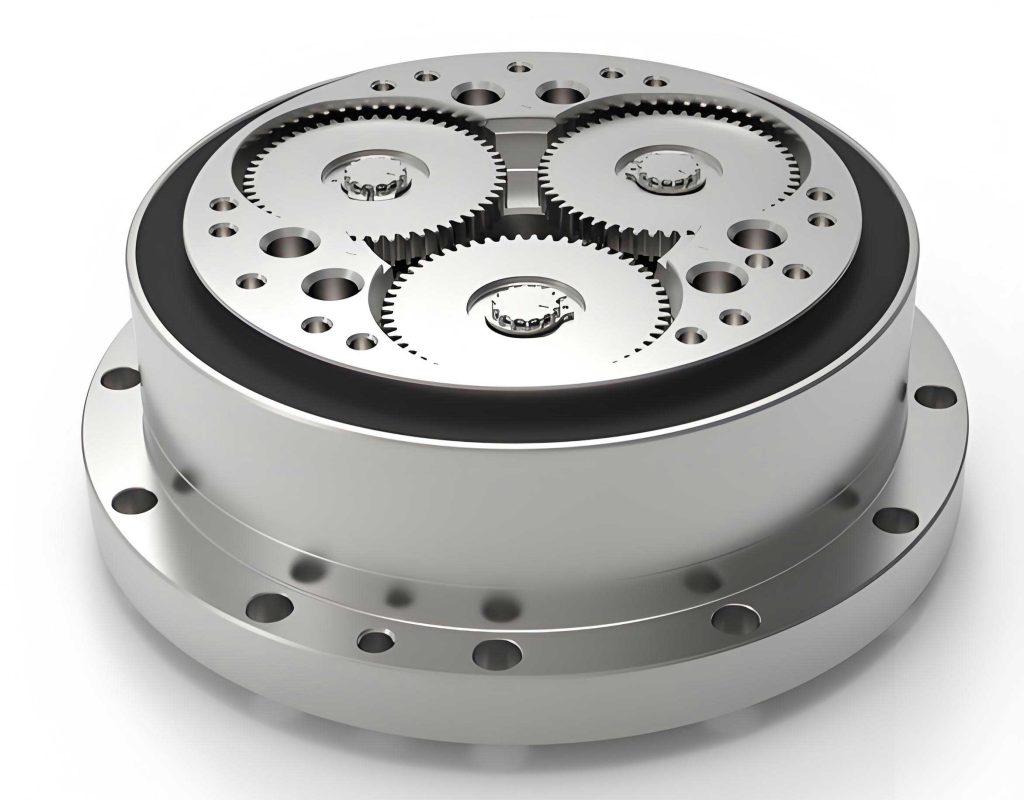
To comprehend the mechanical behavior of the cycloid wheel in a rotary vector reducer, it is essential to first outline its working principle. The rotary vector reducer operates through a precise kinematic chain. When the servo motor rotates clockwise, motion is transmitted via the input shaft to the sun gear, which drives multiple planetary gears for the first-stage reduction. The rotation of the planetary gears then acts as input for the second stage, where it is transferred to the crankshaft fixed to the rotary vector reducer housing. The crankshaft rotates counterclockwise, causing the cycloid wheel to undergo an eccentric motion (revolution). With the pin housing stationary, the cycloid wheel simultaneously experiences a reverse rotation (rotation) due to interaction with the pin teeth. This rotation drives the crankshaft to revolve, and through bearings on the planetary carrier, the motion is finally output as clockwise rotation of the carrier. The overall transmission ratio, denoted as \(i_{16}\), can be derived using the fixed carrier method and is expressed as:
$$ i_{16} = 1 + \frac{z_2}{z_1} z_5 $$
Here, \(z_1\) represents the number of teeth on the sun gear, \(z_2\) denotes the number of teeth on the planetary gears, and \(z_5\) is the number of pin teeth. This formula highlights the high reduction capability inherent to the rotary vector reducer. The advantages of the rotary vector reducer include compact structure, smooth transmission, long service life, large transmission ratio, high rigidity, strong impact resistance, high transmission efficiency (typically 0.85 to 0.92), and superior motion accuracy with minimal rotational error. These features make the rotary vector reducer indispensable in robotic applications where precision and durability are critical.
For the cycloid wheel within the rotary vector reducer, stress analysis under load is fundamental. In an ideal scenario, assuming no clearance between the cycloid wheel and pin teeth, approximately half of the pin teeth would be in simultaneous contact. However, practical considerations such as manufacturing tolerances and assembly clearances reduce the number of concurrently engaged teeth. Based on empirical studies, I assume that seven teeth are in contact during operation, specifically teeth numbered 2 through 8 in a typical configuration. To simplify the analysis, I make several assumptions: the cycloid wheel material is continuous, homogeneous, and isotropic; friction effects between the cycloid wheel and pin teeth are negligible; and contact loads act along the normal direction of the tooth surface. The force model for the cycloid wheel transmission is relatively straightforward, treating it as a statics problem. The force on each engaged tooth can be calculated using the following equation:
$$ F_i = \frac{4 T_c}{K_1 Z_c r_p} \frac{\sin \phi_i}{\left(1 + K_1^2 – 2 K_1 \cos \phi_i\right)^{0.5}} $$
In this expression, \(T_c\) is the resisting torque on the cycloid wheel. For a double cycloid wheel configuration common in rotary vector reducers, \(T_c = 0.55 T\), where \(T\) is the output torque. The parameter \(\phi_i\) is the angle between the line connecting the pin tooth center and the center of the pin circle relative to the negative X-axis, \(Z_c\) is the number of teeth on the cycloid wheel (with \(Z_c = Z_p – 1\)), \(K_1\) is the shortening factor, and \(r_p\) is the radius of the pin circle. The forces are directed along lines that converge at a common point, reflecting the unique load distribution in cycloidal drives. Table 1 summarizes the key parameters for an RV-20E type rotary vector reducer, which serves as a case study for this analysis.
| Parameter | Symbol | Value |
|---|---|---|
| Pin circle radius | \(r_p\) | 52.5 mm |
| Pin radius | \(r_{rp}\) | 2 mm |
| Number of pin teeth | \(Z_p\) | 40 |
| Eccentricity | \(a\) | 1 mm |
| Shortening factor | \(K_1\) | 0.7619 |
| Crank bearing hole diameter | \(r_b\) | 26.5 mm |
| Distance between bearing holes | \(s\) | 55 mm |
| Cycloid wheel thickness | \(b_c\) | 9 mm |
Using the force equation and the parameters from Table 1, I compute the magnitude of forces on teeth 2 through 8. The results are presented in Table 2, which provides the angle \(\phi_i\) and corresponding force \(F_i\) for each engaged tooth. These forces are applied at the contact points between the cycloid wheel and pin teeth, directed toward the convergence point. Additionally, the crank bearing holes experience complex bearing forces, which I simplify as fixed hinge constraints for the FEA to streamline the analysis process. This approach allows for a focused examination of stress concentrations in the tooth profile without complicating the model with dynamic bearing reactions.
| Tooth Number | Angle \(\phi_i\) (degrees) | Force \(F_i\) (N) |
|---|---|---|
| 2 | 13.5 | 1549.1 |
| 3 | 22.5 | 1920.8 |
| 4 | 31.5 | 2055.0 |
| 5 | 40.5 | 2085.8 |
| 6 | 49.5 | 2063.3 |
| 7 | 58.5 | 2008.1 |
| 8 | 67.5 | 1929.6 |
With the theoretical force analysis complete, I proceed to create a three-dimensional model of the cycloid wheel for simulation. The complex tooth profile of the cycloid wheel requires parametric modeling, which I achieve using Pro/E software. The tooth profile is generated based on the parametric equations of a cycloid curve, adjusted for the shortening factor and other geometric constraints specific to the rotary vector reducer. The equations for the tooth profile coordinates are given by:
$$ x_c = \left[ r_p – r_{rp} \Phi^{-1}(K_1, \phi) \right] \cos\left[(1 – i_H) \phi\right] – \left[ a – K_1 r_{rp} \Phi^{-1}(K_1, \phi) \right] \cos(i_H \phi) $$
$$ y_c = \left[ r_p – r_{rp} \Phi^{-1}(K_1, \phi) \right] \sin\left[(1 – i_H) \phi\right] – \left[ a – K_1 r_{rp} \Phi^{-1}(K_1, \phi) \right] \sin(i_H \phi) $$
Here, \(\Phi^{-1}(K_1, \phi)\) represents the amplitude coefficient, \(\phi\) is the rotation angle of the arm relative to a pin tooth center, and \(i_H\) is the relative transmission ratio between the cycloid wheel and pin teeth, defined as \(i_H = Z_p / Z_c\). By substituting the parameters from Table 1 into these equations, I generate the tooth profile curve in Pro/E. This curve is then extruded and trimmed to form a solid model of the cycloid wheel, as illustrated in the generated geometry. The model accurately reflects the dimensions and tooth geometry of the cycloid wheel used in the RV-20E rotary vector reducer, providing a foundation for subsequent finite element analysis.
For the finite element analysis, I utilize the SolidWorks Simulation module. Although ANSYS is a common choice for FEA, SolidWorks Simulation offers convenience in applying loads to specific tooth contact points, which is crucial for this study. The material selected for the cycloid wheel is bearing steel GCr15, commonly used in rotary vector reducer components due to its high strength and wear resistance. Since this material is not available by default in SolidWorks, I manually define its properties, as listed in Table 3. These properties are essential for accurate stress computation and strength evaluation.
| Property | Value |
|---|---|
| Elastic Modulus | 208 GPa |
| Poisson’s Ratio | 0.3 |
| Density | 7.8 g/cm³ |
Prior to applying loads, I segment the tooth profile surfaces of the cycloid wheel model to delineate the contact tangents where forces act. This segmentation facilitates precise load application at the啮合 points between the cycloid wheel and pin teeth. The constrained boundaries are defined at the two crank bearing holes, modeled as fixed hinges to simulate support conditions. The forces from Table 2 are then applied as concentrated loads at the respective tooth contact points, with directions aligned along the calculated force lines. After load application, I mesh the model using a fine grid to ensure convergence and accuracy. The meshing parameters are chosen to balance computational efficiency and result precision, with element sizes tailored to capture stress gradients near the tooth roots and contact regions. The meshed model, comprising numerous tetrahedral elements, is shown in the simulation setup, ready for analysis.
Upon solving the finite element model, I obtain results for nodal displacements, strains, and von Mises stresses across the cycloid wheel. The displacement contour plot reveals that the maximum displacement occurs near tooth 8, with a value of 0.02708 mm. Teeth with lower forces, such as tooth 2, exhibit smaller displacements, while intermediate teeth show displacements scaling with applied loads. The strain distribution indicates that the highest strain is concentrated around tooth 6, reaching 0.001928. This correlates with the force magnitudes, as teeth 4, 5, and 6 experience the largest loads, leading to greater elastic deformation. The von Mises stress plot, which is critical for strength assessment, shows that stress is primarily localized at the tooth contact areas and adjacent hole regions. The peak von Mises stress is observed near tooth 6, with a maximum value of 733.2 MPa. To evaluate safety, I compare this with the allowable stress for GCr15 steel, which is approximately 1200 MPa based on yield strength considerations. Since the maximum operational stress is below this limit, the cycloid wheel satisfies strength requirements for the rotary vector reducer under the analyzed conditions.
The finite element analysis provides detailed insights into the stress state of the cycloid wheel. The stress concentration factors at tooth roots and bearing holes are within acceptable ranges, indicating that the design is robust for typical loads in a rotary vector reducer. However, variations in load distribution due to manufacturing errors or alignment issues could alter stress patterns. Therefore, I recommend further studies incorporating dynamic loads and thermal effects to comprehensively assess the cycloid wheel’s performance over the lifecycle of a rotary vector reducer. Additionally, optimizing tooth profile modifications, such as backlash adjustment or tooth flank correction, could enhance load sharing and reduce peak stresses, thereby improving the reliability and efficiency of the rotary vector reducer.
In conclusion, this study demonstrates the importance of detailed mechanical analysis for critical components like the cycloid wheel in rotary vector reducers. Through theoretical force calculations and finite element simulation, I have shown that the cycloid wheel in an RV-20E type rotary vector reducer operates within safe stress limits under static loading conditions. The methodology outlined here—combining parametric modeling, load analysis, and FEA—serves as a valuable framework for designing and validating cycloid wheels in various rotary vector reducer applications. Future work could explore advanced materials, such as composite alloys, or integrate multi-physics simulations to account for lubrication and wear in the rotary vector reducer. Ultimately, ensuring the strength and durability of the cycloid wheel contributes to the overall performance and longevity of rotary vector reducers in demanding robotic systems.
The rotary vector reducer continues to evolve as a key technology in precision motion control. Its unique combination of high reduction ratio, compactness, and stiffness makes it ideal for industrial robots, where joint actuators must deliver precise movements under heavy loads. The cycloid wheel, as the heart of the rotary vector reducer, requires meticulous design and validation to prevent failures that could compromise entire robotic systems. By employing finite element analysis, engineers can predict stress concentrations and optimize geometries before physical prototyping, saving time and costs. This proactive approach is essential for advancing rotary vector reducer designs to meet the growing demands of automation and robotics. As industries increasingly adopt smart manufacturing, the reliability of components like the rotary vector reducer will play a pivotal role in enhancing productivity and operational safety.
To further elaborate on the analysis, I delve into the mathematical foundations of cycloidal gearing. The transmission ratio of a rotary vector reducer can be derived from kinematic principles. For a standard RV configuration, the overall ratio \(i\) is a product of the planetary stage and cycloidal stage ratios. Expressing this in terms of tooth counts:
$$ i = \left(1 + \frac{Z_p}{Z_c}\right) \times \frac{Z_2}{Z_1} $$
However, in practice, the formula simplifies to the earlier expression when considering specific gear arrangements. The efficiency \(\eta\) of a rotary vector reducer can be estimated using empirical models that account for friction losses in bearings and gear meshes. For instance:
$$ \eta = \eta_1 \cdot \eta_2 $$
where \(\eta_1\) is the efficiency of the planetary stage and \(\eta_2\) is that of the cycloidal stage. Typical values range from 0.85 to 0.92, as noted earlier. The torsional stiffness \(k_t\) of the rotary vector reducer, which affects positioning accuracy, can be calculated from the stiffness of individual components, including the cycloid wheel. A simplified model gives:
$$ k_t = \frac{1}{\frac{1}{k_{gear}} + \frac{1}{k_{bearing}}} $$
Here, \(k_{gear}\) represents the mesh stiffness of the cycloid-pin engagement, and \(k_{bearing}\) is the stiffness of supporting bearings. Understanding these parameters helps in designing rotary vector reducers for high-precision applications where minimal deflection under load is crucial.
The force distribution among engaged teeth in a cycloidal drive is non-uniform due to elastic deformations and manufacturing tolerances. To refine the analysis, I consider a more advanced model that accounts for tooth compliance. The load per tooth \(F_i\) can be expressed as a function of the relative stiffness \(k_i\) and deformation \(\delta_i\):
$$ F_i = k_i \delta_i $$
Summing over all engaged teeth yields the total transmitted torque \(T_c\). In a rotary vector reducer, this torque is shared between two cycloid wheels phase-shifted by 180 degrees to balance loads and reduce vibrations. The phase relationship ensures that at least one tooth pair is always in contact, enhancing smoothness. The dynamic behavior of the rotary vector reducer under varying speeds and loads also merits investigation, but for static strength assessment, the quasi-static approach suffices.
Material selection for the cycloid wheel in a rotary vector reducer is critical. GCr15 steel offers high hardness (HRC 60-64) after heat treatment, which resists wear from repeated pin contacts. The fatigue strength \(\sigma_f\) of this material, considering surface finish and stress concentrations, can be estimated using Goodman or S-N curves. For infinite life design, the allowable alternating stress \(\sigma_a\) should satisfy:
$$ \sigma_a \leq \frac{\sigma_f}{S_f} $$
where \(S_f\) is the safety factor, typically chosen as 2 or higher for critical components in rotary vector reducers. The finite element results indicate a maximum stress of 733.2 MPa, which is well below the yield strength of GCr15 (around 1500 MPa), providing a comfortable margin. However, in rotary vector reducer applications, cyclic loading may lead to fatigue failure if stress amplitudes are high. Thus, conducting a fatigue analysis using FEA software could further validate the design for long-term operation.
Manufacturing tolerances and assembly precision significantly impact the performance of a rotary vector reducer. For the cycloid wheel, tooth profile modifications, such as tip relief or root fillet optimization, are often employed to reduce stress concentrations and improve load distribution. These modifications can be modeled in Pro/E by adjusting the parametric equations. For example, adding a correction factor \(\Delta\) to the tooth profile coordinates:
$$ x_c’ = x_c + \Delta \cos(\theta) $$
$$ y_c’ = y_c + \Delta \sin(\theta) $$
where \(\theta\) is the pressure angle. Such tweaks enhance the meshing condition in the rotary vector reducer, minimizing noise and increasing efficiency. Simulation studies can optimize \(\Delta\) to achieve uniform stress across teeth, thereby extending the service life of the rotary vector reducer.
The finite element analysis process involves several steps: geometry preparation, material assignment, meshing, boundary condition application, solving, and post-processing. For the cycloid wheel, I used a mesh with approximately 500,000 elements to capture details accurately. The convergence study ensured that results were mesh-independent. The solution time on a standard workstation was reasonable, demonstrating the practicality of this approach for iterative design of rotary vector reducer components. The von Mises stress criterion is appropriate for ductile materials like GCr15, as it predicts yielding under multi-axial stress states. The results show that stress concentrations are localized, and the bulk of the cycloid wheel experiences lower stresses, indicating an efficient use of material in the rotary vector reducer.
In summary, the rotary vector reducer relies on the cycloid wheel for robust power transmission. This study confirms that with proper design and analysis, the cycloid wheel can withstand operational stresses, ensuring the reliability of the rotary vector reducer. Future advancements may include integrating smart sensors into rotary vector reducers to monitor stress in real-time, enabling predictive maintenance. As robotics technology progresses, the demand for high-performance rotary vector reducers will grow, and continuous improvement in component analysis, as demonstrated here, will be key to meeting that demand.