
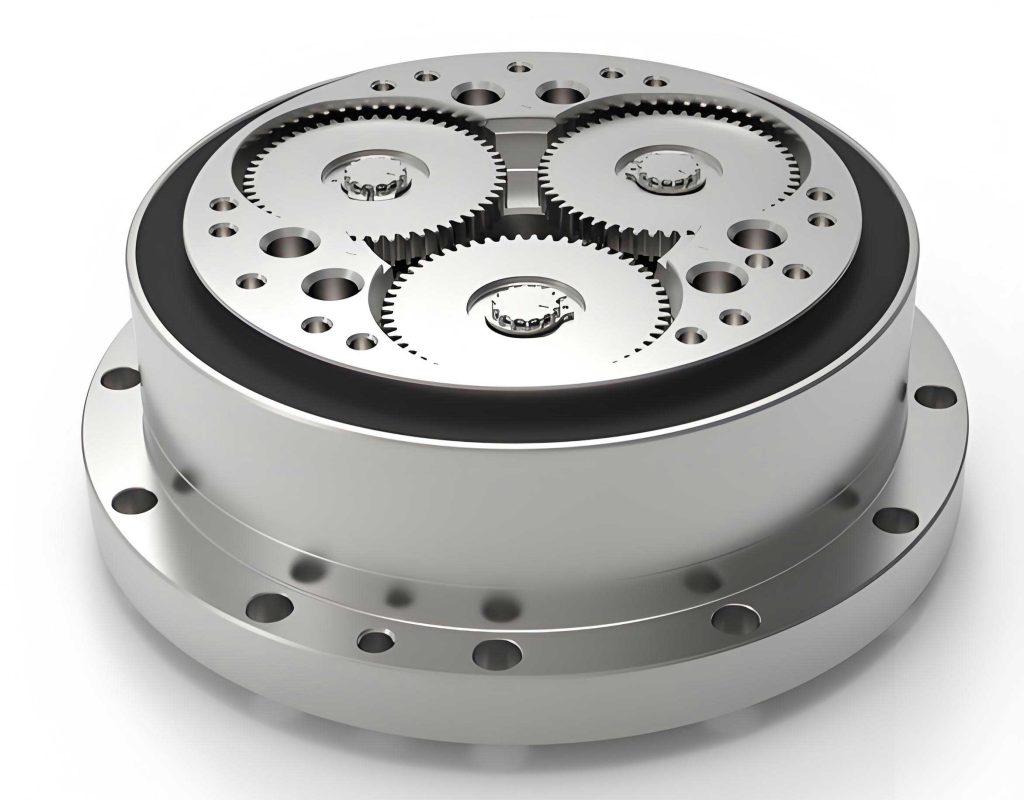
The rotary vector reducer represents a significant evolution from the traditional cycloidal drive, offering superior performance for modern, demanding applications. Characterized by compact dimensions, high torque-to-weight ratio, extensive transmission ratios, and exceptional stiffness, the RV reducer has become the dominant precision transmission solution in industrial robotics. This performance stems from its unique two-stage architecture, with the cycloid-pin gear mechanism constituting the crucial second-stage speed reduction and torque amplification component. The contact behavior between the cycloid disk and the stationary pins directly governs the load distribution, transmission efficiency, stiffness, and longevity of the entire rotary vector reducer system. Therefore, a deep and systematic investigation into the meshing contact characteristics—including contact force distribution, stress state, and the evolution of the contact zone—is fundamental for advancing the design, optimization, and reliability prediction of these critical power transmission units. This analysis focuses precisely on these aspects, employing both theoretical formulations and detailed three-dimensional finite element simulations to unravel the complex contact mechanics within the cycloid drive of a rotary vector reducer.
Mathematical Foundation of the Cycloid Profile
The unique tooth profile of the cycloid disk is the cornerstone of the RV reducer’s performance. Its generation can be visualized through two equivalent kinematic methods. In the first method, a rolling circle of radius $$r_r$$ rotates without slip on the outside of a fixed base circle of radius $$R_b$$. A tracing point attached to the rolling circle at a distance $$a$$ (the eccentricity) from its center describes the curtate cycloid, which forms the theoretical tooth flank. The alternative method involves a fixed outer ring (theoretical pin circle) of radius $$R_p$$ and an inner rolling circle of radius $$r_r’$$, with the tracing point generating the same curve. The fundamental relationship is given by $$R_p = R_b + r_r$$ and $$a = K_1 \cdot r_r$$, where $$K_1$$ is the shortening coefficient. For a rotary vector reducer with $$z_p$$ pins and a cycloid disk with $$z_c = z_p – 1$$ teeth, the rotation angles are linked by $$\beta = \alpha + \varphi = z_p \alpha$$, where $$\alpha$$ is the rotation of the crankshaft (planet carrier) and $$\varphi$$ is the relative rotation of the rolling circle. The parametric equations for the actual tooth profile, accounting for the pin radius $$r_{rp}$$, are derived as:
$$
\begin{align*}
x &= r_{rp} \left[ \frac{\sin(\varphi / z_c) – K_1 \sin(z_p \varphi / z_c)}{K_1^2 + 1 – 2K_1 \cos \varphi)^{3/2}} \right] + r_p \sin(\varphi / z_c) – a \sin(z_p \varphi / z_c) \\
y &= -r_{rp} \left[ \frac{\cos(\varphi / z_c) – K_1 \cos(z_p \varphi / z_c)}{K_1^2 + 1 – 2K_1 \cos \varphi)^{3/2}} \right] + r_p \cos(\varphi / z_c) – a \cos(z_p \varphi / z_c)
\end{align*}
$$
where $$\varphi$$ is the generation angle (or meshing phase angle) and $$r_p$$ is the pin center circle radius. These equations are essential for generating the precise geometry required for analysis and manufacturing of the cycloid disk in a rotary vector reducer.
Theoretical Force and Contact Stress Analysis
Under an output torque $$T_c$$, the cycloid disk experiences elastic deformation, causing it to rotate slightly relative to a rigid pin ring. This leads to a distribution of contact forces on approximately half of its teeth. The force on each engaged tooth acts through the contact normal towards the instantaneous center of rotation. Assuming linear elastic deflection for the system (primarily from pin bending and contact deformation), the load on the i-th tooth is proportional to its distance from the instantaneous center. The force $$F_i$$ can be expressed as:
$$
F_i = \frac{4T_c \sin \psi_i}{K_1 z_c r_p (1 + K_1^2 – 2K_1 \cos \psi_i)}
$$
where $$\psi_i$$ is the angular position of the i-th pin relative to the line of centers. The maximum force occurs at the tooth with the largest moment arm.
The contact between the cycloid tooth and the cylindrical pin is a classical Hertzian line contact problem. First, the radius of curvature $$\rho_i$$ at the contact point on the cycloid profile must be calculated from the profile geometry:
$$
\rho_i = \frac{r_p (1 + K_1^2 – 2K_1 \cos \varphi_i)^{3/2}}{K_1(z_p + 1)\cos \varphi_i – 1 – z_p K_1^2} + r_{rp}
$$
Subsequently, the maximum contact stress $$\sigma_{H,i}$$ at the i-th tooth pair is given by the Hertz formula:
$$
\sigma_{H,i} = 0.418 \sqrt{\frac{E_c F_i}{b_c} \cdot \frac{\rho_i r_{rp}}{\rho_i – r_{rp}}}
$$
where $$E_c$$ is the combined modulus of elasticity, and $$b_c$$ is the face width of the cycloid disk. For the analysis, the design parameters in Table 1 are used for a typical rotary vector reducer stage.
| Parameter | Symbol | Value | Unit |
|---|---|---|---|
| Eccentricity | $$a$$ | 1.0 | mm |
| Number of Cycloid Teeth | $$z_c$$ | 39 | – |
| Number of Pins | $$z_p$$ | 40 | – |
| Shortening Coefficient | $$K_1$$ | 40/51 ≈ 0.7843 | – |
| Pin Center Circle Radius | $$r_p$$ | 51.0 | mm |
| Pin (or Sleeve) Radius | $$r_{rp}$$ | 2.0 | mm |
| Cycloid Disk Face Width | $$b_c$$ | 9.0 | mm |
| Output Torque (per cycloid disk) | $$T_c$$ | 126.5 | N·m |
Applying these formulas, the theoretical distribution of meshing force and maximum contact stress across the 19 simultaneously engaged teeth is calculated. The results, plotted in Figure 3 of the reference material, show that both the force and stress follow a similar trend: they increase to a maximum value at approximately the 4th or 5th engaged tooth and then decrease symmetrically. The peak theoretical Hertzian contact stress is found to be approximately 587 MPa, which is within the allowable limit for common bearing steels used in rotary vector reducer components.
Three-Dimensional Finite Element Modeling
To gain a more comprehensive and realistic understanding beyond plane-strain assumptions, a detailed three-dimensional finite element model of the cycloid disk and a segment of the pin ring was developed. The precise tooth profile was generated in a computational environment using the parametric equations and imported into ANSYS for solid modeling. To focus computational resources on the contact region of interest, the central portion of the cycloid disk was simplified, retaining only the tooth-shaft connection area for load application. The finite element model emphasizes the critical contact mechanics within the rotary vector reducer.
A mapped meshing strategy was employed, with significant refinement in the regions where contact was anticipated. The contact pairs were defined using a surface-to-surface formulation, with the cycloid tooth surface as the contact side and the pin cylindrical surface as the target side. This setup accurately simulates the mechanical interaction in the rotary vector reducer. Boundary conditions and loads were applied to replicate the operating conditions: the outer surfaces of the pin housing were fixed in all degrees of freedom. A cylindrical coordinate system was defined at the center of the cycloid disk. The inner bore nodes of the cycloid disk were coupled to rotate together, with radial and axial displacements constrained, and a tangential force was applied to these nodes to produce the required output torque $$T_c$$. The total force was distributed equally among all inner bore nodes. The complete finite element setup, including constraints, loads, and the refined contact mesh, is illustrated in the referenced figures.
Contact Stress and Zone Distribution for a Single Mesh Position
The finite element solution for the initial meshing position (defined as Position $$\theta_0$$) reveals the contact stress distribution across the face width of the cycloid teeth. The contact pattern appears as a distinct band on each engaged tooth flank. Extracting the maximum contact stress from each of the 19 engaged teeth yields a distribution curve. The FEA results show a trend that agrees with the theoretical prediction—an initial increase followed by a decrease—with the peak stress occurring at the 4th tooth. The absolute value from FEA (approximately 352 MPa) differs from the theoretical Hertz calculation due to the 3D effects, simplified theoretical assumptions about load sharing, and the model’s inclusion of multi-tooth interaction and structural compliance not captured in the simple analytical formula. This validates the model’s relevance for studying the rotary vector reducer’s behavior.
A more insightful analysis involves examining the distribution *within* a single contact zone. Taking Tooth #1 as an example, nodes were extracted along lines parallel to the face width direction (Z-axis) at different lateral positions (X-axis). The contact force on these nodes paints a detailed picture. Plots of contact force versus Z-position at different X-locations show that forces are lower near the two ends of the tooth face (Z=0 and Z=9 mm) and higher, relatively uniform, in the central region. Conversely, plots of contact force versus X-position at different cross-sections along Z show that forces peak at a specific lateral location (near the center of the contact band) and taper off towards its edges.
This two-directional analysis conclusively demonstrates that the contact zone in a rotary vector reducer is not a uniform rectangular strip. Instead, it approximates a “crowned” or barrel-shaped area. The contact pressure is highest at the core of this zone—both centrally along the face width and centrally across the profile width—and diminishes towards the boundaries. This crowning effect is crucial for accommodating minor misalignments and ensuring stable load distribution in the rotary vector reducer.
Evolution of Contact During the Meshing Cycle
The static analysis at $$\theta_0$$ provides a snapshot. To understand the dynamic behavior as the cycloid disk moves, the meshing process was simulated by rotating the disk through a sequence of positions. The motion of the cycloid disk is a combination of translation (eccentric motion) and rotation. Six additional positions, $$\theta_1$$ through $$\theta_6$$, were defined by decomposing the motion into a “spin” of the disk about its own center and a “revolution” of its center about the pin circle center, as detailed in Table 2.
| Rotation State | Spin Angle | Revolution Angle | Meshing Event Description |
|---|---|---|---|
| $$\theta_0$$ | 0° | 0° | Reference position |
| $$\theta_1$$ | +1° | -39° | 4 new teeth enter mesh near the approach side |
| $$\theta_2$$ | +2/3° | -26° | 3 new teeth enter mesh |
| $$\theta_3$$ | +1/3° | -13° | 2 new teeth enter mesh |
| $$\theta_4$$ | -1/3° | +13° | 2 new teeth enter mesh on the recess side |
| $$\theta_5$$ | -2/3° | +26° | 3 new teeth enter mesh on the recess side |
| $$\theta_6$$ | -1° | +39° | 4 new teeth enter mesh on the recess side |
In each state, the number of teeth in simultaneous contact remains nearly constant at 19, with an equal number of teeth entering and exiting the meshing zone. The distribution of maximum contact stress across the 19 engaged teeth was extracted for all seven states. While numerical values fluctuate due to discrete modeling effects, the fundamental trend—a bell-shaped curve peaking near the middle of the engagement arc—remains consistent across all rotation angles. This confirms a stable and predictable load-sharing characteristic throughout the meshing cycle of the rotary vector reducer.
Tracing specific teeth through the cycle provides further insight. Figure 13 (referenced) shows the peak contact stress on Teeth #3, #4, and #5 as a function of rotation state. Each tooth experiences a characteristic life cycle: the stress rises as it moves into the central, high-load zone of the engagement arc, peaks (for Tooth #4, this is at $$\theta_0$$), and then falls as it moves toward the exit. Tooth #5, for instance, remains engaged through all states, and its peak nodal contact force along its face width is highest at $$\theta_0$$ and lower at other states. Furthermore, the X-coordinate of the high-stress region on Tooth #5 shifts during the cycle, indicating that the contact band traverses from near the tooth root towards the tip as the tooth goes through the meshing process. This path of contact is a vital characteristic for wear analysis and lubrication design in a rotary vector reducer.
Conclusions
This comprehensive analysis of the cycloid drive contact mechanics within a rotary vector reducer, combining analytical and detailed 3D finite element methods, yields several key conclusions that are critical for the design and application of these precision drives.
- Load and Stress Distribution: The distribution of meshing force and maximum contact stress across the simultaneously engaged teeth follows a predictable, symmetric pattern, peaking near the center of the engagement arc. This pattern is consistent between theoretical calculation and FEA, and, most importantly, remains fundamentally stable throughout the entire meshing cycle of the rotary vector reducer.
- Three-Dimensional Contact Zone Morphology: The contact between the cycloid tooth and the pin is not a simple line contact. The finite element results clearly demonstrate a crowned, barrel-shaped contact zone. Contact pressure is highest in the central region of the tooth, both along the face width and across the profile, and decreases towards the edges and ends. This crowning is essential for the robust performance and tolerance to imperfections in the rotary vector reducer.
- Dynamic Meshing Behavior: During operation, each individual tooth undergoes a predictable stress cycle as it enters, passes through, and exits the load zone. The contact stress on a tooth rises to a maximum and then decays. Concurrently, the location of the high-pressure contact band on the tooth profile shifts, typically from the root region towards the tip during the engagement process. This dynamic contact path must be considered in durability assessments.
- Modeling Validity: The three-dimensional finite element modeling approach proves highly effective in capturing the complex, spatial nature of the contact in a rotary vector reducer, providing insights beyond simplified plane-stress or analytical Hertzian models. It serves as a powerful tool for analyzing load distribution, stress states, and the effects of design modifications like profile corrections.
These findings enhance the fundamental understanding of force transmission in the core cycloid stage of a rotary vector reducer. They provide a solid foundation for subsequent work on optimizing tooth profile modifications (such as equidistant or combinatorial grinding), predicting system stiffness and natural frequencies, and ultimately improving the fatigue life, efficiency, and precision of rotary vector reducers for advanced robotic and automation systems.