
The analysis of contact stress within the cycloidal gear pair is a cornerstone for ensuring the longevity, precision retention, and durability of rotary vector reducers. These compact and robust speed reducers are pivotal in industrial robotic joints, where they endure significant and often impactive loads. The primary failure mode for the secondary transmission stage, which employs a cycloidal disc meshing with a stationary ring of needle rollers (pinwheels), is surface fatigue on the cycloidal teeth. This stress is not uniform; it is a complex function of the instantaneous contact geometry, load distribution among multiple teeth, inherent manufacturing and assembly errors, and specific modifications applied to the tooth profiles and their flanks. While dynamic performance and circumferential load sharing have been studied, a comprehensive theoretical framework for predicting the contact stress distribution across the face width of the cycloidal gear, especially under non-ideal conditions like misalignment, remains less explored. This gap is critical because edge loading and stress concentration at the ends of the tooth face are common failure origins. Classical Hertzian contact theory, while foundational, falls short as it assumes infinite line contact and cannot accurately model edge effects or situations where the pin geometry deviates from a straight cylinder relative to the curved cycloidal surface—a quintessential non-Hertzian contact problem in rotary vector reducers.
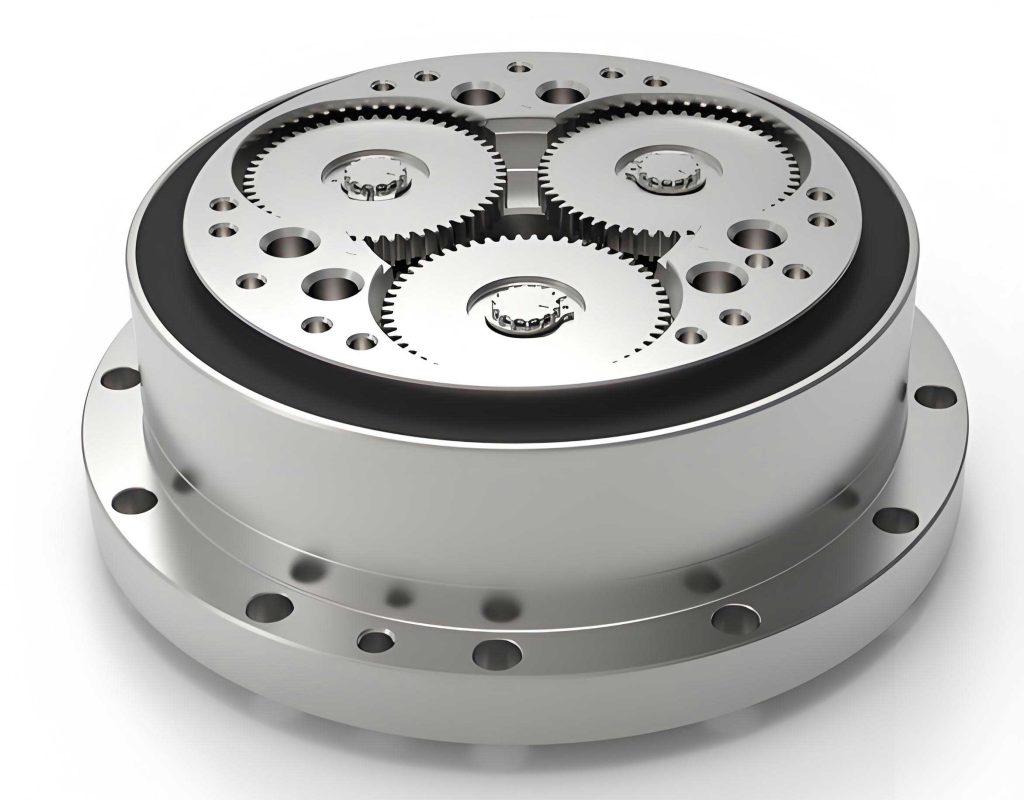
This work presents a detailed numerical methodology to calculate the effective contact area, load distribution, and, most importantly, the contact stress profile along the face width of a cycloidal gear in a rotary vector reducer. The model rigorously accounts for elastic deformations, initial backlash from tooth profile modifications, and assembly errors such as tilting. By solving the force balance and deformation compatibility equations, we establish a mathematical model capable of simulating both ideal and real-world operating conditions, providing a powerful tool for the design and strength evaluation of these critical components.
Mechanical Foundation: Load Distribution on the Cycloidal Gear
The force transmission in a rotary vector reducer involves multiple teeth simultaneously. To determine how the total torque is shared among them, one must consider the elastic approach of the contacting surfaces and the initial gaps resulting from intentional profile modifications (modifications for backlash and optimization). The standard profile modifications include equidistant (Δrrp), offset (Δrp), and rotational (δ0) modifications. The parametric equations for the modified cycloidal tooth profile are given by:
$$ x_c = \left[ r_p + \Delta r_p – (r_{rp} + \Delta r_{rp}) S^{-\frac{1}{2}} \right] \cos\left((1 – i_H)\varphi – \delta_0\right) – \frac{e}{r_p + \Delta r_p} \left[ r_p + \Delta r_p – z_p (r_{rp} + \Delta r_{rp}) S^{-\frac{1}{2}} \right] \cos\left(i_H \varphi + \delta_0\right) $$
$$ y_c = \left[ r_p + \Delta r_p – (r_{rp} + \Delta r_{rp}) S^{-\frac{1}{2}} \right] \sin\left((1 – i_H)\varphi – \delta_0\right) + \frac{e}{r_p + \Delta r_p} \left[ r_p + \Delta r_p – z_p (r_{rp} + \Delta r_{rp}) S^{-\frac{1}{2}} \right] \sin\left(i_H \varphi + \delta_0\right) $$
where $S = 1 + K_1^2 – 2K_1 \cos\varphi$, $i_H = z_p / z_c$, and $K_1 = e z_p / (r_p + \Delta r_p)$. Here, $z_p$ and $z_c$ are the number of pinwheels and cycloidal teeth, $r_p$ is the pinwheel distribution radius, $r_{rp}$ is the pin radius, $e$ is the eccentricity, and $\varphi$ is the arm rotation angle relative to a pinwheel.
The curvature radius $\rho$ at any point on this profile, crucial for contact mechanics, is:
$$ \rho = \frac{(r_p + \Delta r_p)(1 + K_1^2 – 2K_1 \cos\varphi)^{3/2}}{K_1(z_p+1)\cos\varphi – (1 + z_p K_1^2)} + r_{rp} + \Delta r_{rp} $$
Under an output torque $T$, the force on the $i$-th pinwheel, $F_i$, is proportional to its elastic deformation $\delta_i$ minus the initial normal backlash $\Delta s(\varphi_i)$ at that mesh point. If $F_{max}$ is the force on the most loaded tooth with deformation $\delta_{max}$, the relationship is:
$$ F_i = \frac{\delta_i – \Delta s(\varphi_i)}{\delta_{max}} F_{max} $$
The elastic deformation $\delta_i$ is related to $\delta_{max}$ by the geometry of the unmodified cycloid:
$$ \delta_i = \frac{\sin \varphi_i}{\sqrt{1 + K_1^2 – 2K_1 \cos \varphi_i}} \delta_{max} $$
The initial normal backlash $\Delta s(\varphi_i)$, resulting from the modifications, is:
$$ \Delta s(\varphi_i) = \Delta r_{rp} \left(1 – \frac{\sin \varphi_i}{\sqrt{1 + K_1^2 – 2K_1 \cos \varphi_i}}\right) – \frac{\Delta r_p \left(1 – K_1 \cos\varphi_i – \sqrt{1-K_1^2}\sin\varphi_i\right)}{\sqrt{1 + K_1^2 – 2K_1 \cos \varphi_i}} $$
A tooth enters contact only if $\delta_i > \Delta s(\varphi_i)$. Defining the first and last contacting tooth indices as $m$ and $n$, the force balance equation yields $F_{max}$:
$$ F_{max} = \frac{T}{\sum_{i=m}^{n} \left( \frac{l_i}{r’_c} – \frac{\Delta s(\varphi_i)}{\delta_{max}} \right) l_i} $$
where $l_i$ is the distance from the gear center to the line of action of the force on tooth $i$, and $r’_c$ is the cycloidal gear’s pitch radius. The relationship between $F_{max}$ and $\delta_{max}$ is derived from Hertzian theory for a cylinder-on-curved-surface contact, considering the composite curvature at the point of maximum load ($\varphi = \arccos K_1$, with curvature radius $\rho_0$):
$$ \delta_{max} = \frac{2(1-\mu^2)F_{max}}{E \pi b} \left( \frac{2}{3} + \ln{\frac{16 r_{rp} |\rho_0|}{c^2}} \right) $$
$$ \text{with } c = 4.99 \times 10^{-3} \sqrt[3]{\frac{2(1-\mu^2)F_{max}}{E \pi b} \cdot \frac{2|\rho_0| r_{rp}}{|\rho_0| + r_{rp}}} $$
Here, $E$ is the elastic modulus, $\mu$ is Poisson’s ratio, and $b$ is the face width. The composite curvature radius $\rho_n$ for the contact varies, being positive on the concave flank and negative on the convex flank of the cycloidal tooth:
$$ \frac{1}{\rho_n} = \frac{1}{\rho} – \frac{1}{r_{rp}} \quad \text{(concave flank)} $$
$$ \frac{1}{\rho_n} = \frac{1}{|\rho|} + \frac{1}{r_{rp}} \quad \text{(convex flank)} $$
Solving the system of equations formed by the force balance and the deformation-force relation iteratively provides the load $F_i$ on each contacting tooth for a given input torque $T$ on the rotary vector reducer.
Mathematical Model for Face Width Contact Stress
The contact between a pinwheel and the cycloidal tooth is treated as a line contact problem. However, to resolve the stress distribution across the finite face width (the y-direction), we discretize the contact line into $N$ elements. For element $j$, the contact pressure is assumed to be semi-elliptical in the x-direction (depth):
$$ p_j(x, y) = p_{0j} \sqrt{1 – \left( \frac{x}{a_j} \right)^2} $$
where $p_{0j}$ is the maximum contact stress at the center of the element, and $2a_j$ is the contact width for that element. The half-width $a_j$ is related to $p_{0j}$ by the local Hertzian condition:
$$ a_j E’ = 2 R_j p_{0j} $$
$R_j$ is the local composite radius of curvature, and $E’ = \left( \frac{1-\mu_1^2}{E_1} + \frac{1-\mu_2^2}{E_2} \right)^{-1}$ is the composite elastic modulus for the cycloidal gear (material 1) and pinwheel (material 2). The unknown variables are the $N$ values of $p_{0j}$ and the total elastic approach $\delta$. They are determined by solving the force equilibrium and deformation compatibility equations in discretized form:
$$ \pi \sum_{j=1}^{N} a_j h_j p_{0j} = F \quad \text{(Force Balance)} $$
$$ \frac{1}{\pi E’} \sum_{j=1}^{N} D_{i’j} p_{0j} = \delta – z_{i’}(y_{i’}) \quad \text{for } i’ = 1, 2, …, N \quad \text{(Deformation Compatibility)} $$
Here, $h_j$ is the half-length of element $j$, $F$ is the total normal load on that specific tooth contact (calculated in the previous section), $y_{i’}$ is the coordinate of the $i’$-th element’s center, and $D_{i’j}$ is the flexibility coefficient representing the displacement at element $i’$ due to a unit pressure distribution over element $j$. It is calculated by integrating the Boussinesq solution over the element area:
$$ D_{i’j} = \int_{-a_j}^{a_j} \int_{y_j – h_j}^{y_j + h_j} \frac{ \sqrt{1 – (x’/a_j)^2} }{ \sqrt{(x’)^2 + (y_{i’} – y_j – y’)^2} } \, dx’ \, dy’ $$
The term $z_{i’}(y_{i’})$ describes the initial geometric separation between the surfaces before loading. It includes two potential components: a linear term due to a tilting misalignment $\theta_{err}$ of the cycloidal gear, and a crowning or lead modification $z_{b}(y)$ applied to the pinwheels to mitigate edge stress:
$$ z_{i’}(y_{i’}) = y_{i’} \tan \theta_{err} + z_{b}(y_{i’}) $$
A common logarithmic crowning profile for the pinwheel, designed to compensate for shaft deflection under load, is given by:
$$ z_b(y) = \frac{2 k_b (1-\mu^2)}{\pi E} \frac{F}{l} \ln \left( \frac{1}{1 – (2y/l)^2} \right) $$
where $l$ is the pinwheel length and $k_b$ is a load distribution factor. The system of $N+1$ equations (one force balance and $N$ compatibility equations) is solved numerically with the constraint $p_{0j} \ge 0$ for all $j$. This yields the distribution of maximum contact stress $p_{0j}$ and contact half-width $a_j$ across the face, fully characterizing the contact patch in three dimensions for that specific tooth mesh in the rotary vector reducer.
Computational Algorithm and Implementation
The complete analysis for the rotary vector reducer involves a two-stage computational process. First, the circumferential load distribution among the cycloidal teeth is calculated. Second, for each heavily loaded tooth, the face width contact stress distribution is solved. The following structured algorithm outlines the procedure:
Stage 1: Circumferential Load Sharing
1. Input basic reducer parameters: $z_p, z_c, r_p, r_{rp}, e, \Delta r_p, \Delta r_{rp}, b, l, E, \mu$, and input torque $T$.
2. Provide an initial guess for the maximum tooth force, $F_{max}$.
3. Calculate the corresponding maximum deformation $\delta_{max}$ using the Hertz-type relation.
4. Compute elastic deformations $\delta_i$ for all potential contact points.
5. Calculate initial backlashes $\Delta s(\varphi_i)$.
6. Identify the set of teeth $i$ where $\delta_i > \Delta s(\varphi_i)$ to define the contact zone $[m, n]$.
7. Use the force balance equation to compute a new $F_{max}^{new}$.
8. Iterate steps 3-7 until $|F_{max}^{new} – F_{max}|$ is below a specified tolerance.
9. Calculate the final load on each contacting tooth $F_i$.
Stage 2: Face Width Stress Analysis (for a selected tooth)
10. For the chosen tooth $i$, determine its load $F_i$ and local composite curvature radius $R_j$ across the face width.
11. Discretize the face width into $N$ elements. Provide initial guesses for $a_j$, $p_{0j}$, and $\delta$ based on simple Hertz formulas.
12. Calculate the geometric gap $z_{i’}(y_{i’})$ for each element, including tilt error and pin crowning.
13. Compute the flexibility matrix $D_{i’j}$.
14. Solve the nonlinear system $ \frac{1}{\pi E’} \sum_{j} D_{i’j} p_{0j} = \delta – z_{i’}$ for $p_{0j}$ and $\delta$, enforcing $p_{0j} \ge 0$.
15. Update the contact half-widths using $a_j = 2 p_{0j} R_j / E’$.
16. Check for convergence of $a_j$ and the total force $P_1 = \pi \sum a_j h_j p_{0j}$ against the tooth load $F_i$.
17. Iterate steps 12-16 until convergence is achieved. The output is the detailed profile of $p_{0j}$ and $a_j$ vs. $y$.
Numerical Case Study and Results
The methodology is applied to a standard rotary vector reducer model. Key geometric parameters are summarized below:
| Parameter | Value |
|---|---|
| Eccentricity, $e$ (mm) | 1.3 |
| Pin Radius, $r_{rp}$ (mm) | 3.0 |
| Pin Distribution Radius, $r_p$ (mm) | 64.0 |
| Cycloidal Teeth, $z_c$ | 39 |
| Pinwheel Teeth, $z_p$ | 40 |
| Face Width, $b$ (mm) | 10.0 |
| Equidistant Modification, $\Delta r_{rp}$ (mm) | 0.006 |
| Offset Modification, $\Delta r_p$ (mm) | 0.0 |
| Elastic Modulus, $E$ (GPa) | 206 |
| Poisson’s Ratio, $\mu$ | 0.3 |
The analysis first examines the circumferential behavior. For an applied torque of 412 Nm, the elastic deformation curve intersects the initial backlash curve in the angular range $[\varphi_m, \varphi_n] = [6.588^\circ, 121.819^\circ]$, corresponding to 13 teeth (tooth #2 to #14) being in contact. As torque increases, the contact zone widens and more teeth share the load, but the fluctuation in individual tooth forces becomes more pronounced. The tooth near the theoretical inflection point of the cycloid (approximately tooth #5) consistently carries the highest load. A significant finding is that a small subset of teeth around this inflection point bears the majority of the total load.
| Torque, $T$ (Nm) | Contact Zone ($^\circ$) | Number of Teeth in Contact | Min. Tooth Force (N) | Max. Tooth Force (N) | ~% Load on 4 Teeth near Inflection* |
|---|---|---|---|---|---|
| 412 | [6.588, 121.819] | 13 | 50.4 | 588.5 | 50.1% |
| 618 | [5.355, 131.347] | 14 | 69.8 | 824.9 | 57.0% |
| 1030 | [3.981, 142.866] | 15 | 140.2 | 1286.1 | 62.1% |
| 2060 | [2.495, 156.228] | 17 | 94.7 | 2416.8 | 66.0% |
Next, the face width stress analysis is performed on the highest-loaded tooth (#5) under 412 Nm. Key scenarios are investigated:
1. Ideal Alignment, No Crowning ($\theta_{err}=0$, $\delta_a=0$): The contact stress is relatively uniform across the central 90% of the face width. However, pronounced edge stress concentrations appear at both ends, with contact width $2a_j$ flaring out. This mathematically explains the common practical observation of fatigue pitting initiation at the tooth ends in uncrowned rotary vector reducers.
2. Ideal Alignment with Pin Crowning ($\theta_{err}=0$, $\delta_a=1.5 \mu m$): Introducing a logarithmic crown on the pinwheel (with $k_b=1.5$) eliminates the severe edge stresses. The contact stress distribution becomes smooth and bell-shaped across the face, with the contact area slightly reduced but more uniformly distributed, significantly improving resistance to surface fatigue.
3. Misalignment without Crowning ($\theta_{err}=0.01^\circ$, $\delta_a=0$): A small tilt error drastically alters the stress profile. The contact patch shifts and skews towards one end. The “loaded” end experiences severe edge stress concentration and a wider contact width, while the “unloaded” end has minimal contact. This accelerates localized wear and failure.
4. Misalignment with Pin Crowning ($\theta_{err}=0.01^\circ$, $\delta_a=1.5 \mu m$): The crowning profile demonstrates its robustness. Although the contact patch is still biased, the transition in stress is smooth, and the dangerous edge loading at the heavily loaded end is mitigated. The contact width distribution is more controlled, showing that proper crowning can accommodate small assembly errors in the rotary vector reducer.
| Condition | Key Contact Characteristics on Tooth Face Width | Implication for Rotary Vector Reducer |
|---|---|---|
| Ideal, No Crown | Uniform central stress, severe edge stress spikes at both ends. | High risk of edge-initiated pitting and reduced lifespan. |
| Ideal, With Crown | Smooth, bell-shaped stress distribution; no edge spikes. | Optimal for ideal conditions, maximizes fatigue life. |
| Tilt Error, No Crown | Highly skewed patch; extreme edge stress on one side. | Very rapid localized failure; sensitive to assembly quality. |
| Tilt Error, With Crown | Biased but smooth stress profile; edge stress controlled. | Robust design, tolerates small misalignments, longer service life. |
Experimental Validation and Method Verification
To validate the numerical approach, a physical endurance test was conducted on a prototype rotary vector reducer meeting all standard performance specifications (e.g., transmission accuracy < 60 arc-sec, torsional stiffness > 110 Nm/arc-min). The reducer was subjected to a continuous load of 615 Nm on a dedicated test bench for an extended run-in period.
Post-test inspection of the cycloidal gears revealed distinct contact patterns. As predicted by the simulation, only a subset of teeth showed visible contact marks, not the full half of the gear. The most pronounced wear marks were concentrated on the teeth near the inflection point (corresponding to the high-load zone identified in the circumferential analysis), with痕迹 gradually diminishing for teeth farther away. This confirms the non-uniform circumferential load distribution.
For a tooth in the high-load zone, the contact印痕 across the face width was clearly biased towards one end, matching the pattern predicted by the model for a condition with slight misalignment. The overall shape and bias of the experimental wear area aligned well with the simulated contact pressure distribution for a tilted configuration. The simulated contact width was naturally more focused, while the actual wear area was broader due to the spread of塑性 deformation and micro-wear over time around the core high-pressure zone. The close correlation between the predicted contact characteristics (biased load, edge-heavy pattern under tilt) and the observed physical wear marks provides strong empirical support for the correctness and feasibility of the proposed numerical analysis method for the rotary vector reducer.
Conclusions
This work establishes a comprehensive numerical framework for analyzing the complex contact stress state in the cycloidal gear of a rotary vector reducer. The method successfully integrates the calculation of circumferential load sharing among multiple teeth with a detailed non-Hertzian model for stress distribution across the finite tooth face width. Key findings include the confirmation of significant load concentration on a few teeth near the cycloid inflection point, the quantitative demonstration of severe edge stress under ideal alignment without crowning, and the detrimental amplification of this effect by even minor assembly tilts. Conversely, the analysis proves the efficacy of logarithmic lead crowning on the pinwheels in eliminating edge stresses and providing robustness against misalignment.
The proposed algorithm, solving the coupled force balance and deformation compatibility equations, provides a powerful design and diagnostic tool. It enables engineers to predict effective contact areas, load distributions, and detailed stress profiles under specified loads, misalignments, and modification schemes. The strong agreement between simulation trends and experimental wear patterns validates the method’s accuracy. By enabling the optimization of tooth profile modifications and crowning designs, this numerical approach contributes directly to enhancing the load capacity, durability, and reliability of rotary vector reducers, which are essential for the demanding performance requirements of modern precision robotics and automation systems.