
In the field of robotics, the dexterous robotic hand serves as a crucial end-effector, enabling robots to perform complex tasks with human-like flexibility. The primary function of a dexterous robotic hand is grasping, making grasp planning a fundamental research challenge. Historically, human grasps have been categorized into power grasps and precision grasps. Power grasps, also known as enveloping grasps, involve contact between the object and both the phalanges and palm, offering high stability for larger objects. Precision grasps, or fingertip grasps, involve only fingertip contact, providing greater dexterity for smaller objects. While existing studies have explored various dexterous robotic hand designs and control strategies, many suffer from limitations such as low degrees of freedom, underactuation, or inadequate real-time control for varying object sizes. To address these issues, I designed a fully driven five-fingered dexterous robotic hand prototype, referred to as DH-MN-I, and proposed a Contact Force Feedback Control Algorithm (CFFCA) to achieve stable and real-time grasping control for objects of different dimensions. This algorithm leverages feedback from pressure sensors to dynamically adjust contact forces, ensuring robust power grasps and delicate precision grasps. The research presented here details the kinematic analysis, control methodology, and experimental validation of this dexterous robotic hand system, demonstrating its effectiveness through comprehensive tests.
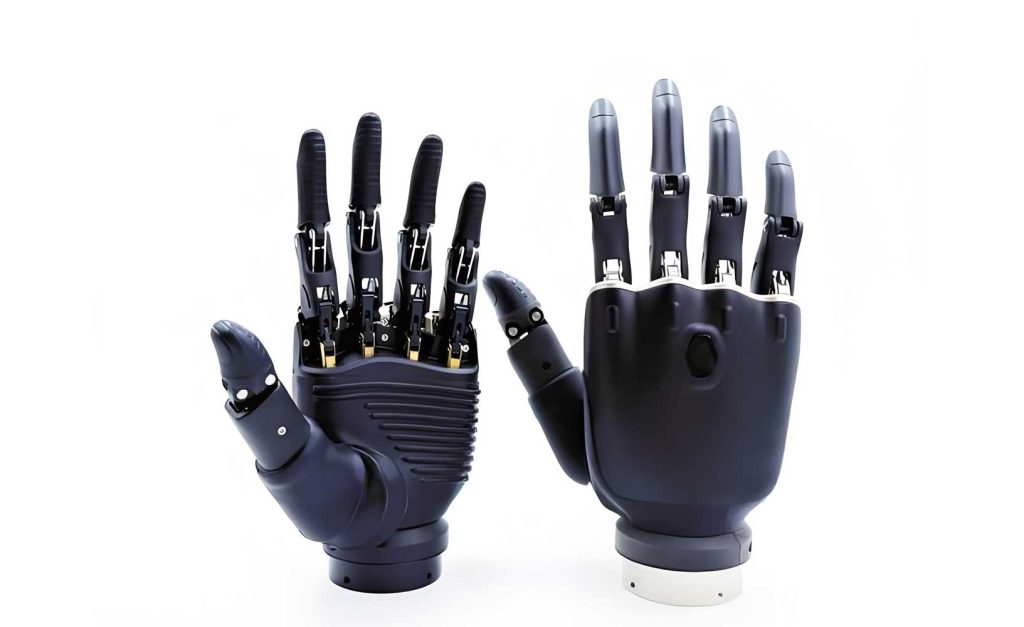
The dexterous robotic hand prototype DH-MN-I consists of five fingers and a palm, with each finger featuring four independent joints driven by servo motors. These joints include the Distal Interphalangeal (DIP), Proximal Interphalangeal (PIP), Metacarpophalangeal (MP), and Carpometacarpal (CMC) joints, providing four degrees of freedom per finger: flexion/extension for DIP, PIP, and MP (0° to 90°), and abduction/adduction for CMC (-20° to 20°). Each phalanx (distal, middle, proximal) and the metacarpal are equipped with pressure sensors to measure contact forces in real-time. This fully driven dexterous robotic hand design allows for high flexibility, enabling intricate manipulations that mimic human hand movements. The development of such a dexterous robotic hand is pivotal for advancing robotic manipulation, as it bridges the gap between simple grippers and human-like dexterity. In this work, I focus on solving the grasping control problem by integrating kinematic modeling with force feedback, ensuring that the dexterous robotic hand can adapt to various object geometries and weights seamlessly.
To control the dexterous robotic hand accurately, a detailed kinematic analysis is essential. I employed the Denavit-Hartenberg (D-H) parameter method to model each finger of the dexterous robotic hand. For a single finger, coordinate frames are assigned at each joint, with the base frame at the CMC joint. The D-H parameters for the finger are summarized in the table below, where $a_i$ represents link lengths, $\theta_i$ denotes joint angles, $d_i$ is the link offset, and $\alpha_i$ is the twist angle.
| Joint | $\theta_i$ | $d_i$ | $\alpha_i$ | $a_i$ |
|---|---|---|---|---|
| 1 (CMC) | $\theta_1$ | 0 | 90° | $a_1$ |
| 2 (MP) | $\theta_2$ | 0 | 0° | $a_2$ |
| 3 (PIP) | $\theta_3$ | 0 | 0° | $a_3$ |
| 4 (DIP) | $\theta_4$ | 0 | 0° | $a_4$ |
Here, $a_1 = 58$ mm (metacarpal), $a_2 = 58$ mm (proximal phalanx), $a_3 = 58$ mm (middle phalanx), and $a_4 = 42$ mm (distal phalanx). The forward kinematics for the fingertip position relative to the base frame is derived as:
$$
\begin{bmatrix}
x \\
y \\
z \\
1
\end{bmatrix}
=
\begin{bmatrix}
(a_4 C_{234} + a_3 C_{23} + a_2 C_2 + a_1) C_1 \\
(a_4 C_{234} + a_3 C_{23} + a_2 C_2 + a_1) S_1 \\
a_4 S_{234} + a_3 S_{23} + a_2 S_2 \\
1
\end{bmatrix}
$$
where $S_i = \sin \theta_i$, $C_i = \cos \theta_i$, $S_{ij} = \sin(\theta_i + \theta_j)$, $C_{ij} = \cos(\theta_i + \theta_j)$, $S_{ijk} = \sin(\theta_i + \theta_j + \theta_k)$, and $C_{ijk} = \cos(\theta_i + \theta_j + \theta_k)$. This equation defines the position of the fingertip in 3D space based on joint angles, which is crucial for planning grasps in the dexterous robotic hand.
For inverse kinematics, which computes joint angles from a desired fingertip position $(x, y, z)$, I incorporated a coupling relationship observed in human fingers to enhance the biomimetic performance of the dexterous robotic hand. Specifically, the DIP joint angle $\theta_4$ is coupled to the PIP joint angle $\theta_3$ as $\theta_4 = \frac{2}{3} \theta_3$, simplifying control while maintaining natural motion. Solving the inverse kinematics involves calculating $\theta_1$, $\theta_3$, and $\theta_2$ sequentially. First, $\theta_1$ is obtained from the base orientation:
$$
\theta_1 = \arctan\left(\frac{y}{x}\right)
$$
Then, let $A = \frac{x}{C_1} – a_1$, $B = z$, and $r = \frac{A^2 + B^2 – a_2^2 – a_3^2 – a_4^2}{2}$. The equation for $\theta_3$ is:
$$
r = a_3 a_4 \cos\left(\frac{2}{3} \theta_3\right) + a_2 a_4 \cos\left(\frac{5}{3} \theta_3\right) + a_2 a_3 \cos(\theta_3)
$$
This nonlinear equation is solved numerically to find $\theta_3$. Finally, with $C = a_2 + a_3 C_3 + a_4 C_{34}$, $D = a_3 S_3 + a_4 S_{34}$, and $E = z$, the angle $\theta_2$ is computed as:
$$
\theta_2 = \pm \arctan\left(\frac{E}{\sqrt{C^2 + D^2 – E^2}}\right) – \arctan\left(\frac{D}{E}\right), \quad 0 \leq \theta_2 \leq 90^\circ
$$
These kinematic models form the foundation for positioning the fingers of the dexterous robotic hand during grasping tasks.
The core of my control strategy is the Contact Force Feedback Control Algorithm (CFFCA), designed to regulate contact forces between the dexterous robotic hand and target objects in real-time. Let $F_{ij}$ represent the contact force measured by pressure sensors, where $i$ indexes the finger (1 for thumb, 2 for index, etc.) and $j$ indexes the phalanx (1 for distal, 2 for middle, 3 for proximal, 4 for metacarpal). The total contact force matrix $F$ is:
$$
F =
\begin{bmatrix}
F_{11} & F_{12} & F_{13} & F_{14} \\
F_{21} & F_{22} & F_{23} & F_{24} \\
F_{31} & F_{32} & F_{33} & F_{34} \\
F_{41} & F_{42} & F_{43} & F_{44} \\
F_{51} & F_{52} & F_{53} & F_{54}
\end{bmatrix}
$$
For a stable grasp, the static friction must balance the object’s weight $G$. Given a friction coefficient $f$ between the dexterous robotic hand and object, the condition for successful lifting is:
$$
\sum f F_{ij} = G
$$
Thus, the desired total contact force $F_q$ is defined as $F_q = G / f$. The algorithm monitors the error $\Delta F = \sum F_{ij} – F_q$ and adjusts servo motors accordingly. The control logic is as follows:
- If $\Delta F < 0$, the contact force is insufficient, so servos rotate forward to increase $F_{ij}$.
- If $\Delta F > 0$, the object can be lifted, but to prevent damage, if $\Delta F > 0.1 F_q$, servos reverse to decrease $F_{ij}$.
- If $\Delta F \leq 0.5 F_q$, servo speed is reduced to slow force changes.
- If $0 < \Delta F < 0.1 F_q$, servos stop, indicating grasp completion.
This feedback loop ensures that the dexterous robotic hand maintains optimal contact forces, adapting dynamically during grasping. The CFFCA enables precise control for both power and precision grasps, making the dexterous robotic hand versatile across object sizes.
For power grasping, suitable for larger objects, the dexterous robotic hand employs an enveloping strategy where multiple phalanges contact the object. The process for a single finger involves sequential joint actuation: first, the MP joint rotates to bring the proximal phalanx into contact; second, the PIP joint rotates for middle phalanx contact; third, the DIP joint rotates for distal phalanx contact. Throughout, pressure sensors provide real-time feedback, and CFFCA modulates servo rotations to achieve $0 < \Delta F < 0.1 F_q$. This method ensures a stable, force-controlled envelopment, leveraging the full kinematic capabilities of the dexterous robotic hand.
For precision grasping, ideal for smaller objects, only the fingertips of the dexterous robotic hand make contact. Using inverse kinematics, desired fingertip positions $(x, y, z)$ are computed, and joints are adjusted simultaneously to reach these points. Since only distal phalanges engage, $F_{ij} = 0$ for $j = 2,3,4$. The CFFCA then regulates $F_{i1}$ (distal phalanx forces) based on $\Delta F$, following the same logic as power grasps. This allows delicate manipulations, such as picking up slender items, showcasing the dexterity of the robotic hand.
To validate the dexterous robotic hand and CFFCA, I conducted experiments with objects of different sizes. For power grasping, an empty plastic bottle (mass 33.4 g, diameter 64 mm, height 196 mm) was used. With $f = 0.2$, $F_q = 1.6366$ N. The dexterous robotic hand successfully grasped the bottle, and contact forces $F_{ij}$ were recorded over time. The results showed four phases: initial contact (low $\sum F$), rapid force increase (servos forward), slowed adjustment ($\Delta F \leq 0.5 F_q$ with fluctuations due to object compliance), and completion ($0 < \Delta F < 0.1 F_q$). For instance, the thumb exhibited $F_{14} = 0$ (metacarpal contact without force), while distal phalanges contributed most to the force. The error $\Delta F$ remained within ±0.2 N during the adjustment phase, demonstrating stability. The table below summarizes the time phases for each finger during power grasping.
| Finger | Phase 1 (s) | Phase 2 (s) | Phase 3 (s) | Phase 4 (s) |
|---|---|---|---|---|
| Thumb | 0–2.8 | 2.8–11.2 | 11.2–81.5 | 84.3 |
| Index | 0–2.8 | 2.8–16.9 | 16.9–87.1 | 89.9 |
| Middle | 0–5.6 | 5.6–16.9 | 16.9–87.1 | 89.9 |
| Ring | 0–2.8 | 2.8–8.4 | 8.4–81.5 | 84.3 |
| Little | 0–2.8 | 2.8–5.6 | 5.6–84.3 | 87.1 |
For precision grasping, a pencil (mass 4.33 g, diameter 6.5 mm, length 177 mm) was used, with $F_q = 0.21217$ N. Only the thumb and index fingertips made contact. The forces $F_{11}$ and $F_{21}$ evolved similarly, with phases: 0–11.2 s (initial), 11.2–14 s (increase), 14–73 s (adjustment with minimal fluctuations due to higher object stiffness), and completion at 75.8 s. The error $\Delta F$ stayed within ±0.03 N, and in later stages, $F_{11} \approx F_{21}$, indicating balanced force distribution. These experiments confirm that the dexterous robotic hand, guided by CFFCA, achieves stable grasps for both large and small objects, with high real-time performance and dexterity.
To contextualize the capabilities of my dexterous robotic hand, I compare it with other notable dexterous robotic hands from literature in terms of finger count, degrees of freedom, and grasp type support. This comparison highlights the advantages of a fully driven design with high flexibility.
| Dexterous Robotic Hand | Number of Fingers | Degrees of Freedom | Power Grasp Support | Precision Grasp Support |
|---|---|---|---|---|
| DH-MN-I (this work) | 5 | 20 | Yes | Yes |
| BCL-13 | 4 | 13 | Yes | Yes |
| Allegro Hand | 4 | 16 | No | Yes |
| Pisa/IIT SoftHand 2 | 5 | 19 | Yes | Yes |
| ZHANG et al. | 5 | 6 | Yes | Yes |
| Panipat Wattanasiri et al. | 5 | 10 | Yes | Yes |
| Wei Qiancai | 4 | 16 | Yes | No |
As shown, my dexterous robotic hand offers a high degree of freedom (20) with five fingers, supporting both grasp types effectively. This enhances grasp stability and versatility compared to hands with fewer fingers or lower degrees of freedom. However, the experiments revealed that the adjustment phase in grasping can be time-consuming, indicating a trade-off between stability and speed. Future work will focus on optimizing the CFFCA to accelerate grasping while maintaining robustness, possibly through predictive control or machine learning techniques.
In conclusion, I have developed a fully driven five-fingered dexterous robotic hand prototype and proposed a Contact Force Feedback Control Algorithm for real-time grasping control. The kinematic models enable precise finger positioning, while the CFFCA dynamically adjusts contact forces based on sensor feedback, ensuring stable power and precision grasps for objects of varying sizes. Experimental results validate the algorithm’s effectiveness, with force errors kept within tight bounds during grasping. The comparison with other dexterous robotic hands underscores the advantages of this design in terms of dexterity and functionality. This research contributes to the advancement of robotic manipulation, offering a practical solution for complex tasks that require human-like hand agility. The integration of force feedback and full actuation in this dexterous robotic hand paves the way for more adaptive and intelligent robotic systems in industrial, service, and healthcare applications.