
In the field of robotics, the development of dexterous robotic hands has been a focal point for enabling machines to perform complex, delicate, or hazardous tasks that mimic human manipulation. These multi-fingered systems, often comprising three to five fingers with multiple joints, serve as parallel-serial robotic mechanisms capable of grasping and manipulating objects with high precision. The significance of dexterous robotic hands extends to applications in extreme environments, such as space exploration, nuclear facilities, and disaster response, where human presence is risky. To achieve effective grasp planning and fine manipulation, it is essential to conduct a thorough kinematic analysis of the dexterous robotic hand. This analysis not only determines the hand’s operational range but also informs design optimizations for enhanced performance. In this article, I will explore the forward kinematics and workspace analysis of a three-fingered dexterous robotic hand using screw theory, a geometric approach that offers clarity and efficiency compared to traditional methods like the Denavit-Hartenberg (D-H) parameters. By examining individual finger workspaces and their synthetic combined space, I aim to elucidate the graspable regions and probability distributions of reachable points, thereby providing a foundation for stable grasping and manipulation strategies in dexterous robotic hands.
The traditional D-H parameter method, while widely used for robot kinematic modeling, presents challenges such as complexity and lack of explicit geometric meaning. For dexterous robotic hands, which involve multiple serial chains (fingers), this can lead to cumbersome coordinate transformations and reduced intuition. In contrast, screw theory provides a streamlined framework by representing rigid body motions as exponentials of twists, requiring only base and tool coordinate systems. This approach not only simplifies the kinematic analysis of dexterous robotic hands but also enhances interpretability for subsequent Jacobian and dynamic studies. In this work, I will leverage screw theory to derive the forward kinematics of a three-fingered dexterous robotic hand, similar to the Shadow hand, and analyze its workspace comprehensively. The analysis will encompass individual finger workspaces, the synthetic workspace of all fingers, and the probability distribution of spatial points, enabling pre-assessment of grasp targets and optimization of finger geometry and placement. Through this exploration, I intend to demonstrate the efficacy of screw theory in advancing the design and control of dexterous robotic hands for real-world applications.
Before delving into the kinematics of dexterous robotic hands, it is crucial to establish the theoretical foundations of screw theory. Screw theory describes rigid body motions using twists and exponentials, offering a geometric perspective on rotations and translations. For a rigid body rotating with unit angular velocity $\omega \in \mathbb{R}^3$ about an axis, through an angle $\theta$, the motion can be expressed as a matrix exponential: $$ R(\omega, \theta) = e^{\hat{\omega} \theta}, $$ where $\hat{\omega}$ is the skew-symmetric matrix representation of $\omega$, satisfying $\hat{\omega} r = \omega \times r$ for any vector $r \in \mathbb{R}^3$. When $\|\omega\| = 1$, the Rodrigues’ formula gives: $$ e^{\hat{\omega} \theta} = I + \hat{\omega} \sin \theta + \hat{\omega}^2 (1 – \cos \theta), $$ with $I$ being the identity matrix. This formulation elegantly captures pure rotations in dexterous robotic hand joints.
For combined rotation and translation, consider a rigid body rotating about an axis $\omega$ while translating parallel to it with velocity $v$. The motion is represented by a twist $\hat{\xi} \in \mathbb{R}^{4 \times 4}$, defined as: $$ \hat{\xi} = \begin{bmatrix} \hat{\omega} & v \\ 0 & 0 \end{bmatrix}, $$ where $v = -\omega \times q$ for a point $q$ on the axis. The twist coordinates are $\xi = (v, \omega) \in \mathbb{R}^6$. The exponential map $e^{\hat{\xi} \theta}$ describes the rigid transformation from an initial pose $p(0)$ to a final pose $p(\theta)$: $$ p(\theta) = e^{\hat{\xi} \theta} p(0). $$ Explicitly, for $\omega \neq 0$: $$ e^{\hat{\xi} \theta} = \begin{bmatrix} e^{\hat{\omega} \theta} & (I – e^{\hat{\omega} \theta})(\omega \times v) + \omega \omega^T v \theta \\ 0 & 1 \end{bmatrix}, $$ and for $\omega = 0$ (pure translation): $$ e^{\hat{\xi} \theta} = \begin{bmatrix} I & v \theta \\ 0 & 1 \end{bmatrix}. $$ This framework seamlessly extends to serial chains, such as those in dexterous robotic hands.
For an $n$-degree-of-freedom (DOF) open-chain robot, like a finger in a dexterous robotic hand, the forward kinematics map $g_{st}: SE(3) \to SE(3)$ from the base frame $S$ to the tool frame $T$ is given by the product of exponentials: $$ g_{st}(\theta) = e^{\hat{\xi}_1 \theta_1} e^{\hat{\xi}_2 \theta_2} \dots e^{\hat{\xi}_n \theta_n} g_{st}(0), $$ where $g_{st}(0)$ is the initial pose of the end-effector relative to the base, and $\hat{\xi}_i$ are the twists for each joint parameterized by joint angles $\theta_i$. This formulation avoids the need for multiple intermediate coordinate systems, as required in D-H methods, and provides clear geometric insights into the motion of dexterous robotic hands. In the following sections, I will apply this to model the fingers of a three-fingered dexterous robotic hand.
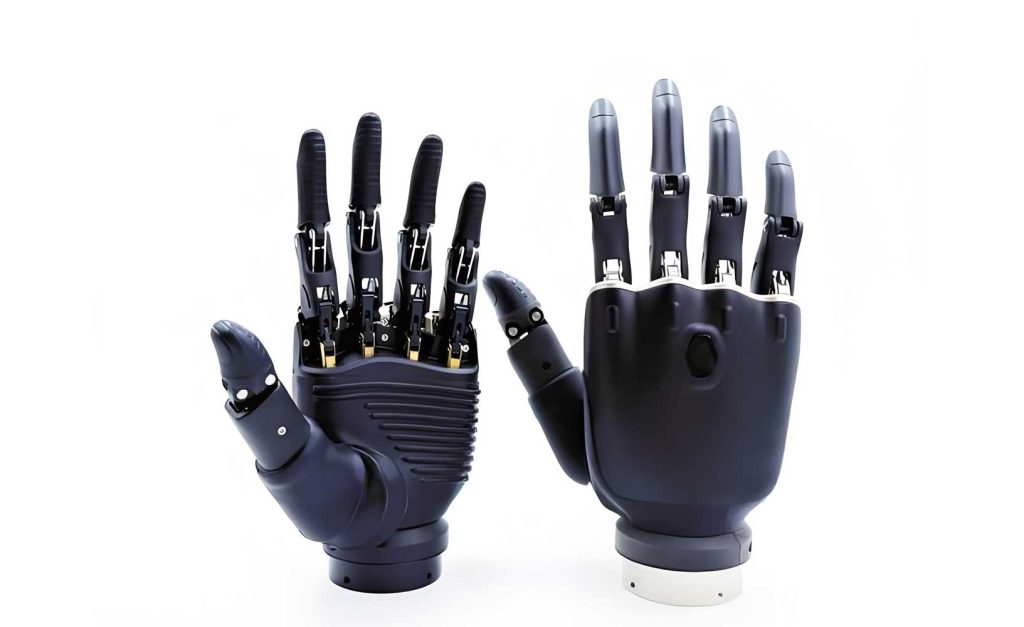
The dexterous robotic hand under consideration consists of three fingers: a thumb (TH), index finger (FF), and ring finger (RF). Each finger is modeled as a serial chain with specific DOFs and link lengths, mimicking human hand anatomy for versatile grasping. The thumb has 5 DOFs, including abduction/adduction and flexion at the lower phalanx, abduction/adduction and flexion at the middle phalanx, and flexion at the upper phalanx, with perpendicular axes at the base. The index and ring fingers have 4 DOFs each, featuring abduction/adduction and flexion at the lower phalanx, and coupled flexion at the middle and upper phalanges (with a coupling coefficient of 1). This structure enables the dexterous robotic hand to perform a wide range of manipulations, from precision grips to power grasps. To analyze the workspace, I first derive the forward kinematics for each finger using screw theory, as detailed below.
For the index finger (and similarly the ring finger), I define the base frame at the finger base, with the $z$-axis aligned with the first joint (abduction/adduction) and the $x$-axis along the proximal link. The twists $\xi_i$ for each joint are constructed based on the joint axes $\omega_i$ and points $q_i$ on the axes. Let $a_1, a_2, a_3, a_4$ denote the link lengths from the base to the fingertip. The joint angles are $\theta_1$ (abduction/adduction), $\theta_2$ (flexion at lower phalanx), $\theta_3$ (flexion at middle phalanx), and $\theta_4$ (flexion at upper phalanx). Using the product of exponentials, the forward kinematics $g_{st}(\theta)$ for the index finger is derived as:
$$ g_{st}(\theta) = \begin{bmatrix} c_1 c_{234} & -c_1 s_{234} & -s_1 & c_1 (a_1 + a_2 c_2 + a_3 c_{23} + a_4 c_{234}) \\ s_1 c_{234} & -s_1 s_{234} & c_1 & s_1 (a_1 + a_2 c_2 + a_3 c_{23} + a_4 c_{234}) \\ -s_{234} & -c_{234} & 0 & -a_2 s_2 – a_3 s_{23} – a_4 s_{234} \\ 0 & 0 & 0 & 1 \end{bmatrix}, $$
where $s_i = \sin \theta_i$, $c_i = \cos \theta_i$, $s_{ij} = \sin(\theta_i + \theta_j)$, $c_{ij} = \cos(\theta_i + \theta_j)$, and similarly for triple sums. This equation provides the position and orientation of the fingertip for any joint configuration, essential for workspace analysis of the dexterous robotic hand.
For the thumb, with 5 DOFs, the twists are more complex due to additional joints. Let $\theta_1$ (abduction/adduction at base), $\theta_2$ (flexion at lower phalanx), $\theta_3$ (abduction/adduction at middle phalanx), $\theta_4$ (flexion at middle phalanx), and $\theta_5$ (flexion at upper phalanx). The link lengths are $a_1$ to $a_5$. The forward kinematics yields:
$$ g_{st}(\theta) = \begin{bmatrix} r_{11} & r_{12} & r_{13} & p_x \\ r_{21} & r_{22} & r_{23} & p_y \\ r_{31} & r_{32} & r_{33} & p_z \\ 0 & 0 & 0 & 1 \end{bmatrix}, $$
with elements defined as follows: $$ r_{11} = s_5 (s_4 (s_1 s_3 – c_1 c_2 c_3) – c_1 c_4 s_2) – c_5 (c_4 (s_1 s_3 – c_1 c_2 c_3) + c_1 s_2 s_4), $$ $$ r_{12} = c_5 (s_4 (s_1 s_3 – c_1 c_2 c_3) – c_1 c_4 s_2) + s_5 (c_4 (s_1 s_3 – c_1 c_2 c_3) + c_1 s_2 s_4), $$ $$ r_{13} = -c_3 s_1 – c_1 c_2 s_3, $$ $$ r_{21} = c_5 (c_4 (c_1 s_3 + s_1 c_2 c_3) – s_1 s_2 s_4) – s_5 (s_4 (c_1 s_3 + s_1 c_2 c_3) + c_4 s_1 s_2), $$ $$ r_{22} = -c_5 (s_4 (c_1 s_3 + s_1 c_2 c_3) + s_1 s_2 c_4) – s_5 (c_4 (c_1 s_3 + s_1 c_2 c_3) – s_1 s_2 s_4), $$ $$ r_{23} = c_1 c_3 – c_2 s_1 s_3, $$ $$ r_{31} = -c_5 (c_2 s_4 + c_3 c_4 s_2) – s_5 (c_2 c_4 – c_3 s_2 s_4), $$ $$ r_{32} = s_5 (c_2 s_4 + c_3 c_4 s_2) – c_5 (c_2 c_4 – c_3 s_2 s_4), $$ $$ r_{33} = s_2 s_3, $$ $$ p_x = a_2 c_1 c_2 – a_4 c_1 s_2 s_4 – a_4 c_1 s_1 s_3 + a_4 c_1 c_2 c_3 c_4 – a_5 c_1 c_4 s_2 s_5 – a_5 c_1 c_5 s_2 s_4 – a_5 c_4 c_5 s_1 s_3 + a_5 s_1 s_3 s_4 s_5 – a_5 c_1 c_2 c_3 s_4 s_5 + a_5 c_1 c_2 c_3 c_4 c_5, $$ $$ p_y = a_2 s_1 c_2 + a_4 c_1 c_4 s_3 – a_4 s_1 s_2 s_4 + a_4 s_1 c_2 c_3 c_4 + a_5 c_1 c_4 c_5 s_3 – a_5 c_4 s_1 s_2 s_5 – a_5 c_5 s_1 s_2 s_4 – a_5 c_1 s_3 s_4 s_5 + a_5 s_1 c_2 c_3 c_4 c_5 – a_5 s_1 c_2 c_3 s_4 s_5, $$ $$ p_z = a_5 c_3 s_2 s_4 s_5 – a_4 c_2 s_4 – a_4 c_3 c_4 s_2 – a_5 c_2 c_4 s_5 – a_5 c_2 c_5 s_4 – a_5 c_3 c_4 c_5 s_2 – a_2 s_2. $$
These kinematic equations form the basis for workspace computation in the dexterous robotic hand. To facilitate analysis, I summarize the finger parameters and joint ranges in Table 1, which are inspired by human hand anatomy and typical dexterous robotic hand designs.
| Finger | Joint | Range | Link Length (mm) |
|---|---|---|---|
| Thumb (TH) | $\theta_1$ (Abduction/Adduction) | $-55^\circ$ to $55^\circ$ | $a_1 = 0$ |
| $\theta_2$ (Flexion) | $0^\circ$ to $70^\circ$ | $a_2 = 38$ | |
| $\theta_3$ (Abduction/Adduction) | $-12^\circ$ to $12^\circ$ | $a_3 = 0$ | |
| $\theta_4$ (Flexion) | $-40^\circ$ to $40^\circ$ | $a_4 = 32$ | |
| $\theta_5$ (Flexion) | $0^\circ$ to $90^\circ$ | $a_5 = 27.5$ | |
| Index (FF) and Ring (RF) | $\theta_1$ (Abduction/Adduction) | $-20^\circ$ to $20^\circ$ | $a_1 = 0$ |
| $\theta_2$ (Flexion) | $0^\circ$ to $90^\circ$ | $a_2 = 45$ | |
| $\theta_3$ (Flexion) | $0^\circ$ to $90^\circ$ | $a_3 = 25$ | |
| $\theta_4$ (Flexion) | $0^\circ$ to $90^\circ$ | $a_4 = 26$ |
With the forward kinematics established, I proceed to analyze the workspace of the dexterous robotic hand. The workspace is defined as the set of all points in 3D space that can be reached by the fingertip, representing the graspable volume. This analysis is critical for determining the operational capabilities of the dexterous robotic hand and optimizing finger placement. I compute the workspace numerically using MATLAB, sampling joint angles within their ranges and applying the kinematic equations to generate point clouds for each finger. The results are visualized and discussed below.
First, I examine the individual workspaces of the fingers. For the index finger, the point cloud reveals a compact volume with boundaries in Cartesian coordinates. Specifically, the $X$-direction range is $[-32.83, 32.83]$ mm, the $Y$-direction range is $[-130, -34]$ mm (negative due to coordinate orientation), and the $Z$-direction range is $[44, 190.98]$ mm, showing a variation from large to small and back to large along $Z$. The ring finger exhibits a similar structure but with a $Y$-direction range of $[-86, 10]$ mm, reflecting its position on the hand. The thumb, with more DOFs, has a larger workspace: $X$-direction range $[-85.9, 85.9]$ mm, $Y$-direction range $[-131.5, -34.96]$ mm, and $Z$-direction range $[-44.4, 115.14]$ mm. These ranges align with the thumb’s dominant role in grasping, as seen in human hands. The workspaces are free of voids, indicating continuous reachability, which is beneficial for dexterous robotic hand operations.
To understand the combined grasping capability of the dexterous robotic hand, I analyze the synthetic workspace of all three fingers. This involves transforming each finger’s coordinate system to a common palm frame. Let the palm base frame $O$ be at the center of the hand, with fingers attached at specific offsets. The transformation matrices from finger bases to $O$ are defined as $^O_B R$ for the index finger, $^O_C R$ for the ring finger, and $^O_A R$ for the thumb, incorporating a $45^\circ$ inclination for the thumb. Applying these transformations, the unified forward kinematics $g^O_{st}(\theta)$ for each finger is obtained by left-multiplying the original $g_{st}(\theta)$ with the corresponding transformation matrix. The combined point cloud represents the synthetic workspace, encompassing independent, complementary, and overlapping regions.
The synthetic workspace analysis reveals key insights into the dexterous robotic hand’s versatility. In the $XOY$ plane projection, the thumb and index finger show a substantial overlapping region, termed the dexterous space, which facilitates precision manipulation like pinch grips. In the $XOZ$ plane, the index and ring finger projections overlap completely due to symmetry, while the thumb overlaps minimally, primarily at distal joints. In the $YOZ$ plane, the thumb overlaps significantly with both other fingers, indicating good complementary for power grasps. These overlapping regions are crucial for coordinated tasks in dexterous robotic hands, as they enable stable multi-finger contacts. The synthetic workspace is compact and without holes, suggesting that the finger geometry and placement are well-suited for a wide range of objects. This analysis validates the screw theory approach and provides a geometric foundation for grasp planning in dexterous robotic hands.
Beyond spatial extent, the distribution of reachable points within the workspace influences grasping stability. Dense point clusters indicate regions where the dexterous robotic hand can operate more frequently and flexibly, while sparse areas correspond to less accessible zones. To quantify this, I analyze the probability distribution of workspace points along the $X$, $Y$, and $Z$ axes. This involves discretizing the point clouds and computing histograms for each finger and the synthetic set. The results are summarized in Table 2 and discussed below.
| Direction | Thumb Range (mm) and Density | Index Finger Range (mm) and Density | Ring Finger Range (mm) and Density | Synthetic Range (mm) and Notes |
|---|---|---|---|---|
| $X$ | $-85.9$ to $85.9$, wide and dispersed | $-32.83$ to $32.83$, concentrated | $-32.83$ to $32.83$, concentrated | $-85.9$ to $85.9$, with high density in central regions |
| $Y$ | $-131.5$ to $-34.96$, broad distribution | $-130$ to $-34$, similar to thumb | $-86$ to $10$, offset due to position | $-131.5$ to $10$, complementary coverage |
| $Z$ | $-44.4$ to $115.14$, extensive range | $44$ to $190.98$, high concentration | $44$ to $190.98$, high concentration | $-44.4$ to $190.98$, full vertical coverage |
The probability distributions show that the thumb covers the largest $X$ and $Z$ ranges, but with dispersion, while the index and ring fingers have narrower $X$ ranges but high point density, making them precise for targeted grasping. In the $Y$ direction, all fingers contribute to a broad distribution, ensuring lateral reach. For the synthetic workspace, the $X$ distribution peaks near zero, indicating that central objects are more graspable. The $Y$ distribution has dual peaks corresponding to thumb and ring finger zones, enabling versatile side grasps. The $Z$ distribution is bimodal, with concentrations at lower (thumb) and higher (index/ring) regions, supporting both low and high object placements. These insights allow for pre-screening of grasp targets: objects sized within high-density regions are more likely to be stably grasped by the dexterous robotic hand. For instance, a cylindrical object with diameter around 30 mm in $X$ and positioned near $Y = -50$ mm would align with dense points, enhancing grip security.
To further elucidate the workspace properties, I derive mathematical expressions for the boundary surfaces. For a simplified model, consider the index finger with joints $\theta_2, \theta_3, \theta_4$ contributing to radial reach. The fingertip position from the forward kinematics is: $$ p_x = c_1 (a_2 c_2 + a_3 c_{23} + a_4 c_{234}), $$ $$ p_y = s_1 (a_2 c_2 + a_3 c_{23} + a_4 c_{234}), $$ $$ p_z = -a_2 s_2 – a_3 s_{23} – a_4 s_{234}. $$ The radial distance $r = \sqrt{p_x^2 + p_y^2} = |a_2 c_2 + a_3 c_{23} + a_4 c_{234}|$ and height $p_z$ define a reachability envelope. By varying angles within limits, the workspace boundary can be approximated as a surface of revolution. For the dexterous robotic hand, similar envelopes for each finger intersect to form the synthetic workspace. The volume $V$ of the synthetic workspace can be estimated via Monte Carlo integration: $$ V \approx \frac{1}{N} \sum_{i=1}^N \mathbb{I}(p_i \in W) \cdot \Delta, $$ where $N$ is sample count, $\mathbb{I}$ is the indicator function, $p_i$ are points, $W$ is the workspace, and $\Delta$ is a scaling factor. This volumetric analysis aids in comparing different dexterous robotic hand designs.
In practice, the dexterous robotic hand’s workspace is influenced by joint limits, link lengths, and finger arrangement. To optimize these parameters, I formulate an optimization problem: maximize the synthetic workspace volume $V$ subject to constraints on finger size and palm geometry. Let $L = [a_1, a_2, \dots]$ be the link lengths, and $\Theta_{\text{min}}, \Theta_{\text{max}}$ be joint limits. The objective function is: $$ \text{maximize } V(L, \Theta) \text{ subject to } \sum a_i \leq L_{\text{total}}, \Theta_{\text{min}} \leq \theta_i \leq \Theta_{\text{max}}. $$ Using gradient-based methods or genetic algorithms, one can tune parameters for enhanced dexterity. For instance, increasing thumb link lengths expands the workspace but may reduce manipulation speed. Such trade-offs are critical in dexterous robotic hand design.
The screw theory approach also facilitates the computation of Jacobians and dynamics for dexterous robotic hands. The spatial Jacobian $J_s(\theta)$ relates joint velocities to end-effector twist, derived from the twists $\xi_i$: $$ J_s(\theta) = [\xi_1, \xi_2′, \dots, \xi_n’], $$ where $\xi_i’$ are transformed twists. For the index finger, the Jacobian provides insight into dexterity metrics like manipulability ellipsoids, which describe how well the finger can move in different directions. The manipulability measure $w = \sqrt{\det(J J^T)}$ peaks in high-density workspace regions, correlating with grasp stability. This aligns with the probability distribution analysis, reinforcing that dexterous robotic hands perform best in dense zones.
Moreover, the synthetic workspace analysis informs grasp planning algorithms. By identifying overlapping regions, one can predefine grasp types: precision grasps in thumb-index overlap, power grasps in thumb-ring overlap, and spherical grasps in three-finger overlap. For a given object, its bounding box can be compared with workspace densities to select optimal finger poses. This pre-planning reduces computational load in real-time control of dexterous robotic hands. Additionally, the probability distributions can be used to train machine learning models for grasp prediction, enhancing autonomy.
In conclusion, this study demonstrates the application of screw theory to the kinematic and workspace analysis of a three-fingered dexterous robotic hand. By deriving forward kinematics via exponential maps, I obtained concise equations that reveal the geometric structure of finger motions. The individual and synthetic workspace analyses, supported by numerical simulations, highlight the reachable volumes and overlapping dexterous regions essential for grasping. The probability distributions of workspace points offer a quantitative basis for object selection and grasp stability assessment. These findings underscore the advantages of screw theory in simplifying modeling and providing intuitive insights for dexterous robotic hands. Future work could extend this approach to dynamic analysis, contact force optimization, and integration with sensory feedback for adaptive grasping. As dexterous robotic hands evolve, such theoretical foundations will be invaluable in achieving human-like manipulation capabilities in diverse robotic applications.
To summarize key formulas and parameters, I present Table 3, which consolidates the kinematic equations and workspace metrics for quick reference in dexterous robotic hand design.
| Component | Forward Kinematics (Exponential Form) | Workspace Range (mm) | Key Metrics |
|---|---|---|---|
| Index Finger | $g_{st}(\theta) = e^{\hat{\xi}_1 \theta_1} e^{\hat{\xi}_2 \theta_2} e^{\hat{\xi}_3 \theta_3} e^{\hat{\xi}_4 \theta_4} g_{st}(0)$ | $X: [-32.83, 32.83]$, $Y: [-130, -34]$, $Z: [44, 190.98]$ | Point density: high in central $X$, vertical span |
| Ring Finger | Same as index, with different $Y$ offset | $X: [-32.83, 32.83]$, $Y: [-86, 10]$, $Z: [44, 190.98]$ | Symmetrical to index in $XZ$, complementary in $Y$ |
| Thumb | $g_{st}(\theta) = e^{\hat{\xi}_1 \theta_1} e^{\hat{\xi}_2 \theta_2} e^{\hat{\xi}_3 \theta_3} e^{\hat{\xi}_4 \theta_4} e^{\hat{\xi}_5 \theta_5} g_{st}(0)$ | $X: [-85.9, 85.9]$, $Y: [-131.5, -34.96]$, $Z: [-44.4, 115.14]$ | Largest volume, dispersed points, key for dexterity |
| Synthetic Workspace | $g^O_{st}(\theta) = \text{Transform} \cdot g_{st}(\theta)$ | $X: [-85.9, 85.9]$, $Y: [-131.5, 10]$, $Z: [-44.4, 190.98]$ | Overlap regions: thumb-index (precision), thumb-ring (power) |
Through this comprehensive analysis, I have shown that screw theory not only streamlines the kinematic modeling of dexterous robotic hands but also enriches workspace evaluation, paving the way for advanced grasp strategies. The integration of tables and formulas, as presented, serves as a valuable resource for researchers and engineers working on dexterous robotic hands. As robotics continues to advance, such analytical tools will be crucial in developing more capable and adaptable dexterous robotic hands for complex real-world tasks.