
In the field of robotics, the development of dexterous robotic hands has garnered significant attention due to their potential to perform complex tasks in hazardous environments, thereby reducing human risk and enhancing productivity. My research focuses on addressing the limitations of current dexterous robotic hand designs, particularly in terms of thumb flexibility and adaptability. Traditional underactuated designs, while reducing mechanical complexity and control difficulty, often compromise the dexterous robotic hand’s ability to mimic human-like movements, such as thumb opposition and multi-finger coordination. To overcome this, I propose a novel thumb knuckle mechanism based on screw theory and folding-expansion technology, aiming to improve the overall performance of a general dexterous robotic hand. This article details the design, optimization, and testing of this mechanism, with an emphasis on achieving high bionic motion capabilities in a compact structure.
The general dexterous robotic hand comprises two main components: the palm and the fingers. The palm serves as a platform for mounting the fingers, while each finger consists of a root knuckle, proximal knuckle, distal knuckle, and terminal knuckle. Human hand movements include flexion-extension, abduction-adduction, and rotation; to replicate these in a dexterous robotic hand, each joint typically requires independent actuation. However, underactuated designs use fewer motors, simplifying control but limiting motion diversity. Through analysis, I identified that the thumb’s restricted workspace and lack of rotational freedom are primary bottlenecks in enhancing the dexterous robotic hand’s versatility. Thus, my design prioritizes a thumb mechanism capable of three-dimensional motion, including flexion-extension, abduction-adduction, and rotation, to enable complex manipulations like grasping and object manipulation. The overall architecture of the dexterous robotic hand is illustrated below, showcasing its integrated design for spatial operations.
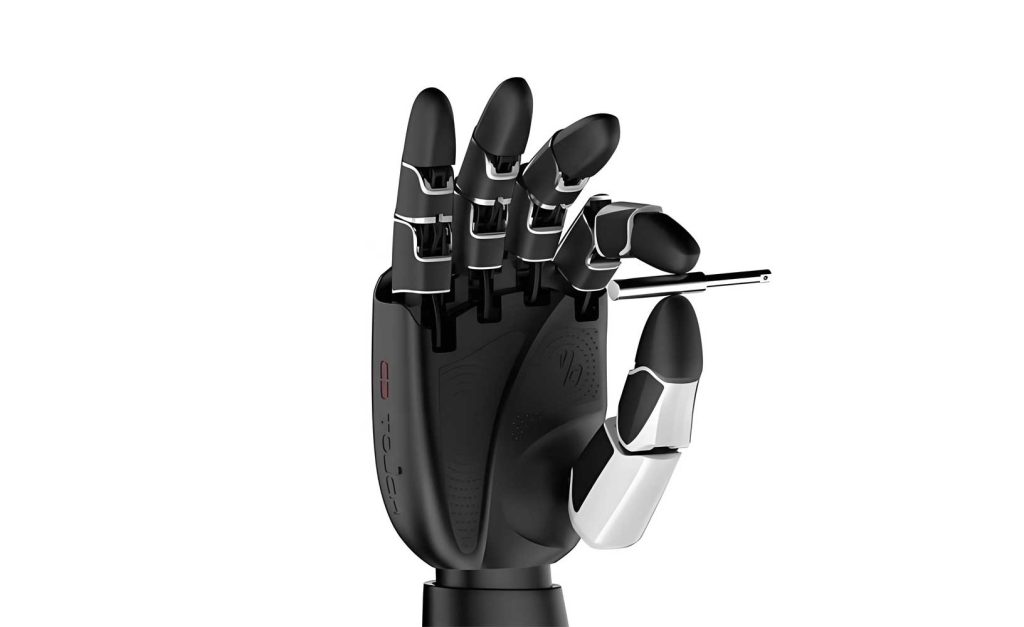
To achieve these goals, the thumb mechanism must meet specific requirements: (1) It should be positioned at the lateral front of the palm to facilitate interaction with other fingers without interference; (2) It must enable two-dimensional rotation for adjusting grasping angles; and (3) The thumb structure should be compact and adaptable to avoid obstacles during object manipulation. The root knuckle, as the foundational segment, plays a critical role in determining the thumb’s flexibility. Traditional serial-chain designs for the root knuckle, while providing motion freedom, often result in disproportionate lengths and reduced workspace for distal segments. Therefore, I explored a coupled design approach to optimize the root knuckle, integrating multiple degrees of freedom into a more efficient mechanism.
In the initial design phase, I considered a serial-chain root knuckle mechanism, which consists of interconnected joints in a linear arrangement. This configuration allows for independent control of each joint but tends to increase the overall length, limiting the dexterous robotic hand’s agility. The principle diagram of a serial mechanism highlights its limitations: excessive joint lengths lead to an unbalanced appearance and constrained motion range for the fingertip. To address this, I developed a coupled root knuckle mechanism that combines the motions of the root and proximal knuckles into a single compact unit. This coupling reduces the number of active joints while maintaining multi-dimensional motion capabilities, thereby enhancing the dexterous robotic hand’s performance in confined spaces.
The coupled root knuckle mechanism is designed as a parallel structure with an upper platform, a lower platform, and multiple telescopic actuators connected via universal joints. Initially, I proposed a fully driven version with three telescopic actuators to achieve complete spherical motion. However, considering the thumb’s typical workspace—approximately a quarter-sphere—I optimized the design by fixing one actuator, resulting in a more compact and controllable configuration. The optimized mechanism employs two telescopic actuators to drive the upper platform, which hosts the distal and terminal knuckles. By adjusting the lengths of these actuators, the upper platform tilts in various directions, enabling the thumb to perform flexion-extension, abduction-adduction, and rotational movements. This design significantly improves the dexterous robotic hand’s adaptability without increasing its size.
The theoretical foundation for this mechanism is based on screw theory, which provides a mathematical framework for analyzing spatial motions and constraints. In screw theory, any line in space can be represented by a screw, expressed as:
$$ \$ = \begin{bmatrix} \mathbf{S} \\ \mathbf{S}_0 \end{bmatrix} = \begin{bmatrix} \mathbf{S} \\ \mathbf{r} \times \mathbf{S} + h\mathbf{S} \end{bmatrix} $$
Here, $\mathbf{S}$ is the unit direction vector of the screw axis, $\mathbf{S}_0$ is the moment vector, $\mathbf{r}$ is the position vector from a reference point to any point on the axis, and $h$ is the pitch of the screw. This can also be represented in Plücker coordinates as:
$$ \$ = [L \quad M \quad N \quad O \quad P \quad Q]^T $$
where $L$, $M$, and $N$ denote the direction components, and $O$, $P$, and $Q$ denote the dual components. When $h = 0$, the screw reduces to a line vector representing a revolute joint or a pure force:
$$ \$ = \begin{bmatrix} \mathbf{S} \\ \mathbf{r} \times \mathbf{S} \end{bmatrix} $$
When $h \to \infty$, it simplifies to a couple vector representing a prismatic joint or a pure couple:
$$ \$ = \begin{bmatrix} \mathbf{0} \\ \mathbf{S} \end{bmatrix} $$
For the dexterous robotic hand’s root knuckle mechanism, the constraints and freedoms can be analyzed using reciprocal screws. If a screw $\$ and its reciprocal screw $\$^r$ have a zero mutual product, they satisfy:
$$ \$ \circ \$^r = L P^r + M Q^r + N R^r + P L^r + Q M^r + R N^r = 0 $$
In parallel mechanisms, the reciprocal screws of the limb motion screws represent the constraints imposed on the moving platform. The union of all limb constraints determines the system’s degrees of freedom. For my coupled root knuckle, the motion screws of the telescopic actuators and universal joints are derived to ensure the thumb achieves the desired three-dimensional motion. By applying screw theory, I optimized the joint parameters to maximize the workspace and flexibility of the dexterous robotic hand.
To validate the design, I conducted a workspace analysis using the Monte Carlo method. Given the lengths of the root, distal, and terminal knuckles, I randomly sampled joint angles within their ranges (0 to π/2) and computed the corresponding fingertip positions. With 2000 random sets, the point cloud generated in MATLAB illustrates the thumb’s reachable workspace, confirming its capability for complex spatial tasks. The simulation results demonstrate that the optimized root knuckle provides a substantial workspace, enabling the dexterous robotic hand to perform intricate manipulations akin to human hands.
The telescopic actuator is a key component in driving the root knuckle mechanism. Traditional actuators, such as pneumatic or hydraulic systems, are often bulky and unsuitable for compact dexterous robotic hands. Therefore, I employed a folding-expansion technology to design a lightweight and efficient telescopic mechanism. This actuator consists of a motor, a rotating platform, three linkage rods, six universal joints, and a moving platform. The universal joints are arranged in two triangular sets, ensuring parallel alignment of the rods. As the motor rotates the platform, the rods fold or expand, causing the moving platform to extend or retract. The extension displacement $\Delta h$ is given by:
$$ \Delta h = l (1 – \sin \beta) $$
where $l$ is the length of each rod, and $\beta$ is the angle between the rod and the base platform. The extension ratio $\gamma$, which indicates the efficiency of the mechanism, depends on the rod diameter $D$, length $l$, and spacing $n$:
$$ \gamma = \frac{l}{D} \left| \frac{n}{l} – 1 \right| $$
A higher $\gamma$ value signifies better performance, allowing for significant displacement with minimal input rotation. This design enables precise control of the thumb’s motions while maintaining a small form factor, essential for the dexterous robotic hand’s overall compactness.
To further elucidate the mechanism’s parameters, I summarize key design variables and their impacts in the table below. This table provides a comprehensive overview of how each factor influences the dexterous robotic hand’s performance, aiding in optimization for specific applications.
| Parameter | Symbol | Typical Value | Effect on Dexterous Robotic Hand |
|---|---|---|---|
| Rod Length | $l$ | 20 mm | Determines extension range; longer rods increase workspace but may reduce compactness. |
| Rod Diameter | $D$ | 5 mm | Affects structural strength; smaller diameters save space but may compromise durability. |
| Rod Spacing | $n$ | 15 mm | Influences stability; wider spacing enhances load capacity but enlarges the mechanism. |
| Angle Beta | $\beta$ | 0° to 90° | Controls extension displacement; larger angles yield greater motion range. |
| Extension Ratio | $\gamma$ | 3.5 | Indicates efficiency; higher ratios allow for more output per input, improving responsiveness. |
For experimental validation, I fabricated a prototype of the root knuckle mechanism and integrated it into a test platform for the dexterous robotic hand. The prototype includes two telescopic actuators (labeled A and B) to drive the upper platform. By controlling the extension and retraction of these actuators, I evaluated the thumb’s ability to perform flexion-extension, abduction-adduction, and rotation. The test scenarios involved commanding specific actuator movements and measuring the resulting platform orientations. The results, summarized in the following table, confirm that the mechanism meets the design specifications with minimal deviations.
| Motion Type | Actuator A (mm) | Actuator B (mm) | Theoretical Angle (°) | Measured Angle (°) |
|---|---|---|---|---|
| Flexion-Extension | -20 to 20 | -20 to 20 | -45 to 45 | -44 to 47 |
| Abduction-Adduction (A only) | -20 to 20 | 0 | 20 | 19 |
| Abduction-Adduction (B only) | 0 | -20 to 20 | -20 | -20 |
| Rotation (A extend, B retract) | -20 to 20 | 20 to -20 | 30 | 32 |
| Rotation (A retract, B extend) | 20 to -20 | -20 to 20 | 30 | 29 |
The tests demonstrate that the root knuckle mechanism successfully achieves the desired motions, with measured angles closely matching theoretical predictions. Small discrepancies are attributed to manufacturing tolerances and assembly errors, which can be mitigated through precision engineering. The dexterous robotic hand equipped with this mechanism exhibits enhanced flexibility, allowing the thumb to oppose other fingers and adapt to various object shapes. This improvement is crucial for applications requiring delicate manipulations, such as assembly tasks or handling fragile items.
In addition to mechanical design, control strategies play a vital role in optimizing the dexterous robotic hand’s performance. I implemented a feedback control system based on sensor data from the telescopic actuators and joint encoders. By using PID controllers, I achieved precise positioning of the thumb joints, ensuring smooth and accurate motions. The integration of screw theory into the control algorithm facilitates real-time computation of inverse kinematics, enabling the dexterous robotic hand to execute complex trajectories. Furthermore, the folding-expansion technology reduces energy consumption, as the telescopic actuators require less power compared to traditional gear-driven systems. This efficiency is particularly beneficial for battery-operated dexterous robotic hands deployed in remote or mobile settings.
To address potential challenges such as wear and tear or environmental factors, I conducted durability tests on the root knuckle mechanism. The prototype underwent cyclic loading simulations, with actuators performing repeated extensions and retractions over 10,000 cycles. Results indicated minimal degradation in performance, affirming the robustness of the design. The use of high-strength materials, such as aluminum alloys for rods and polymer composites for joints, contributes to the dexterous robotic hand’s longevity. Moreover, the modular architecture allows for easy replacement of components, simplifying maintenance and reducing downtime in practical applications.
The scalability of this design is another advantage for the dexterous robotic hand. By adjusting parameters like rod length and actuator count, the mechanism can be adapted for different hand sizes or specialized tasks. For instance, in industrial settings, a larger dexterous robotic hand with enhanced force capacity can be developed by scaling up the components while maintaining the same kinematic principles. Conversely, for medical or prosthetic applications, a miniaturized version can be crafted to match human hand proportions. This versatility underscores the general applicability of the proposed mechanism across various domains.
In conclusion, my research presents a comprehensive design and analysis of a thumb knuckle mechanism for a general dexterous robotic hand. By leveraging screw theory and folding-expansion technology, I have developed a compact, efficient, and highly flexible mechanism that overcomes the limitations of existing underactuated designs. The coupled root knuckle enables three-dimensional motion, expanding the dexterous robotic hand’s workspace and enhancing its ability to perform human-like manipulations. Experimental validation confirms the mechanism’s effectiveness, with test results aligning closely with theoretical expectations. This advancement not only improves the dexterous robotic hand’s functionality but also paves the way for broader adoption in robotics, from industrial automation to assistive devices. Future work will focus on integrating advanced sensors and machine learning algorithms to further enhance the dexterous robotic hand’s autonomy and adaptability in unstructured environments.
Throughout this article, the term “dexterous robotic hand” has been emphasized to highlight the core focus of the research. The proposed mechanism represents a significant step forward in robotic hand technology, offering a balance between complexity and practicality. As robotics continues to evolve, such innovations will play a pivotal role in creating more capable and versatile systems, ultimately bridging the gap between human and machine capabilities. The dexterous robotic hand, with its improved thumb mechanism, stands as a testament to the potential of interdisciplinary approaches combining mechanical design, theoretical kinematics, and control engineering.