
In the evolving landscape of robotics, the development of sophisticated end-effectors remains a critical frontier. Among these, the dexterous robotic hand stands out for its potential to replicate the remarkable versatility and adaptability of the human hand. As robotic systems penetrate deeper into domains such as industrial manufacturing, delicate assembly, medical surgery, rehabilitation, and even space exploration, the demand for a truly capable, multi-functional dexterous robotic hand has never been greater. However, despite significant progress, many existing designs for a dexterous robotic hand are plagued by inherent complexities—intricate mechanical structures, a high number of independent actuators leading to elevated costs and control challenges, substantial weight, and difficulties in miniaturization. These limitations often restrict their widespread adoption outside specialized laboratories. To bridge this gap between aspiration and practical application, we present the design, kinematic analysis, and simulation of a novel, cost-effective five-finger dexterous robotic hand. Our primary innovation lies in incorporating a dedicated side-swinging capability for specific fingers, powered by a worm-gear mechanism, while employing a simplified, underactuated tendon-driven transmission system for finger flexion. This approach aims to achieve a favorable balance between mechanical simplicity, functional dexterity, and economic feasibility for this dexterous robotic hand.
The fundamental inspiration for any anthropomorphic dexterous robotic hand is, of course, the human hand itself. The human hand possesses an astonishing 27 degrees of freedom (DoF), enabling a vast repertoire of gestures and grasp types, from a powerful cylindrical grip to a precise pinch. Capturing this full spectrum in a mechanical counterpart is immensely challenging. Therefore, a common design philosophy is to strategically allocate a reduced number of DoFs to emulate the most essential functions. Our design for this dexterous robotic hand adopts a modular approach with a total of 17 DoFs, distributed across the five fingers to maximize utility while minimizing redundancy. The specific allocation is detailed in Table 1.
| Finger Name | Number of Physical Joints | Degrees of Freedom (DoF) | Joint Axis Configuration and Functional Description |
|---|---|---|---|
| Thumb | 3 | 3 | Features a base joint (abduction/adduction), a proximal interphalangeal (PIP) joint, and a distal interphalangeal (DIP) joint. The axis of the base joint is oriented orthogonally to the axes of the subsequent joints, facilitating opposition—a key feature for precision grasping in a dexterous robotic hand. |
| Index Finger | 4 | 4 | Incorporates a metacarpophalangeal (MCP) base joint providing side-swing (abduction/adduction) motion (0-20°), followed by PIP and DIP joints for flexion/extension. The axes of the flexion joints are parallel to each other but perpendicular to the side-swing axis, enhancing the dexterous robotic hand’s ability to conform to object contours. |
| Middle Finger | 3 | 3 | Comprises MCP, PIP, and DIP joints dedicated solely to flexion/extension. All joint axes are arranged in parallel, typical for an underactuated finger in a dexterous robotic hand. |
| Ring Finger | 3 | 3 | Identical in structure and DoF to the middle finger, promoting symmetry and modularity in the dexterous robotic hand design. |
| Little Finger | 4 | 4 | Mirrors the index finger, possessing a side-swing MCP joint followed by flexion joints. This provides the dexterous robotic hand with additional adaptability for enclosing grasps. |
The overall architecture of the dexterous robotic hand can be conceptually divided into two primary assemblies: the upper hand assembly and the lower integrated tendon-drive box. The hand assembly houses the palm and the five articulated fingers. The palm serves as the mechanical substrate, providing anchor points for the finger bases and internal routing channels for the tendon networks. Crucially, the index and little fingers are mounted on specialized base modules that enable their side-swinging motion. The thumb is attached to the palm at an approximate angle of 45°, mimicking the natural opposition of the human thumb, which is vital for the dexterous robotic hand’s precision manipulation capabilities. The lower drive box is a centralized unit containing all the actuators—servo motors for tendon pull and DC motors for the side-swing mechanisms—along with associated pulleys and tensioning systems. This segregation helps in maintaining a compact and lightweight profile for the hand itself while locating the bulkier drive components remotely, a common strategy in advanced dexterous robotic hand designs.
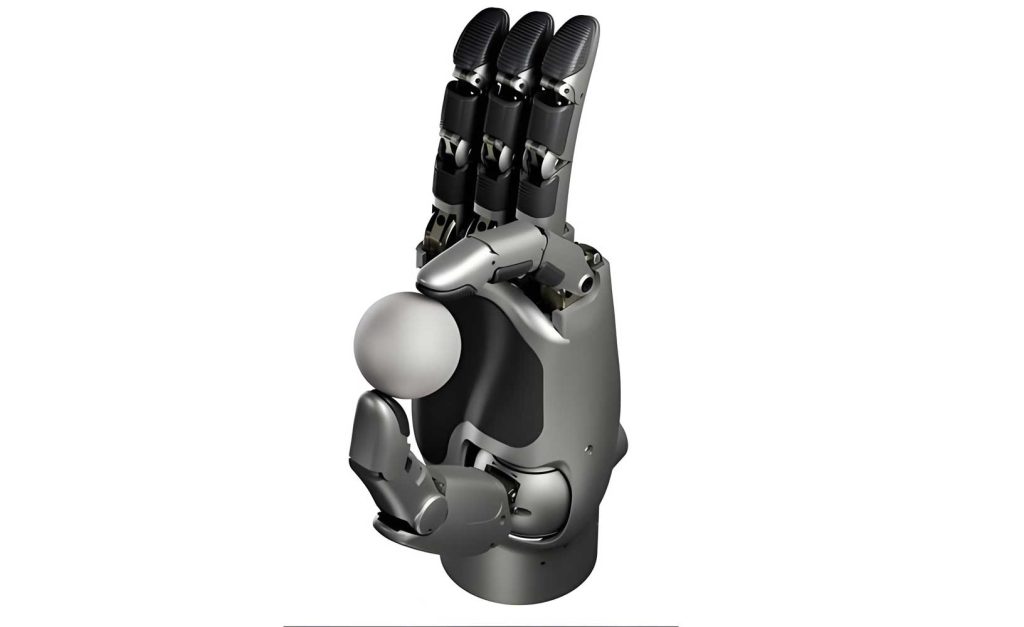
The finger design is the cornerstone of this dexterous robotic hand’s functionality. Embracing a modular philosophy, all fingers (except the thumb) share identical phalangeal lengths for the distal (32 mm), middle (30 mm), and proximal (37 mm) links. The thumb’s phalanges measure 32 mm, 30 mm, and 45 mm, respectively, keeping the total finger length under 100 mm for a life-like scale. Each finger joint is a carefully engineered assembly consisting of a parent-child pin hinge, a torsional return spring, and a guiding pulley. The tendon, which acts as the flexion actuator, is routed in a specific pattern through these pulleys and over semicircular protrusions on the phalanges. One end of the tendon is fixed at the fingertip, and the other end, after traversing the entire finger, exits through a hole near the dorsum of the MCP joint and connects to a servo-mounted spool in the drive box. When the servo motor winds the tendon, tension increases, causing the finger to curl (flexion). Upon release of tension, the embedded torsional springs at each joint provide the restoring force to extend the finger back to its open posture. This underactuated, single-tendon design means that one actuator controls the sequential flexion of all three joints in a finger. As the finger contacts an object, the joints automatically adapt their relative angles based on the object’s geometry and the applied tendon force, allowing the finger to envelop the object passively—a principle known as adaptive or self-adaptive grasping, which is highly advantageous for a dexterous robotic hand intended for versatile interaction with unstructured environments.
The transmission and drive system is a hybrid, employing different methods for different types of motion. For the critical side-swinging degree of freedom in the index and little fingers, we implemented a worm-gear drive mechanism. A compact DC motor drives a worm screw, which engages with a worm wheel integrated into the finger’s MCP base joint. This system provides several benefits for the dexterous robotic hand: it offers high reduction ratios in a compact space, ensures self-locking to maintain the side-swing angle without continuous power input, and delivers smooth, precise rotational control. The flexion of all finger joints, as described, is achieved via tendon-sheath or tendon-pulley transmission. All flexion servo motors are housed in the integrated drive box. Each servo has a custom-designed spool with features for securely anchoring and winding the tendon. This centralized tendon drive simplifies the mechanical complexity within the hand structure, reduces weight, and facilitates easier maintenance and tendon replacement for the dexterous robotic hand.
To quantitatively understand and predict the motion of our dexterous robotic hand, a rigorous kinematic analysis is indispensable. We employ the Denavit-Hartenberg (D-H) convention, a standard method in robotics, to model the forward kinematics of a representative finger. For this analysis, we select the middle finger as a canonical example, as it possesses three pure flexion joints without side-swing. The D-H parameters establish a systematic relationship between consecutive link coordinate frames. We assign a coordinate frame {i} to each link, with the z-axis aligned with the joint axis of rotation. The base frame {0} is attached to the MCP joint base, and the end-effector frame {3} is attached to the fingertip. The D-H parameters for the middle finger are summarized in Table 2.
| Link i | Twist Angle $\alpha_{i-1}$ | Link Length $a_{i-1}$ | Link Offset $d_i$ | Joint Angle $\theta_i$ |
|---|---|---|---|---|
| 1 | 0° | $l_1 = 37$ mm | 0 | $\theta_1$ (Variable) |
| 2 | 0° | $l_2 = 30$ mm | 0 | $\theta_2$ (Variable) |
| 3 | 0° | $l_3 = 32$ mm | 0 | $\theta_3$ (Variable) |
In this table, $l_1$, $l_2$, and $l_3$ are the lengths of the proximal, middle, and distal phalanges, respectively. The joint angles $\theta_1$, $\theta_2$, and $\theta_3$ represent the flexion angles of the MCP, PIP, and DIP joints, with a typical operational range from 0° (fully extended) to 90° (fully flexed). The homogeneous transformation matrix between two consecutive frames, $^{i-1}_i T$, is given by the standard D-H formula:
$$^{i-1}_i T = \begin{bmatrix}
\cos\theta_i & -\sin\theta_i & 0 & a_{i-1} \\
\sin\theta_i \cos\alpha_{i-1} & \cos\theta_i \cos\alpha_{i-1} & -\sin\alpha_{i-1} & -\sin\alpha_{i-1} d_i \\
\sin\theta_i \sin\alpha_{i-1} & \cos\theta_i \sin\alpha_{i-1} & \cos\alpha_{i-1} & \cos\alpha_{i-1} d_i \\
0 & 0 & 0 & 1
\end{bmatrix}$$
Since for our finger $\alpha_{i-1}=0$ and $d_i=0$, the transformation matrix simplifies significantly. The cumulative transformation from the base frame {0} to the fingertip frame {3} is obtained by sequential multiplication:
$$^{0}_{3}T = ^{0}_{1}T \cdot ^{1}_{2}T \cdot ^{2}_{3}T$$
Performing this multiplication yields the complete forward kinematics solution for the fingertip position and orientation relative to the base:
$$^{0}_{3}T = \begin{bmatrix}
\cos(\theta_1+\theta_2+\theta_3) & -\sin(\theta_1+\theta_2+\theta_3) & 0 & l_1 \cos\theta_1 + l_2 \cos(\theta_1+\theta_2) + l_3 \cos(\theta_1+\theta_2+\theta_3) \\
\sin(\theta_1+\theta_2+\theta_3) & \cos(\theta_1+\theta_2+\theta_3) & 0 & l_1 \sin\theta_1 + l_2 \sin(\theta_1+\theta_2) + l_3 \sin(\theta_1+\theta_2+\theta_3) \\
0 & 0 & 1 & 0 \\
0 & 0 & 0 & 1
\end{bmatrix}$$
The position vector of the fingertip in the base coordinate system, $^{0}\mathbf{p}_{3}$, is extracted from the fourth column of this matrix:
$$^{0}\mathbf{p}_{3} = \begin{bmatrix}
x \\
y \\
z
\end{bmatrix} = \begin{bmatrix}
l_1 \cos\theta_1 + l_2 \cos(\theta_1+\theta_2) + l_3 \cos(\theta_1+\theta_2+\theta_3) \\
l_1 \sin\theta_1 + l_2 \sin(\theta_1+\theta_2) + l_3 \sin(\theta_1+\theta_2+\theta_3) \\
0
\end{bmatrix}$$
This equation is fundamental for the dexterous robotic hand, as it allows us to compute the precise location of the fingertip for any given set of joint angles within the mechanical limits. To extend this analysis to a finger with side-swing, such as the index finger, an additional frame and transformation must be prepended to account for the rotation $\phi$ about the side-swing axis before the flexion sequence begins.
Understanding the workspace—the volume in space that the fingertip can reach—is critical for assessing the grasping capability of a dexterous robotic hand. The workspace defines the boundaries within which the hand can interact with objects. We performed a numerical workspace analysis using MATLAB, specifically leveraging the Robotics Toolbox for efficient computation and visualization. For the middle finger, we generated a large set of random joint angle tuples ($\theta_1$, $\theta_2$, $\theta_3$), each uniformly distributed within their allowable range [0°, 90°]. For each tuple, the forward kinematics equation was solved to compute the corresponding fingertip (x, y) coordinates (the motion is planar for this finger). By plotting tens of thousands of such points, we obtained a point cloud representing the reachable workspace. A similar but more complex analysis was conducted for the index finger, where an additional side-swing angle $\phi$ in the range [0°, 20°] was also randomly sampled. The transformation for the index finger incorporates this extra degree of freedom:
$$^{0}\mathbf{p}_{3, \text{index}} = R_z(\phi) \cdot \begin{bmatrix}
l_1 \cos\theta_1 + l_2 \cos(\theta_1+\theta_2) + l_3 \cos(\theta_1+\theta_2+\theta_3) \\
l_1 \sin\theta_1 + l_2 \sin(\theta_1+\theta_2) + l_3 \sin(\theta_1+\theta_2+\theta_3) \\
0
\end{bmatrix}$$
where $R_z(\phi)$ is the rotation matrix about the z-axis (side-swing axis). The resulting workspaces, visualized as dense point clouds, clearly demonstrate that the inclusion of the side-swing degree of freedom substantially expands the spatial envelope accessible to the fingertip. This expansion is not merely lateral; it creates a more volumetric and versatile workspace, enabling the dexterous robotic hand to approach objects from a wider variety of angles and to perform more complex enveloping grasps, especially on objects with non-convex shapes. The quantitative comparison can be summarized by the approximate area (for planar middle finger) or volume (for spatial index finger) of these point clouds. While the middle finger’s workspace is a contiguous, fan-shaped region in a plane, the index finger’s workspace is a swept volume, significantly larger and more useful for a general-purpose dexterous robotic hand.
To validate the mechanical design and grasping performance of our proposed dexterous robotic hand, we conducted dynamic simulation studies using ADAMS (Automatic Dynamic Analysis of Mechanical Systems) software. A detailed virtual prototype of the complete five-finger dexterous robotic hand was constructed in ADAMS by importing the 3D CAD model. All mechanical joints were defined with appropriate constraints (revolute joints for finger flexion and side-swing). The tendon actuation was modeled using cable elements that apply tensile forces between the servo spools (modeled as rotational motion inputs) and the anchor points on the fingertips. Contact forces between the finger phalanges and target objects were defined using a penalty-based method with specified coefficients of static and dynamic friction (typically set at 0.3 and 0.1, respectively, for plastic/rubber-like materials). Torsional springs were added to each joint to model the return spring’s effect. We then simulated several canonical grasp types as defined by Cutkosky’s grasp taxonomy to evaluate the versatility of our dexterous robotic hand.
The first simulation involved a spherical power grasp. A rigid sphere with a radius of 40 mm was positioned within the palm of the dexterous robotic hand. The servo actuators were commanded to pull the tendons sequentially, causing the fingers to flex and envelop the sphere. The simulation results showed that all five fingers made stable contact with the sphere’s surface, conforming to its curvature. The contact forces distributed around the sphere, and the object was securely held without slipping, demonstrating the dexterous robotic hand’s capability for enveloping and stabilizing rounded objects. The second simulation targeted a cylindrical power grasp. A cylinder with a radius of 29 mm and a length of 140 mm was placed transversely in the hand. The thumb opposed the fingers, and the flexion motion resulted in the fingers wrapping around the cylinder. The side-swing ability of the index and little fingers proved particularly beneficial here, allowing them to better adapt to the cylindrical surface and increase the contact area, thereby enhancing grip stability for the dexterous robotic hand.
The third and more demanding simulation tested precision grasping. A thin rectangular plate (30 mm x 20 mm x 2 mm) was positioned for a fingertip pinch grasp, primarily between the thumb and index finger. This task requires finer control and precise opposition. The simulation confirmed that the thumb’s 45° opposition angle and the independent control of the index finger’s side-swing allowed the dexterous robotic hand to successfully acquire and hold the thin plate. The fingertips made stable contact on the opposing faces of the plate, and the grasp was maintained against gravity. Table 3 summarizes key metrics observed during these simulation trials, underscoring the functional performance of our dexterous robotic hand design.
| Grasp Type | Target Object | Key Performance Observation | Role of Side-Swing | Conclusion for Dexterous Robotic Hand |
|---|---|---|---|---|
| Spherical Power Grasp | Sphere (R=40 mm) | All fingers established multiple stable contact points; object securely immobilized. | Minor role; fingers primarily flexed. | Effective for large, rounded objects. |
| Cylindrical Power Grasp | Cylinder (R=29 mm, L=140 mm) | Fingers enveloped >180° of circumference; no slip observed under simulated load. | Significant; enabled index/little fingers to wrap more effectively. | Excellent for tubular/cylindrical objects. |
| Precision Pinch Grasp | Thin Plate (30x20x2 mm) | Plate held firmly between thumb tip and index fingertip; stable orientation maintained. | Critical; allowed index finger to align optimally with the thumb. | Capable of delicate, precise manipulation. |
These simulation results provide strong evidence for the efficacy of our design choices. The underactuated, tendon-driven mechanism successfully produced adaptive grasping behavior without requiring individual joint control. The incorporation of side-swing for two fingers added a crucial layer of dexterity, enabling the hand to transition between different grasp types seamlessly. The dexterous robotic hand demonstrated an ability to handle objects of varying geometry, size, and required grasp force, which are essential attributes for a versatile end-effector.
In conclusion, this work has presented the comprehensive design, kinematic modeling, and simulation-based validation of a novel five-finger dexterous robotic hand. The primary contributions are twofold: first, the innovative integration of a worm-gear-driven side-swing mechanism for selective fingers, which expands the workspace and enhances grasp adaptability without overcomplicating the core drive system; second, the implementation of a simplified, single-tendon underactuated design for finger flexion, which reduces the number of actuators, lowers cost and weight, and leverages passive adaptation for stable grasping. Through detailed D-H parameter kinematic analysis, we established the mathematical foundation for finger motion and visualized the advantageous expansion of the workspace conferred by the side-swing capability. Dynamic simulations in ADAMS confirmed the practical feasibility of the design, showing successful execution of power grasps on spherical and cylindrical objects as well as precision pinch grasps on a thin plate. This dexterous robotic hand represents a step towards more accessible and functionally capable robotic manipulators. Future work will focus on the physical prototyping of the dexterous robotic hand, integration of tactile and position sensors for closed-loop control, and the development of intelligent grasp planning algorithms to fully exploit the mechanical capabilities of this dexterous robotic hand in real-world applications.