
As a researcher deeply immersed in the confluence of robotics and bio-inspiration, I find the development of the dexterous robotic hand to be one of the most fascinating and demanding frontiers in our field. This electromechanical marvel, born from the marriage of bionics and robotics, aims to emulate not just the form but, more importantly, the unparalleled functionality of the human hand. It stands as a quintessential component of fourth-generation robots, striving to simulate human manipulation through biomimicry in movement, perception, control, energy, and materials. In this comprehensive analysis, I will detail the evolutionary journey of the dexterous robotic hand, dissect its core technological pillars, confront the significant challenges that lie ahead, and offer perspectives on future trajectories.
The human hand is a masterpiece of evolutionary engineering—compact, robust, and capable of an astounding range of forces and delicate manipulations. Replicating this capability artificially is the central goal of dexterous robotic hand research. The motivation is profound: to create universal end-effectors that can extend human reach into hazardous environments (space, deep sea, nuclear facilities), provide sophisticated prosthetics, enable automated complex assembly, and ultimately serve as the primary interface for humanoid robots in domestic and service roles. Unlike specialized grippers, a true dexterous robotic hand must exhibit adaptability, versatility, and a degree of autonomous intelligence.
Historical Evolution: A Journey in Four Acts
The quest for an artificial, dexterous manipulator has unfolded over several distinct phases, each marked by technological breakthroughs and shifting paradigms. We can categorize this evolution into four key stages.
| Stage | Period | Key Characteristics | Representative Systems & Milestones |
|---|---|---|---|
| Early Stage (Prosthetic Origins) | Pre-1960s | Body-powered or simple mechanical aids; focused on gross gripping for basic function or cosmetic replacement; lacked active control and sensing. | Spring-driven iron hands (e.g., the “Götz von Berlichingen” hand); passive cosmetic prostheses; cable-driven body-powered hooks. |
| Initial Research Stage | 1960s – 1970s | First systematic explorations of robotic multi-fingered hands; introduction of active actuation (electric motors); foundational work on kinematics and basic control; often bulky with remote actuation. | Belgrade Hand (1962): An early prosthetic/robotic hand. Okada Hand (1974): A 3-fingered, tendon-driven hand with multiple DOFs, demonstrating early dexterity. |
| Intermediate Development Stage | 1980s | Establishment of foundational theories for grasp planning and multi-fingered manipulation. Development of iconic, research-centric hands with high degree-of-freedom (DOF) counts. Widespread use of tendon-driven systems with remote actuators. | Utah/MIT Hand (1980s): A 4-fingered, 16-DOF hand driven by pneumatic tendons, heavily instrumented with sensors. Stanford/JPL (Salisbury) Hand: A compact 3-fingered, 9-DOF tendon-driven hand that became a benchmark for control algorithms. |
| Cross-Century & Integration Stage | 1990s – Present | Drive towards integration, embedding actuators and electronics within the hand structure (“hand-arm system”). Emphasis on modularity, robustness, and practical application. Proliferation of multi-modal sensing (force, tactile, proprioception). Rise of underactuated and adaptive designs. | DLR Hand I/II (Germany): Pioneered integrated joint modules with motors and sensors. Robonaut Hand (NASA): Designed for space operations with robust sensing. Shadow Hand: Commercially available, tendon-driven hand with pneumatic actuators. iHY Hand, Allegro Hand: Examples of compact, electrically driven hands. |
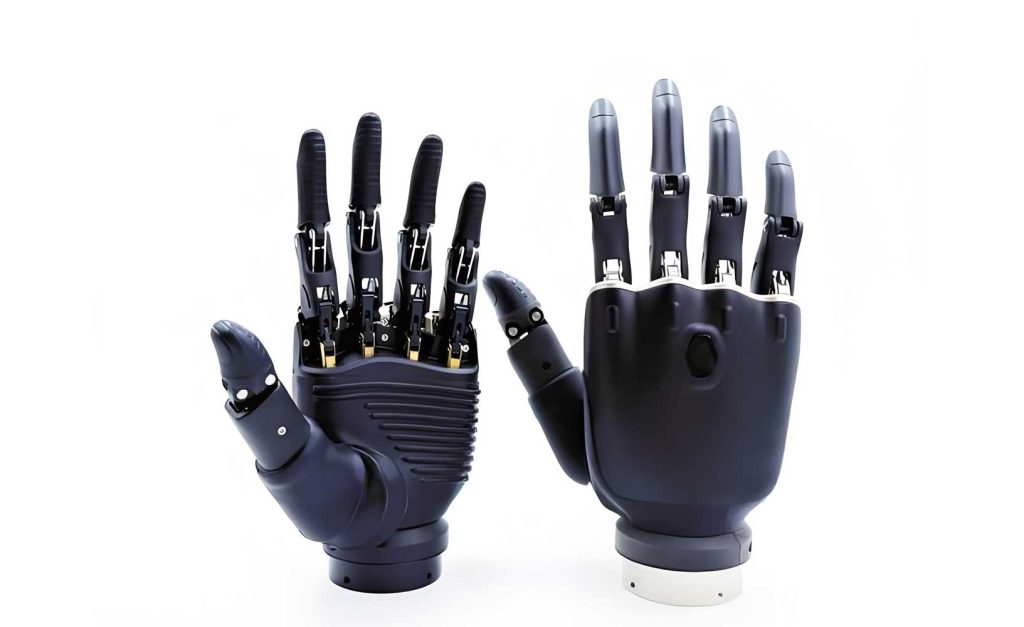
The progression from bulky, remotely-actuated research platforms to sleek, integrated, and sensor-rich systems is evident. The modern dexterous robotic hand is no longer a standalone curiosity but an integral part of a larger robotic system, demanding seamless mechanical and control integration.
Core Technological Pillars of a Modern Dexterous Robotic Hand
The performance of a dexterous robotic hand rests on several interdependent technological pillars. Advances in one area often expose limitations in another, driving holistic innovation.
1. Mechanism and Kinematics
The skeletal structure defines the hand’s fundamental capabilities. Key considerations include:
- Number of Fingers and Degrees of Freedom (DOF): While the human hand has over 20 DOF, practical robotic hands often compromise. A common configuration is a 4-finger (3 fingers + 1 opposable thumb) or 3-finger design with 12-16 DOF. The kinematic model for a finger with $n$ rotational joints can be described by the forward kinematics map:
$$ \mathbf{x}_{tip} = f(\mathbf{q}) $$
where $\mathbf{x}_{tip} \in \mathbb{R}^3$ is the fingertip position and $\mathbf{q} \in \mathbb{R}^n$ is the vector of joint angles. The differential kinematics is given by:
$$ \dot{\mathbf{x}}_{tip} = \mathbf{J}(\mathbf{q}) \dot{\mathbf{q}} $$
where $\mathbf{J}(\mathbf{q})$ is the geometric Jacobian matrix. For a dexterous robotic hand, managing the Jacobian for all fingers simultaneously is critical for coordinated control. - Underactuation vs. Full Actuation: A fully actuated hand has one independent actuator per DOF, enabling precise control of every joint posture. An underactuated hand has fewer actuators than DOFs, using mechanisms like linkages, tendons, or differentials to passively adapt to object geometry. This simplifies control and reduces cost and weight, often at the expense of precise in-hand manipulation capability. The choice depends on the primary task: power grasping vs. fine manipulation.
- Joint Design: Achieving human-like range of motion in a compact volume is challenging. Common joint types include revolute, universal, and spherical joints, often implemented with precision bearings, flexure hinges, or even soft robotic principles.
2. Actuation and Drive Transmission
Actuators are the muscles of the dexterous robotic hand. The ideal actuator is powerful, small, lightweight, efficient, and back-drivable.
- Actuator Types:
Type Advantages Disadvantages Suitability for Dexterous Robotic Hand Electric Motors (DC brushless, servo) High precision, good controllability, clean, readily available. Lower power/weight ratio than muscles; often require gearing, which can introduce backlash and reduce back-drivability. Dominant choice. Integrated into modular joint units (e.g., DLR Hand). Pneumatic Artificial Muscles (PAMs) (e.g., McKibben muscles) High power/weight ratio, compliant, inherently safe. Requires bulky air supply, nonlinear dynamics, control challenges. Used in some research hands (e.g., Shadow Hand) for compliant force control. Tendon-Driven Systems Allows remote placement of actuators (in forearm), reducing hand mass and inertia. Friction, hysteresis, coupling between joints, complexity in routing. Classic approach (Utah/MIT, Stanford/JPL). Still used where low hand mass is critical. Shape Memory Alloys (SMAs), EAPs Extremely high power density, silent operation, direct drive potential. Low efficiency, slow cycle time, hysteresis, cooling challenges. Promising for future micro-actuation within finger segments, not yet mainstream. - Transmission: Gearing, capstans, and pulleys are used to amplify torque and match actuator speed to joint motion. Harmonic drives are favored for their compactness and zero-backlash, but add weight and cost.
3. Sensing and Perception
A dexterous robotic hand without sensing is blind and numb. Rich sensory feedback is the cornerstone of intelligent manipulation.
- Proprioception: Knowing the internal state. This includes:
- Joint Position: Measured by encoders (optical, magnetic) or potentiometers. Critical for any closed-loop control.
- Joint Torque/Force: Measured by strain gauges on links or in torque sensors at the joint. Enforces force control and ensures safety. The relationship between actuator torque $\boldsymbol{\tau}_a$ and joint torque $\boldsymbol{\tau}_j$ often involves the transmission matrix $\mathbf{A}$: $\boldsymbol{\tau}_j = \mathbf{A}^T \boldsymbol{\tau}_a$.
- Exteroception: Sensing interaction with the world.
- Tactile Sensing: The “artificial skin.” Technologies include:
Technology Principle Metrics Resistive (e.g., piezoresistive) Change in electrical resistance under pressure. Normal force, pressure distribution. Capacitive Change in capacitance between electrodes under deformation. High sensitivity, can measure proximity and light touch. Optical Deformation of a light-guiding layer detected by cameras or photodiodes. High spatial resolution, robust to EMI. Barometric (e.g., BioTac) Pressure change in a liquid-filled membrane measured by a hydro-acoustic sensor. Multi-modal: texture, vibration (slip), thermal properties. - Fingertip Force/Torque Sensing: Miniaturized 6-axis force/torque sensors embedded in fingertips provide precise contact wrench information $\mathbf{W}_c = [\mathbf{f}^T, \boldsymbol{\tau}^T]^T$, essential for fine manipulation and grasp stability analysis.
- Slip Detection: Critical for preventing dropped objects. Can be inferred from tactile vibration signals or from the mismatch between commanded grip force and observed motion.
- Tactile Sensing: The “artificial skin.” Technologies include:
4. Control, Planning, and Operation
This is the “brain” of the dexterous robotic hand, transforming sensor data and high-level commands into coordinated muscle commands.
- Grasp Planning: Determining where and how to place fingers on an object to achieve a stable grasp. This involves computing force-closure or form-closure conditions. A fundamental concept is the Grasp Matrix $\mathbf{G}$, which maps contact forces $\mathbf{f}_c$ at the fingertips to the net wrench $\mathbf{W}_{obj}$ on the object:
$$ \mathbf{W}_{obj} = \mathbf{G} \mathbf{f}_c $$
A grasp is force-closure if $\mathbf{G}$ is surjective and forces can be applied in any direction within friction cones. - Control Architectures:
- Impedance/Admittance Control: Regulates the dynamic relationship between force and position, making the hand behave like a spring-damper system. Essential for safe and compliant interaction.
- Hybrid Position/Force Control: Controls position in some Cartesian directions and force in others, crucial for tasks like turning a crank or inserting a peg.
- Dexterous In-Hand Manipulation Control: Achieving finger gaits or rolling contacts to reposition an object within the hand. This often requires complex non-linear control strategies and real-time sensing.
- Operation Modes:
- Teleoperation: A human operator controls the hand directly, often using a data glove or master manipulator. This leverages human intelligence for complex tasks but is limited by communication delays and interface transparency.
- Autonomous Operation: The hand and its supervisory system perceive, plan, and execute tasks without human intervention. This is the ultimate goal but extremely challenging for unstructured environments.
- Shared/Supervised Autonomy: A middle ground where the human provides high-level goals or corrections, while the dexterous robotic hand handles low-level stability, compliance, and primitive actions (e.g., “grasp the screwdriver,” “tighten the screw”).
Enduring Challenges and Future Vectors
Despite remarkable progress, the dream of a dexterous robotic hand that truly rivals the human hand remains unrealized. The challenges are both intrinsic (technical) and extrinsic (systemic).
Intrinsic Technical Challenges
| Challenge Category | Specific Problems | Potential Research Directions |
|---|---|---|
| Power Density & Energy Autonomy | High-torque, compact actuators drain power quickly. Tethered systems limit mobility. The power-to-weight ratio of robotic actuators still lags far behind biological muscle. | Development of new actuator materials (e.g., improved SMAs, electroactive polymers). Advanced energy storage (solid-state batteries). More efficient transmissions and variable impedance actuators. |
| Robust, High-Density Sensing | Artificial skin is fragile, complex to manufacture, and difficult to wire. Sensor fusion from thousands of tactile taxels in real-time is computationally heavy. | Research into self-healing materials, distributed electronics (printed sensors), and neuromorphic/event-based sensing that mimics biological nerve signals for efficiency. |
| Real-Time, Adaptive Intelligence | Current planning algorithms are too slow for dynamic environments. Lack of common sense and ability to learn from few physical interactions. | Leveraging machine learning (reinforcement learning, sim-to-real transfer) for learning manipulation skills. Using physics-informed AI models for faster planning. Developing intuitive digital twins of the dexterous robotic hand for simulation-based testing. |
| Dexterity vs. Simplicity Trade-off | Highly dexterous hands are mechanically complex, expensive, and difficult to control. Simple, robust hands lack fine manipulation skills. | Continued innovation in underactuated and variable-grasp-configuration mechanisms. Reconfigurable hand topologies. “Soft robotics” approaches that trade precise kinematic control for inherent adaptability. |
| System Integration | The hand must be seamlessly integrated with the arm, perception head (vision), and overarching robot control architecture. Communication bandwidth and latency are critical. | Modular design philosophies. Standardized communication protocols (e.g., ROS 2). Co-design of hand and arm from the outset for optimal performance. |
Extrinsic and Systemic Challenges
Beyond the lab bench, the advancement of dexterous robotic hand technology faces broader hurdles:
- Cost and Accessibility: State-of-the-art hands are prohibitively expensive for widespread research or commercial application, stifling innovation and adoption.
- Standardization and Benchmarking: There is a lack of standard performance metrics (e.g., a “dexterity index”) and benchmark tasks (like the YCB Object Set for grasping) to fairly compare different hand designs and control algorithms.
- Interdisciplinary Collaboration: Deep progress requires sustained collaboration between mechanical engineers, material scientists, computer scientists, neuroscientists, and cognitive psychologists. Breaking down disciplinary silos is essential.
- From Research to Application: Bridging the “valley of death” between academic prototypes and reliable, maintainable products for industry or healthcare is a major challenge requiring different skill sets and funding models.
Conclusion and Forward Look
The field of dexterous robotic hand research stands at an exciting inflection point. The journey from simple grippers to sensor-laden, partially intelligent manipulators has been remarkable. The modern dexterous robotic hand is a testament to advances in mechatronics, materials, and control theory. However, the comparison with the biological archetype remains humbling. The path forward is not merely one of incremental improvement but likely requires rethinking fundamental aspects of actuation (perhaps moving towards more bio-inspired muscular systems), embracing embodied intelligence through advanced machine learning, and developing robust, manufacturable, and sensitive artificial skins.
The ultimate dexterous robotic hand will not be a slavish copy of the human hand, but a bio-inspired engineered system that captures the functional essence of dexterity—adaptability, robustness, and subtlety of touch. Its realization will unlock new frontiers in manufacturing, healthcare, logistics, and personal assistance, truly extending human capability into the physical world. The challenges are immense, but the convergence of technologies from AI to nanotechnology suggests that the next decade may bring us closer than ever to this long-held goal. The focus must remain on integrative, system-level design, where mechanism, actuation, sensing, and intelligence are co-evolved to create not just a hand, but a complete and capable manipulative system.