
In the field of robotics, the development of a humanoid dexterous robotic hand has been a focal point due to its potential to replicate human-like manipulation capabilities. As a researcher in this domain, I have dedicated efforts to analyzing and modeling a complex-structured five-fingered dexterous robotic hand, aiming to achieve high precision and real-time control. This work focuses on deriving closed-form kinematic solutions using geometric analysis and validating them through numerical simulations. The dexterous robotic hand in question features five independently movable fingers, each driven by linear servo motors with coupled joints via linkage mechanisms. The complexity of such a dexterous robotic hand necessitates a thorough kinematic analysis to facilitate advanced control strategies for applications in medical rehabilitation, aerospace, underwater operations, and logistics.
The importance of a dexterous robotic hand lies in its ability to perform delicate tasks that require adaptability and flexibility. Traditional robotic grippers often lack the dexterity needed for intricate manipulations, whereas a humanoid dexterous robotic hand can emulate the multi-faceted movements of a human hand. However, the kinematic modeling of a dexterous robotic hand is challenging due to the high number of degrees of freedom and joint couplings. In this study, I address these challenges by developing analytical models for both forward and inverse kinematics, leveraging geometric constraints to decouple interdependent joints. This approach not only simplifies the computation but also enhances the accuracy required for precise control of the dexterous robotic hand.
My research begins with a structural analysis of the dexterous robotic hand. The hand consists of five fingers: four fingers (index, middle, ring, and little) with similar mechanisms, and a thumb with an additional abduction/adduction capability. Each finger is driven by a linear servo motor embedded in the palm, and the joints are coupled through linkages to mimic natural finger movements. The thumb has three joints: a swing joint for abduction/adduction, a proximal joint, and a distal joint for flexion/extension. The other four fingers each have two interphalangeal joints (proximal and distal) coupled via a four-bar linkage. To standardize the analysis, I established coordinate systems for each finger base and the world frame, as detailed in the following sections.
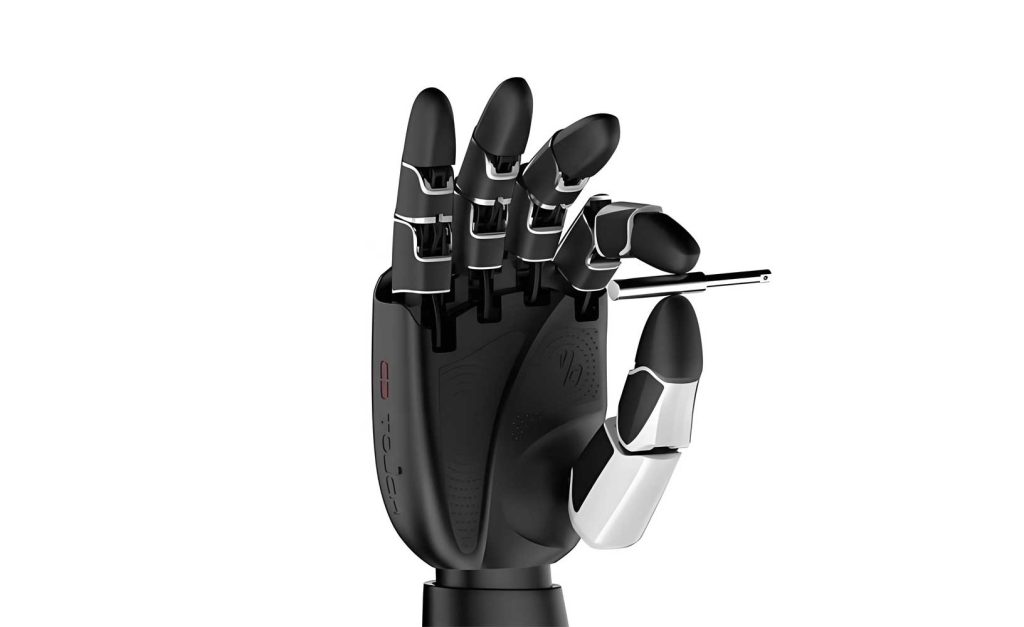
The kinematic modeling of this dexterous robotic hand is divided into two parts: the thumb mechanism and the four-finger mechanisms. For the thumb, which includes both flexion/extension and swing mechanisms, I derived the forward kinematics by analyzing the geometric relationships in the linkage system. The thumb’s flexion/extension mechanism is modeled as a series of connected links, with the linear actuator driving a rod that controls the joint angles. The swing mechanism allows the thumb to move in a plane perpendicular to the flexion/extension motion. By defining parameters such as link lengths and fixed angles, I expressed the thumb tip position in the world frame as a function of the actuator displacements.
For the four fingers, each mechanism is simplified to a four-bar linkage coupled with a linear actuator. The forward kinematics involves decoupling the joint angles using geometric constraints from the linkage. Specifically, I applied closed-vector equations to relate the actuator displacement to the proximal and distal joint angles. This decoupling is crucial for obtaining a closed-form solution, as it reduces the nonlinearity inherent in coupled systems. The derived equations enable direct computation of the fingertip positions based on actuator inputs, which is essential for real-time control of the dexterous robotic hand.
To formalize the kinematic models, I used mathematical notations and derived explicit formulas. Below, I present the key equations for both the thumb and four-finger mechanisms. Note that all symbols are defined in the context of the dexterous robotic hand’s geometry, with parameters measured from the physical prototype.
For the thumb flexion/extension mechanism, let \( L_{d1} \) be the driven link length (actuator displacement), and let \( \theta_3, \theta_4, \theta_5 \) represent the angles of specific links. The relationship between \( L_{d1} \) and these angles is given by:
$$ \theta_4 = 2 \arctan \sqrt{ \frac{L_{25} – (L_{d1} – L_4)^2}{(L_{d1} + L_4)^2 – L_{25}} } – 2 \arctan \sqrt{ \frac{L_{22} – (L_{d1} – L_3)^2}{(L_{d1} + L_3)^2 – L_{22}} } + \theta_3 + \pi $$
$$ \theta_5 = 2 \arctan \sqrt{ \frac{L_{d1}^2 – (L_4 – L_5)^2}{(L_4 + L_5)^2 – L_{d1}^2} } + 2 \arctan \sqrt{ \frac{L_{25} – (L_{d1} – L_4)^2}{(L_{d1} + L_4)^2 – L_{25}} } – 2 \arctan \sqrt{ \frac{L_{22} – (L_{d1} – L_3)^2}{(L_{d1} + L_3)^2 – L_{22}} } + \theta_3 $$
Here, \( L_{25} \) and \( L_{22} \) are constants derived from link lengths. The thumb tip position \( \mathbf{P} \) in the base frame \(\{B_5\}\) is:
$$ \mathbf{P}_{B_5} = \begin{bmatrix} x_{B_5} \\ y_{B_5} \\ 0 \end{bmatrix} = \begin{bmatrix} L_3 \cos \theta_3 + L_4 \cos \theta_4 + L_5 \cos \theta_5 – L_6 \cos(\theta_5 – \alpha) \\ L_3 \sin \theta_3 + L_4 \sin \theta_4 + L_5 \sin \theta_5 – L_6 \sin(\theta_5 – \alpha) \\ 0 \end{bmatrix} $$
where \( \alpha \) is a fixed angle. The swing mechanism of the thumb is controlled by another actuator with displacement \( L_{d2} \), affecting the angle \( \theta_8 \):
$$ \theta_8 = 2 \arctan \sqrt{ \frac{L_{d2}^2 – (L_9 – L_8)^2}{(L_9 + L_8)^2 – L_{d2}^2} } + \theta_9 $$
The transformation from the thumb base frame to the world frame involves rotation and translation based on \( \theta_8 \) and fixed offsets. Thus, the forward kinematics for the thumb in the world frame \(\{W\}\) is:
$$ \mathbf{P}_W = \begin{bmatrix} W_x \\ W_y \\ W_z \end{bmatrix} = \mathbf{T}_{W}^{B_5} \cdot \begin{bmatrix} x_{B_5} \\ y_{B_5} \\ 0 \\ 1 \end{bmatrix} $$
where \( \mathbf{T}_{W}^{B_5} \) is the homogeneous transformation matrix incorporating the swing motion and base offsets.
For the four-finger mechanisms, let \( L_d \) be the actuator displacement for each finger. The proximal joint angle \( \theta_1 \) is derived from the four-bar linkage geometry:
$$ \theta_1 = 2 \arctan \sqrt{ \frac{L_d^2 – (L_1′ – L_6)^2}{(L_1′ + L_6)^2 – L_d^2} } + \theta_6 + \beta – \pi $$
where \( \beta \) is a fixed angle. The distal joint angle \( \theta_4 \) is coupled to \( \theta_1 \) through:
$$ \theta_4 = \text{Atan2}(b, a) + \text{Atan2}( \sqrt{a^2 + b^2 – c^2}, c) $$
with:
$$ a = 2 L_1 L_4 \cos \theta_1, \quad b = 2 L_1 L_4 \sin \theta_1 – 2 L_2 L_4, \quad c = L_1^2 + L_2^2 + L_4^2 – L_3^2 – 2 L_1 L_2 \sin \theta_1 $$
The fingertip position in the base frame \(\{B_i\}\) for each finger is:
$$ \mathbf{P}_{B_i} = \begin{bmatrix} L_1 \cos \theta_1 – L_4 \cos \theta_4 + L_7 \cos(\theta_4 – \alpha) \\ L_1 \sin \theta_1 – L_4 \sin \theta_4 + L_7 \sin(\theta_4 – \alpha) \\ 0 \end{bmatrix} $$
and in the world frame:
$$ \mathbf{P}_W = \mathbf{R}_{W}^{B_i} \cdot \mathbf{P}_{B_i} + \mathbf{P}_{B_i \text{origin}}^W $$
where \( \mathbf{R}_{W}^{B_i} \) is the rotation matrix and \( \mathbf{P}_{B_i \text{origin}}^W \) is the translation vector for each finger base.
The inverse kinematics for this dexterous robotic hand involves determining the actuator displacements given a desired fingertip position in the world frame. For the thumb, from the world coordinates \( \mathbf{P}_W = [W_x, W_y, W_z]^T \), I first compute the position in the thumb base frame using inverse transformations, then solve for \( L_{d1} \) and \( L_{d2} \) through geometric relationships. For the four fingers, a similar process yields \( L_d \) for each finger. The derived closed-form inverse solutions ensure computational efficiency, which is vital for real-time applications of the dexterous robotic hand.
To validate these kinematic models, I conducted numerical simulations using Adams software. I built a virtual prototype of the dexterous robotic hand in Adams, simulating the motion of the middle finger and thumb under predefined actuator inputs. The simulation parameters are summarized in the tables below, which provide a concise overview of the geometric properties of the dexterous robotic hand.
| Link Sequence | Link Length (mm) | Fixed Angle (°) |
|---|---|---|
| \( L_1 \) | 40.77 | — |
| \( L_1′ \) | 7.42 | — |
| \( L_2 \) | 6.00 | 90.00 |
| \( L_3 \) | 36.00 | — |
| \( L_4 \) | 4.95 | — |
| \( L_5 \) (Drive: \( L_d \)) | 59–67 | — |
| \( L_6 \) | 62.68 | 94.62 |
| \( L_7 \) | 43.56 | — |
| \( \alpha \) | — | 125.81 |
| \( \beta \) | — | 35.75 |
| Link Sequence | Link Length (mm) | Fixed Angle (°) |
|---|---|---|
| \( L_1 \) (Drive: \( L_{d1} \)) | 60–70 | — |
| \( L_2 \) | 67.04 | — |
| \( L_3 \) | 9.00 | 56.31 |
| \( L_4 \) | 67.00 | — |
| \( L_5 \) | 11.27 | — |
| \( L_6 \) | 26.61 | — |
| \( L_7 \) (Drive: \( L_{d2} \)) | 46–56 | — |
| \( L_8 \) | 6.40 | — |
| \( L_9 \) | 50.76 | 2.86 |
| \( \alpha \) | — | 121.00 |
| \( \beta \) | — | 141.00 |
In the simulation, I set the initial actuator positions and velocities for both the middle finger and thumb. For the middle finger, \( L_d \) started at 59 mm with a velocity of 2 mm/s, simulating extension over 4 seconds until reaching 67 mm. For the thumb, \( L_{d1} \) started at 70 mm and \( L_{d2} \) at 46 mm, with velocities of -2.5 mm/s and 2.5 mm/s, respectively, simulating flexion and adduction over 4 seconds. I recorded the fingertip displacement \( d \) (distance from the world origin) and velocity \( v \) (linear speed) from both the Adams simulation and the analytical model solved in Simulink.
The results showed close agreement between the analytical model and the numerical simulation. For the middle finger, the displacement error \( e_{d_m} = d_m^a – d_m^s \) was less than 0.5 mm, and the velocity error \( e_{v_m} = v_m^a – v_m^s \) was less than 0.4 mm/s. For the thumb, the displacement error \( e_{d_t} = d_t^a – d_t^s \) was less than 0.11 mm, and the velocity error \( e_{v_t} = v_t^a – v_t^s \) was less than 0.45 mm/s. These small errors validate the accuracy of the closed-form kinematic solutions for this dexterous robotic hand, demonstrating that the geometric analysis effectively captures the system’s dynamics.
To further analyze the capabilities of the dexterous robotic hand, I computed the workspace of all five fingers. The workspace represents the set of points reachable by the fingertips, which is crucial for grasp planning. Using the forward kinematic models, I generated point clouds for each finger by varying the actuator displacements within their limits. The combined workspace reveals that the thumb and index finger have an intersection point at coordinates approximately (28.5, 192.12, 50) mm in the world frame. This intersection indicates that the dexterous robotic hand can perform precision grips, such as three-finger grasps, enhancing its versatility for manipulation tasks.
The workspace analysis also shows that the thumb’s range in the x-direction lies between the middle and index fingers, allowing for diverse grip configurations. This characteristic is essential for a humanoid dexterous robotic hand to emulate natural hand movements. By understanding the workspace, I can optimize control algorithms to avoid singularities and maximize dexterity, ensuring robust performance in real-world applications.
In conclusion, my research on this humanoid five-fingered dexterous robotic hand has successfully derived closed-form solutions for both forward and inverse kinematics using geometric methods. The analytical models enable efficient computation, which is fundamental for high-precision control systems. The validation through Adams simulations confirms the models’ correctness, with minimal errors in displacement and velocity predictions. Additionally, the workspace analysis highlights the hand’s ability to perform complex grasps, underscoring its potential in various robotic applications. Future work will focus on implementing these models in real-time control systems and exploring dynamic effects for more advanced manipulations with the dexterous robotic hand.
Throughout this study, the term “dexterous robotic hand” has been emphasized to reflect the core focus on achieving human-like manipulation. The integration of analytical kinematics with numerical simulations provides a comprehensive framework for developing advanced robotic hands. As robotics continues to evolve, the insights gained from this work will contribute to the design and control of more sophisticated dexterous robotic hands, pushing the boundaries of what robots can achieve in unstructured environments.
To reiterate, the key contributions of this work include the geometric derivation of closed-form kinematic solutions, the validation via simulation, and the workspace characterization for a five-fingered dexterous robotic hand. These efforts lay the groundwork for future research in adaptive grasping, tactile feedback integration, and machine learning-based control for dexterous robotic hands. By continuing to refine these models, I aim to enhance the autonomy and capability of robotic systems, making them more adept at handling real-world challenges.