
The precise control of grasping force is a paramount challenge in the field of dexterous robotic hands. For a robotic hand to interact effectively and safely with its environment, it must not only successfully grasp objects of varying sizes and shapes but also modulate the applied force to prevent damage to delicate items or accidental drops due to insufficient grip. Traditional approaches often rely on embedding tactile sensor arrays directly into the finger pads. While effective, this method increases the complexity, cost, and manufacturing difficulty of the dexterous robotic hand. This work proposes an alternative methodology: establishing a direct mathematical model between the fingertip contact force and the driving motor current. By monitoring the actuator current, which is relatively simple to measure, one can predict and subsequently control the fingertip force without the necessity for dense tactile sensing on every phalanx. This approach offers a cost-effective and practical solution for implementing force-aware control in a dexterous robotic hand.
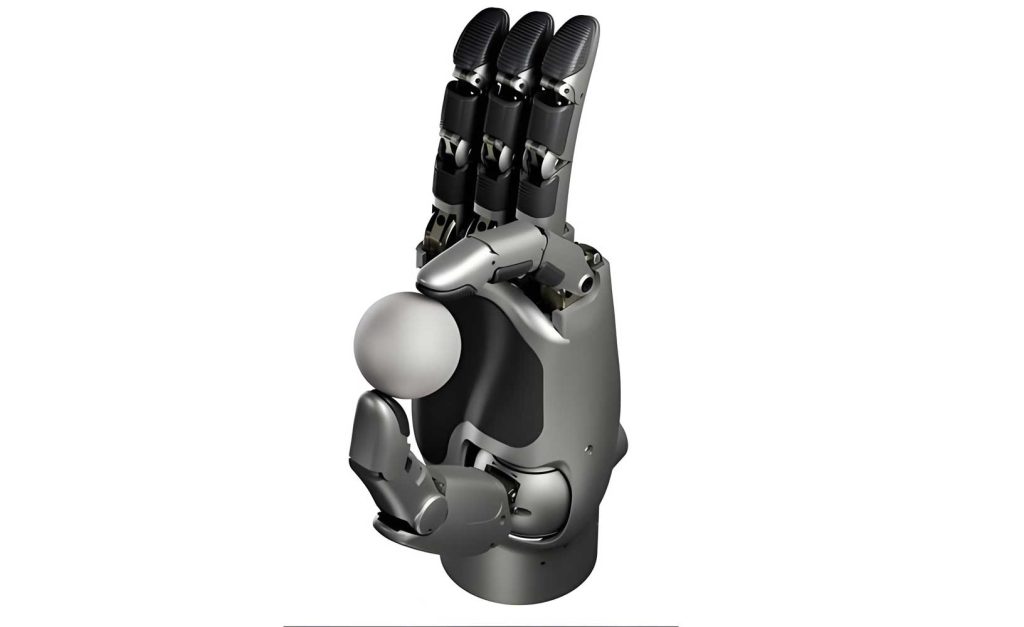
The experimental platform for this investigation is a tendon-driven, anthropomorphic dexterous robotic hand with five fingers, each possessing three joints. The finger dimensions are designed based on the proportional ratios of the human hand (proximal:middle:distal phalanx ≈ 1:1:0.6). A push-pull rod and linkage mechanism transmit motion from the actuator to the finger joints, providing stable and predictable kinematics. To acquire the necessary data, the experimental setup was augmented with two key sensing modules: a fingertip force sensor and a motor current sensor.
A foil strain-gauge force sensor (model DYHW-110) was attached to the distal phalanx of one finger to measure the normal contact force $F$ at the fingertip. Its key parameters are listed in the table below.
| Parameter | Specification |
|---|---|
| Measurement Range | 0 – 30 N |
| Output Sensitivity ($K_1$) | 0.5 – 10 mV/V |
| Technology | Metal Foil Strain Gauge |
For measuring the driving motor current $I$, a high-precision Hall-effect current sensor (model WHB06LSP5S2H) was employed. The sensor’s output voltage $V_{out}$ is linearly proportional to the current flowing through the conductor placed through its aperture. The relationship is given by $V_{out} = K_2 \cdot I$, where $K_2 = 830$ mV/A. The principle involves the generation of a Hall potential $V_H$ proportional to the measured current $I$, which is then amplified and conditioned to produce the output voltage. The system’s data flow is as follows: A host computer sends a grasp command to the dexterous robotic hand controller. As the hand executes a grasp on a standard 350g steel object, the raw signals from both the force sensor and the current sensor are synchronously acquired by a dynamic signal test and analysis system at a sampling frequency of 2 kHz.
The raw signals captured during a 7-second grasping operation are shown conceptually below. The current signal appears as a pulsed waveform with a period of 100 ms, where the pulse amplitude represents the instantaneous current value. The force signal remains at zero until the finger makes contact with the object at approximately 2.3 seconds, after which it rises to a maximum value. However, significant high-frequency noise and impulsive spikes are visibly superimposed on the raw force signal, attributed to thermal noise from signal conditioning circuits, environmental noise, and electromagnetic interference. This noise corrupts the signal and would lead to significant errors in subsequent modeling steps, making effective filtering a critical prerequisite.
To address this, the Savitzky-Golay (S-G) smoothing filter was applied. This filter is a time-domain method based on local polynomial least-squares fitting. It is superior to simple moving averages as it tends to preserve important signal features such as peak height and width, which are crucial for accurate force measurement. Consider a window of data points centered on point $x_i$, with $n_l$ points to the left and $n_r$ points to the right. An $M$-th degree polynomial $p_i(x)$ is fitted to these $n_l + n_r + 1$ points in the least-squares sense. The smoothed value $g_i$ at point $x_i$ is simply the value of this local polynomial evaluated at $x_i$:
$$g_i = p_i(x_i) = \sum_{k=0}^{M} b_k x_i^k$$
The coefficients $b_k$ are determined by minimizing the sum of squared errors between the polynomial and the raw data $y_i$ within the window:
$$\min \sum_{j=-n_l}^{n_r} \left[ p_i(x_{i+j}) – y_{i+j} \right]^2$$
Applying this S-G filter in software (e.g., MATLAB) effectively removed the high-frequency锯齿 and spikes from the force signal while maintaining the overall trend and key features of the original force profile, resulting in a clean signal suitable for accurate modeling.
Before empirical modeling, a theoretical dynamic analysis of the finger transmission system provides context. The entire drivetrain of a single finger on the dexterous robotic hand, including motor inertia, linkage inertia, and load, can be considered. The system is subject to varying fingertip contact force, internal reaction forces, and joint friction. The dynamic equation is:
$$T = J_s \frac{d\omega_s}{dt} + T_{fs} + T_h$$
where $T$ is the motor torque, $J_s$ is the total reflected inertia, $\omega_s$ is the motor angular velocity, $T_{fs}$ is the friction torque, and $T_h$ is the torque due to the fingertip contact force. The friction torque $T_{fs}$ includes components from the push rod ($f_p V_p$) and joint bearings ($f_j \omega_j$):
$$T_{fs} = f_p V_p + f_j \omega_j$$
The contact torque relates to the fingertip force $F$ by $T_h = r F$, where $r$ is an effective moment arm. Substituting, we get:
$$T = J_s \frac{d\omega_s}{dt} + f_p V_p + f_j \omega_j + r F$$
For a DC motor operating in its linear region, the output torque is proportional to the armature current: $T = K_t I$, where $K_t$ is the motor’s torque constant. Under quasi-static conditions or when the velocity-dependent terms are accounted for or relatively small during the final gripping phase, a primary relationship between the steady-state motor current and the fingertip force emerges. This foundational principle guides the empirical modeling approach: we seek to find the functional relationship $F = f(I)$.
To establish this empirical model, the synchronized and filtered force and current data were analyzed. Data points were selected at intervals corresponding to the current pulse periods, pairing instantaneous current $I_i$ with its corresponding force value $F_i$. A set of 36 such data pairs $(I_i, F_i)$ was extracted from the period where contact occurred (approx. 2.3s to 6.4s). The Least Squares method was employed for polynomial curve fitting. The goal is to find an $m$-th degree polynomial
$$\hat{F}(I) = a_0 + a_1 I + a_2 I^2 + … + a_m I^m$$
that minimizes the sum of squared errors (SSE) between the measured forces $F_i$ and the polynomial predictions $\hat{F}(I_i)$:
$$Z = \sum_{i=1}^{n} \left[ F_i – \hat{F}(I_i) \right]^2 = \sum_{i=1}^{n} \left[ F_i – (a_0 + a_1 I_i + … + a_m I_i^m) \right]^2$$
where $n=36$. The optimal coefficients $a_k$ are found by setting the partial derivatives of $Z$ with respect to each coefficient to zero:
$$\frac{\partial Z}{\partial a_k} = 0, \quad \text{for } k = 0, 1, …, m$$
This leads to a system of $(m+1)$ linear equations, which can be expressed in matrix form and solved uniquely:
$$\begin{bmatrix}
n & \sum I_i & \cdots & \sum I_i^m \\
\sum I_i & \sum I_i^2 & \cdots & \sum I_i^{m+1} \\
\vdots & \vdots & \ddots & \vdots \\
\sum I_i^m & \sum I_i^{m+1} & \cdots & \sum I_i^{2m}
\end{bmatrix}
\begin{bmatrix}
a_0 \\ a_1 \\ \vdots \\ a_m
\end{bmatrix}
=
\begin{bmatrix}
\sum F_i \\ \sum I_i F_i \\ \vdots \\ \sum I_i^m F_i
\end{bmatrix}$$
Fits were performed for 1st, 2nd, and 3rd-degree polynomials. The results are summarized below:
| Polynomial Order (m) | Fitted Equation | Coefficient of Determination ($R^2$) |
|---|---|---|
| 1 | $\hat{F}_1(I) = -1.428 + 0.0122I$ | 0.999953 |
| 2 | $\hat{F}_2(I) = 0.517 – 0.00197I + 3.70 \times 10^{-5}I^2$ | 0.999971 |
| 3 | $\hat{F}_3(I) = -0.143 + 0.00206I + 1.03 \times 10^{-5}I^2 + 1.69 \times 10^{-8}I^3$ | 0.999985 |
The Coefficient of Determination $R^2$, calculated as $R^2 = 1 – \frac{\sum (F_i – \hat{F}_i)^2}{\sum (F_i – \bar{F})^2}$, quantifies the goodness of fit, with values closer to 1 indicating a better fit. The 3rd-order polynomial achieved the highest $R^2$ value. Furthermore, the residuals $\Delta F = F_i – \hat{F}_3(I_i)$ were uniformly distributed around zero within a small range of [-0.424, 0.492] N, confirming the model’s accuracy. Therefore, the definitive model for the relationship between fingertip force $F$ (in Newtons) and drive motor current $I$ (in milliamperes) for this dexterous robotic hand is:
$$F(I) = 1.69 \times 10^{-8} I^3 + 1.03 \times 10^{-5} I^2 + 0.00206 I – 0.143 \quad \text{for } I \in [56.12, 397.5] \text{ mA}$$
The derived model reveals distinct operational phases of the dexterous robotic hand during grasping, as seen in the $F$-$I$ curve. For currents below ~56 mA, the force is essentially zero (pre-contact phase). Between ~56 mA and ~138 mA, the curve shows a moderately steep slope. This corresponds to the initial contact and wrapping phase where the finger makes contact and begins to conform to the object, with force building relatively quickly as the motor takes up backlash and system compliance. In the range of ~138 mA to ~269 mA, the slope decreases significantly. This plateau-like region likely represents the phase where the kinematic linkage is settling, overcoming internal static friction and mechanical play without substantially increasing the fingertip load on the object. Finally, for currents above ~269 mA, the slope increases sharply. This is the critical force-building phase where the structure is rigidly engaged, and the motor torque directly translates into a rapid increase in fingertip pressure until stalling occurs. This nonlinear relationship is effectively captured by the third-degree polynomial. The model enables a control system for the dexterous robotic hand to predict the exerted force in real-time based solely on motor current feedback, allowing for the implementation of simple yet effective force-limit or force-servo controllers to ensure safe and reliable manipulation.
This research presented a practical framework for modeling the relationship between fingertip force and actuator current in a dexterous robotic hand. The methodology involved the integration of force and current sensing, sophisticated signal processing using the Savitzky-Golay filter for noise reduction, and rigorous empirical modeling via least-squares polynomial fitting. The resulting third-order polynomial model provides a highly accurate and reliable mapping for the specific prototype. This approach demonstrates that effective force prediction and control in a dexterous robotic hand can be achieved without relying on complex tactile sensor skins, instead leveraging the inherent relationship between the actuator’s electrical signal and the resulting mechanical output. This reduces cost and complexity, paving the way for more accessible and robust force-sensitive applications in robotic manipulation.