
In the realm of robotics, the development of multifingered dexterous robotic hands has been a pivotal advancement, enabling machines to perform complex manipulation tasks that mimic human dexterity. Traditional dexterous robotic hands often feature rigid palms, which limit adaptability to objects of varying shapes and sizes. This paper explores a novel approach: integrating a metamorphic mechanism into the palm of a dexterous robotic hand. By allowing the palm to reconfigure, this design enhances the hand’s workspace and dexterity, facilitating versatile grasping strategies. The focus here is on the dimensional synthesis of such a metamorphic palm, enabling it to achieve multiple fingertip grasping poses. Through mathematical modeling, optimization, and simulation, we demonstrate how this innovative dexterous robotic hand can overcome limitations of conventional designs.
The concept of a dexterous robotic hand stems from the need to go beyond simple grippers, which are often limited to predefined tasks. A dexterous robotic hand, with multiple fingers and joints, can manipulate objects with precision, adapting to different geometries and forces. However, most existing dexterous robotic hands, such as the Stanford/JPL hand or the Utah/MIT hand, utilize fixed palms. This rigidity constrains the relative orientations of finger operation planes, reducing flexibility in grasping. In contrast, the human hand possesses a malleable palm that contributes significantly to its dexterity. To bridge this gap, researchers have proposed incorporating metamorphic mechanisms—structures capable of changing their topology or configuration—into robotic hands. This work delves into the design and synthesis of a metamorphic palm for a three-fingered dexterous robotic hand, aiming to enable multiple grasping poses through palm reconfiguration.
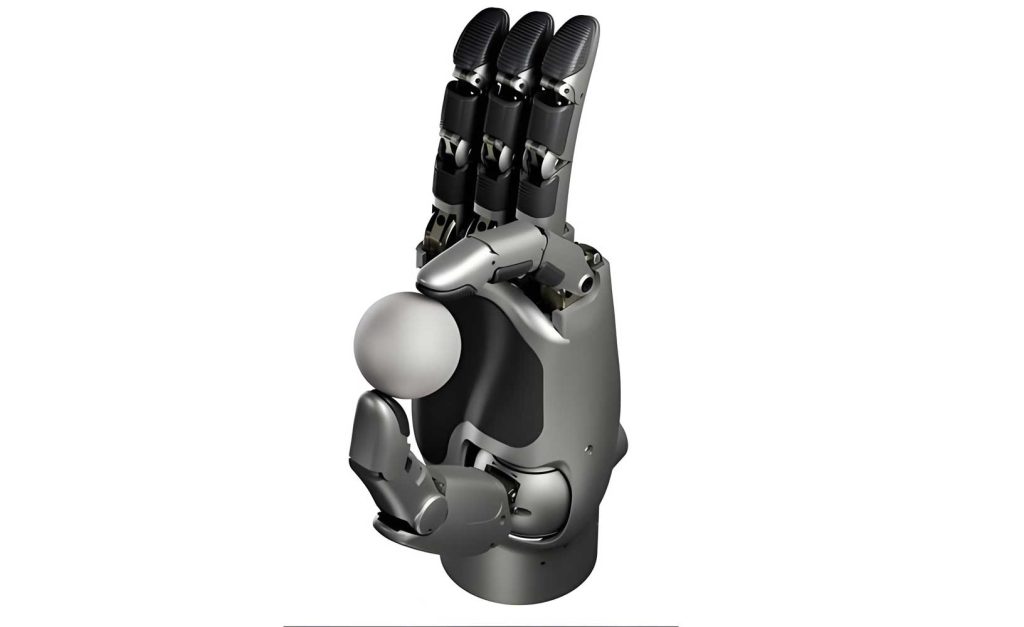
The metamorphic dexterous robotic hand considered here consists of three identical fingers, each with three revolute joints arranged in parallel, attached to a spherical five-bar linkage that serves as the palm. This spherical five-bar mechanism is a closed-loop chain with revolute joints whose axes intersect at a common point, the sphere center. The palm’s reconfiguration ability stems from the motion of its links, which alters the positions of the finger attachment points. When a palm link is stationary, each finger operates within a plane perpendicular to that link’s great circle on the sphere. We define these as finger operation planes, and their orientations are key to analyzing grasping poses. By modeling these planes mathematically, we can transform the problem of grasping synthesis into one of studying the unit normal vectors of the planes. This approach simplifies the complexity inherent in the dexterous robotic hand’s workspace.
To begin, let us establish the global coordinate system for the metamorphic palm. The palm is a spherical five-bar linkage with links denoted by arcs on a unit sphere, characterized by central angles $l_1, l_2, l_3, l_4, l_5$, where these angles satisfy the closure condition: $\sum_{j=1}^5 l_j = 2\pi$. The fingers are attached to the base link (link AE), one coupler link (link BC), and another coupler link (link CD). The attachment points are defined by angles $\delta_1, \delta_2, \delta_3$ measured from the joint axes along their respective links. The palm has two input angles, $\theta_1$ and $\theta_2$, corresponding to the drives at links AB and DE, which control the configuration. The output angles, $\phi_1, \phi_2, \phi_3$, describe the relative orientations between adjacent links. This setup allows the palm to metamorphose, changing its shape and thus the finger operation planes.
The finger operation planes are crucial for fingertip grasping, where all finger tips converge at a point. For such grasping to be feasible, the three finger operation planes must intersect along a common line through the sphere center. This condition translates to the coplanarity of their unit normal vectors. Let $\Pi_i$ represent the $i$-th finger operation plane, with unit normal vector $\mathbf{n}_i$ ($i=1,2,3$). Since each plane passes through the origin (the sphere center), its equation is:
$$\Pi_i: \mathbf{n}_i \cdot \mathbf{r} = 0, \quad i=1,2,3$$
where $\mathbf{r}$ is any point on the plane. The vectors $\mathbf{n}_i$ depend on the palm’s structural parameters and input angles. To derive them, we define local coordinate systems on the links where fingers are attached. For instance, for finger 1 on the base link AE, the local system $Ox_1y_1z_1$ has $z_1$ along OA, $x_1$ in the plane of link AE, and $y_1$ completing a right-handed frame. In this local frame, the unit normal $\mathbf{n}_1$ is:
$$^1\mathbf{n}_1 = (\cos\delta_1, 0, -\sin\delta_1)^T$$
Since this local system coincides with the global system, $\mathbf{n}_1 = (\sin\delta_1, 0, \cos\delta_1)^T$ after adjustment for perpendicularity. For finger 2 on link BC, with local system $Ox_2y_2z_2$, the unit normal in local coordinates is $^2\mathbf{n}_2 = (-\cos\delta_2, 0, -\sin\delta_2)^T$. Transforming to the global system involves rotations by angles related to $\phi_1, l_1, \theta_1$:
$$\mathbf{n}_2 = R_{z_2,\theta_1} R_{y_2,l_1} R_{z_2,\phi_1} \, ^2\mathbf{n}_2$$
where $R$ denotes rotation matrices. Similarly, for finger 3 on link CD, we have:
$$\mathbf{n}_3 = R_{y_3,l_5} R_{z_3,\theta_2} R_{y_3,l_4} R_{z_3,-\phi_3} \, ^3\mathbf{n}_3$$
with $^3\mathbf{n}_3 = (-\cos\delta_3, 0, \sin\delta_3)^T$. These transformations yield explicit expressions for $\mathbf{n}_i$ as functions of parameters, enabling analysis of grasping poses.
The condition for fingertip grasping—co-linearity of the three planes—requires that the system $\mathbf{N} \mathbf{r} = \mathbf{0}$ has a non-trivial solution, where $\mathbf{N} = [\mathbf{n}_1, \mathbf{n}_2, \mathbf{n}_3]^T$. This implies:
$$\det(\mathbf{N}) = |\mathbf{n}_1 \ \mathbf{n}_2 \ \mathbf{n}_3| = 0$$
This determinant equation must hold for a valid grasping pose. However, it alone does not specify the relative orientations between planes, which define the grasping posture. For common fingertip grasps, such as those shown in prior studies, the angles between planes are constrained. Let $\gamma_1, \gamma_2, \gamma_3$ be the dihedral angles between the planes, satisfying:
$$\mathbf{n}_1 \cdot \mathbf{n}_2 = \cos\gamma_1, \quad \mathbf{n}_1 \cdot \mathbf{n}_3 = \cos\gamma_2, \quad \mathbf{n}_2 \cdot \mathbf{n}_3 = \cos\gamma_3$$
Thus, achieving a specific grasping pose involves solving both the co-linearity condition and these angle constraints simultaneously. This forms a system of nonlinear equations with palm parameters and input angles as variables.
To synthesize a palm capable of multiple grasping poses, we consider three common configurations: (a) an even distribution where planes are spaced 120° apart, (b) a configuration for grasping quasi-square objects, and (c) a configuration for grasping elongated objects. For each pose $i$ ($i=1,2,3$), we require:
$$
\begin{aligned}
&|\mathbf{n}_{1i} \ \mathbf{n}_{2i} \ \mathbf{n}_{3i}| = 0 \\
&\mathbf{n}_{1i} \cdot \mathbf{n}_{2i} = \cos\gamma_{1i} \\
&\mathbf{n}_{1i} \cdot \mathbf{n}_{3i} = \cos\gamma_{2i} \\
&\mathbf{n}_{2i} \cdot \mathbf{n}_{3i} = \cos\gamma_{3i}
\end{aligned}
$$
where $\mathbf{n}_{ji}$ denotes the unit normal for finger $j$ at pose $i$. The palm has eight structural parameters: $l_1, l_2, l_3, l_4, l_5, \delta_1, \delta_2, \delta_3$, and for each pose, two input angles $\theta_{1i}, \theta_{2i}$. With three poses, we have 12 variables and 11 equations (including closure and specific angle conditions for pose 1). This leads to an optimization problem to find feasible parameters.
We impose additional constraints for practicality: all $l_j$ and $\delta_k$ must lie between 0 and $\pi$, and the drives must allow full rotation, requiring Grashof conditions for the spherical four-bar linkages formed when one drive is fixed. For example, when link DE is locked, the mechanism becomes a spherical four-bar ABCD, with link lengths $l_1′, l_2′, l_3′, l_4’$ after transformation. The Grashof conditions for a spherical crank are:
$$
\begin{aligned}
&l_1′ + l_3′ \leq l_2′ + l_4′ \\
&l_1′ + l_2′ \leq l_3′ + l_4′ \\
&l_1′ + l_4′ \leq l_2′ + l_3′
\end{aligned}
$$
To solve this, we formulate a nonlinear least-squares optimization problem. Let $\mathbf{x} = (l_1, l_2, l_3, l_4, l_5, \delta_1, \delta_2, \delta_3, \theta_{12}, \theta_{13}, \theta_{22}, \theta_{23})$ be the variable vector. The objective function minimizes the sum of squared errors from the equations. For pose 1 (even distribution), we set $\gamma_{11}=\gamma_{21}=\gamma_{31}=120^\circ$ and enforce that when $\theta_{11}=\pi, \theta_{21}=0$ (links aligned on a great circle), the planes are evenly spaced. This gives constraints: $l_2 + \delta_1 + \delta_2 = 2\pi/3$ and $l_3 + l_4 – \delta_2 – \delta_3 = 2\pi/3$, along with $\sum l_j = 2\pi$. For poses 2 and 3, we use desired angles based on typical grasps.
Using computational tools like MATLAB’s Genetic Algorithm and Optimization Toolbox, we can find solutions. The genetic algorithm helps avoid local minima and handles the non-convex nature of the problem. Below is a table summarizing a computed solution for the structural parameters:
| Parameter | Value (degrees) | Parameter | Value (degrees) |
|---|---|---|---|
| $l_1$ | 79.1 | $l_5$ | 39.8 |
| $l_2$ | 40.2 | $\delta_1$ | 39.8 |
| $l_3$ | 100.1 | $\delta_2$ | 50.1 |
| $l_4$ | 99.9 | $\delta_3$ | 49.9 |
This parameter set ensures the palm can metamorphose to achieve the target poses. The corresponding input angles for poses 2 and 3 are obtained from optimization, as shown in the following table:
| Pose | Target Angles ($\gamma$) | Achieved Angles ($\gamma$) | $\det(\mathbf{N})$ Value | $\theta_1$ (deg) | $\theta_2$ (deg) |
|---|---|---|---|---|---|
| 1 | 120°, 120°, 120° | 120.0°, 120.0°, 120.0° | 0 | 180.0 | 0 |
| 2 | 160°, 100°, 100° | 159.3°, 100.4°, 100.3° | 0.45e-3 | 250.3 | -68.7 |
| 3 | 155°, 50°, 155° | 154.6°, 51.2°, 154.2° | 0.22e-3 | 180.1 | 75.3 |
The small determinant values indicate near-perfect co-linearity, validating the design. This dexterous robotic hand, with its metamorphic palm, can thus adapt to different object shapes by reconfiguring its palm, a significant advancement over fixed-palm designs.
To further illustrate the concept, consider the geometric mapping of finger operation planes. As the palm moves, the unit normal vectors $\mathbf{n}_i$ trace out surfaces on a sphere. By introducing a fourth dimension—the input angle $\theta_1$—we can visualize these as ruled surfaces in a higher space, termed “pose ruled surfaces.” For a fixed $\theta_2$, when $\theta_1$ varies, $\mathbf{n}_2$ and $\mathbf{n}_3$ change while $\mathbf{n}_1$ remains constant (since finger 1 is on the base). Plotting these surfaces helps identify configurations where the vectors become coplanar, corresponding to feasible grasps. This graphical approach complements the algebraic analysis, providing intuition for the dexterous robotic hand’s workspace.
The optimization process involves minimizing an objective function $f(\mathbf{x})$ that sums squared errors from all constraints. For our case, with three poses, $f(\mathbf{x})$ includes terms for the closure condition, angle constraints for pose 1, and for poses 2 and 3, the co-linearity and angle equations. Mathematically:
$$
\begin{aligned}
f(\mathbf{x}) = & \left( \sum_{j=1}^5 l_j – 2\pi \right)^2 + \left( l_2 + \delta_1 + \delta_2 – 2\pi/3 \right)^2 + \left( l_3 + l_4 – \delta_2 – \delta_3 – 2\pi/3 \right)^2 \\
&+ \sum_{i=2}^3 \left( |\mathbf{n}_{1i} \ \mathbf{n}_{2i} \ \mathbf{n}_{3i}|^2 + (\mathbf{n}_{1i} \cdot \mathbf{n}_{2i} – \cos\gamma_{1i})^2 + (\mathbf{n}_{1i} \cdot \mathbf{n}_{3i} – \cos\gamma_{2i})^2 + (\mathbf{n}_{2i} \cdot \mathbf{n}_{3i} – \cos\gamma_{3i})^2 \right)
\end{aligned}
$$
Subject to bounds: $0 < l_j < \pi$, $0 < \delta_1 < l_1$, $0 < \delta_2 < l_3$, $0 < \delta_3 < l_4$, and the Grashof conditions. The use of genetic algorithms is advantageous here due to the non-linearity and multiple constraints, ensuring a global search for parameters that make this dexterous robotic hand both functional and practical.
Simulation of the dexterous robotic hand using 3D modeling software confirms the theoretical results. With the optimized parameters, the hand can achieve the three grasping poses. For pose 1, the even distribution, the palm is configured with input angles $\theta_1=180^\circ, \theta_2=0^\circ$, resulting in symmetric finger operation planes at 120° intervals. This is ideal for spherical objects. For pose 2, with $\theta_1=250.3^\circ, \theta_2=-68.7^\circ$, the planes adjust to angles near 160° and 100°, suitable for gripping quasi-square objects. For pose 3, $\theta_1=180.1^\circ, \theta_2=75.3^\circ$ yields angles around 155° and 50°, effective for elongated items. These simulations demonstrate the versatility of the metamorphic dexterous robotic hand, highlighting how palm reconfiguration expands its capabilities.
The benefits of this approach extend beyond mere grasping. The metamorphic palm allows the dexterous robotic hand to perform fine manipulations after grasping, by slight adjustments of the palm configuration. This mimics human hand movements, where the palm contributes to dexterity. Moreover, the spherical five-bar linkage offers a compact design with two degrees of freedom, controlled by relatively simple actuators. Compared to traditional dexterous robotic hands with rigid palms, this design reduces the need for complex finger coordination algorithms, as the palm can passively adapt to object shapes. However, challenges remain, such as ensuring stability during reconfiguration and minimizing energy consumption.
Future work on this dexterous robotic hand could explore additional grasping poses, perhaps by considering more than three configurations or by integrating sensor feedback for adaptive control. The mathematical framework developed here can be extended to hands with more fingers or different metamorphic mechanisms. For instance, using spatial linkages or compliant mechanisms could further enhance dexterity. Additionally, real-world testing with prototypes would validate the design under dynamic conditions and varying loads.
In conclusion, the integration of a metamorphic palm into a dexterous robotic hand represents a significant innovation in robotics. By enabling palm reconfiguration, this dexterous robotic hand achieves greater flexibility and workspace, accommodating diverse object geometries. Through dimensional synthesis via optimization, we have derived palm parameters that facilitate multiple fingertip grasping poses. The use of mathematical modeling, including unit normal vectors and co-linearity conditions, provides a robust foundation for design. Simulations corroborate the theoretical findings, showcasing the hand’s ability to grasp objects of different shapes. This advancement underscores the potential of metamorphic mechanisms in next-generation dexterous robotic hands, paving the way for more adaptive and capable robotic manipulation systems.
The development of such dexterous robotic hands has implications for various fields, from industrial automation to prosthetics. In manufacturing, a dexterous robotic hand with a metamorphic palm could handle a wider range of parts without retooling, improving efficiency. In healthcare, prosthetic hands incorporating this technology could offer users more natural and versatile grip patterns. As research progresses, we anticipate further refinements that will make dexterous robotic hands even more lifelike and functional.
To summarize key equations, the finger operation plane condition is $\mathbf{n}_i \cdot \mathbf{r} = 0$, with $\mathbf{n}_i$ expressed via rotation matrices. The grasping condition requires $\det(\mathbf{N}) = 0$ and angle constraints $\mathbf{n}_i \cdot \mathbf{n}_j = \cos\gamma_{ij}$. The optimization problem minimizes $f(\mathbf{x})$ subject to constraints, yielding parameters like $l_1 = 79.1^\circ$, etc. This systematic approach ensures that the dexterous robotic hand meets design goals while maintaining practicality.
Ultimately, the metamorphic dexterous robotic hand exemplifies how mechanical design and computational optimization can synergize to create advanced robotic systems. By rethinking the palm as an active component, we unlock new possibilities for manipulation, bringing us closer to robots with human-like dexterity. As this technology evolves, the dexterous robotic hand will continue to be a focal point in robotics research, driving innovations that enhance interaction with the physical world.