
The pursuit of a truly dexterous robotic hand capable of human-like manipulation remains a cornerstone of advanced robotics. Such a system is fundamental for applications ranging from autonomous service robots and prosthetics to complex industrial assembly and space exploration. The quintessential challenge lies in synthesizing high-fidelity force and motion control within a highly constrained, multi-degree-of-freedom mechanism. Achieving stable, compliant, and precise interaction with unstructured environments is paramount, as a purely rigid position-controlled dexterous robotic hand would be prone to causing damage or instability upon contact.
The inherent mechanical design of modern high-performance dexterous robotic hand architectures introduces two significant control complexities: joint elasticity and nonlinear friction. To achieve high torque density and compact form factors, transmission elements like harmonic drives, timing belts, and cable pulleys are indispensable. However, these components introduce substantial flexibility between the actuator and the link, fundamentally altering the system’s dynamics. Concurrently, the tight integration and miniature scale of the joints give rise to pronounced and non-negligible nonlinear friction forces. These factors—elasticity and friction—severely degrade the performance of traditional rigid-body control laws, leading to oscillations, steady-state errors, and poor force regulation. Therefore, developing control strategies that explicitly account for and compensate for these phenomena is critical for unlocking the full potential of a dexterous robotic hand.
This article presents a comprehensive framework for adaptive impedance control tailored for a dexterous robotic hand with elastic joints. We begin by establishing a detailed dynamic model that captures the effects of joint flexibility and the specific kinematics of differential drive mechanisms common in anthropomorphic fingers. Building upon this model, we derive joint-space and Cartesian-space impedance control laws based on passivity principles, utilizing joint torque feedback to enhance stability and performance. To address the detrimental effects of nonlinear disturbances, we introduce an adaptive friction observer utilizing an Extended Kalman Filter (EKF) and an optimized gravity compensation scheme based on the Least Squares method. Finally, experimental validation on a multi-fingered dexterous robotic hand demonstrates the efficacy of the proposed approach in achieving accurate trajectory tracking and stable, compliant force interaction.
Dynamic Modeling of a Dexterous Robotic Hand with Elastic Joints
The foundation of any high-performance controller is an accurate dynamic model. For a dexterous robotic hand, we must model both the rigid-body dynamics of the finger linkages and the elastic coupling introduced by the transmission system.
Elastic Single-Joint Dynamics
Consider a single joint of a dexterous robotic hand finger, driven by a motor through a harmonic drive or belt system. Its dynamics can be represented as a two-mass-spring system:
$$J_m \ddot{\theta}_m + B_m \dot{\theta}_m + \tau = u$$
$$J_l \ddot{\theta}_l + B_l \dot{\theta}_l + g_l(\theta_l) = \tau + \tau_{ext}$$
$$\tau = k (\theta_m – \theta_l)$$
Where:
- $\theta_m$ and $\theta_l$ are the motor and link side angular positions (reflected through the gear ratio).
- $J_m$, $B_m$ and $J_l$, $B_l$ are the motor and link side inertia and viscous damping coefficients, respectively.
- $k$ is the stiffness of the elastic joint.
- $g_l$ is the gravity torque at the link side.
- $u$ is the motor torque (control input).
- $\tau_{ext}$ is the external torque acting on the joint.
Complete Finger Model with Differential Drive
Anthropomorphic fingers in a dexterous robotic hand often use a differential mechanism to couple two actuators (for pitch and yaw) to the base joint of the finger. This introduces kinematic coupling. The complete dynamics for an $n$-DOF finger can be compactly expressed as:
Link Side Dynamics:
$$M(q)\ddot{q} + C(q, \dot{q})\dot{q} + g(q) = \tau + \tau_{ext}$$
Motor Side Dynamics:
$$J_m \ddot{\theta}_m + (L^{-1})^T (\tau + \tau_{ext}) + \tau_{f,m} = \tau_m$$
Elastic Coupling:
$$\tau = K (L q – \theta_m)$$
Where:
- $q \in \mathbb{R}^n$ is the vector of link-side joint positions.
- $\theta_m \in \mathbb{R}^n$ is the vector of motor positions.
- $M(q)$ is the link-side inertia matrix.
- $C(q, \dot{q})$ represents Coriolis and centrifugal forces.
- $g(q)$ is the gravity torque vector.
- $\tau$ is the joint torque vector from the elastic elements.
- $\tau_{ext}$ is the external torque in joint space.
- $J_m$ is the diagonal matrix of motor inertias.
- $L$ is the transformation matrix representing the differential gear coupling.
- $K$ is the diagonal joint stiffness matrix.
- $\tau_{f,m}$ is the friction torque vector at the motor side.
- $\tau_m$ is the commanded motor torque vector.
The following table summarizes the key parameters and variables in the dexterous robotic hand dynamic model.
| Symbol | Description | Domain |
|---|---|---|
| $q, \theta_m$ | Link-side and motor-side position vectors | $\mathbb{R}^n$ |
| $M(q)$ | Link-side inertia matrix | $\mathbb{R}^{n \times n}$ |
| $K$ | Joint stiffness matrix | $\mathbb{R}^{n \times n}$ (diag.) |
| $L$ | Differential coupling matrix | $\mathbb{R}^{n \times n}$ |
| $\tau, \tau_{ext}$ | Joint torque and external torque vectors | $\mathbb{R}^{n}$ |
| $g(q)$ | Gravity torque vector | $\mathbb{R}^{n}$ |
Impedance Control for the Dexterous Robotic Hand
Impedance control does not explicitly regulate force or position, but rather the dynamic relationship between them. The objective is to make the dexterous robotic hand behave as a programmable mass-spring-damper system. This is ideal for safe and stable physical interaction.
Joint Space Impedance Control
In joint space, the desired impedance for each joint is given by:
$$J_d \ddot{\tilde{\theta}} + D_d \dot{\tilde{\theta}} + K_d \tilde{\theta} = \tau_{ext}$$
where $\tilde{\theta} = \theta – \theta_d$ is the position error, $\theta_d$ is the desired trajectory, and $J_d$, $D_d$, $K_d$ are the desired inertia, damping, and stiffness matrices, respectively. For an elastic joint system with joint torque feedback, a passivity-based controller can be designed. By defining a new control input $u$ that incorporates a desired apparent inertia $J_c$, the control law becomes:
$$u = -K_c (\theta – \theta_s) – D_c \dot{\theta}$$
with $K_c^{-1} = K_d^{-1} – K^{-1}$ and $D_c = D_d$. The closed-loop system achieves the target impedance while ensuring stability through passivity.
Cartesian Space Impedance Control
For manipulation tasks, specifying behavior in the operational (Cartesian) space of the fingertip is more intuitive. Let $x \in \mathbb{R}^m$ represent the Cartesian pose of the end-effector, related to $q$ by the forward kinematics $x = f(q)$ and its Jacobian $J(q) = \partial f / \partial q$. The target Cartesian impedance is:
$$\Lambda_d \ddot{\tilde{x}} + D_d \dot{\tilde{x}} + K_d \tilde{x} = F_{ext}$$
where $\tilde{x} = x – x_d$, $F_{ext}$ is the external Cartesian force, and $\Lambda_d$, $D_d$, $K_d$ are the Cartesian impedance parameters.
Transforming the dynamics into Cartesian space yields:
$$\Lambda(x) \ddot{x} + \mu(x, \dot{x}) \dot{x} + F_g(x) = F_{\tau} + F_{ext}$$
where $\Lambda(x) = (J(q)^{-1})^T M(q) J(q)^{-1}$ is the Cartesian inertia, $\mu(x, \dot{x})$ encapsulates Coriolis/centrifugal terms, and $F_g(x)$ is the gravity force in Cartesian space. For the relatively slow motions typical of a dexterous robotic hand, velocity terms can be neglected. Furthermore, setting $\Lambda_d = \Lambda(x)$ simplifies the control law. The resulting controller, expressed in joint torques, is:
$$\tau = g(q) + J(q)^T [ \Lambda(x) \ddot{x}_d – D_d \dot{\tilde{x}} – K_d \tilde{x} ]$$
Implementing this with an inner motor position PD loop and using motor position $\theta$ for kinematics approximation gives the practical control law:
$$u = – J(\theta)^T [ K_x \tilde{x}(\theta) + D_x \dot{x} ]$$
where $\tilde{x}(\theta) = f(\theta) – x_d$, $\dot{x} = J(\theta)\dot{\theta}$, and $K_x$, $D_x$ correspond to the desired Cartesian stiffness and damping.
Adaptive Compensation for Enhanced Performance
While the impedance controllers provide a robust framework, the performance of the dexterous robotic hand is significantly hampered by unmodeled nonlinearities, primarily gravity and friction. Adaptive compensation is essential.
Optimized Gravity Compensation
Accurate gravity compensation $g(q)$ is needed. However, in a highly integrated dexterous robotic hand, the precise mass and center-of-mass of each link are difficult to obtain from design alone. An optimization-based method is employed. The gravity torque can be modeled as:
$$G(\theta) = H(\theta) (M \times ) g$$
where $H(\theta)$ contains the COM coordinates, $g$ is the gravity vector, and $M$ is the vector of link masses to be identified. Using $N$ sampled static positions and measured torques $\bar{G}(\theta_i)$, the optimal masses are found via Least Squares:
$$\min_{M} \frac{1}{2} \sum_{i=1}^{N} || H(\theta_i) (M \times ) g – \bar{G}(\theta_i) ||^2$$
Furthermore, due to joint elasticity, the motor position $\theta$ differs from the link position $q$ under load. A quasi-static gravity compensation $\bar{g}(\theta)$ is computed iteratively to account for this:
$$\hat{q}_{n+1} = \theta – K^{-1} g(\hat{q}_n)$$
starting from $\hat{q}_0 = \theta$. This converges quickly and provides an accurate gravity estimate based on the measurable motor position.
Adaptive Friction Observer via Extended Kalman Filter
Friction in the dexterous robotic hand joints is modeled as a combination of viscous and Coulomb friction:
$$\tau_f = b \dot{\theta} + c \cdot \text{sign}(\dot{\theta})$$
where $b$ and $c$ are the viscous and Coulomb coefficients. An Extended Kalman Filter (EKF) is designed to estimate these parameters online along with the joint state. The state vector is defined as $x = [\theta, \dot{\theta}, \tau, b, c]^T$. The non-linear state transition is linearized for the EKF prediction step. The discrete-time state transition matrix $A_k$, after linearization and series expansion, takes the form:
$$
A_k \approx
\begin{bmatrix}
1 & a_2 & a_3 & -\dot{\theta}a_3 & -f(\dot{\theta})a_3\\
0 & a_1 & \frac{1}{I}a_2 & -\frac{\dot{\theta}}{I}a_2 & -\frac{f(\dot{\theta})}{I}a_2\\
0 & 0 & 1 & 0 & 0\\
0 & 0 & 0 & 1 & 0\\
0 & 0 & 0 & 0 & 1
\end{bmatrix}
$$
with
$$a_1 = e^{-(b+\alpha c)\frac{T_s}{I}}, \quad a_2 = \frac{I}{b+\alpha c}(1 – a_1), \quad a_3 = \frac{I}{(b+\alpha c)^2}(a_1 – 1 + (b+\alpha c)\frac{T_s}{I})$$
where $T_s$ is the sample time, $I$ is the inertia, and $\alpha$ is the linearized derivative of the smoothed sign function $f(\dot{\theta})$. The EKF then performs the standard predict-update cycle, providing estimates $\hat{b}$ and $\hat{c}$. The estimated friction torque $\hat{\tau}_f = \hat{b}\dot{\theta} + \hat{c}\cdot\text{sign}(\dot{\theta})$ is then added to the control output for compensation.
Complete Adaptive Impedance Control Law
The final, enhanced control command for the dexterous robotic hand combines Cartesian impedance, optimized gravity compensation, and adaptive friction compensation:
$$u = – J(\theta)^T [ K_x \tilde{x}(\theta) + D_x \dot{x} ] + \bar{g}(\theta) + \hat{\tau}_f$$
This controller enables precise, compliant, and stable interaction by the dexterous robotic hand.
Experimental Validation and Results
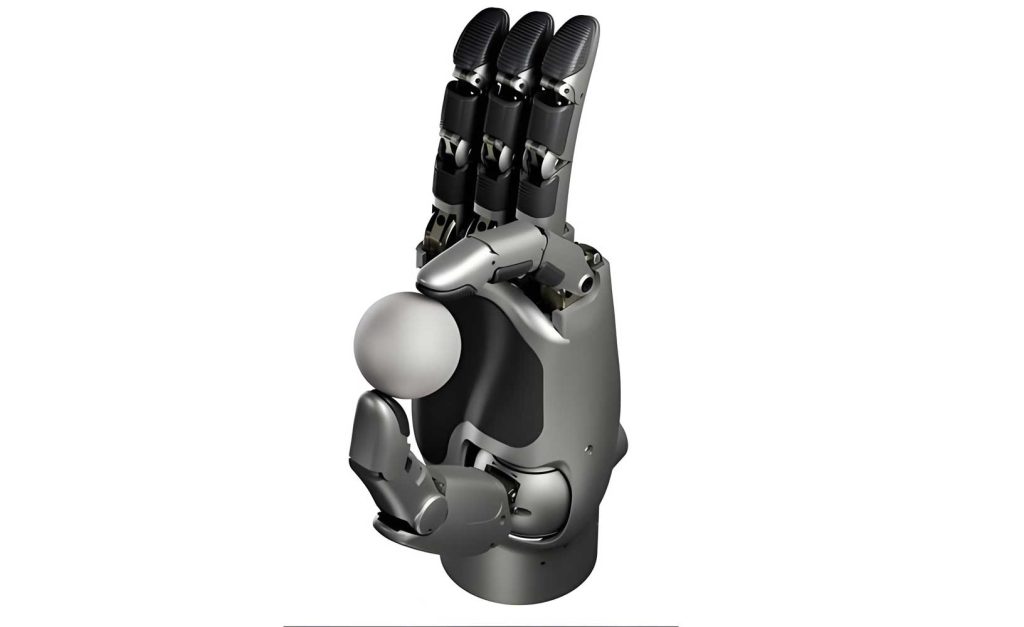
The proposed framework was implemented and tested on a five-fingered anthropomorphic dexterous robotic hand. Experiments focused on validating the friction observer, joint-space impedance, and Cartesian-space impedance control with all compensations active.
Friction Observer Performance
The EKF-based observer successfully converged to stable estimates for both viscous ($b$) and Coulomb ($c$) friction parameters. The convergence validated the observer’s ability to adapt to the joint’s nonlinear characteristics online. Furthermore, the observer provided accurate velocity estimates, a critical but often noisy signal in real systems.
Joint-Space Impedance with Friction Compensation
A finger joint was commanded to track a periodic trajectory. The results clearly demonstrated the benefit of adaptive friction compensation:
| Control Mode | Maximum Tracking Error | Remarks |
|---|---|---|
| Impedance Control without Friction Compensation | ~2.0° | Visible steady-state and phase errors. |
| Impedance Control with Adaptive Friction Compensation | ~0.8° | Significantly improved tracking accuracy. |
In a contact scenario, the joint-space impedance controller allowed the finger to touch a rigid environment and maintain a stable contact force, demonstrating compliant behavior.
Cartesian-Space Impedance Control
Experiments evaluated the dexterous robotic hand fingertip’s behavior in Cartesian space. In a trajectory tracking task, the fingertip accurately followed the desired path in free space and, upon contact, exhibited stable force regulation according to the defined impedance. In a disturbance rejection test, the fingertip was manually displaced and, upon release, returned smoothly to its target pose with sub-millimeter steady-state error, thanks to the integrated gravity and friction compensation.
The measured force-displacement relationship during contact along one axis confirmed the implemented impedance behavior. With a designed stiffness $K_x = 1300 \, \text{N/m}$, the measured interaction closely matched the linear spring model, verifying the controller’s effectiveness.
Conclusion and Future Perspectives
This work has presented a holistic approach to controlling a dexterous robotic hand with the critical real-world complexities of joint elasticity and nonlinear friction. By deriving impedance control laws based on a passivity framework for an elastic joint model, stability is guaranteed. The integration of a Least Squares-optimized gravity compensator and, more importantly, an EKF-based adaptive friction observer, transforms the baseline controller into a high-performance system capable of precise trajectory tracking and stable, compliant force interaction.
The experimental results on a multi-fingered dexterous robotic hand validate that the proposed adaptive impedance controller successfully mitigates the effects of flexibility and friction, key hurdles in precise manipulation. The improved positional accuracy and dependable force response are essential for complex tasks like grasping fragile objects or performing dexterous in-hand manipulation.
Future research directions are plentiful. The next logical step is to extend this single-finger control framework to multi-finger coordinated impedance control, enabling the entire dexterous robotic hand to perform complex grasping and manipulation tasks with full force closure and internal force regulation. Furthermore, integrating tactile and slip sensing feedback into the impedance adaptation loop would pave the way for fully autonomous, perception-driven adaptive grasping. Investigating machine learning techniques to model more complex, non-static friction phenomena could further refine the compensation. The pursuit of ever more intelligent and responsive control strategies continues to be central to realizing the full potential of the dexterous robotic hand as a tool for seamless human-robot collaboration and autonomous operation in dynamic environments.