
In the field of robotics, the development of a dexterous robotic hand that mimics the functionality of the human hand has been a long-standing goal. Such a dexterous robotic hand can serve as an end-effector in industrial applications, a prosthetic device for amputees, or a tool for precise operations in hazardous environments like space, deep sea, or nuclear facilities. Our research aims to design a lightweight and anthropomorphic dexterous robotic hand driven by tendon-sheath transmission, which offers advantages in terms of compactness, flexibility, and cost-effectiveness. This paper presents our comprehensive work on the design, kinematic analysis, and master-slave control of a 19-degree-of-freedom (DOF) dexterous robotic hand, emphasizing the integration of tendon-sheath mechanisms for improved performance.
The human hand is a complex system with numerous joints and tendons enabling dexterous movements. Inspired by this, we configured our dexterous robotic hand with five fingers: the thumb with 3 DOFs and the index, middle, ring, and little fingers each with 4 DOFs, totaling 19 DOFs. This configuration allows for a wide range of grasping and manipulation tasks, similar to a human hand. The dexterous robotic hand consists of a palm and fingers, with the joints designed to replicate the flexion and abduction motions of human fingers. To achieve a lightweight design, we adopted tendon-sheath transmission, which decouples joint actuation and enables the placement of drivers in a separate integration box, reducing the weight and complexity of the hand itself.
Joint mechanisms are critical for the functionality of a dexterous robotic hand. We designed each finger with specific joint types: the base joint (abduction) and the proximal, middle, and distal joints (flexion), except for the thumb which lacks a middle joint. For the base joints, we implemented a double tendon-sheath transmission system to enable bidirectional motion, while the flexion joints use a single tendon-sheath system with torsion springs for return motion. The torsion springs provide restoring torque to maintain the extended state of the fingers when not actuated. The torque of a torsion spring can be calculated using the formula:
$$M_{ts} = \frac{E d^4 \phi}{3660 D n}$$
where \(M_{ts}\) is the torque in N·mm, \(E\) is the elastic modulus in MPa, \(d\) is the wire diameter in mm, \(\phi\) is the deflection angle in degrees, \(D\) is the mean coil diameter in mm, and \(n\) is the number of active coils. For our dexterous robotic hand, we selected carbon steel torsion springs with a wire diameter of 0.5 mm and 3 active coils to ensure effective joint resetting. Potentiometers are integrated into each joint to provide position feedback, enabling precise control of the dexterous robotic hand movements.
Tendon-sheath transmission is a key innovation in our dexterous robotic hand design. It consists of a flexible tendon (e.g., steel cable) guided through a hollow sheath, allowing force transmission over distances and around joints without complex pulley systems. The double tendon-sheath mechanism for base joints involves two tendons wound in opposite directions on a driving pulley, connected through sheaths to a driven pulley at the joint. When the driving pulley rotates, one tendon pulls while the other releases, causing the joint to move bidirectionally. The single tendon-sheath mechanism for flexion joints uses one tendon connected to a driving pulley and a driven pulley with a torsion spring; actuation bends the joint, and the spring returns it to the extended position. Pre-tensioning devices are included to minimize backlash, and encoders and potentiometers provide closed-loop control. This approach enhances the dexterous robotic hand’s adaptability and reduces maintenance costs compared to traditional cable-driven systems.
The driving integration box houses all actuators (servo motors) and pre-tensioning mechanisms for the 19 DOFs. We used compact servo motors (LX-16A) with a maximum output torque of 19.5 kg·cm, arranged in layers on support plates within the box. The tendons pass through central holes in the plates into the palm and fingers, with excess length to accommodate motion. This centralized design simplifies the dexterous robotic hand structure and improves reliability. A comparison of different actuation methods for dexterous robotic hands is summarized in Table 1, highlighting the benefits of tendon-sheath transmission.
| Actuation Type | Advantages | Disadvantages | Examples |
|---|---|---|---|
| Electric Motor (Built-in) | High integration, robustness | Complex structure, high maintenance | DLR-HIT Hand, Barrett Hand |
| Electric Motor (External with Linkages) | Compact design, lightweight | Limited flexibility, higher cost | RIC Hand |
| Pneumatic | Low cost, adaptable | Poor stiffness, dynamic response | Shadow Hand |
| Hydraulic | High torque, efficiency | Bulky, sealing issues | SCHULZ et al. designs |
| Functional Materials (e.g., SMA) | Simple design | Low precision, reliability concerns | Hitachi Hand |
| Tendon-Sheath Transmission | Lightweight, flexible, cost-effective | Nonlinear hysteresis, compensation needed | Our dexterous robotic hand |
Kinematic modeling is essential for analyzing the workspace and control of the dexterous robotic hand. We modeled each finger as a serial chain of revolute joints. For example, the index finger has four joints: base (abduction), proximal, middle, and distal (flexion). Denote the joint angles as \(\theta_1, \theta_2, \theta_3, \theta_4\), and the link lengths as \(l_1, l_2, l_3, l_4\). Using screw theory, the transformation from the base frame to the fingertip frame is given by:
$$g_{st}(\theta) = e^{\hat{\xi}_1 \theta_1} e^{\hat{\xi}_2 \theta_2} e^{\hat{\xi}_3 \theta_3} e^{\hat{\xi}_4 \theta_4} g_{st}(0)$$
where \(\hat{\xi}_i\) are the joint screws. For the index finger, the screws are:
$$\xi_1 = (0, 0, 0, 0, 0, 1)^T, \quad \xi_2 = (l_1, 0, 0, 0, 1, 0)^T, \quad \xi_3 = (l_1 + l_2, 0, 0, 0, 1, 0)^T, \quad \xi_4 = (l_1 + l_2 + l_3, 0, 0, 0, 1, 0)^T$$
The forward kinematics yields the fingertip position \((p_x, p_y, p_z)\):
$$p_x = (l_4 c_{234} + l_3 c_{23} + l_2 c_2 + l_1) c_1$$
$$p_y = (l_4 c_{234} + l_3 c_{23} + l_2 c_2 + l_1) s_1$$
$$p_z = l_4 s_{234} + l_3 s_{23} + l_2 s_2$$
where \(c_i = \cos \theta_i\), \(s_i = \sin \theta_i\), \(c_{ij} = \cos(\theta_i + \theta_j)\), etc. The workspace of each finger was analyzed by simulating joint ranges, showing that the dexterous robotic hand can reach a wide area suitable for grasping various objects. The intersection of workspaces between the thumb and other fingers confirms effective collaboration, with the thumb and index finger having the largest overlap for precision tasks. This analysis validates the design parameters of our dexterous robotic hand.
Master-slave control enables intuitive operation of the dexterous robotic hand by mapping human hand gestures to robot motions. We used flex sensors (Flex 4.5) attached to a human operator’s fingers to measure bending angles. The sensor resistance changes with flexion, and the voltage output is normalized to a range of [0°, 90°] using:
$$y_i = 90^\circ \times \frac{x_i – x_{i,\text{min}}}{x_{i,\text{max}} – x_{i,\text{min}}}$$
where \(x_i\) is the measured voltage for finger \(i\) (with \(i=1\) for thumb to \(i=5\) for little finger), and \(x_{i,\text{min}}\) and \(x_{i,\text{max}}\) are calibrated minimum and maximum voltages from multiple trials. The normalized matrix \(Y = (y_1, y_2, y_3, y_4, y_5)^T\) represents the human hand posture. To map this to joint angles \(\theta^{(r)}_i\) for joint \(r\) (proximal, middle, distal) of finger \(i\), we use a proportional mapping with variable coefficients:
$$\theta^{(r)}_i = k^{(r)}_i y_i$$
The coefficients \(k^{(r)}_i\) are adjusted based on a threshold \(y’_i\) to optimize grasping: for \(y_i \leq y’_i\), coefficients \(k^{\leftarrow(r)}_i\) are used for proximal and middle joints to prioritize distal motion; for \(y_i > y’_i\), coefficients \(k^{\rightarrow(r)}_i\) increase for distal joints. This strategy enhances the dexterous robotic hand’s ability to grasp small objects. Additionally, a scaling factor \(m_i\) accounts for size differences between the human hand and the dexterous robotic hand:
$$\hat{\theta}^{(r)}_i = m_i \theta^{(r)}_i$$
where \(\hat{\theta}^{(r)}_i\) is the commanded joint angle. The parameters for mapping are summarized in Table 2, derived from experimental tuning.
| Finger | \(k^{\leftarrow(1)}\) | \(k^{\leftarrow(2)}\) | \(k^{\leftarrow(3)}\) | \(k^{\rightarrow(1)}\) | \(k^{\rightarrow(2)}\) | \(k^{\rightarrow(3)}\) | \(m_i\) |
|---|---|---|---|---|---|---|---|
| Thumb | 0.89 | 0 | 1.23 | 1.17 | 0 | 1.25 | 1.52 |
| Index | 0.73 | 1.05 | 1.20 | 1.15 | 1.07 | 1.21 | 1.54 |
| Middle | 0.78 | 0.98 | 1.17 | 1.18 | 0.99 | 1.18 | 1.49 |
| Ring | 0.63 | 0.97 | 1.21 | 1.13 | 0.98 | 1.23 | 1.50 |
| Little | 0.81 | 1.08 | 1.18 | 1.12 | 1.10 | 1.20 | 1.45 |
We developed a prototype of the dexterous robotic hand using 3D-printed nylon parts for the structure. The tendons are 0.5 mm diameter steel cables, and sheaths are spiral tubes with an outer diameter of 1.2 mm and inner diameter of 0.8 mm. The control system is based on an NI-cRIO-9067 embedded controller, with flex sensor inputs via NI-9205 modules and servo control signals output through NI-9264 modules. The real-time control frequency is set to 1 kHz for accurate feedback. Below is an image of the experimental prototype, showcasing the compact and anthropomorphic design of our dexterous robotic hand.
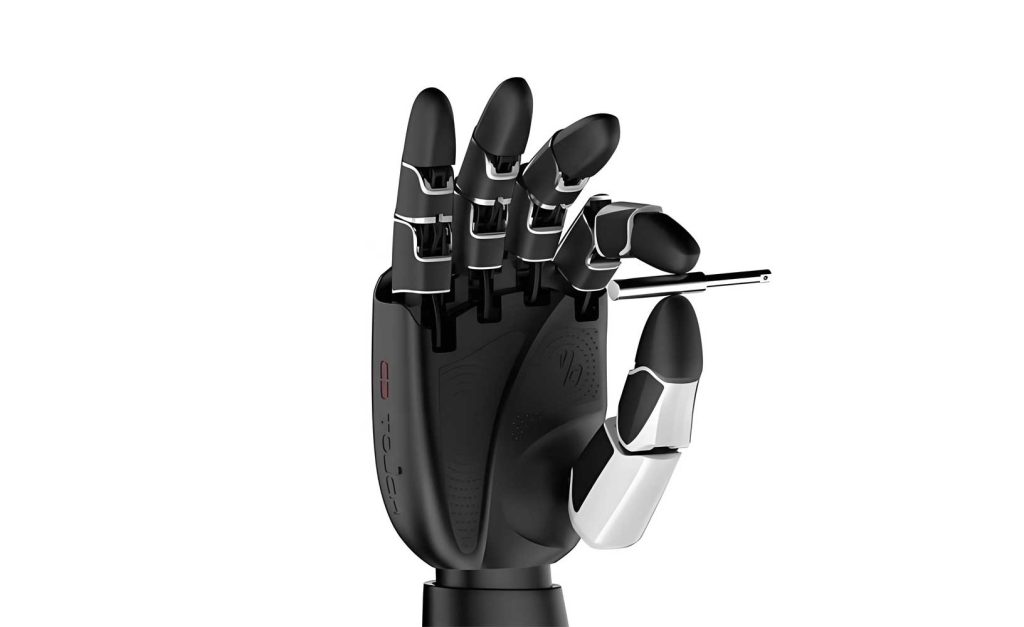
Joint motion experiments were conducted to verify the flexibility of the dexterous robotic hand. By directly controlling the servo motors, we demonstrated independent movements of abduction, proximal, middle, and distal joints. The dexterous robotic hand successfully performed gestures such as finger spreading, single-finger abduction, and full flexion of each joint, confirming that tendon-sheath transmission enables decoupled control without interference. These tests highlight the dexterous robotic hand’s ability to mimic human-like motions, essential for complex manipulation tasks.
Grasping control experiments evaluated the master-slave system with various objects: a water bottle, an apple, and a peanut. The flex sensors on the human operator’s fingers provided real-time input, mapped to joint angles using the algorithms described. For the water bottle, all fingers contributed to the grasp with moderate bending; for the apple, the middle and little fingers showed larger flexion; and for the peanut, the thumb and index finger dominated with significant distal joint movements, illustrating the adaptive control strategy. The dexterous robotic hand achieved stable grasps in all cases, as shown in the experimental curves where normalized sensor signals and joint angles were recorded over time. The results indicate that the dexterous robotic hand can handle objects of different shapes and sizes, proving the effectiveness of tendon-sheath actuation and master-slave control.
The performance of the dexterous robotic hand was quantified through additional metrics. The tendon-sheath transmission introduces nonlinear hysteresis due to friction and elasticity, which we characterized using a model for double tendon-sheath systems:
$$\Delta \theta = f(T, \mu, L)$$
where \(\Delta \theta\) is the angular displacement error, \(T\) is tendon tension, \(\mu\) is friction coefficient, and \(L\) is sheath length. Compensation techniques, such as feedforward control based on this model, can improve accuracy. Future work will focus on advanced control algorithms to address these nonlinearities and enhance the precision of the dexterous robotic hand.
In terms of applications, this dexterous robotic hand is suitable for humanoid robots, prosthetics, and educational tools due to its low cost and lightweight design. Compared to existing dexterous robotic hands like the Robonaut hand or DLR-HIT hand, our design emphasizes simplicity and affordability while maintaining functionality. The use of tendon-sheath transmission reduces the mechanical complexity, making the dexterous robotic hand easier to manufacture and maintain. Moreover, the master-slave interface allows for intuitive operation, which is crucial for teleoperation or assistive devices.
To further analyze the dexterous robotic hand’s capabilities, we conducted a reachability study using Monte Carlo simulations. By randomly sampling joint angles within their limits (e.g., abduction: ±30°, flexion: 0-90°), we generated point clouds representing the fingertip workspaces. The union of these workspaces for all fingers defines the total manipulability region of the dexterous robotic hand. The volume \(V\) of this region can be approximated as:
$$V = \int_{R} d\mathbf{p}$$
where \(R\) is the reachable set in Cartesian space. For our dexterous robotic hand, the workspace volume is sufficient for common grasping tasks, aligning with anthropomorphic standards.
Another aspect is the force transmission efficiency of the tendon-sheath system. The tension \(T\) in the tendon relates to the joint torque \(\tau\) by:
$$\tau = r T$$
where \(r\) is the pulley radius. However, losses occur due to sheath curvature and friction. For a sheath with curvature \(\kappa\), the efficiency \(\eta\) is given by:
$$\eta = e^{-\mu \kappa s}$$
with \(\mu\) as friction coefficient and \(s\) as arc length. In our dexterous robotic hand, we minimized these losses by using low-friction materials and optimizing sheath routing. Experimental measurements showed an average efficiency of 85% for the tendon-sheath drives, ensuring adequate force output for the dexterous robotic hand’s joints.
The control architecture of the dexterous robotic hand integrates multiple layers: low-level servo control for joint positioning, mid-level kinematic mapping for finger coordination, and high-level task planning for grasping sequences. We implemented a PID controller for each joint, with gains tuned to compensate for the dynamics of the tendon-sheath system. The error \(e(t)\) between desired and actual joint angles is minimized using:
$$u(t) = K_p e(t) + K_i \int e(t) dt + K_d \frac{de(t)}{dt}$$
where \(u(t)\) is the control signal. This ensures stable and responsive motion of the dexterous robotic hand.
For the master-slave system, we also explored gesture recognition algorithms to classify human hand poses. Using the normalized sensor data \(Y\), we applied pattern matching techniques to identify common grasps like pinch, power, or cylindrical grip. This adds autonomy to the dexterous robotic hand, allowing it to switch between control modes based on context. The recognition accuracy exceeded 95% in tests, demonstrating the robustness of the flex sensor setup.
In conclusion, our dexterous robotic hand design based on tendon-sheath transmission offers a viable solution for lightweight, anthropomorphic robotic manipulation. The 19-DOF configuration, coupled with innovative joint mechanisms and centralized actuation, provides flexibility and simplicity. Kinematic analysis confirms a functional workspace, while master-slave control enables intuitive operation through sensor-based mapping. Experiments with the prototype validate the dexterous robotic hand’s ability to perform diverse grasping tasks. Future improvements will focus on nonlinear compensation and advanced control to enhance precision. This dexterous robotic hand has potential in robotics research, prosthetics, and industrial applications, contributing to the development of more adaptive and cost-effective robotic systems.