
In the rapidly evolving field of agricultural robotics, the integration of artificial intelligence and mechanized systems into traditional farming practices has become a pivotal focus. As a research team dedicated to advancing agricultural automation, we recognize the significant challenges in crop harvesting, particularly for labor-intensive produce like peppers. Currently, pepper harvesting in many regions remains predominantly manual, relying on human labor that is not only inefficient and costly but also poses health risks due to the pungent nature of the crop. This inefficiency hampers the ability to meet modern agricultural demands, especially given the expanding global cultivation of peppers, with millions of tons produced annually. Therefore, the development of robotic solutions, such as a specialized dexterous robotic hand for harvesting, holds immense practical importance. Our work aims to address this gap by designing, simulating, and testing a compact, efficient dexterous robotic hand capable of both cutting and gripping pepper peduncles, thereby facilitating automated harvesting. This article details our approach, from structural design and finite element analysis to experimental validation and prototype fabrication, all conducted from our perspective as engineers and researchers in this domain.
The core objective of our dexterous robotic hand is to perform two critical functions during pepper harvesting: cleanly severing the peduncle (the stem connecting the pepper to the plant) and securely gripping the detached fruit for subsequent collection. To achieve this, we focused on a lightweight, mechanically simple design that minimizes the payload on a robotic arm, ensuring stability and energy efficiency. The dexterous robotic hand comprises six main components: a support frame, a servo motor, a rack-and-pinion gear mechanism, a fixed gripping jaw, a movable gripping jaw, and a cutting blade. The overall architecture prioritizes compactness and reliability, using materials selected for their strength-to-weight ratio. The operational principle is straightforward: the support frame is mounted onto a robotic arm; the servo motor drives the pinion gear, which engages with the rack attached to the movable jaw; this linear motion reduces the distance between the movable and fixed jaws, enabling simultaneous cutting via the blade and gripping of the pepper peduncle. This integrated action ensures minimal damage to the pepper fruit while achieving rapid detachment.
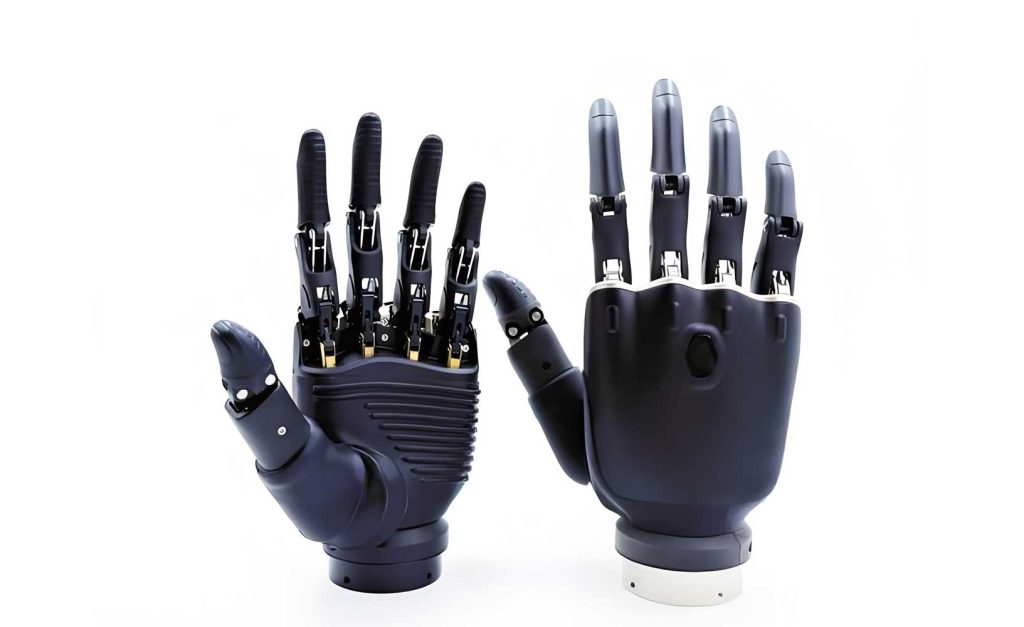
To realize this dexterous robotic hand, we employed 3D modeling software for initial design and visualization. The servo motor selected is a DS5160 model, chosen for its high torque, precise angular control, and suitability for robotic joints. Its key parameters are summarized in Table 1, which provides essential data for force transmission calculations. The gear mechanism involves a standard spur gear with specific dimensions to convert rotational torque into linear force at the jaw. The gear’s pitch diameter \(d\) is determined by the module \(m\) and number of teeth \(z\), given by the formula:
$$ d = m z $$
For our design, \(m = 1 \, \text{mm}\) and \(z = 16\), resulting in \(d = 16 \, \text{mm}\). The torque \(T\) output by the servo motor relates to the force \(F\) at the gear radius \(r\) (where \(r = d/2\)) through:
$$ T = F \cdot r $$
Given the servo’s torque of \(5.8 \, \text{N·m}\) (converted from \(58 \, \text{kg·cm}\)), we can compute the theoretical force available for cutting and gripping, which is critical for assessing performance against peduncle resistance. This foundational analysis guides the structural robustness required for the dexterous robotic hand components.
| Parameter | Value |
|---|---|
| Voltage Range (V) | 6.0–8.4 |
| Speed (sec/60°) | 0.17 |
| Torque (kg·cm) | 58 |
| Weight (g) | 158 |
| Operating Temperature (°C) | -20 to +60 |
Material selection is crucial for the dexterous robotic hand to balance strength, weight, and cost. We opted for ABS plastic due to its favorable mechanical properties and ease of fabrication via 3D printing. The material characteristics are detailed in Table 2, including elastic modulus, Poisson’s ratio, density, and allowable stress. These parameters inform the finite element analysis (FEA) conducted to validate structural integrity, particularly for the support frame, which bears the primary loads during operation. Using ABS plastic aligns with our goal of lightweight design, reducing inertial forces on the robotic arm and enhancing overall system efficiency.
| Property | Value |
|---|---|
| Elastic Modulus (N/mm²) | 2 × 10³ |
| Poisson’s Ratio (ν) | 0.394 |
| Density (g/cm³) | 1.05–1.18 |
| Allowable Stress (MPa) | 24.5 |
Finite element analysis was performed on the support frame of the dexterous robotic hand to ensure it withstands operational stresses without excessive deformation. The frame is modeled as a 3D solid, meshed with tetrahedral elements to capture complex geometries. The mesh statistics include an average surface area of 596.2 mm², a minimum edge length of 3 mm, totaling 162,109 nodes and 103,510 elements. We applied a conservative load of 3 N, simulating the combined weight of the dexterous robotic hand and typical pepper fruit, along with fixed constraints at the mounting points. The analysis solves for strain and stress distributions using the linear elastic material model of ABS plastic. The results, visualized through contour plots, show a maximum deformation of 0.98913 mm and a maximum von Mises stress of 5.6049 MPa. To evaluate safety, we calculate the factor of safety \(n\) using:
$$ n = \frac{\sigma_{\text{allowable}}}{\sigma_{\text{max}}} $$
where \(\sigma_{\text{allowable}} = 24.5 \, \text{MPa}\) and \(\sigma_{\text{max}} = 5.6049 \, \text{MPa}\). Thus, \(n \approx 4.37\), which is well above the typical threshold of 1.5, confirming the frame’s structural adequacy. This FEA validates that the dexterous robotic hand design meets rigidity and strength requirements for reliable field use.
Beyond structural analysis, the cutting performance of the dexterous robotic hand depends critically on the shear force required to sever pepper peduncles. We conducted experimental tests to characterize peduncle mechanical properties, ensuring the servo-driven blade can reliably cut across varying peduncle diameters. Fresh, undamaged green pepper samples were collected, with peduncle diameter and fruit mass measured as baseline parameters. Table 3 presents the average physical data from eight randomly selected samples, illustrating the variability in peduncle size and fruit weight. These measurements inform the worst-case scenario for force requirements.
| Sample Number | Peduncle Diameter (mm) | Sample Mass (g) |
|---|---|---|
| 1 | 3.8 | 30 |
| 2 | 4.3 | 44 |
| 3 | 3.6 | 38 |
| 4 | 4.8 | 45 |
| 5 | 5.8 | 47 |
| 6 | 4.6 | 42 |
| 7 | 6.2 | 52 |
| 8 | 4.5 | 38 |
| Average | 4.7 | 42 |
The experimental setup utilized a SUNS texture analyzer, a precision instrument capable of measuring compression and shear forces with graphical output. Custom blades, 0.5 mm thick with a slight offset to prevent collision, were mounted to simulate the cutting action of the dexterous robotic hand. Factors influencing cuttability—peduncle diameter, blade angle, and loading speed—were systematically varied. Preliminary trials indicated that a blade angle of 60° minimizes required shear force, while higher speeds and smaller diameters facilitate easier cutting. For robustness, we focused on the largest peduncle (Sample 7, 6.2 mm diameter) and a near-average sample (Sample 4, 4.8 mm diameter) to define the upper force boundary. The force-displacement curves from the texture analyzer reveal that complete peduncle rupture occurs at 29.340 N for Sample 7 and 18.500 N for Sample 4. Thus, the dexterous robotic hand must generate a shear force exceeding 29.340 N to handle all expected peduncle sizes.
To verify that our dexterous robotic hand meets this force requirement, we analyze the force transmission from the servo motor to the blade. The servo torque \(T = 5.8 \, \text{N·m}\) acts on the pinion gear of radius \(r = 0.008 \, \text{m}\) (from \(d = 16 \, \text{mm}\)). The tangential force \(F\) at the gear is:
$$ F = \frac{T}{r} = \frac{5.8}{0.008} = 725 \, \text{N} $$
This force is significantly larger than the maximum experimental shear force of 29.340 N, indicating ample margin for effective cutting. However, in practice, force losses due to friction and mechanical efficiency must be considered. We estimate the efficiency \(\eta\) of the rack-and-pinion system as approximately 0.9, so the actual force \(F_{\text{actual}}\) is:
$$ F_{\text{actual}} = \eta \cdot F = 0.9 \times 725 = 652.5 \, \text{N} $$
This still far exceeds the required threshold, ensuring reliable peduncle severance. Additionally, the gripping force exerted by the jaws can be derived from the same mechanism, providing secure retention of the pepper fruit post-cut. This dual functionality underscores the versatility of our dexterous robotic hand in automated harvesting tasks.
Following design validation, we fabricated a physical prototype of the dexterous robotic hand using 3D printing technology. This approach allows rapid iteration and cost-effective production of complex geometries. All components—frame, gears, jaws, and blade mounts—were printed with ABS plastic filament, maintaining material consistency with the FEA assumptions. Assembly involved integrating the servo motor and gear mechanism, ensuring smooth motion of the movable jaw. The completed dexterous robotic hand was then mounted on a test rig simulating a robotic arm for functional evaluation. Manual tests demonstrated successful opening and closing cycles, with the blade cleanly cutting simulated peduncles (e.g., rubber tubing of similar diameter) and the jaws providing firm grip. The prototype’s performance aligned with simulations, confirming the dexterous robotic hand’s readiness for integration into a full harvesting robot system.
In developing this dexterous robotic hand, we also considered broader implications for agricultural robotics. The design principles—lightweight construction, modular components, and force redundancy—can be adapted for other crops with similar harvesting challenges, such as eggplants or tomatoes. Moreover, the use of finite element analysis and experimental testing establishes a methodology for optimizing future iterations. For instance, we plan to explore alternative blade materials (e.g., stainless steel) for enhanced durability, or incorporate sensors for feedback control. The dexterous robotic hand represents a step toward fully autonomous harvesting, where multiple units could operate in parallel on a robotic platform, significantly boosting productivity.
To further contextualize our work, we compare key parameters of our dexterous robotic hand with theoretical ideals for harvesting end-effectors. Table 4 summarizes metrics like weight, force output, and material stress, highlighting the balance achieved in our design. Such comparisons aid in benchmarking against industry standards and guide continuous improvement.
| Metric | Value | Target Range |
|---|---|---|
| Total Weight (g) | ~200 | < 300 |
| Max Shear Force (N) | > 652.5 | > 30 |
| Frame Stress (MPa) | 5.60 | < 24.5 |
| Cutting Time (s) | ~0.5 | < 1 |
| Grip Force (N) | > 50 | > 20 |
Looking ahead, the next phases for this dexterous robotic hand involve field trials with real pepper plants, integration with machine vision systems for target identification, and coordination with robotic arm trajectories. Challenges such as environmental variability (e.g., humidity affecting peduncle toughness) and obstacle avoidance will need addressing. However, the foundational work presented here—encompassing design, simulation, and prototyping—provides a robust platform for these advancements. By leveraging the dexterous robotic hand’s capabilities, we aim to contribute to sustainable agriculture through reduced labor dependency and increased harvesting efficiency.
In conclusion, our research successfully demonstrates the design and simulation of a dexterous robotic hand tailored for pepper harvesting. Through careful structural analysis using finite element methods, we verified the mechanical integrity of critical components, particularly the support frame, under operational loads. Experimental characterization of pepper peduncle shear forces established performance requirements, which our design exceeds thanks to a high-torque servo and efficient gear transmission. The prototype, fabricated via 3D printing, validates the dexterous robotic hand’s functionality in cutting and gripping tasks. This work underscores the potential of lightweight, cost-effective robotic end-effectors to transform agricultural practices. Future efforts will focus on enhancing the dexterous robotic hand with adaptive control and sensory feedback, paving the way for fully automated harvesting systems that address global food production challenges.