
In the evolving landscape of space technology, particularly for on-orbit servicing and deep-space exploration, the demand for advanced robotic manipulation capabilities has become paramount. The development of a dexterous robotic hand is a critical component for humanoid robots tasked with complex operations such as payload assembly, module replacement, and precision manipulation in space environments. This article, from my perspective as a researcher involved in this field, delves into the design and control system of a single finger for a space-grade dexterous robotic hand. The focus is on achieving robust position and force control, which are essential for reliable and adaptable operations in the challenging conditions of space.
The core challenge in designing a space dexterous robotic hand lies in balancing high degrees of freedom, compactness, reliability, and the ability to perform force-sensitive tasks. Traditional robotic hands with actuators embedded in the joints often face limitations in size and environmental protection. Inspired by advanced designs like NASA’s Robonaut 2 Hand, our approach for this space dexterous robotic hand utilizes a tendon-driven mechanism. This strategy allows the placement of motors, drivers, and control electronics in the forearm, significantly reducing the finger’s volume and mass while enhancing its suitability for the thermal and radiation conditions of space. This dexterous robotic hand is envisioned as a key subsystem for future space stations, capable of assisting or even replacing astronauts in repetitive or hazardous tasks.
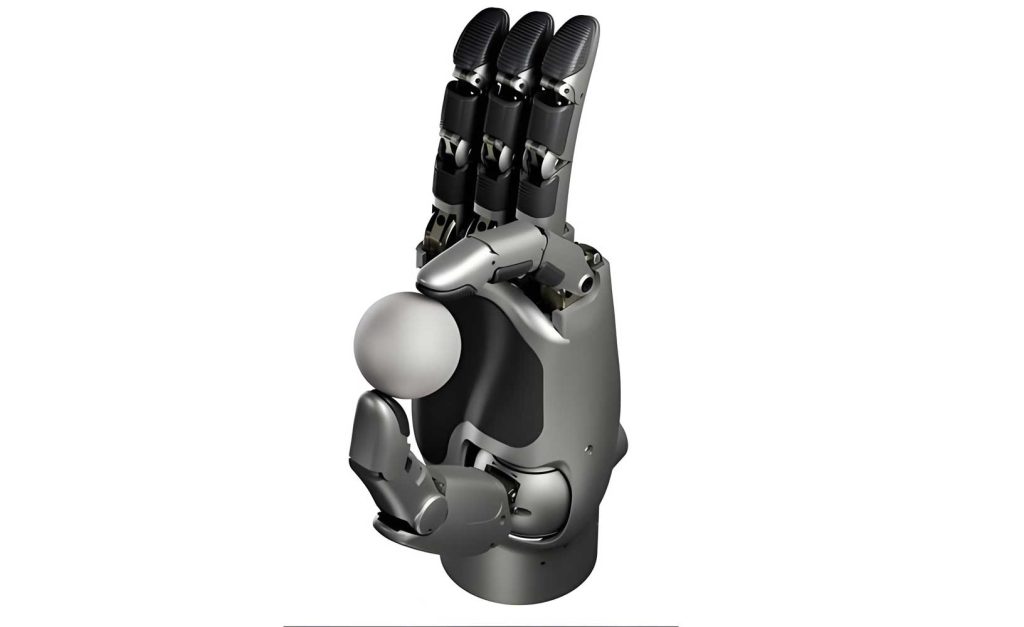
The overall architecture of the dexterous robotic hand can be divided into three integrated systems: the motion system, the sensing system, and the control system. The motion system comprises modular finger subsystems, a wrist subsystem, and the tendon actuator assembly, all supported by a structural framework including the palm and forearm. The sensing system is paramount for closed-loop control, incorporating joint angle sensors and fingertip six-axis force sensors. The control system, the focus of this discussion, orchestrates these elements to execute precise movements and compliant interactions. The fingers themselves are modular. The index and middle fingers are designed with three active degrees of freedom (DOF): abduction/adduction (side swing), metacarpophalangeal (base) flexion, and proximal interphalangeal (middle) flexion. The distal joint is coupled via a four-bar linkage, making it a dependent joint. The ring and little fingers are simpler, single-DOF designs for power grasping, while the thumb has a unique kinematic structure for opposition. This configuration for the dexterous robotic hand aims to maximize functionality within stringent spatial and mass constraints.
Kinematic and Tendon Drive Modeling
The actuation of the dexterous robotic hand’s fingers is achieved through a tendon-driven scheme. To minimize the number of actuators and tendons—a crucial factor for reliability and simplicity—we adopted an N+1 tendon routing configuration for the multi-DOF fingers. For a finger with N independent joints, this method requires N+1 tendons to fully control the joint motions, providing both actuation and inherent tension management. For the three-DOF index finger, this means four tendons are sufficient.
The relationship between the joint torque vector \(\boldsymbol{\tau} \in \mathbb{R}^{3}\) and the tendon tension vector \(\mathbf{f} \in \mathbb{R}^{4}\) is linear and defined by the tendon routing matrix \(\mathbf{R}\):
$$\boldsymbol{\tau} = \mathbf{R} \mathbf{f}$$
For our specific finger design, based on the moment arms determined by the pulley radii and routing paths, the matrix \(\mathbf{R}\) is:
$$
\mathbf{R} = \begin{bmatrix}
r_a & r_a & -r_a & -r_a \\
r_b & -r_b & r_b & -r_b \\
0 & 0 & r_c & -r_c
\end{bmatrix}
$$
Where \(r_a = 0.004 \, \text{m}\) is the moment arm for the abduction/adduction joint, and \(r_b = r_c = 0.005 \, \text{m}\) are the moment arms for the base and middle flexion joints, respectively. This matrix is fundamental to the control of the dexterous robotic hand’s digits.
Similarly, based on the principle of virtual work, the differential relationship between tendon displacement velocities \(\dot{\mathbf{x}}\) and joint angular velocities \(\dot{\mathbf{q}}\) is:
$$\dot{\mathbf{x}} = \mathbf{R}^T \dot{\mathbf{q}}$$
Integrating this from a defined zero position (finger fully extended, \(\mathbf{q}=0\)), we obtain the kinematic mapping between tendon displacement \(\mathbf{x}\) and joint angle \(\mathbf{q}\):
$$\mathbf{x} = \mathbf{R}^T \mathbf{q}$$
This equation is inverted in the controller to translate desired joint angles into required tendon displacements for the motors. A summary of the key parameters for the dexterous robotic hand’s finger is presented in Table 1.
| Parameter | Symbol | Value | Description |
|---|---|---|---|
| Abduction/Adduction Moment Arm | \(r_a\) | 0.004 m | Distance from tendon path to joint axis |
| Base Flexion Moment Arm | \(r_b\) | 0.005 m | Distance from tendon path to joint axis |
| Middle Flexion Moment Arm | \(r_c\) | 0.005 m | Distance from tendon path to joint axis |
| Number of Active Joints | N | 3 | Degrees of Freedom (DOF) |
| Number of Tendons | N+1 | 4 | Tendon-driven configuration |
| Joint Angle Range (Base) | \(q_2\) | 0° to 90° | Mechanical limit |
| Joint Angle Range (Middle) | \(q_3\) | 0° to 110° | Mechanical limit |
Control System Architecture and Impedance Control
The control system for a single finger of this dexterous robotic hand must achieve two primary objectives: accurate trajectory tracking in free space and stable, compliant force regulation during contact. A hierarchical control structure is employed, combining a low-level joint position controller with a high-level Cartesian impedance controller. The overall block diagram of the single-finger control system is implemented as follows.
The desired joint angle trajectory \(\boldsymbol{\theta}_d\) is generated from a task planner. A forward kinematics block computes the corresponding desired Cartesian position of the fingertip \(\mathbf{X}_d\):
$$ \mathbf{X}_d = \text{FK}(\boldsymbol{\theta}_d) $$
where FK denotes the forward kinematics function of the finger.
To manage interaction forces, an impedance controller is implemented in the Cartesian space. The fundamental idea is to establish a dynamic relationship between the position error and the contact force, effectively making the dexterous robotic hand’s fingertip behave like a mass-spring-damper system. The desired impedance is expressed by the second-order equation:
$$ \mathbf{M}_d (\ddot{\mathbf{X}}_r – \ddot{\mathbf{X}}_d) + \mathbf{B}_d (\dot{\mathbf{X}}_r – \dot{\mathbf{X}}_d) + \mathbf{K}_d (\mathbf{X}_r – \mathbf{X}_d) = \mathbf{F}_e $$
where:
- \(\mathbf{M}_d\), \(\mathbf{B}_d\), \(\mathbf{K}_d\) are the desired inertia, damping, and stiffness matrices, respectively.
- \(\mathbf{X}_r\) is the modified reference position output by the impedance controller.
- \(\mathbf{F}_e\) is the measured contact force vector from the fingertip six-axis force sensor.
Transforming this equation into the Laplace domain provides a clearer view of the force-to-position compensation:
$$ \mathbf{X}_f(s) = \mathbf{X}_r(s) – \mathbf{X}_d(s) = \left( \mathbf{M}_d s^2 + \mathbf{B}_d s + \mathbf{K}_d \right)^{-1} \mathbf{F}_e(s) $$
The term \(\mathbf{X}_f\) is the position modification due to contact force. Thus, the final reference position becomes:
$$ \mathbf{X}_r = \mathbf{X}_d + \mathbf{X}_f $$
This modified reference \(\mathbf{X}_r\) is then converted back into joint space using the finger’s inverse kinematics (IK):
$$ \boldsymbol{\theta}_r = \text{IK}(\mathbf{X}_r) $$
The joint angle error is computed as \(\boldsymbol{\theta}_e = \boldsymbol{\theta}_r – \boldsymbol{\theta}_a\), where \(\boldsymbol{\theta}_a\) is the actual joint angle measured by the Hall-effect-based angle sensors. This error is then transformed into the required tendon displacement command using the transpose of the routing matrix:
$$ \mathbf{x}_{cmd} = \mathbf{R}^T \boldsymbol{\theta}_e $$
This command is sent to the tendon actuators (motors with winches) to drive the finger. The stiffness and damping matrices \(\mathbf{K}_d\) and \(\mathbf{B}_d\) are tuned to achieve critical damping, ensuring a stable and non-oscillatory response during contact for the dexterous robotic hand. Their selection is crucial for the performance of the impedance-controlled dexterous robotic hand.
| Impedance Parameter Matrix | Diagonal Values | Purpose |
|---|---|---|
| Desired Stiffness \(\mathbf{K}_d\) | [500, 500, 500] N/m | Defines the virtual spring stiffness in Cartesian X, Y, Z axes. |
| Desired Damping \(\mathbf{B}_d\) | [40, 40, 40] Ns/m | Provides damping to achieve critical damping response. |
| Desired Inertia \(\mathbf{M}_d\) | [0.5, 0.5, 0.5] kg | Defines the virtual mass. Often set to low values for responsiveness. |
Sensor Integration and Signal Processing
Accurate control of the dexterous robotic hand is contingent upon high-fidelity sensing. Two primary sensory modalities are integrated: joint position sensing and fingertip force/torque sensing.
The joint angle sensors for each active joint in the dexterous robotic hand consist of an elliptical magnet mounted on the joint axle and a linear Hall-effect sensor fixed to the link. The magnetic field strength varies linearly with the rotation angle, providing a robust and non-contact measurement solution suitable for the space environment. The output voltage \(V\) is related to the joint angle \(q\) by:
$$ V(q) = V_0 + S \cdot q $$
where \(V_0\) is the offset voltage at the zero position and \(S\) is the sensitivity (V/rad). This simple relationship allows for precise and low-latency feedback, which is essential for the fast control loops of the dexterous robotic hand.
The fingertip six-axis force sensor is a custom-designed element based on a Maltese cross structure with strain concentration zones. Sixteen strain gauges are arranged in full-bridge configurations on the four main beams (labeled A, B, C, D in the design). Through careful calibration and decoupling algorithms, the strain readings \(\boldsymbol{\epsilon}\) are transformed into a force-torque vector \(\mathbf{F}_{sensor} = [F_x, F_y, F_z, T_x, T_y, T_z]^T\) acting at the fingertip. The relationship can be expressed as:
$$ \mathbf{F}_{sensor} = \mathbf{C} \cdot \boldsymbol{\epsilon} $$
where \(\mathbf{C}\) is a 6×16 calibration matrix obtained via least-squares regression from experimental data. This sensor enables the dexterous robotic hand to measure contact forces directly, closing the loop for the impedance controller.
Experimental Validation and Results
To validate the control system design for the dexterous robotic hand, extensive experiments were conducted on a single-finger prototype. The experiments focused on two phases: pure position control in free space and integrated position-force control during contact.
Position Control Experiment: A desired joint trajectory was commanded for the index finger: \(\boldsymbol{\theta}_d = [0^\circ, 38^\circ, 59^\circ]^T\) for the abduction, base flexion, and middle flexion joints, respectively. The coupled distal joint angle, calculated via the four-bar linkage kinematics, was \(28^\circ\). The low-level controller successfully drove the finger to the target posture. The joint angles converged smoothly to their setpoints with minimal steady-state error, as would be expected from a well-tuned PID controller at the joint/tendon level. This experiment confirmed the basic functionality of the tendon drive system and the kinematic mappings for the dexterous robotic hand.
Impedance Control and Force Regulation Experiment: Following position control, a force regulation task was performed. The finger was commanded to move to a position slightly beyond a rigid contact surface. Upon contact, the impedance controller was activated with a desired contact force of \(\mathbf{F}_d = [10, 0, 0]^T\) N (a 10 N normal force in the X-direction). The impedance parameters were set as shown in Table 2. The results demonstrated the efficacy of the control system for the dexterous robotic hand. The X-component of the contact force smoothly rose and stabilized at the desired 10 N. The Y and Z force components remained near zero (within a small noise band of approximately ±0.2 N), indicating stable and decoupled force regulation. The system exhibited the desired compliant behavior, allowing the fingertip to yield slightly to maintain the prescribed force without exhibiting large overshoot or instability. This is a critical capability for a dexterous robotic hand performing delicate assembly or insertion tasks in space.
The performance metrics from the force control experiment are summarized in Table 3. These results quantitatively affirm that the proposed control system meets the fundamental requirements for a space-capable dexterous robotic hand in terms of precision and compliance.
| Metric | X-Axis (Normal Force) | Y-Axis (Shear Force) | Z-Axis (Shear Force) |
|---|---|---|---|
| Desired Force | 10.0 N | 0.0 N | 0.0 N |
| Steady-State Mean Force | 9.95 N | 0.02 N | 0.18 N |
| Steady-State Standard Deviation | 0.15 N | 0.05 N | 0.07 N |
| Rise Time (10% to 90%) | 0.45 s | N/A | N/A |
| Settling Time (to within 5%) | 0.70 s | N/A | N/A |
Discussion and Comparative Analysis
The development of this single-finger control system represents a significant step towards a fully operational space dexterous robotic hand. The N+1 tendon drive offers a compelling advantage in reducing actuator count and simplifying the finger structure compared to direct-drive or fully independent tendon (2N) designs. However, it introduces challenges in tension distribution and control coupling. Our control law, which directly uses the \(\mathbf{R}^T\) mapping, implicitly manages the tension constraints as long as the commanded tendon displacements are within physical limits and the controller is well-behaved.
The choice of impedance control over pure force control or hybrid position/force control is well-suited for a dexterous robotic hand operating in uncertain environments. It provides a unified framework for both free motion and contact, eliminating the need for strict switching logic between control modes. The stability of the overall system, however, depends heavily on the accurate knowledge of the environment’s stiffness. For interactions with very stiff environments (like a metal panel), high desired stiffness \(\mathbf{K}_d\) can lead to high forces from small position errors, potentially causing instability. Therefore, adaptive impedance control, where \(\mathbf{K}_d\) and \(\mathbf{B}_d\) are adjusted based on estimated environmental properties, is a logical next step for enhancing the robustness of the dexterous robotic hand.
Compared to other renowned dexterous robotic hands like the Shadow Hand or the DLR/HIT Hand II, our design emphasizes the specific constraints of space applications: radiation-hardened electronics, thermal management of actuators placed in the forearm, and ultra-compact finger design with integrated sensing. The use of a simple yet effective elliptical magnet and Hall sensor for joint sensing is a pragmatic solution for a space-grade dexterous robotic hand, favoring reliability over extreme resolution.
Mathematical Extension: Dynamics and Advanced Control
To further elaborate on the system’s complexity, let’s consider the equation of motion for the finger of the dexterous robotic hand. The dynamics in joint space can be written as:
$$ \mathbf{M}(\mathbf{q})\ddot{\mathbf{q}} + \mathbf{C}(\mathbf{q}, \dot{\mathbf{q}})\dot{\mathbf{q}} + \mathbf{G}(\mathbf{q}) + \boldsymbol{\tau}_{fric} = \boldsymbol{\tau}_{joint} – \mathbf{J}^T(\mathbf{q})\mathbf{F}_{ext} $$
where:
- \(\mathbf{M}(\mathbf{q})\) is the symmetric, positive-definite inertia matrix.
- \(\mathbf{C}(\mathbf{q}, \dot{\mathbf{q}})\dot{\mathbf{q}}\) represents Coriolis and centrifugal forces.
- \(\mathbf{G}(\mathbf{q})\) is the gravity vector. (In space, microgravity makes this term negligible for the finger itself, but it may be considered for ground testing).
- \(\boldsymbol{\tau}_{fric}\) is the joint friction torque.
- \(\boldsymbol{\tau}_{joint}\) is the net torque applied at the joints, related to tendon tensions by \(\boldsymbol{\tau}_{joint} = \mathbf{R} \mathbf{f}\).
- \(\mathbf{J}(\mathbf{q})\) is the geometric Jacobian matrix mapping joint velocities to Cartesian fingertip velocities.
- \(\mathbf{F}_{ext}\) is the external force at the fingertip.
The impedance controller we implemented operates effectively without explicitly canceling these nonlinear dynamic terms because the low-level joint position controller is high-gain and fast, effectively linearizing the plant from the perspective of the outer impedance loop. However, for more dynamic tasks or to achieve higher bandwidth force control, a model-based control scheme like computed-torque control could be integrated. The control law would then be:
$$ \boldsymbol{\tau}_{joint} = \hat{\mathbf{M}}(\mathbf{q})\mathbf{a} + \hat{\mathbf{C}}(\mathbf{q}, \dot{\mathbf{q}})\dot{\mathbf{q}} + \hat{\mathbf{G}}(\mathbf{q}) + \mathbf{J}^T(\mathbf{q})\mathbf{F}_d $$
where \(\hat{\bullet}\) denotes estimated model parameters, \(\mathbf{F}_d\) is the desired force from the impedance law, and \(\mathbf{a}\) is a new control input defined for error dynamics. This represents a more advanced direction for future iterations of the dexterous robotic hand’s control system.
Conclusion and Future Perspectives
This article has detailed the design, modeling, and experimental validation of a single-finger control system for a space-optimized dexterous robotic hand. The integration of an N+1 tendon drive mechanism with a Cartesian impedance control strategy has proven effective in achieving precise position control and stable, compliant force regulation. The experimental results on a prototype finger confirm the system’s capability to reach desired postures and to regulate contact forces with good accuracy and damping characteristics. These foundational capabilities are essential for any dexterous robotic hand intended for sophisticated manipulation in orbital and deep-space environments.
The successful implementation of this single-finger system paves the way for the next critical phase: the integration and coordinated control of all five fingers to perform full-hand grasping and in-hand manipulation. Future work will focus on developing whole-hand grasp planners, object-level impedance control, and enhancing the system’s autonomy through machine learning techniques for grasp adaptation. Furthermore, rigorous environmental testing (thermal-vacuum, vibration, radiation) will be necessary to qualify this dexterous robotic hand for actual spaceflight. The journey towards a truly space-worthy, autonomously dexterous robotic hand is ongoing, and the control system presented here forms a robust and promising cornerstone for that endeavor.