
The pursuit of creating machines that can interact with the physical world as seamlessly as humans has driven significant research into the development of anthropomorphic end-effectors. At the forefront of this endeavor is the design of the dexterous robotic hand. This article presents a comprehensive study on the design, kinematic modeling, control, and experimental validation of a five-fingered, underactuated dexterous robotic hand, designated as the SHU-II model. Inspired by the human hand’s structure and functionality, this dexterous robotic hand achieves a high degree of integration and versatility for practical manipulation tasks.
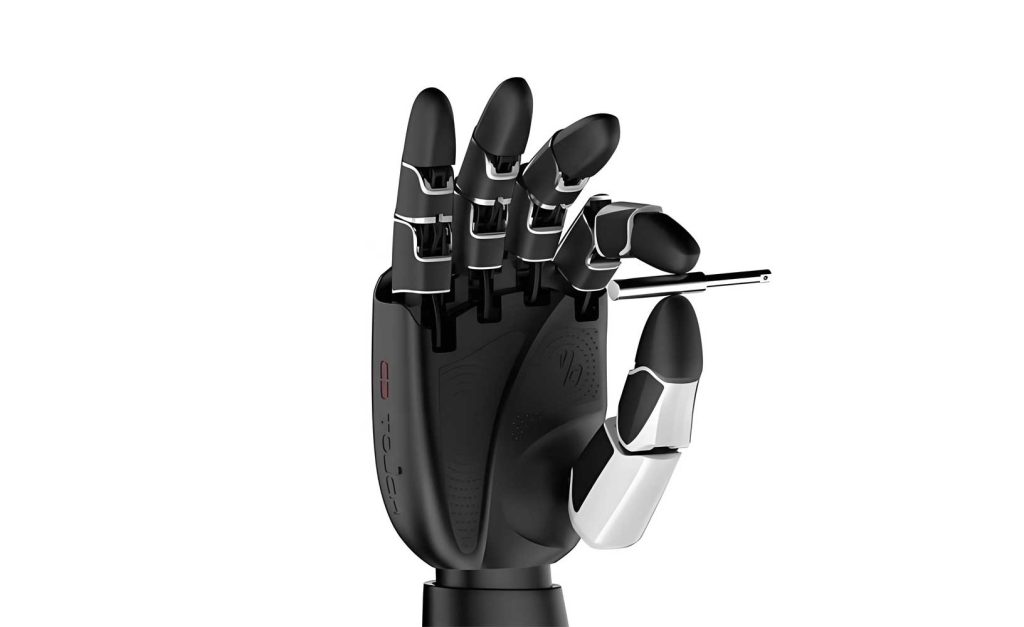
The design philosophy prioritizes biomimicry, lightweight construction, and practical utility. With a total of 16 degrees of freedom (DOF)—4 DOF for the thumb and 3 DOF for each of the other four fingers—the hand balances complexity with controllability. A key innovation lies in the implementation of virtualized finger joints, where traditional physical hinge joints are replaced by a tendon-driven system acting on rigid phalanges connected by flexible spring steel strips. This approach significantly reduces the weight and mechanical complexity of the fingers. Furthermore, the drive system and control electronics are fully embedded within the palm, resulting in a compact, standalone unit that can be easily mounted onto various robotic arm platforms.
From a theoretical standpoint, a precise kinematic model is essential for predicting motion and planning grasps. This model is derived using homogeneous transformation matrices, enabling the calculation of finger trajectories and the workspace of the fingertips. The analysis confirms the hand’s ability to perform a wide range of gestures and form secure enclosures around objects of varying shapes and sizes. Control of such an underactuated system presents unique challenges, addressed here through a strategy combining position and force control to ensure stable and adaptive grasping.
Structural Design of the Dexterous Robotic Hand
The overall dimensions of the SHU-II dexterous robotic hand are scaled to 1.1:1 relative to an average human hand. It is constructed primarily from ABS material using rapid prototyping technology, yielding a total mass of approximately 1 kg. The hand comprises a palm and five independently controllable fingers. Each finger, except the thumb, consists of four phalanges: the base, proximal, intermediate, and distal phalanges, interconnected to form three virtual revolute joints. The joint virtualization is achieved using a tendon-cable routing system that pulls on the phalanges, causing them to rotate around virtual axes located at the interface between phalanges. A spring steel strip runs along the dorsal side of each finger, providing restoring elasticity for finger extension and ensuring compliant, coupled motion between phalanges. To enhance lateral stability and prevent unwanted displacements, side-guard plates are integrated into the phalanx design, as illustrated in the simple model.
An underactuated configuration is employed to reduce the number of actuators, thereby simplifying control and reducing weight. Only six DC motors are used to drive all 16 DOF. Five motors are responsible for finger flexion/extension via tendon cables, and one dedicated motor controls the thumb’s abduction/adduction motion (its swing about the palm). This underactuation means that when a finger motor is activated, the phalanges close in a coordinated, adaptive manner determined by mechanical coupling and contact forces, rather than being independently positioned. All motors and the associated control circuitry are housed within the palm, leading to a highly integrated and portable design. The internal layout of the palm is meticulously designed to accommodate these components efficiently.
Kinematic Modeling and Trajectory Analysis
Establishing an accurate kinematic model is fundamental for understanding the motion capabilities of the dexterous robotic hand. The model allows us to compute the position and orientation of any point on the hand, particularly the fingertip positions, relative to a fixed palm coordinate frame. This is achieved using the Denavit-Hartenberg (D-H) convention and homogeneous transformation matrices.
The palm coordinate frame $\{O_0: x_0, y_0, z_0\}$ is fixed at the base of the thumb. A local coordinate frame is attached to the base and the distal end of each phalanx for every finger. For the four fingers (index, middle, ring, little), the transformation from frame $\{i-1\}$ to frame $\{i\}$ involves a rotation $\theta_{i-2}$ about the virtual joint axis and translations that account for the link lengths ($a_{i-1}$) and the offset ($l_{i-2}$) caused by the virtual joint’s center of rotation during bending. The parameter $l_{i-2}$ is related to the joint bending angle and a nominal joint radius $r$ (8 mm in this design) by:
$$ l_{i-2} = r_{i-2} \tan\left(\frac{\theta_{i-2}}{2}\right) $$
where $i = 3, 4, 5$ denotes the proximal, intermediate, and distal joints, respectively.
The homogeneous transformation matrix between consecutive phalanx frames for these fingers is given by:
$$ ^{i-1}_{i}T_j =
\begin{bmatrix}
\cos\theta_{i-2} & -\sin\theta_{i-2} & 0 & l_{i-2} + (l_{i-2} + a_{i-1})\cos\theta_{i-2} \\
\sin\theta_{i-2} & \cos\theta_{i-2} & 0 & (l_{i-2} + a_{i-1})\sin\theta_{i-2} \\
0 & 0 & 1 & 0 \\
0 & 0 & 0 & 1
\end{bmatrix}
$$
for $i=3,4,5$ and $j=2,3,4,5$ (representing the four fingers). The transformation from the finger base frame to the first moving phalanx is a simple translation:
$$ ^{1}_{2}T_j =
\begin{bmatrix}
1 & 0 & 0 & a_1 \\
0 & 1 & 0 & 0 \\
0 & 0 & 1 & 0 \\
0 & 0 & 0 & 1
\end{bmatrix} $$
The position of a point $P_{ij}$ on phalanx $i$ of finger $j$ in its own frame is $P_{ij} = [0, 0, 0, 1]^T$. Its position in the finger’s base frame $\{1_j\}$ is:
$$ ^1_{ij}P = ^1_{2}T_j \cdot ^2_{3}T_j \cdots ^{i-1}_{i}T_j \cdot P_{ij} $$
Finally, this position is transformed to the global palm frame $\{0\}$ using a fixed transformation $^0_{1}T_j$ that accounts for the finger’s location on the palm.
The thumb kinematics are more complex due to its additional abduction/adduction degree of freedom $\theta_0$. The transformation from the thumb base frame to its first moving phalanx incorporates this swing rotation $\theta_0$ and a fixed offset defined by parameters $a_0$ and $d_0$:
$$ ^{1}_{2}T_1 = T(a_0, 0, d_0) R(Y, \beta) R(X, -90^\circ) = \begin{bmatrix}
\cos(\theta_0 – \beta) & -\sin(\theta_0 – \beta) & 0 & a_0 \\
0 & 0 & -1 & 0 \\
-\sin(\theta_0 – \beta) & \cos(\theta_0 – \beta) & 0 & d_0 \\
0 & 0 & 0 & 1
\end{bmatrix} $$
where $\beta = \cot^{-1}(d_0 / a_0)$. Subsequent transformations for the thumb’s phalanges follow the same pattern as the other fingers. The thumb base frame is related to the palm frame by:
$$ ^0_{1}T_1 = R(Y, 90^\circ) R(Z, 180^\circ – \theta_0) $$
Using the phalanx lengths provided in the table below, the forward kinematics equations are solved to generate the workspace and motion trajectories of all five fingertips.
| Finger | $a_1$ (Base) | $a_2$ (Proximal) | $a_3$ (Intermediate) | $a_4$ (Distal) | $d_0$ (Thumb Offset) |
|---|---|---|---|---|---|
| Index | 25 | 32 | 27.5 | 22 | – |
| Middle | 25 | 35.5 | 29 | 24 | – |
| Ring | 25 | 32 | 27.5 | 22 | – |
| Little | 25 | 30.5 | 24 | 20 | – |
| Thumb | – | 30.5 | 24 | 20 | 54 |
Simulation results, assuming a flexion range of $0^\circ$ to $60^\circ$ for all finger joints and a thumb swing range of $0^\circ$ to $90^\circ$, reveal the extensive workspace of the dexterous robotic hand. The fingertips of the four fingers cover a spatial region within approximately 80 mm from the palm, while the thumb’s workspace extends to about 125 mm. Projection onto the palm plane shows significant overlap between the thumb and other fingers, enabling precision pinch grasps. Simultaneously, the collective motion of all fingers forms a large enveloping surface, suitable for power grasping of sizable objects.
Dynamic Analysis and Control Strategy
Effective control of an underactuated dexterous robotic hand requires an understanding of its dynamic response. The system’s behavior can be simplified by modeling a single tendon-driven finger as a series of coupled links. The dynamics can be expressed in the Lagrangian form:
$$ M(\theta)\ddot{\theta} + C(\theta, \dot{\theta})\dot{\theta} = \tau – K\theta – J^T f $$
where $M$ is the inertia matrix, $C$ represents Coriolis and centrifugal forces, $\theta$, $\dot{\theta}$, $\ddot{\theta}$ are joint angle, velocity, and acceleration vectors, $\tau$ is the actuator torque vector, $K$ is a diagonal matrix of joint stiffness (from the spring strips), $J$ is the Jacobian matrix, and $f$ is the contact force vector.
For the underactuated finger, the joint motions are kinematically coupled through the tendon routing pulleys. This coupling can be expressed linearly:
$$ r_1 \theta_1 = r_2 \theta_2 + B_1 $$
$$ r_3 \theta_2 = r_4 \theta_3 + B_2 $$
where $r_i$ are pulley radii and $B_i$ are constants accounting for offsets. When the finger is in free space ($f=0$), the dynamics simplify. When contact occurs, the system can be modeled as a second-order system relating the actuator torque to the contact force. Assuming a spring-like contact model with stiffness $K_x$ at a distance $l’$ from the joint, the transfer function can be derived as:
$$ G(s) = \frac{F(s)}{T(s)} = \frac{k_p \omega_n^2}{s^2 + 2\xi\omega_n s + \omega_n^2} $$
where $\omega_n = \sqrt{(l’^2 K_x + K_3)/m}$, $k_p = l’ K_x / (m \omega_n^2)$, and $\xi = c/(2m\omega_n)$.
Given the nonlinearities and modeling uncertainties inherent in a tendon-driven system, a traditional PID controller may be insufficient. Therefore, a hybrid control strategy is proposed. During free motion (position control), a modified PD controller with a friction compensation term is used:
$$ U_{cp}(s) = K_p \theta_e(s) + K_d \theta_e(s) s + G(\theta_e(s)) $$
where $\theta_e$ is the position error, and $G(\cdot)$ is a function to counteract friction effects.
During contact and grasping (force control), a variable-parameter PID controller is employed to achieve compliant force regulation:
$$ U_{cf}(t) = K_P(\theta) e(t) + K_I(\theta) \int_0^t e(t) dt + K_D(\theta) \frac{de(t)}{dt} $$
Here, the gains $K_P, K_I, K_D$ are functions of the finger’s configuration $\theta$, allowing the controller to adapt to different grasp states and object properties, enhancing the stability and adaptability of the dexterous robotic hand.
Experimental Validation and Application
The performance of the SHU-II dexterous robotic hand was rigorously tested through a series of experiments focusing on gesture articulation, object grasping, and integration with robotic manipulators.
Gesture Experiments
In an unloaded state, the hand successfully executed numerous human-like hand postures. These gestures demonstrate the independent control of finger groups and the coordinated motion provided by the underactuated design. The ability to form these poses validates the kinematic model and the effectiveness of the virtual joint and drive system. However, due to the underactuated coupling, certain postures where specific phalanges are required to be extended while others are flexed simultaneously are not achievable without external contact forces—a known characteristic of underactuated hands that becomes an advantage during grasping.
Grasping Experiments
The core function of any dexterous robotic hand is stable and reliable grasping. The SHU-II hand was tested on a variety of everyday objects with differing shapes, sizes, weights, and material properties. The underactuation proved highly beneficial here, as the fingers naturally conformed to object geometries, distributing contact forces and achieving stable grasps with minimal control input. The table below summarizes the test objects and the observed grasp types.
| Object | Mass (g) | Dimensions (mm) | Primary Grasp Type |
|---|---|---|---|
| Pen | 16 | D=8.7, L=131.8 | Precision Pinch (Thumb-Index) |
| Card | 12 | 85.5 x 53.9 x 0.9 | Lateral Pinch (Thumb-Side of Index) |
| Apple | 180 | D=84.4 | Spherical Enclosure (Power Grasp) |
| Small Box | 60 | 90 x 62.4 x 19.2 | Tri-digit Grasp (Thumb+Two Fingers) |
| Large Box | 152 | 108.5 x 81.1 x 63.5 | Palmar Grasp (Thumb+Three Fingers) |
| Small Bottle | 340 | D=66, L=116 | Cylindrical Grasp |
| Cylindrical Cup | 84 | D=60, L=191 | Cylindrical Grasp |
The experiments confirmed the hand’s wide operational range: it could pinch objects as thin as 0.9 mm, envelop spherical objects up to 84 mm in diameter, and securely lift objects weighing over 340 g. The results closely matched the kinematic workspace predictions, affirming the design’s efficacy.
Integration with Robotic Arm Platforms
The embedded nature of the hand’s drive and control systems makes it highly portable. It was seamlessly integrated onto two different robotic arm platforms via custom-designed flange adapters. First, mounted on a UR collaborative robot arm, the dexterous robotic hand performed fruit sorting tasks. It reliably picked fruits of different sizes and placed them in designated locations, demonstrating stability during arm motion. Second, a pair of SHU-II hands were installed on a Baxter robot. In a coordinated bimanual task, one hand picked up a cup while the other picked up a bottle and poured water into the cup. This complex manipulation task highlighted the hand’s adaptive grasping capability, stability under dynamic loads, and its potential for dexterous dual-arm operations.
Conclusion
This work presented the complete development cycle of the SHU-II, a five-fingered underactuated dexterous robotic hand. Its biomimetic design, featuring virtualized joints and an embedded underactuated drive system, results in a lightweight, compact, and highly functional end-effector. The detailed kinematic model, derived using homogeneous transformation matrices, accurately predicts the hand’s extensive workspace, enabling both precision pinch and power enveloping grasps. The proposed hybrid control strategy, accounting for the underactuated dynamics, ensures stable position control and compliant force interaction. Comprehensive experiments validated the hand’s performance, showing its ability to execute numerous gestures and reliably grasp a wide variety of objects. Successful integration and operation on standard industrial and research robotic platforms underscore its practicality and versatility. Future work may focus on adding sensory feedback, increasing the independent DOF for enhanced dexterity, and exploring more advanced learning-based control algorithms for complex manipulation tasks. The SHU-II dexterous robotic hand represents a significant step toward creating versatile, low-cost, and easily deployable robotic manipulators for real-world applications.