
As a researcher deeply engaged in robotics, I have observed the fascinating evolution of the dexterous robotic hand. These systems represent the pinnacle of bio-inspired engineering, aiming to replicate the human hand’s unparalleled combination of mechanical complexity, sensory acuity, and cognitive control. A dexterous robotic hand is not merely an end-effector; it is a highly integrated mechatronic system converging advancements in mechanics, materials science, sensing, actuation, and intelligent control. This analysis delves into the technological trajectory, core subsystems, and future directions of this field, synthesizing insights from its developmental milestones.
The journey of the dexterous robotic hand began not in general robotics, but in the domain of prosthetic limbs, where the functional need to restore human capability provided the initial impetus. Early conceptualizations focused on basic grasping mechanisms. The technological progression can be broadly segmented into distinct phases, characterized by shifting research priorities and enabling technological breakthroughs.
| Period | Dominant Focus | Key Technological Drivers | Performance Characteristics |
|---|---|---|---|
| Early Stage (Pre-2000s) | Basic Mechanical Structure & Actuation | Linkages, Cables (Tendons), Electric Motors | Limited Degrees of Freedom (DoF), Simple Pinch/Grasp, Often Underactuated |
| Development Phase (~2000-2015) | Improved Kinematics, Underactuation, Early Sensing | Coupling Mechanisms, Multi-DoF Finger Design, Force/Torque Sensors | Enhanced Adaptability, Shape-Conforming Grasps, Basic Force Feedback |
| Growth & Diversification (2015-Present) | Dexterous Manipulation, Advanced Sensing, Soft Robotics, AI Control | Distributed Tactile Sensors, Variable Stiffness Actuators, Machine Learning, Soft Materials | In-Hand Manipulation, Rich Haptic Perception, Human-like Compliance, Learning-Based Control |
The shift in focus is evident. Initially, the primary challenge was constructing a physically viable mechanism. Today, the frontier lies in endowing these mechanisms with the perception and intelligence to interact autonomously and safely with unstructured environments. The modern dexterous robotic hand is evaluated on metrics far beyond simple grip strength, including manipulation dexterity, perceptual bandwidth, and cognitive autonomy.
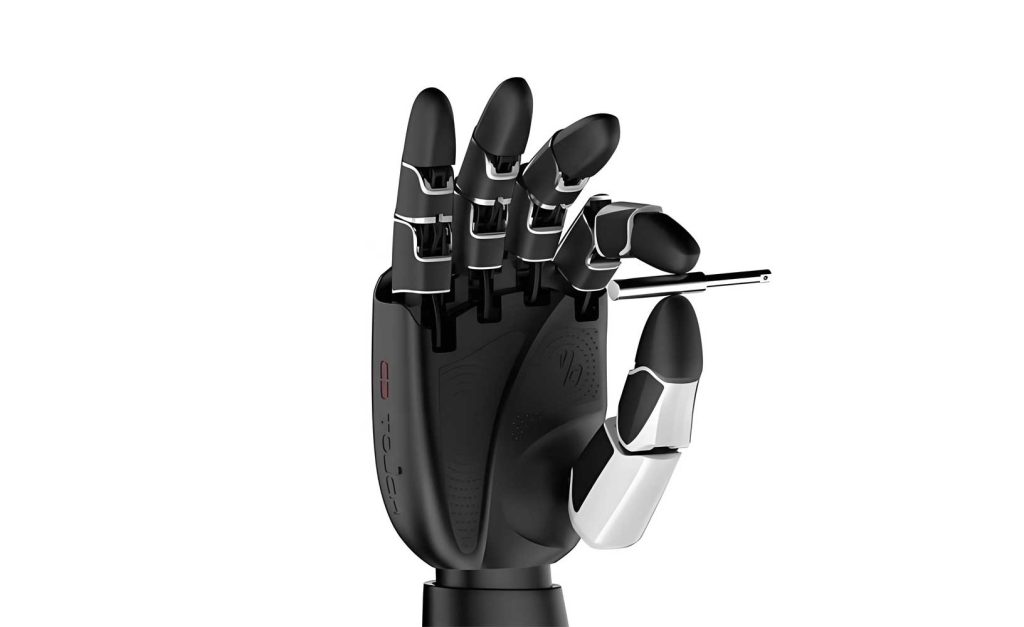
Anatomy of a Dexterous Robotic Hand: Core Technical Subsystems
The engineering of a dexterous robotic hand involves the intricate integration of several interdependent subsystems. Each presents unique challenges and trade-offs between performance, weight, complexity, and robustness.
1. Mechanical Structure and Kinematics
The skeletal design defines the hand’s motion capabilities. Human hand mimicry remains a common approach, typically featuring four fingers with three joints (metacarpophalangeal – MCP, proximal interphalangeal – PIP, distal interphalangeal – DIP) and an opposable thumb with similar complexity. The kinematics of a single finger segment can be modeled. For a simple revolute joint, the transformation from link i-1 to link i is given by the Denavit-Hartenberg parameters:
$$
A_i = Rot_{z, \theta_i} Trans_{z, d_i} Trans_{x, a_i} Rot_{x, \alpha_i}
$$
Where $\theta_i$ is the joint angle, $d_i$ is the link offset, $a_i$ is the link length, and $\alpha_i$ is the link twist. The position of the fingertip in the base frame is then:
$$
P_{fingertip} = A_1 A_2 A_3 … A_n \cdot P_{origin}
$$
However, pure kinematic mimicry often gives way to design optimization for specific tasks. Key structural paradigms include:
- Fully Actuated Hands: Each joint is independently driven by a dedicated actuator. This offers maximum control authority for precise fingertip positioning and independent joint torque control, crucial for sophisticated in-hand manipulation. The trade-off is extreme mechanical complexity, weight, and control difficulty. For n joints, this requires n actuators and associated control channels.
- Underactuated Hands: The number of actuators m is less than the number of degrees of freedom n (m < n). This is achieved through coupling mechanisms (e.g., linkages, tendons, gears) that distribute the force of one actuator across multiple joints. These hands are simpler, lighter, cheaper, and often exhibit passive adaptability, automatically conforming to object shapes. However, they sacrifice independent control of individual joints. The motion is governed by coupling functions. For a tendon-driven two-joint finger:
$$
\theta_2 = k \cdot \theta_1 + c
$$
Where $k$ is a coupling ratio determined by pulley radii or link geometry. - Soft and Hybrid Hands: Utilizing compliant materials (elastomers, fabrics) and fluidic actuation (pneumatics, hydraulics), these hands excel in safe interaction with fragile or irregular objects. They represent a paradigm shift from rigid-body mechanics to continuum mechanics, where deformation itself is the primary mode of action.
| Structural Type | Actuation Principle | Advantages | Disadvantages |
|---|---|---|---|
| Fully Actuated | Independent motor per joint | Maximum dexterity, precise force/position control | High complexity, weight, cost, control challenge |
| Tendon-Driven Underactuated | Cables/pulleys, fewer motors | Lightweight, compact, passive shape adaptation | Cable friction/stretch, coupled motion, less precise control |
| Linkage-Based Underactuated | Mechanical linkages (four-bar, etc.) | Robust, low backlash, deterministic motion | Less adaptable to shape, more complex internal mechanics |
| Soft Robotic | Pneumatic/Hydraulic chambers, material deformation | Inherent safety, excellent conformity, high power density | Difficult modeling/control, slower response, sealing challenges |
2. Actuation and Drive Systems
Actuators are the muscles of the dexterous robotic hand. The choice profoundly impacts its size, weight, force output, speed, and efficiency. The fundamental requirement is high power/weight and power/volume ratios.
- Electric Motors: The most prevalent choice, especially brushless DC (BLDC) and servo motors. They offer good controllability and efficiency. A major challenge is integration; placing high-torque motors in the palm or forearm requires reduction gears, adding bulk and backlash. The torque $\tau$ at a joint is related to motor torque $\tau_m$ and gear ratio $N$:
$$
\tau = N \cdot \tau_m \cdot \eta
$$
where $\eta$ is the gearbox efficiency. Recent trends favor miniaturized, high-torque density motors placed directly in the finger segments (distributed actuation) to eliminate long transmission paths. - Tendon-Driven Systems: Actuators (motors) are placed in the forearm or upper arm, and forces are transmitted to the joints via cables or synthetic tendons. This centralization reduces the hand’s mass and inertia. However, it introduces non-linearities like friction, elasticity, and coupling. The tendon tension $T$ required to produce a joint torque $\tau$ depends on the moment arm $r$:
$$
\tau = r \cdot T
$$
Tendon routing is critical to avoid coupling and ensure positive tension. - Fluidic Actuators: Pneumatic (air) or hydraulic (fluid) actuators, including pneumatic artificial muscles (PAMs) and soft fluidic elastomer actuators. They provide very high force/weight ratios and natural compliance. Hydraulics offer higher power density than pneumatics. The force from a pneumatic cylinder is $F = P \cdot A$, where $P$ is pressure and $A$ is piston area. Control complexity, the need for pumps/valves, and potential leakage are key challenges.
- Advanced and Smart Actuators: This includes Shape Memory Alloys (SMAs), piezoelectric actuators, and Variable Stiffness Actuators (VSAs). VSAs allow independent control of joint position and stiffness, enabling safe interaction and energy storage/release, mimicking human biomechanics. The stiffness $k$ is often modulated by changing the preload of an elastic element.
3. Sensing and Perception
A truly dexterous robotic hand must perceive its state and its environment. Sensing is multi-modal, encompassing proprioception (internal state) and exteroception (external interaction).
Proprioceptive Sensing:
- Joint Position/Velocity: Typically using encoders (optical, magnetic) on motor shafts or at joints.
- Joint Torque/Tendon Tension: Strain gauges on links or in-line load cells measure interaction forces directly.
Exteroceptive (Tactile) Sensing: This is the frontier for creating intelligent hands. The goal is to replicate the dense, multi-modal sensing of human skin (mechanoreceptors).
- Force/Pressure: Using piezoresistive (e.g., conductive elastomers), capacitive, or piezoelectric sensor arrays. They provide 3-axis force vectors at discrete taxels (tactile pixels).
- Shape/Texture: High-density sensor arrays or vision-based sensors (e.g., GelSight, which uses a camera to track deformation of a soft, patterned gel layer) can reconstruct detailed contact geometry and surface features.
- Thermal Sensing: To detect material properties or human touch.
The integration of these sensors generates vast data streams. The sensor output $S(x,y,t)$ is a spatiotemporal signal that must be processed to extract features like slip, contact location, and object stiffness. This feeds directly into the control loop.
| Sensing Modality | Technology Examples | Measured Parameters | Integration Challenge |
|---|---|---|---|
| Joint State | Optical Encoders, Potentiometers | Angle $\theta$, Angular Velocity $\omega$ | Miniaturization, Robust Wiring |
| Direct Force/Torque | Strain Gauges, 6-Axis F/T Sensors | Joint Torque $\tau$, Wrench $W$ | Cross-talk Calibration, Packaging |
| Distributed Tactile | Piezoresistive/Capacitive Arrays, Optical Waveguides | Normal/Shear Force, Pressure Map $P(x,y)$ | High-Density Wiring, Sensor Durability, Signal Processing |
| High-Resolution Shape | Vision-Based (e.g., GelSight), Structured Light | Surface Geometry $\partial S$, Micro-texture | Complex Optics, Real-time Image Processing |
4. Control and Intelligence
This subsystem transforms sensor data and high-level commands into actuator signals to achieve desired behaviors. The control hierarchy for a dexterous robotic hand is multi-layered.
Low-Level Control: Manages individual joints or actuators. Common strategies include:
– Position Control: Drives the joint to a desired angle $\theta_d$. A simple PID controller computes the motor command $u(t)$:
$$
u(t) = K_p e(t) + K_i \int_0^t e(\tau) d\tau + K_d \frac{de(t)}{dt}, \quad e(t) = \theta_d(t) – \theta(t)
$$
– Force/Impedance Control: Regulates the interaction force $F$ or the dynamic relationship between force and position (Impedance $Z(s) = F(s)/X(s)$). This is crucial for safe and compliant contact. In impedance control, the hand behaves like a programmable spring-damper system:
$$
F = K (x_d – x) + B (\dot{x}_d – \dot{x})
$$
where $K$ is stiffness and $B$ is damping.
Mid-Level Control (Grasp & Manipulation Planning): Determines how to configure the hand to achieve a stable grasp or perform an in-hand manipulation (e.g., rolling, sliding). This involves:
– Grasp Synthesis: Calculating optimal contact points and finger postures. Often formulated as an optimization problem maximizing grasp quality metric $Q$ (e.g., based on wrench space):
$$
\text{maximize } Q(\mathbf{p}, \mathbf{c}) \text{ subject to kinematic and force constraints}
$$
where $\mathbf{p}$ are hand postures and $\mathbf{c}$ are contact points.
– Manipulation Primitive Sequencing: Breaking down a complex task like “unscrew a bottle cap” into a sequence of predefined or learned finger motion patterns.
High-Level Control (Perception & Learning): The most active research area, leveraging machine learning to overcome the complexity of analytical modeling.
– Reinforcement Learning (RL): The hand learns control policies through trial-and-error interaction. The policy $\pi(a|s)$ maps state $s$ (sensor readings) to action $a$ (motor commands) to maximize a reward $r$.
– Learning from Demonstration (LfD): Human teleoperation or motion capture provides training data for the hand to imitate complex dexterous skills.
– Vision-Based Control: Fusing visual feedback from external cameras with tactile feedback for object recognition, pose estimation, and servoing.
Technological Trajectory and Future Vectors
Analyzing the evolution reveals clear trajectories. The early phase was dominated by mechanical innovation—creating functional kinematics and actuation. The subsequent period saw the rise of underactuation for practical, adaptive hands. The current era is defined by the integration of rich sensing and cognitive AI to move from grasping to true dexterous manipulation.
The future development of the dexterous robotic hand will likely be propelled by several converging vectors:
- Material Intelligence: Development of new materials with embedded sensing, actuation, and computation (e.g., smart composites, functional polymers) to create “sensitive skins” and lightweight, strong structures.
- Neuromorphic Engineering: Designing sensors and processors that mimic the efficient, event-driven processing of biological nervous systems for ultra-low-latency, low-power tactile feedback and reflex loops.
- Embodied AI and Foundation Models: Training large-scale models on vast datasets of physical interactions (real and simulated) to develop generalizable “common sense” for object manipulation, enabling zero- or few-shot learning of new tasks.
- Human-Robot Symbiosis: Enhancing control through advanced interfaces (e.g., high-fidelity haptic feedback, non-invasive neural interfaces) for seamless teleoperation or collaborative tasks where the dexterous robotic hand acts as a natural extension of the human operator.
- System Integration and Miniaturization: Continued progress in micro-electromechanical systems (MEMS), power electronics, and wireless communication to pack more capability into smaller, more efficient, and fully self-contained form factors.
The ultimate goal is to create a dexterous robotic hand that approaches or even surpasses the human hand in specific operational domains, not through mere imitation, but through synergistic engineering that leverages the strengths of both biological design and artificial systems. This technology holds transformative potential across fields from advanced manufacturing and logistics to healthcare, prosthetics, and space exploration, fundamentally changing how machines interact with the physical world.