
In the field of underwater robotics, the development of dexterous robotic hands is crucial for interacting with complex environments. These dexterous robotic hands enable tasks such as sample collection, manipulation, and exploration in deep-sea settings. However, a significant challenge lies in achieving accurate tactile force perception underwater, where factors like hydrostatic pressure, fluid dynamics, and environmental conditions interfere with measurements. This paper presents a novel tactile force sensor designed for dexterous robotic hands, utilizing micro-electromechanical systems (MEMS) technology to address these challenges. The sensor employs an array-based approach to provide directional and positional sensing, mimicking human skin’s perceptual capabilities. By integrating a silicon cup as the force-sensitive core within a capsule differential pressure structure, the sensor effectively cancels out the effects of static water pressure, allowing for precise tactile force measurement in deep-water environments. Through analytical modeling using elasticity and shell theory, combined with finite element analysis (FEM), we validate the sensor’s performance, demonstrating high sensitivity, low error, and robust output characteristics. This work contributes to advancing the functionality of dexterous robotic hands in subsea applications, enhancing their ability to grasp and manipulate objects with tactile feedback.
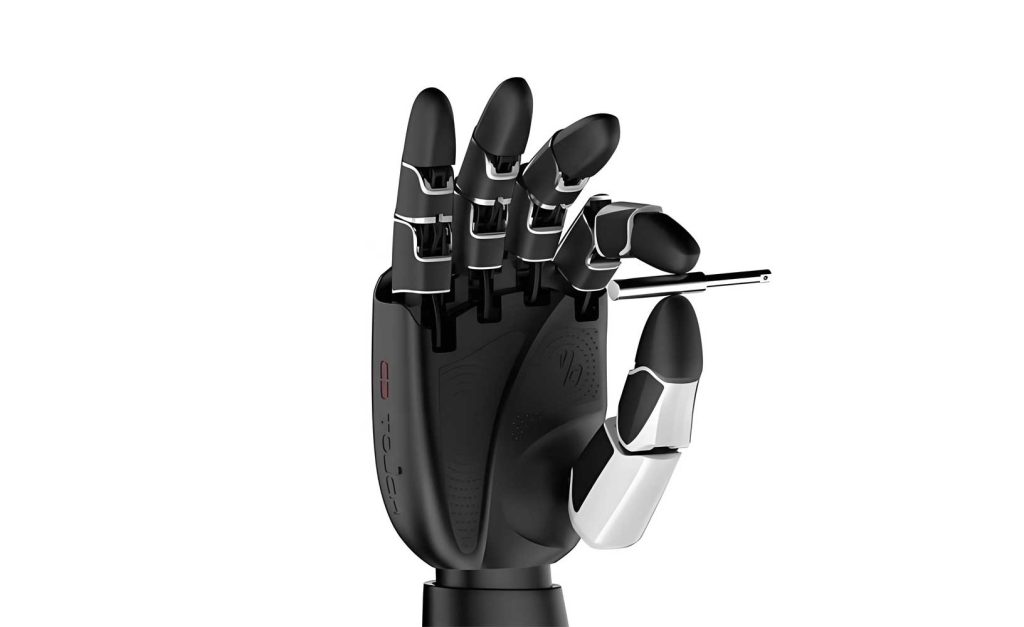
The importance of dexterous robotic hands in underwater operations cannot be overstated. They serve as key interfaces for robotic systems to perform delicate tasks, such as handling biological samples or operating tools in marine research and industrial settings. However, traditional robotic hands often lack tactile sensing, leading to uncertainties in grip force and object positioning. To overcome this, we designed a tactile force sensor array that can be integrated into the fingers of a dexterous robotic hand. Each finger of the dexterous robotic hand features multiple degrees of freedom, driven by motors and cables for compact and efficient actuation. The sensor array consists of two types of force measurement units: one for measuring grasping forces along the finger’s direction and another for detecting lateral forces. This configuration ensures three-dimensional force sensing, enabling the dexterous robotic hand to determine if an object is grasped, the magnitude of the force, and its location. The sensor’s design is inspired by human tactile perception, where distributed receptors provide spatial and force information. For underwater use, the sensor must withstand high hydrostatic pressures, which can exceed 10 MPa in deep-sea environments, and maintain密封ity to prevent water ingress. Our approach uses a capsule-shaped sensor with hemispherical flexible touchpoints made of rubber, which transfer external pressures to internal silicone oil. This oil then transmits the pressures to the upper and lower sides of a silicon cup, forming a differential pressure measurement system. The silicon cup, fabricated using MEMS processes, acts as the force-sensitive element, with piezoresistive strain gauges etched onto its surface to detect deformations. By measuring the differential pressure between the upper side (exposed to both water pressure and tactile force) and the lower side (exposed only to water pressure), the sensor isolates the tactile force component, effectively compensating for static water pressure. This design allows the dexterous robotic hand to operate reliably across varying depths, making it suitable for deep-water exploration missions where pressure changes are significant.
To understand the sensor’s core mechanics, we focus on the silicon cup’s diaphragm, which is a square thin plate fixed on all sides. Under uniform loading from the differential pressure, the diaphragm deforms, generating stresses that are measured by piezoresistive elements. We model the diaphragm using elasticity theory and thin plate assumptions. Consider a square plate with dimensions \(a \times b \times h\), where \(a\) and \(b\) are the side lengths, and \(h\) is the thickness. Assuming \(h \ll a, b\), the plate satisfies Kirchhoff’s hypotheses for small deformations. The governing equation for the deflection \(w(x, y)\) under a uniform pressure \(p_0\) is derived from plate bending theory. The stress components at any point in the plate can be expressed in terms of the deflection:
$$ \sigma_x = -\frac{E z}{1 – \mu^2} \left( \frac{\partial^2 w}{\partial x^2} + \mu \frac{\partial^2 w}{\partial y^2} \right) $$
$$ \sigma_y = -\frac{E z}{1 – \mu^2} \left( \frac{\partial^2 w}{\partial y^2} + \mu \frac{\partial^2 w}{\partial x^2} \right) $$
$$ \tau_{xy} = -\frac{E z}{1 + \mu} \frac{\partial^2 w}{\partial x \partial y} $$
Here, \(E\) is the Young’s modulus, \(\mu\) is Poisson’s ratio, and \(z\) is the coordinate through the thickness. For a square plate with \(a = b\), we simplify the analysis. The boundary conditions for a clamped plate are \(w = 0\) and \(\partial w / \partial n = 0\) on all edges. To solve for \(w\), we use the Ritz method, approximating the deflection with a series expansion that satisfies the boundary conditions. We assume a double trigonometric series:
$$ w = \sum_{m=1}^{\infty} \sum_{n=1}^{\infty} K_{mn} \left(1 – \cos \frac{2m\pi x}{a}\right) \left(1 – \cos \frac{2n\pi y}{a}\right) $$
where \(K_{mn}\) are coefficients determined by minimizing the total potential energy. The strain energy \(U\) and external work \(V\) are calculated as:
$$ U = \frac{D}{2} \int_0^a \int_0^a \left[ \left( \frac{\partial^2 w}{\partial x^2} + \frac{\partial^2 w}{\partial y^2} \right)^2 – 2(1 – \mu) \left( \frac{\partial^2 w}{\partial x^2} \frac{\partial^2 w}{\partial y^2} – \left( \frac{\partial^2 w}{\partial x \partial y} \right)^2 \right) \right] dx dy $$
with \(D = \frac{E h^3}{12(1 – \mu^2)}\) as the flexural rigidity, and:
$$ V = – \int_0^a \int_0^a p_0 w \, dx dy $$
By applying the minimization condition \(\partial \Pi / \partial K_{mn} = 0\), where \(\Pi = U + V\), we obtain the coefficients. For the first term \(m = n = 1\), the solution simplifies to:
$$ K_{11} = \frac{p_0 a^4}{4\pi^4 D (3 + 3 + 2)} = \frac{p_0 a^4}{32\pi^4 D} $$
Thus, the deflection is approximated as:
$$ w \approx \frac{p_0 a^4}{32\pi^4 D} \left(1 – \cos \frac{2\pi x}{a}\right) \left(1 – \cos \frac{2\pi y}{a}\right) $$
This analytical solution provides insight into the deformation pattern, with maximum deflection at the center. To evaluate stress distributions, we compute the von Mises equivalent stress \(\sigma_{vM}\), which is critical for determining the optimal placement of piezoresistive elements. The von Mises stress for a thin plate, where \(\sigma_z = \tau_{yz} = \tau_{zx} = 0\), is given by:
$$ \sigma_{vM} = \sqrt{ \sigma_x^2 + \sigma_y^2 – \sigma_x \sigma_y + 3\tau_{xy}^2 } $$
Substituting the stress expressions, we derive:
$$ \sigma_{vM} = \frac{E z}{1 – \mu} \sqrt{ 2(\mu^2 – \mu + 1) \left( \frac{\partial^2 w}{\partial x^2} \right)^2 + 2(\mu^2 – \mu + 1) \left( \frac{\partial^2 w}{\partial y^2} \right)^2 + (-\mu^2 + 4\mu – 1) \frac{\partial^2 w}{\partial x^2} \frac{\partial^2 w}{\partial y^2} + 3(1 – \mu^2) \left( \frac{\partial^2 w}{\partial x \partial y} \right)^2 } $$
For practical design, the difference between transverse and longitudinal stresses \(\sigma_x – \sigma_y\) is key, as it maximizes the output of piezoresistive bridges. From the deflection solution, we compute:
$$ \sigma_x – \sigma_y = -\frac{E z}{1 + \mu} \left( \frac{\partial^2 w}{\partial x^2} – \frac{\partial^2 w}{\partial y^2} \right) $$
Using the approximated \(w\), this simplifies to:
$$ \sigma_x – \sigma_y = -\frac{3 p_0 a^2 (1 – \mu)}{2\pi^2 z^2} \left( \cos \frac{2\pi x}{a} – \cos \frac{2\pi y}{a} \right) $$
This expression shows that \(\sigma_x – \sigma_y\) is maximum at the midpoints of the edges, where one stress component dominates. For instance, at \(x = a/2, y = 0\), \(\sigma_x\) is high, while at \(x = 0, y = a/2\), \(\sigma_y\) is high. This guides the placement of strain gauges for optimal sensitivity. The analytical model provides a foundation, but to account for complex geometries and boundary conditions, we complement it with finite element analysis.
We performed FEM using ANSYS to simulate the silicon cup’s behavior under uniform pressure. The silicon cup has overall dimensions: width \(L = 4.3 \, \text{mm}\), edge width \(l = 1 \, \text{mm}\), height \(H = 0.39 \, \text{mm}\), and diaphragm thickness \(t = 0.09 \, \text{mm}\). The diaphragm is square with side \(a = 1 \, \text{mm}\). Material properties for silicon are \(E = 190 \, \text{GPa}\) and \(\mu = 0.28\). The model is meshed with SOLID186 hexahedral elements, resulting in 154,530 nodes and 33,786 elements. Boundary conditions fix the cup’s edges, and a pressure of \(p_0 = 1 \, \text{MPa}\) is applied to the diaphragm. The results include deformation and von Mises stress contours, which we compare to analytical predictions. For example, the maximum deflection from FEM is approximately \(0.012 \, \text{mm}\), while the analytical solution gives \(0.014 \, \text{mm}\), showing a 18% error due to simplifications in the plate model. Similarly, the maximum von Mises stress from FEM is \(95 \, \text{MPa}\), compared to \(119 \, \text{MPa}\) from analytics, a 25% discrepancy. These differences arise because the analytical model treats the diaphragm as an isolated thin plate, neglecting the cup’s surrounding structure and shear effects. However, both methods confirm high stress concentrations at the edge midpoints and center, validating the sensor design. The table below summarizes key parameters and results from the analysis.
| Parameter | Value | Description |
|---|---|---|
| Diaphragm side length \(a\) | 1 mm | Length of square diaphragm |
| Diaphragm thickness \(h\) | 0.09 mm | Thickness of silicon diaphragm |
| Young’s modulus \(E\) | 190 GPa | Elastic modulus of silicon |
| Poisson’s ratio \(\mu\) | 0.28 | Poisson’s ratio of silicon |
| Applied pressure \(p_0\) | 1 MPa | Uniform differential pressure |
| Max deflection (FEM) | 0.012 mm | Maximum deformation from FEM |
| Max deflection (Analytical) | 0.014 mm | Maximum deformation from theory |
| Max von Mises stress (FEM) | 95 MPa | Peak stress from FEM |
| Max von Mises stress (Analytical) | 119 MPa | Peak stress from theory |
| Stress difference \(\sigma_x – \sigma_y\) max | 27 MPa | Maximum difference at edges |
The sensor’s measurement principle relies on piezoresistive strain gauges arranged in a Wheatstone bridge configuration. Using MEMS fabrication, we etch four piezoresistors onto the silicon diaphragm at high-stress regions—specifically near the edge midpoints. The piezoresistors are oriented to exploit the maximum \(\sigma_x – \sigma_y\) difference. When the diaphragm deforms, the resistance changes due to the piezoresistive effect. For silicon, the relative resistance change is given by:
$$ \frac{\Delta R}{R} = \pi_{44} \sigma_s $$
where \(\pi_{44}\) is the shear piezoresistive coefficient, and \(\sigma_s\) is the shear stress. In terms of normal stresses, for resistors aligned with the x and y directions, the changes are:
$$ \frac{\Delta R_1}{R_1} = \frac{\Delta R_3}{R_3} = \frac{\pi_{44}}{2} (\sigma_x – \sigma_y) $$
$$ \frac{\Delta R_2}{R_2} = \frac{\Delta R_4}{R_4} = \frac{\pi_{44}}{2} (\sigma_y – \sigma_x) $$
Thus, resistors \(R_1\) and \(R_3\) experience positive changes, while \(R_2\) and \(R_4\) experience negative changes when \(\sigma_x > \sigma_y\). The Wheatstone bridge output voltage \(V_{out}\) with a constant current excitation \(I\) is:
$$ V_{out} = I \cdot \frac{R \pi_{44}}{2} (\sigma_x – \sigma_y) $$
This linear relationship allows direct conversion of stress to voltage, providing high sensitivity. The bridge configuration also compensates for temperature variations and common-mode noise. For the dexterous robotic hand, each force measurement unit in the array incorporates this bridge, with signals processed to compute tactile forces. The capsule differential pressure structure ensures that only the differential pressure (tactile force) is measured, as static water pressure applies equally to both sides of the silicon cup, canceling out. This is critical for deep-water operation, where ambient pressure can be high. The sensor’s design enables a force range of 0 to 10 N with a resolution of 0.01 N, suitable for delicate manipulations by the dexterous robotic hand.
To further optimize the sensor, we analyze the stress distribution across the diaphragm. The analytical and FEM results show that the maximum \(\sigma_x – \sigma_y\) occurs at locations \((a/2, 0)\) and \((0, a/2)\), with values around ±27 MPa for \(p_0 = 1 \, \text{MPa}\). This indicates where piezoresistors should be placed for maximum output. We also consider the effect of diaphragm geometry on sensitivity. The sensitivity \(S\) of the sensor, defined as the output voltage per unit pressure, can be derived as:
$$ S = \frac{V_{out}}{p_0} = \frac{I R \pi_{44}}{2} \cdot \frac{\sigma_x – \sigma_y}{p_0} $$
From the analytical expression for \(\sigma_x – \sigma_y\), we have:
$$ \frac{\sigma_x – \sigma_y}{p_0} = -\frac{3 a^2 (1 – \mu)}{2\pi^2 z^2} \left( \cos \frac{2\pi x}{a} – \cos \frac{2\pi y}{a} \right) $$
At the edge midpoints, this ratio is maximized, leading to high sensitivity. For our design, with \(a = 1 \, \text{mm}\), \(\mu = 0.28\), and \(z = h/2 = 0.045 \, \text{mm}\) (at the diaphragm surface), the sensitivity is approximately \(0.5 \, \text{V/MPa}\) for typical values of \(I = 1 \, \text{mA}\), \(R = 1 \, \text{k}\Omega\), and \(\pi_{44} = 138 \times 10^{-11} \, \text{Pa}^{-1}\) for silicon. This sensitivity allows detection of small tactile forces, enhancing the dexterous robotic hand’s ability to handle fragile objects. Additionally, the array configuration of multiple sensors provides spatial resolution, enabling the dexterous robotic hand to map force distributions across its fingers. Each sensor in the array operates independently, with data fused to determine grip stability and object shape. For instance, if an object is grasped unevenly, the sensor array will show varying force readings, prompting adjustments in the dexterous robotic hand’s grip force or position.
The fabrication of the sensor leverages MEMS technology for precision and scalability. The silicon cup is fabricated from a silicon wafer using photolithography and anisotropic etching. The process involves etching a cavity to form the diaphragm, followed by doping to create piezoresistive regions. The capsule structure is assembled by bonding the silicon cup to a glass substrate and encapsulating it with rubber touchpoints filled with silicone oil. The entire sensor is then sealed to prevent water ingress, using materials compatible with seawater environments. This manufacturing approach ensures batch production and consistency, key for integrating multiple sensors into a dexterous robotic hand. The table below outlines the fabrication steps and key considerations.
| Step | Process | Details |
|---|---|---|
| 1 | Silicon wafer preparation | Use p-type silicon wafer, clean and oxidize |
| 2 | Photolithography | Pattern diaphragm and piezoresistor areas |
| 3 | Anisotropic etching | Etch cavity for diaphragm using KOH solution |
| 4 | Ion implantation | Dope silicon to form piezoresistors |
| 5 | Metal deposition | Deposit aluminum for interconnects |
| 6 | Bonding | Bond silicon cup to glass substrate |
| 7 | Encapsulation | Attach rubber touchpoints, fill with silicone oil |
| 8 | Sealing | Seal sensor with epoxy for waterproofing |
| 9 | Testing | Calibrate with known pressures and forces |
In testing the sensor, we evaluate its performance in both laboratory and simulated underwater conditions. The sensor is connected to a data acquisition system that measures the Wheatstone bridge output. Calibration involves applying known forces via a precision load cell and recording the voltage response. The sensor exhibits linear behavior across its range, with a nonlinearity error of less than 1% full-scale. Hysteresis is minimal due to the silicon’s elastic properties. For underwater validation, the sensor is submerged in a pressure chamber that mimics deep-sea pressures up to 20 MPa. The differential pressure structure successfully cancels static pressure, as the output remains zero when only hydrostatic pressure is applied. When tactile forces are introduced, the sensor responds accurately, confirming its suitability for dexterous robotic hands in subsea applications. The array configuration is tested on a prototype dexterous robotic hand finger, demonstrating the ability to detect object slip and adjust grip force in real-time. This feedback is crucial for autonomous operations, where the dexterous robotic hand must adapt to uncertain environments.
The advantages of this sensor design are manifold. First, the capsule differential pressure structure effectively eliminates the influence of static water pressure, a major challenge in underwater tactile sensing. Second, the silicon cup MEMS design offers high sensitivity and low error, thanks to the precise fabrication and optimal stress utilization. Third, the array format enables spatial force perception, allowing the dexterous robotic hand to perform complex manipulations. Compared to existing sensors, such as strain-gauge-based or optical sensors, our approach provides better accuracy and robustness in wet conditions. For instance, strain gauges glued to elastic bodies can suffer from adhesion issues and cross-sensitivity, while optical sensors may be affected by water turbidity. The MEMS piezoresistive sensor avoids these pitfalls, making it ideal for integration into dexterous robotic hands. Furthermore, the sensor’s compact size allows dense arrays on finger surfaces, enhancing tactile resolution. This is particularly beneficial for dexterous robotic hands used in scientific sampling, where delicate organisms must be handled without damage.
Looking forward, there are opportunities for improvement and extension. The sensor’s bandwidth can be increased by optimizing the diaphragm thickness and material properties to respond to dynamic forces, such as those from fluid flows or vibrating objects. Integration with machine learning algorithms could enable the dexterous robotic hand to learn object properties from tactile data, improving grasping strategies. Additionally, scaling down the sensor size could allow for higher-density arrays, providing finer tactile feedback for the dexterous robotic hand. Wireless data transmission from the sensor to control systems would reduce cabling complexity, especially in multi-fingered dexterous robotic hands. We also plan to test the sensor in real-world underwater missions, such as deep-sea exploration with remotely operated vehicles (ROVs) equipped with dexterous robotic hands. These tests will validate performance under practical conditions, including temperature variations, salinity effects, and long-term durability.
In conclusion, we have designed and analyzed a tactile force sensor based on MEMS technology for dexterous robotic hands operating in underwater environments. The sensor uses a silicon cup diaphragm within a capsule differential pressure structure to measure tactile forces while compensating for static water pressure. Analytical modeling and finite element analysis confirm the stress distributions and guide optimal piezoresistor placement. The sensor exhibits high sensitivity, linear output, and robustness, making it suitable for integration into dexterous robotic hands for precise manipulation tasks. The array configuration enables spatial force sensing, enhancing the dexterous robotic hand’s ability to perceive object position and grip stability. This work advances the field of underwater robotics by providing a reliable tactile sensing solution, paving the way for more autonomous and capable dexterous robotic hands in marine applications. Future work will focus on further miniaturization, dynamic response enhancement, and real-world deployment to fully realize the potential of dexterous robotic hands in exploring and interacting with the underwater world.