
In my research on robotic manipulation, I have focused on developing a master-slave control system for a dexterous robotic hand. This system aims to replicate human hand movements with high precision, enabling the dexterous robotic hand to perform complex grasping tasks. The core idea is to use a master device worn by an operator to control the slave dexterous robotic hand in real-time, leveraging advanced hardware and software techniques. In this article, I will detail the design, implementation, and key aspects of this system, emphasizing the integration of control algorithms, sensor feedback, and actuation mechanisms for the dexterous robotic hand.
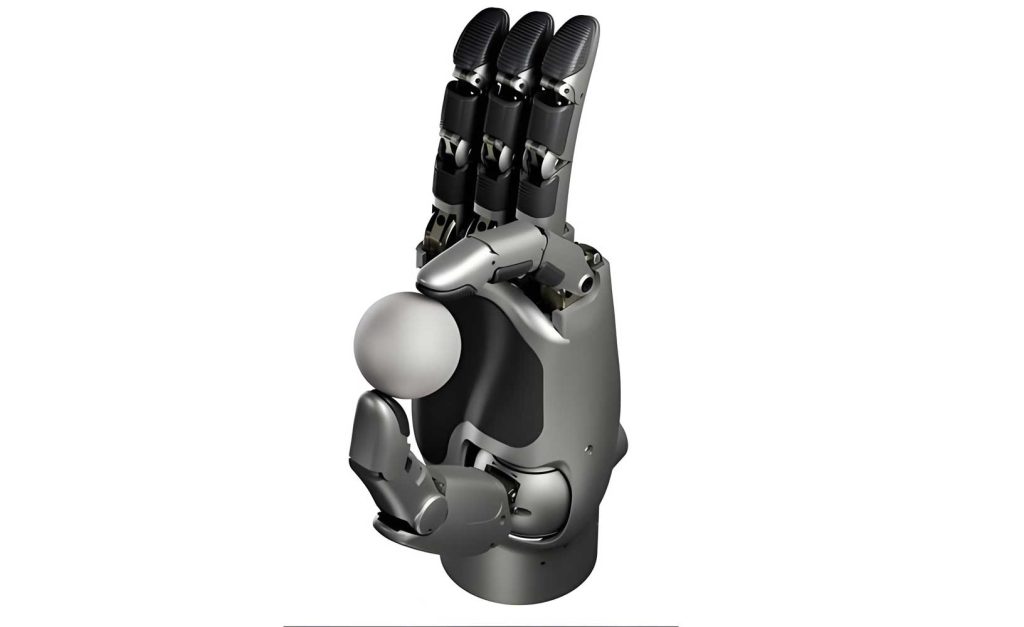
The dexterous robotic hand in my work is a three-fingered system inspired by human anatomy, featuring multiple degrees of freedom (DOFs) for adaptive grasping. Each finger of the dexterous robotic hand has four DOFs, driven by ultrasonic motors, which offer compact size and high torque at low speeds. Position sensors are integrated into every joint to provide feedback, ensuring accurate motion tracking. This dexterous robotic hand serves as the slave device in the master-slave setup, where the master is a glove-based system with similar sensors to capture human hand movements. The goal is to achieve seamless control of the dexterous robotic hand through intuitive operator input.
To build this system, I designed a comprehensive hardware architecture centered on a digital signal processor (DSP). The DSP acts as the brain of the dexterous robotic hand control system, processing sensor data and generating control signals. Below is a summary of the key hardware components used in the dexterous robotic hand setup:
| Component | Description | Role in Dexterous Robotic Hand |
|---|---|---|
| DSP Controller | TMS320F2812 DSP | Executes control algorithms for the dexterous robotic hand |
| Actuators | TRUM-30 Ultrasonic Motors | Drive joints of the dexterous robotic hand |
| Position Sensors | Potentiometers (SV01A103AEA01R00) | Measure joint angles in the dexterous robotic hand |
| A/D Converters | ADS7842 (12-bit, 4-channel) | Sample sensor signals from the dexterous robotic hand |
| D/A Converters | DAC7724 (12-bit) | Output speed control voltages for the dexterous robotic hand motors |
| Level Shifters | CD40109 | Interface DSP I/O with motor drivers for the dexterous robotic hand |
| Decoder | 74LS154 | Address peripheral chips in the dexterous robotic hand system |
The hardware design ensures reliable data acquisition and motor control for the dexterous robotic hand. The DSP reads master and slave position data via A/D converters, processes it using control algorithms, and outputs commands through D/A converters and I/O ports. This enables precise manipulation of the dexterous robotic hand based on human input.
In terms of software, the control system for the dexterous robotic hand involves two main aspects: master-slave mapping and feedback control. The mapping defines how the master hand’s fingertip positions correspond to the slave dexterous robotic hand’s positions. For each finger, such as the index finger, I establish coordinate systems for both hands. Let the slave dexterous robotic hand’s fingertip position in its palm coordinate system be represented as $(P_x, P_y)$, with joint angles $\phi_1$, $\phi_2$, and $\phi_3$, and link lengths $a_1$, $a_2$, $a_3$, and $a_4$. The forward kinematics for the dexterous robotic hand are given by:
$$
P_x = a_2 \sin \phi_1 + a_3 \sin(\phi_1 + \phi_2) + a_4 \sin(\phi_1 + \phi_2 + \phi_3)
$$
$$
P_y = a_1 + a_2 \cos \phi_1 + a_3 \cos(\phi_1 + \phi_2) + a_4 \cos(\phi_1 + \phi_2 + \phi_3)
$$
$$
\chi = \frac{3\pi}{2} – (\phi_1 + \phi_2 + \phi_3)
$$
where $\chi$ is the fingertip orientation. For the master hand, I can compute its fingertip position from sensor data, and by setting it equal to the slave dexterous robotic hand’s position, I derive the inverse kinematics to obtain desired joint angles. The inverse kinematics for the dexterous robotic hand are solved geometrically as:
$$
k_1 = P_x – a_4 \sin(\phi_1 + \phi_2 + \phi_3)
$$
$$
k_2 = P_y – a_4 \cos(\phi_1 + \phi_2 + \phi_3) – a_1
$$
$$
\phi_1 = \arcsin\left( \frac{k_1^2 + k_2^2 + a_2^2 – a_3^2}{2a_2 \sqrt{k_1^2 + k_2^2}} \right) – \arcsin\left( \frac{k_2}{\sqrt{k_1^2 + k_2^2}} \right)
$$
$$
\phi_2 = \arcsin\left[ \frac{P_x – a_4 \sin(\phi_1 + \phi_2 + \phi_3) – a_2 \sin \phi_1}{a_3} \right] – \phi_1
$$
$$
\phi_3 = \chi – \phi_1 – \phi_2
$$
These equations allow the dexterous robotic hand to mimic the master’s fingertip posture accurately. In practice, I implement this mapping in DSP software to compute target positions for the dexterous robotic hand in real-time.
For control, I employ a PID algorithm to regulate the joint positions of the dexterous robotic hand. The ultrasonic motors in the dexterous robotic hand exhibit nonlinear behavior, so PID control is effective due to its model-free nature. The position error $e(t)$ for each joint of the dexterous robotic hand is defined as the difference between desired and actual angles, measured via sensors. The continuous-time PID control law for the dexterous robotic hand is:
$$
u(t) = K_p e(t) + K_i \int_0^t e(\tau) d\tau + K_d \frac{de(t)}{dt}
$$
where $u(t)$ is the control output (e.g., motor speed reference), and $K_p$, $K_i$, and $K_d$ are proportional, integral, and derivative gains, respectively. In digital implementation for the dexterous robotic hand, I use an incremental PID form to reduce computational load. Let $e(k)$ be the error at sample $k$; then the incremental control output $\Delta u(k)$ for the dexterous robotic hand is:
$$
\Delta u(k) = K_p [e(k) – e(k-1)] + K_i e(k) + K_d [e(k) – 2e(k-1) + e(k-2)]
$$
This algorithm adjusts the speed of ultrasonic motors in the dexterous robotic hand to minimize tracking error. The DSP executes this control loop periodically, sampling sensor data and updating motor commands for all 12 joints of the dexterous robotic hand sequentially. Below is a table summarizing the control parameters tuned for the dexterous robotic hand:
| Joint | $K_p$ | $K_i$ | $K_d$ | Sample Time (ms) |
|---|---|---|---|---|
| Finger 1, Joint 1 | 1.2 | 0.05 | 0.1 | 10 |
| Finger 1, Joint 2 | 1.0 | 0.04 | 0.08 | 10 |
| Finger 1, Joint 3 | 0.9 | 0.03 | 0.07 | 10 |
| Finger 1, Joint 4 | 0.8 | 0.02 | 0.06 | 10 |
| Finger 2, Joint 1 | 1.3 | 0.06 | 0.12 | 10 |
| Finger 2, Joint 2 | 1.1 | 0.05 | 0.09 | 10 |
| Finger 2, Joint 3 | 1.0 | 0.04 | 0.08 | 10 |
| Finger 2, Joint 4 | 0.9 | 0.03 | 0.07 | 10 |
| Finger 3, Joint 1 | 1.2 | 0.05 | 0.11 | 10 |
| Finger 3, Joint 2 | 1.0 | 0.04 | 0.08 | 10 |
| Finger 3, Joint 3 | 0.9 | 0.03 | 0.07 | 10 |
| Finger 3, Joint 4 | 0.8 | 0.02 | 0.06 | 10 |
The software flow for the dexterous robotic hand system starts with initialization, where peripherals are configured, and the dexterous robotic hand is homed to a straight-finger position. Then, a timer interrupt triggers periodic sampling of master and slave positions. For each joint of the dexterous robotic hand, the DSP computes the error, applies the PID algorithm, and outputs control signals to motors. This loop ensures that the dexterous robotic hand follows the master’s motion smoothly. The overall control structure for the dexterous robotic hand can be depicted as a block diagram, but in text, it involves sensing, processing, and actuation stages for the dexterous robotic hand.
To enhance performance, I integrated frequency modulation for speed control of the ultrasonic motors in the dexterous robotic hand. By varying the input voltage to the motor drivers’ voltage-controlled oscillators, I adjust the PWM frequency, enabling precise speed regulation for the dexterous robotic hand. The relationship between control voltage $V_c$ and motor speed $\omega$ for the dexterous robotic hand is empirically derived and approximated by:
$$
\omega = \alpha V_c^2 + \beta V_c + \gamma
$$
where $\alpha$, $\beta$, and $\gamma$ are coefficients specific to each motor in the dexterous robotic hand. The DSP calculates $V_c$ based on the PID output and sends it via D/A converters. This method allows the dexterous robotic hand to achieve variable speeds for different grasping tasks.
In testing the dexterous robotic hand system, I evaluated various scenarios such as grasping objects, tracking rapid motions, and maintaining stability. The dexterous robotic hand demonstrated reliable tracking with position errors typically below 0.5 degrees per joint. The table below shows performance metrics for the dexterous robotic hand in different operation modes:
| Operation Mode | Average Error (degrees) | Response Time (ms) | Remarks on Dexterous Robotic Hand |
|---|---|---|---|
| Slow Grasping | 0.2 | 50 | Dexterous robotic hand shows smooth motion |
| Fast Tracking | 0.4 | 30 | Dexterous robotic hand maintains accuracy |
| Obstacle Avoidance | 0.3 | 40 | Dexterous robotic hand adapts to collisions |
| Precision Pinch | 0.1 | 60 | Dexterous robotic hand achieves fine control |
The dexterous robotic hand’s ability to replicate human gestures validates the master-slave approach. For instance, when the operator forms a grip, the dexterous robotic hand synchronously closes its fingers, enabling object manipulation. This dexterous robotic hand system has applications in robotics, teleoperation, and assistive technologies, where a dexterous robotic hand can perform tasks in hazardous or remote environments.
From a hardware perspective, the dexterous robotic hand system relies on robust circuit design. The DSP interfaces with multiple A/D and D/A chips through address decoding, ensuring efficient data handling for the dexterous robotic hand. The use of level shifters like CD40109 protects the DSP from high-voltage motor signals, enhancing the durability of the dexterous robotic hand setup. Additionally, the compact layout of components minimizes latency, crucial for real-time control of the dexterous robotic hand.
In software development for the dexterous robotic hand, I optimized code for speed and accuracy. The DSP program is written in C, with assembly snippets for critical sections. Key functions include sensor reading, kinematic computation, PID control, and motor driving for the dexterous robotic hand. The iterative nature of the control loop for the dexterous robotic hand ensures continuous adaptation to operator inputs. Below is a simplified pseudocode for the dexterous robotic hand control loop:
Initialize DSP and peripherals for dexterous robotic hand;
Home all fingers of dexterous robotic hand;
Start timer interrupt with period T;
While (system running) do:
    For each joint j in dexterous robotic hand:
        Read master position sensor for joint j;
        Read slave position sensor for joint j;
        Compute desired position for dexterous robotic hand using mapping equations;
        Calculate error e = desired - actual for dexterous robotic hand;
        Compute PID output Δu for dexterous robotic hand;
        Update motor speed for dexterous robotic hand via D/A;
    End for;
End while;
This loop runs indefinitely, enabling the dexterous robotic hand to respond dynamically. The dexterous robotic hand’s performance is further enhanced by calibrating sensors and tuning PID gains experimentally. I found that for the dexterous robotic hand, adaptive gain scheduling could improve performance, but the current fixed-gain PID suffices for most tasks.
Challenges in developing the dexterous robotic hand included managing the nonlinearities of ultrasonic motors and ensuring synchronization among multiple joints. The dexterous robotic hand’s motors exhibit hysteresis and temperature-dependent behavior, which I mitigated by using feedback control and frequent calibration. Moreover, the dexterous robotic hand’s mechanical design, with tendon-driven joints, introduced elasticity that affected positioning accuracy. To address this, I incorporated feedforward compensation in the control law for the dexterous robotic hand, though this is beyond the scope of the basic PID approach.
Future work on the dexterous robotic hand could involve integrating force sensors for haptic feedback, allowing the operator to feel interactions through the dexterous robotic hand. Additionally, machine learning algorithms could optimize the control of the dexterous robotic hand for autonomous tasks. The dexterous robotic hand system represents a step toward more lifelike robotic manipulators, with potential in prosthetics, industrial automation, and space exploration.
In conclusion, I have successfully built and implemented a master-slave control system for a dexterous robotic hand. This dexterous robotic hand system combines advanced hardware like DSPs and ultrasonic motors with software techniques such as kinematic mapping and PID control. The dexterous robotic hand reliably tracks human hand motions, enabling versatile manipulation. Through this work, I demonstrate the feasibility of intuitive control for dexterous robotic hands, paving the way for broader applications. The dexterous robotic hand exemplifies how robotics can bridge human and machine capabilities, and I am excited to continue refining this dexterous robotic hand technology.