
The successful execution of prehensile tasks by a dexterous robotic hand within its workspace fundamentally depends on the precise and coordinated movement of its fingertip end-effectors. These fingertips must navigate along specific spatial paths to reach their target positions relative to the object being grasped. Consequently, effective trajectory planning is paramount, directly influencing the smoothness, safety, operational efficiency, and accuracy of the dexterous robotic hand‘s manipulation actions. In this article, I will explore methodologies for generating such trajectories, focusing specifically on planning within the joint space using a computationally efficient and smooth interpolation technique.
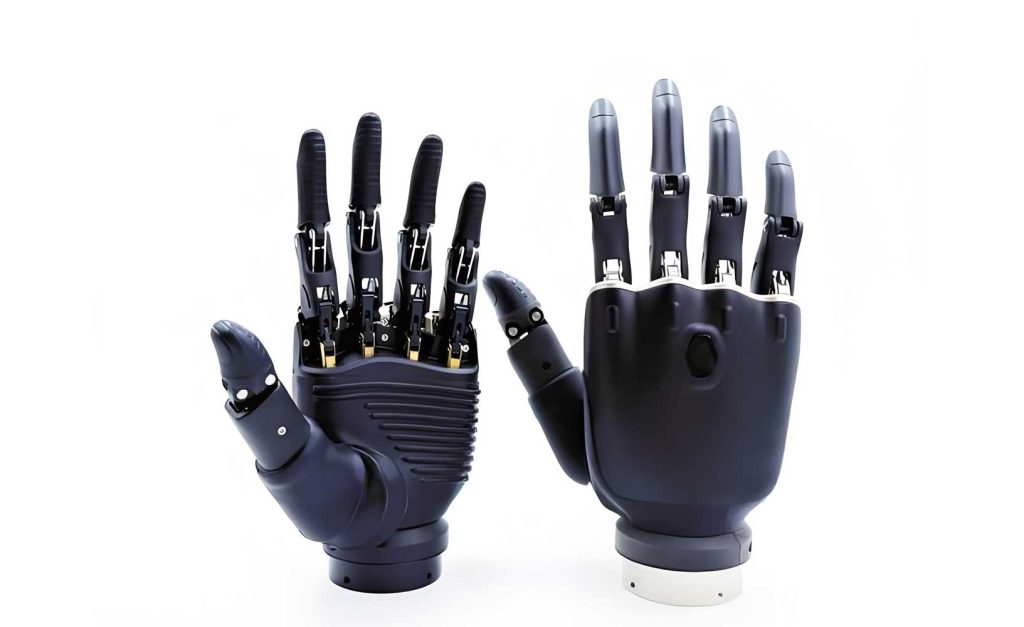
The mechanical architecture of a multi-fingered dexterous robotic hand typically features several independently actuated fingers, each with multiple degrees of freedom. A common design involves three fingers, with each finger possessing three joints driven by individual motors. To enhance its adaptability, the hand might incorporate additional degrees of freedom, such as the abduction/adduction of the outer fingers or a rotating wrist joint. These features collectively expand the operational workspace and enable a wider variety of grasps. Many advanced dexterous robotic hand designs utilize tendon-driven transmission systems with compact DC motors, which help minimize the structural footprint while maximizing the hand’s inherent flexibility and range of motion.
Trajectory planning is the process by which a robotic system, such as a dexterous robotic hand, determines a motion scheme to accomplish a given task. The ultimate objective is to compute a reasonable motion algorithm to control the hand’s operational sequence. In essence, the robot’s work process involves transforming a high-level task description into desired motions and forces through planning. The control system then uses this information to issue appropriate commands to the actuators. Therefore, trajectory planning must be grounded in kinematics and dynamics, focusing on the methods for planning and generating motion within the joint space. While planning is an application of kinematics, the resulting trajectories significantly impact the dynamic performance. Users can describe a desired path for the dexterous robotic hand, allowing the controller to determine the path to a target, along with parameters like velocity, acceleration, and duration. This information is then processed to generate the corresponding motion control signals.
Methods of Trajectory Planning
The trajectory planning problem can be approached in two primary domains: joint space and Cartesian (operational) space. Joint space trajectory planning involves expressing each joint variable as a function of time and computing its first and second derivatives (velocity and acceleration). Cartesian space trajectory planning defines path constraints directly in the Cartesian coordinate system of the end-effector. However, since path constraints are naturally defined in Cartesian space while joint actuators operate in their own coordinate space, planning in Cartesian space necessitates a transformation of these constraints into joint coordinates via inverse kinematics. For the purposes of this discussion, I will focus on planning within the joint space, as it often leads to simpler, more computationally direct solutions for point-to-point motion.
Trajectory Planning in Finger Joint Space
When a dexterous robotic hand performs a grasping motion, its fingertips follow a specific spatial trajectory from an initial point to a target point. To realize this, the desired joint angles are first obtained through inverse kinematics calculations. The core of joint space planning is then to find a smooth, time-parameterized function for each joint that guides it from its start value, potentially through intermediate via-points, to its final value.
A naive approach would be to use a simple linear interpolation function connecting the start and end points. However, this results in a constant velocity segment, implying a discontinuous jump in velocity at the boundaries (from zero to a constant value and back to zero). This discontinuity translates to theoretically infinite acceleration at the start and end points, which is physically unrealistic for a dexterous robotic hand and can cause vibration, wear, and control instability.
To address this, I employ a method known as linear interpolation with parabolic blends. This technique connects the start and end points with a straight-line segment but blends into and out of this segment using parabolic arcs. Within these parabolic blend regions, a constant acceleration is applied to smoothly ramp the velocity up from zero and down to zero, ensuring continuity in both position and velocity throughout the entire trajectory. The following figure illustrates this concept for a single segment.
$$ \text{Position } q(t) =
\begin{cases}
q_0 + \frac{1}{2}\ddot{q}_b t^2, & 0 \leq t \leq t_b \\
q_0 + \frac{1}{2}\ddot{q}_b t_b^2 + \dot{q}_{bl} (t – t_b), & t_b < t < t_f – t_b \\
q_f – \frac{1}{2}\ddot{q}_b (t_f – t)^2, & t_f – t_b \leq t \leq t_f
\end{cases}
$$
Where:
- $q_0$ and $q_f$ are the initial and final joint positions.
- $t_f$ is the total trajectory time.
- $t_b$ is the duration of one parabolic blend region.
- $\ddot{q}_b$ is the magnitude of the constant acceleration/deceleration during the blend.
- $\dot{q}_{bl}$ is the constant velocity during the linear segment.
For simplicity, I assume the duration and magnitude of acceleration are equal for the initial and final parabolic blends. The trajectory is symmetric about the midpoint $t_f/2$. Enforcing velocity continuity at the blend points ($t_b$ and $t_f – t_b$) yields the key relationship.
The velocity during the linear segment is given by:
$$ \dot{q}_{bl} = \frac{\ddot{q}_b t_b}{1} = \ddot{q}_b t_b $$
The position at the end of the first blend is:
$$ q(t_b) = q_0 + \frac{1}{2} \ddot{q}_b t_b^2 $$
The total displacement must equal the sum of displacements in the three segments. Noting that the time at the middle point $t_h = t_f/2$ and the position $q_h = (q_0 + q_f)/2$, we can derive:
$$ q_0 + \frac{1}{2}\ddot{q}_b t_b^2 + \ddot{q}_b t_b (t_f/2 – t_b) = \frac{q_0 + q_f}{2} $$
Simplifying this leads to the fundamental constraint equation:
$$ \ddot{q}_b t_b^2 – \ddot{q}_b t_f t_b + (q_f – q_0) = 0 $$
Given the user typically specifies the total time $t_f$ and the displacement $\Delta q = q_f – q_0$, the blend time $t_b$ can be solved for a chosen acceleration $\ddot{q}_b$:
$$ t_b = \frac{t_f}{2} – \sqrt{\frac{t_f^2}{4} – \frac{\Delta q}{\ddot{q}_b}} $$
For a real solution to exist, the acceleration must satisfy:
$$ \ddot{q}_b \geq \frac{4 \Delta q}{t_f^2} $$
When equality holds ($\ddot{q}_b = \frac{4 \Delta q}{t_f^2}$), the linear segment length shrinks to zero, and the trajectory consists solely of two back-to-back parabolic arcs. As the chosen acceleration increases, the blend time $t_b$ decreases, making the linear segment longer. In the limit as $\ddot{q}_b \to \infty$, the blend time approaches zero, reverting to the simple (discontinuous) linear interpolation case.
Planning with Multiple Via-Points
In practical tasks, a dexterous robotic hand may need to move through intermediate via-points to avoid obstacles or follow a complex path. The parabolic blend method can be extended to this scenario. Each linear segment connecting two via-points is smoothed at its beginning and end with a parabolic arc. For interior via-points, two parabolic blends (one from the incoming segment and one for the outgoing segment) meet. The trajectory will pass near, but not necessarily exactly through, the specified via-point to maintain continuous velocity. The start and end points of the overall trajectory are handled as special cases, ensuring the path begins and ends exactly at those points with zero velocity.
Consider a sequence of $n$ joint angle via-points $q_1, q_2, …, q_n$, with $q_1$ as the start and $q_n$ as the end. The user must specify the desired duration $t_{d_{jk}}$ for the linear travel between points $j$ and $k$, and the magnitude of acceleration $\ddot{q}_k$ for the parabolic blend at point $k$. The following parameters must be calculated for each segment: the blend duration $t_k$ at point $k$, the duration of the linear segment $t_{jk}$ between blends, and the linear velocity $\dot{q}_{jk}$ for that segment.
The following table summarizes the equations for solving these parameters for interior points, the start point, and the end point.
| Segment Type | Parameters to Solve | Equations |
|---|---|---|
| Interior Point (k) (Connecting segments j-k and k-l) |
$t_k$, $t_{jk}$, $\dot{q}_{jk}$ |
$$ t_k = \frac{\dot{q}_{kl} – \dot{q}_{jk}}{\ddot{q}_k} $$ $$ t_{jk} = t_{d_{jk}} – \frac{1}{2}t_j – \frac{1}{2}t_k $$ $$ \dot{q}_{jk} = \frac{q_k – q_j}{t_{d_{jk}} – \frac{1}{2}t_j} $$ Where $\dot{q}_{kl}$ is similarly defined for the next segment. The sign of $\ddot{q}_k$ must match the direction of the velocity change. |
| Start Point (1) | $t_1$, $t_{12}$, $\dot{q}_{12}$ |
Starting velocity $\dot{q}_1 = 0$. $$ t_1 = t_{d_{12}} – \sqrt{t_{d_{12}}^2 – \frac{2(q_2 – q_1)}{\ddot{q}_1}} $$ $$ t_{12} = t_{d_{12}} – t_1 $$ $$ \dot{q}_{12} = \ddot{q}_1 t_1 $$ |
| End Point (n) | $t_n$, $t_{(n-1)n}$, $\dot{q}_{(n-1)n}$ |
Ending velocity $\dot{q}_n = 0$. $$ t_n = t_{d_{(n-1)n}} – \sqrt{t_{d_{(n-1)n}}^2 – \frac{2(q_n – q_{n-1})}{\ddot{q}_n}} $$ $$ t_{(n-1)n} = t_{d_{(n-1)n}} – t_n $$ $$ \dot{q}_{(n-1)n} = \ddot{q}_n t_n $$ |
Using the equations in this table, one can systematically compute all necessary trajectory parameters ($t_k$, $t_{jk}$, $\dot{q}_{jk}$) for the entire multi-point path planned for the dexterous robotic hand.
Real-Time Trajectory Generation
Once the trajectory parameters are calculated offline during the planning phase, the control system must generate the reference joint position $q(t)$, velocity $\dot{q}(t)$, and acceleration $\ddot{q}(t)$ in real-time. Since the overall trajectory is a sequence of parabolic and linear segments, the generation algorithm involves determining the current segment and applying the appropriate set of equations.
The general form of the equations for any segment, resetting time $t=0$ at the start of each segment, is as follows:
For an initial parabolic blend segment (acceleration):
$$ \ddot{q}(t) = \ddot{q}_b $$
$$ \dot{q}(t) = \ddot{q}_b t $$
$$ q(t) = q_0 + \frac{1}{2} \ddot{q}_b t^2 $$
$$ \text{for } 0 \leq t \leq t_b $$
For a linear segment (constant velocity):
Let $q_0^{lin}$ and $\dot{q}_{bl}$ be the starting position and velocity of this segment.
$$ \ddot{q}(t) = 0 $$
$$ \dot{q}(t) = \dot{q}_{bl} $$
$$ q(t) = q_0^{lin} + \dot{q}_{bl} t $$
$$ \text{for } 0 \leq t \leq t_{lin} $$
For a final parabolic blend segment (deceleration):
Let $q_0^{dec}$ be the starting position and $\dot{q}_{bl}$ be the starting velocity of this segment.
$$ \ddot{q}(t) = -\ddot{q}_b $$
$$ \dot{q}(t) = \dot{q}_{bl} – \ddot{q}_b t $$
$$ q(t) = q_0^{dec} + \dot{q}_{bl} t – \frac{1}{2} \ddot{q}_b t^2 $$
$$ \text{for } 0 \leq t \leq t_b $$
The real-time generator must track the elapsed time since the start of the overall motion, use a pre-computed schedule of segment switch times, and apply the correct set of equations from above. The following algorithm outlines this process.
| Step | Action |
|---|---|
| 1. | Pre-computation (Offline): Given via-points, durations, and accelerations, calculate all segment parameters: blend times ($t_k$), linear segment times ($t_{jk}$), linear velocities ($\dot{q}_{jk}$), and the starting position for each segment. |
| 2. | Initialization: Set current segment index $s=1$. Set segment start time $T_{start}=0$. Determine segment type (start blend, linear, or end blend) and its parameters ($q_0^{seg}$, $\dot{q}_0^{seg}$, $\ddot{q}^{seg}$, $t_{seg}$). |
| 3. | Real-Time Loop: For each control cycle at time $T$ (global time since motion start): |
| 3.1 | Calculate local segment time: $t = T – T_{start}$. |
| 3.2 | If $t \ge t_{seg}$, the segment is complete. Increment $s$, update $T_{start} = T_{start} + t_{seg}$, and load parameters for the new segment. Recalculate local time $t$. |
| 3.3 | Compute reference signals using the equations for the current segment type: $$ \begin{aligned} q_{ref} &= q_0^{seg} + \dot{q}_0^{seg} t + \frac{1}{2} \ddot{q}^{seg} t^2 \\ \dot{q}_{ref} &= \dot{q}_0^{seg} + \ddot{q}^{seg} t \\ \ddot{q}_{ref} &= \ddot{q}^{seg} \end{aligned} $$ |
| 3.4 | Output $q_{ref}$, $\dot{q}_{ref}$, $\ddot{q}_{ref}$ to the joint controller. |
| 3.5 | Loop until the final segment is complete ($s = S_{total}$). |
This method ensures that the dexterous robotic hand follows a smooth, continuous, and precisely timed trajectory through all specified points. The coordinated arrival of all finger joints at their respective via-points and the final target is guaranteed by the synchronous timing built into the plan, which is crucial for stable and synchronous grasping maneuvers.
Conclusion and Broader Context
The linear interpolation with parabolic blends method provides a robust and computationally efficient framework for trajectory planning in the joint space of a dexterous robotic hand. By constructing smooth time-parameterized functions for each joint that pass through intermediate via-points, it ensures continuity in velocity and bounded acceleration. This is essential for stable control, minimizing mechanical stress, and achieving the precise, fluid motions required for complex manipulation tasks. The ability to generate these trajectories in real-time from pre-computed parameters forms a critical foundation for the higher-level control of a dexterous robotic hand.
Trajectory planning does not exist in isolation. It interacts closely with other key research areas in dexterous robotic hand manipulation. The planned finger paths are directly used in grasp planning and finger gaiting strategies to achieve and maintain stable grips. Furthermore, the dynamics of the hand and the object significantly influence feasible trajectories, especially for fast movements or when handling heavy or fragile items. Therefore, integrating dynamic constraints and force optimization into the planning process is a vital next step. The exploration of sensor-guided online trajectory adaptation, where tactile and visual feedback continuously refine the planned path, represents the frontier of making dexterous robotic hand operation truly autonomous and adaptable in unstructured environments. The foundational joint-space planning technique discussed here serves as the essential groundwork upon which these advanced, intelligent control systems are built.