
In the field of robotics, the pursuit of creating a truly dexterous robotic hand has been a longstanding challenge, driven by the need for machines to perform complex manipulation tasks in unstructured environments. Over the past few decades, significant advancements have been made in mechanical design, actuation, sensing, and control, leading to the development of various robotic hands. Among these, our work focuses on the design and implementation of a highly integrated, multisensory four-fingered dexterous robotic hand, which embodies the principles of mechatronic integration and modularity. This dexterous robotic hand represents a step forward in achieving human-like manipulation capabilities, with applications ranging from industrial automation to space exploration and prosthetic devices. In this article, I will detail the comprehensive development of this dexterous robotic hand, covering its mechanical architecture, sensor systems, hardware infrastructure, software frameworks, and experimental validations, all from a first-person perspective as part of the research team.
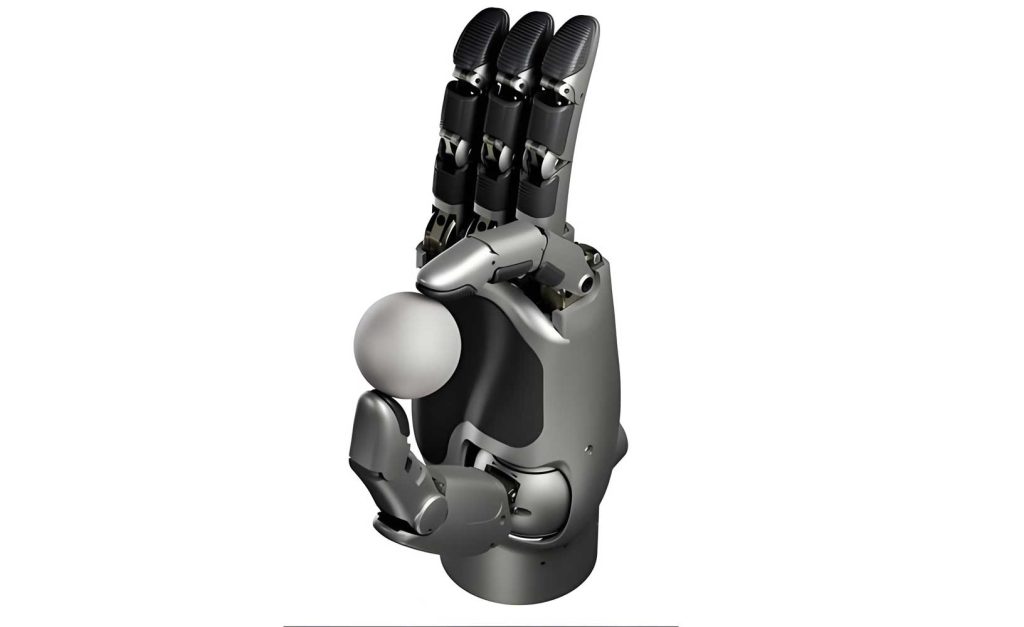
The inspiration for our dexterous robotic hand stems from the evolution of robotic manipulation, where early hands like the Stanford/JPL and Utah/MIT hands laid the groundwork. However, these designs often faced limitations in integration, sensing, and reliability. Our goal was to create a dexterous robotic hand that overcomes these hurdles by leveraging commercial off-the-shelf components, advanced sensor fusion, and real-time control systems. This dexterous robotic hand features 13 degrees of freedom (DOF) distributed across four modular fingers, each with three active DOF and a coupled distal joint, plus an additional DOF for thumb abduction/adduction. The entire system is encapsulated within a human-like envelope, ensuring both functionality and aesthetic appeal. The core philosophy behind this dexterous robotic hand is to achieve a balance between high performance, robustness, and cost-effectiveness, making it suitable for widespread adoption in research and practical applications.
To begin, the mechanical design of the dexterous robotic hand is centered on modularity and compactness. Each finger module is identical, simplifying manufacturing and maintenance. The base joint of each finger employs a differential mechanism using four bevel gears to decouple the two DOF for abduction/adduction and flexion/extension. This design allows force distribution between two actuators, enabling the use of smaller, lighter motors without compromising output force. The actuators are commercial brushless DC motors with a diameter of 16 mm and length of 28 mm, chosen for their reliability and availability. These motors are paired with planetary gear reducers (159:1 ratio) and bevel gear stages (2.5:1 ratio) to drive the differential inputs. The joint position sensing is achieved through Hall-effect-based absolute encoders mounted at the reducer outputs, providing non-contact, high-precision feedback. The finger proximal and distal joints are coupled via a rigid linkage, with actuation provided by a single motor in the proximal phalanx. This motor drives a harmonic drive reducer (100:1 ratio) through a bevel gear (3:1 ratio), and the linkage ensures synchronized motion of the intermediate and distal joints. The kinematic parameters are optimized to minimize motion error, with a maximum deviation of less than 0.6° across the coupled joints. The palm structure is reconfigurable, allowing the same components to be assembled as either a left or right hand, enhancing versatility. The mechanical integration ensures that all components, including actuators, sensors, and electronics, are housed within the finger and palm bodies, reducing external wiring and improving robustness.
The kinematics of the dexterous robotic hand can be described using the Denavit-Hartenberg (D-H) convention. For a single finger, the coordinate frames are assigned as shown in the design schematics, with parameters summarized in Table 1. The forward kinematics for the finger can be derived from the homogeneous transformation matrices. For joint i, the transformation from frame i-1 to frame i is given by:
$$ T_i^{i-1} = \begin{pmatrix}
\cos\theta_i & -\sin\theta_i \cos\alpha_i & \sin\theta_i \sin\alpha_i & a_i \cos\theta_i \\
\sin\theta_i & \cos\theta_i \cos\alpha_i & -\cos\theta_i \sin\alpha_i & a_i \sin\theta_i \\
0 & \sin\alpha_i & \cos\alpha_i & d_i \\
0 & 0 & 0 & 1
\end{pmatrix} $$
where $\theta_i$ is the joint angle, $\alpha_i$ is the twist angle, $a_i$ is the link length, and $d_i$ is the link offset. The overall transformation from the base to the fingertip is:
$$ T_{tip}^{base} = T_1^{0} T_2^{1} T_3^{2} T_4^{3} $$
The joint limits and link lengths are critical for ensuring human-like dexterity. Table 1 provides the detailed parameters for one finger of the dexterous robotic hand.
| Joint i | $\theta_i$ (Range) | $\alpha_i$ (deg) | $a_i$ (mm) | $d_i$ (mm) |
|---|---|---|---|---|
| 1 | [-20°, 20°] | 0 | 67.8 | 0 |
| 2 | [0°, 90°] | 90 | 0 | 0 |
| 3 | [0°, 90°] | 0 | 30.0 | 0 |
| 4 | [0°, 90°] | 0 | 29.5 | 0 |
The dynamics of the dexterous robotic hand are equally important for control. Using the Lagrangian formulation, the equations of motion can be expressed as:
$$ M(q)\ddot{q} + C(q, \dot{q})\dot{q} + G(q) = \tau $$
where $q$ is the vector of joint angles, $M(q)$ is the inertia matrix, $C(q, \dot{q})$ represents Coriolis and centrifugal forces, $G(q)$ is the gravitational vector, and $\tau$ is the torque vector applied by the actuators. For real-time control, we simplify these models by considering the dominant effects, such as joint stiffness and damping, which are captured through sensor feedback.
Moving to the sensor systems, the dexterous robotic hand is equipped with a comprehensive suite of sensors to enable precise control and interaction with the environment. Each finger incorporates multiple sensing modalities, as summarized in Table 2. The joint position sensors are based on Hall-effect principles, providing absolute angular measurements with high resolution and reliability. These sensors are integrated directly into the joint assemblies, avoiding the drawbacks of potentiometers such as wear and noise. The joint torque sensing is achieved through strain gauges mounted on custom-designed flexures. For the base joint, a two-axis torque sensor is placed between the differential mechanism and the finger linkage, measuring forces in both abduction/adduction and flexion/extension directions. For the distal joints, single-axis torque sensors are embedded in the finger segments. The output torque $\tau_s$ from these sensors is related to the strain $\epsilon$ by:
$$ \tau_s = k \epsilon $$
where $k$ is a calibration constant derived from material properties and geometry. Additionally, a six-axis force/torque sensor is integrated into each fingertip. This sensor uses a planar elastic structure with strain gauges arranged in full Wheatstone bridges, and it includes onboard analog-to-digital conversion (12-bit resolution). The sensor measures forces up to 30 N and torques up to 600 N·mm, with overload protection of 200%. The force-torque relationship is given by:
$$ F = K_f \cdot V, \quad T = K_t \cdot V $$
where $F$ and $T$ are the force and torque vectors, $K_f$ and $K_t$ are calibration matrices, and $V$ is the voltage output from the strain gauges. Temperature sensors are also included to monitor motor and electronics heating, ensuring safe operation. The sensor data is critical for implementing impedance control, where the hand can adjust its stiffness and damping based on environmental interactions.
| Sensor Type | Quantity per Finger | Specifications |
|---|---|---|
| Joint Position (Hall-effect) | 3 | Absolute measurement, non-contact, resolution < 0.1° |
| Joint Torque (Strain gauge) | 3 | Range ±5 N·m, sensitivity 2 mV/V |
| Motor Position (Hall sensor) | 3 | Relative measurement for commutation |
| Fingertip Force/Torque (6-axis) | 1 | Force: ±30 N, Torque: ±600 N·mm, digital output |
| Temperature (Thermistor) | 2 | Range -40°C to 125°C, accuracy ±0.5°C |
The hardware architecture of the dexterous robotic hand is built around a multi-layer control system to handle real-time processing and communication. At the core is a PCI-based DSP/FPGA control card, which serves as the main computational unit. This card features a Texas Instruments TMS320C6713 floating-point DSP running at 150 MHz, capable of up to 900 MFLOPS, and an FPGA for interface management. The DSP executes high-level control algorithms, such as inverse kinematics and impedance control, while the FPGA manages communication protocols. The dexterous robotic hand uses a custom high-speed serial communication protocol called PPSeCo (Point-to-Point High-Speed Serial Communication) to interconnect the fingers, palm, and control card. PPSeCo operates at 25 Mbps with only two wires per link, significantly reducing cable clutter compared to traditional bus systems like VME. The data transmission can be modeled as:
$$ R_{data} = f_{clk} \times N_{bits} $$
where $R_{data}$ is the data rate, $f_{clk}$ is the clock frequency, and $N_{bits}$ is the number of bits per clock cycle. In our implementation, PPSeCo ensures low-latency transfer of sensor data and control commands, essential for real-time performance.
The palm electronics include an FPGA board that aggregates data from all fingers via PPSeCo links and forwards it to the DSP control card. It also houses the drive circuit for the thumb abduction/adduction motor, a brushed DC motor with potentiometer feedback. The finger electronics are fully modular, with each finger containing an FPGA board, brushless DC motor drivers, and a flexible printed circuit board (FPCB) for sensor signal conditioning. The FPCB routes signals from all sensors to analog-to-digital converters (ADCs), with three 12-bit ADCs per finger handling up to 8 channels each. This integration minimizes connectors and enhances reliability. The motor drivers use integrated controller chips to drive the three brushless DC motors per finger, with PWM signals generated by the FPGA. The power management is handled by DC-DC converters in the palm, providing regulated voltages to all subsystems. Table 3 summarizes the key hardware components of the dexterous robotic hand.
| Component | Description | Function |
|---|---|---|
| DSP/FPGA Control Card | TMS320C6713 DSP + FPGA, PCI interface | Real-time computation, control law execution |
| Palm FPGA Board | FPGA with PPSeCo interfaces, DC motor driver | Data aggregation, thumb control, power distribution |
| Finger FPGA Board | FPGA with PPSeCo, motor control outputs | Local sensor processing, motor commutation |
| Motor Driver Board | Integrated BLDC driver, 35 mm × 65 mm | Drive three brushless DC motors per finger |
| Sensor FPCB | Flexible circuit with ADCs and amplifiers | Signal conditioning for all finger sensors |
| Communication | PPSeCo protocol, 25 Mbps, 2 wires/link | High-speed serial data transfer between modules |
The software framework for the dexterous robotic hand is structured into multiple layers to facilitate modular development and real-time control. As illustrated in the system diagram, the layers include the Lower Control Level, Data Process Level, Higher Control Level, and External Command Level. The Lower Control Level runs on the finger FPGAs, handling low-level tasks such as reading sensor data via ADCs, generating PWM signals for motor control, and implementing safety checks like temperature monitoring. The control loop at this level operates at a high frequency (e.g., 1 kHz) to ensure responsive actuation. The Data Process Level manages communication over PPSeCo, packaging sensor data from fingers into frames and distributing control commands from the DSP. This level ensures synchronized data flow with minimal jitter. The Higher Control Level executes on the DSP, performing computationally intensive algorithms. For instance, the impedance control law is implemented here, where the desired joint torque $\tau_d$ is computed based on position error and force feedback:
$$ \tau_d = K_p (q_d – q) + K_d (\dot{q}_d – \dot{q}) + J^T F_{ext} $$
where $K_p$ and $K_d$ are proportional and derivative gain matrices, $q_d$ and $\dot{q}_d$ are desired joint positions and velocities, $q$ and $\dot{q}$ are actual values, $J$ is the Jacobian matrix, and $F_{ext}$ is the external force measured by the fingertip sensor. This allows the dexterous robotic hand to exhibit compliant behavior, adapting to object interactions. The External Command Level provides interfaces for user input, such as from a PC or data glove, enabling teleoperation or pre-programmed tasks. The software is developed in C and VHDL, with real-time scheduling ensured by the DSP’s operating system. This layered approach enhances scalability, allowing future upgrades like adding more sensors or advanced control schemes without overhauling the entire system.
To validate the performance of the dexterous robotic hand, we conducted a series of experiments focusing on grasping and manipulation tasks. The dexterous robotic hand demonstrated the ability to perform both power grasps, such as holding a cylindrical bottle, and precision grasps, like picking up small objects like screws or playing keys on a piano. In one test, the hand was tasked with grasping a square block weighing 0.5 kg. The impedance control parameters were tuned to achieve a stable grasp without slipping, with the fingertip force sensors providing real-time feedback to adjust grip force. The success rate exceeded 95% over 100 trials, highlighting the reliability of the dexterous robotic hand. Another experiment involved coordinated manipulation, where two fingers rotated a pen while a third provided support. The joint position sensors achieved an accuracy of ±0.2°, and the force sensors showed a resolution of 0.1 N, enabling fine control. The thermal management system kept motor temperatures below 60°C during continuous operation, ensuring longevity. Table 4 summarizes key performance metrics of the dexterous robotic hand.
| Metric | Value | Description |
|---|---|---|
| Fingertip Force Output | Up to 10 N per finger | Maximum force at fingertip under load |
| Joint Position Accuracy | ±0.2° | Error relative to desired angle |
| Force Sensing Resolution | 0.1 N | Smallest detectable force change |
| Control Loop Frequency | 1 kHz | Update rate for motor control and sensing |
| Communication Latency | < 1 ms | Delay in PPSeCo data transfer |
| Grasping Success Rate | > 95% | For standard objects in controlled tests |
| Operating Temperature Range | 0°C to 50°C | Ambient temperature for reliable operation |
Looking ahead, future work on the dexterous robotic hand aims to further enhance its capabilities. We are developing a next-generation five-fingered dexterous robotic hand with improved integration, reduced weight, and enhanced reconfigurability. This new design will incorporate advanced materials like carbon fiber to reduce inertia, and it will feature more compact sensors based on MEMS technology. The control algorithms will be extended to include machine learning techniques for adaptive grasping, where the hand can learn from experience to optimize grip strategies. Additionally, we plan to integrate the dexterous robotic hand with robotic arms for macro-micro manipulation tasks, enabling complex operations like assembly or surgery. The communication protocol may evolve to use wireless links for greater mobility, and energy efficiency will be improved through better power management. These advancements will push the boundaries of what a dexterous robotic hand can achieve, making it even more versatile and autonomous.
In conclusion, the development of this dexterous robotic hand represents a significant milestone in robotic manipulation. By combining modular mechanical design, multisensory feedback, high-speed hardware, and layered software, we have created a system that excels in reliability and dexterity. The dexterous robotic hand demonstrates robust performance in various grasping and manipulation tasks, validated through rigorous experiments. As research progresses, we believe that such dexterous robotic hands will become indispensable in fields ranging from manufacturing to healthcare, bridging the gap between human and machine capabilities. The insights gained from this work will inform future designs, ultimately leading to more intuitive and capable robotic systems.