
In the field of robotics, the development of a dexterous robotic hand that mimics human hand capabilities has been a long-standing challenge. Existing humanoid dexterous robotic hands often suffer from a lack of compliance and flexibility, which limits their application in areas such as intelligent prosthetics, fruit-picking robots, and space exploration. To address this issue, we propose a novel dexterous robotic hand structure based on a flexible driving module. This dexterous robotic hand incorporates a hybrid transmission system using tendons and linkages, designed to closely resemble the human hand’s anatomy. The flexible driving module employs an elastic drum structure, enabling fast no-load speed and compliant loading under load, with integrated tendon tension detection. Through optimization of linkage coupling mechanisms based on human finger physiological relationships, this dexterous robotic hand achieves high anthropomorphism and performance. Prototype testing demonstrates that the dexterous robotic hand can execute human-like gestures and stably grasp objects of various shapes and sizes, with rapid motion speeds. This work advances the design of dexterous robotic hands by balancing actuation complexity and structural compliance.
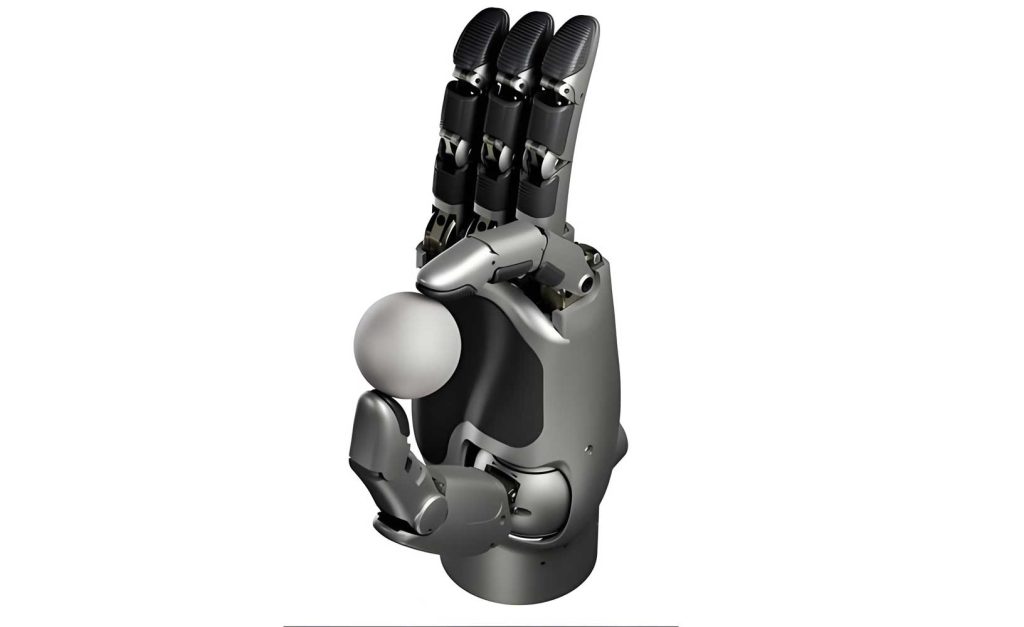
The dexterous robotic hand is designed with five fingers and a palm, similar to a human hand. Each finger consists of three phalanges: proximal, middle, and distal, corresponding to metacarpophalangeal (MCP), proximal interphalangeal (PIP), and distal interphalangeal (DIP) joints. The fingers use a hybrid tendon-linkage transmission, where tendons drive the joints via flexible driving modules embedded in the proximal phalanges. The PIP and DIP joints are coupled using a four-bar linkage mechanism to mimic natural finger motion coupling, reducing the number of actuators while maintaining biomimetic movement. The MCP joint features a cross-axis structure allowing two degrees of freedom: flexion/extension and adduction/abduction. Actuation for MCP joints is provided by motors within the palm, with some motors driving adjacent fingers’ adduction/abduction motions to save space. This design ensures compact integration and dexterous operation capabilities. The overall specifications of the dexterous robotic hand are summarized in Table 1.
| Parameter | Value |
|---|---|
| Hand Size (Length × Width × Thickness) | 210 mm × 115 mm × 35 mm (in extended state) |
| Total Weight | 450 g |
| Number of Joints | 19 |
| Degrees of Freedom | 12 |
| Motor Model | 12GAN20 |
| Gear Reduction Ratio | 298:1 |
| Motor Voltage | 12 V |
| Rated Torque | 0.196 N·m |
| Tendon Diameter | 0.3 mm |
| Tendon Material | Nylon |
| Maximum Tendon Tension | 91 N |
The flexible driving module is a core component of this dexterous robotic hand, providing compliance and force sensing. It consists of a base, DC motor, gear reducer, elastic drum, and guide pulleys. The elastic drum comprises eight identical elastic strips made of PA66 nylon, arranged uniformly around a support disk. When the motor rotates the drum to wind the tendon, the elastic strips deform under load, introducing compliance into the transmission. This allows the dexterous robotic hand to handle fragile objects safely. The tendon tension detection mechanism uses a thin-film pressure sensor to measure axial forces from the elastic strips, enabling real-time grip force monitoring. The mechanical performance of the flexible driving module is characterized by a no-load tendon speed near 35 mm/s and a maximum output tension of 15 N. Based on the tendon leverage and finger dimensions, the maximum fingertip force is estimated to be approximately 2 N, suitable for general dexterous robotic hand applications.
The elastic drum’s structural stiffness is critical for compliance in the dexterous robotic hand. The elastic strips have a rectangular cross-section with width \(g\), height \(h\), span \(l\), and distance \(e\). The tendon wraps around the midpoint of the span, and each strip is modeled as a simply supported beam with a central point load. The force on a single strip \(F_p\) is related to tendon tension \(F_T\) by:
$$F_p = 2 F_T \sin\left(\frac{\pi}{8}\right)$$
According to beam bending theory, the maximum deflection \(w_{\text{max}}\) for small deformations is:
$$w_{\text{max}} = \frac{F_p l^3}{4E g h^3}$$
where \(E\) is the Young’s modulus. However, for large deformations, geometric nonlinearities must be considered. We used ANSYS Workbench for nonlinear static stiffness analysis and parameter optimization. The material properties of PA66 are listed in Table 2.
| Parameter | Value |
|---|---|
| Material | PA66 |
| Density | 1140 kg/m³ |
| Young’s Modulus | 1480 MPa |
| Tensile Yield Strength | 57.1 MPa |
| Poisson’s Ratio | 0.35 |
Optimization was performed using a direct method to maximize deflection while satisfying strength constraints. The design variables were \(X = [l, g, h]\), with a safety factor of 1.2. The optimization results, compared with initial and adjusted values, are shown in Table 3. The optimized elastic strip provides greater deflection while maintaining structural integrity, enhancing the compliance of the dexterous robotic hand.
| Parameter | Initial | Optimized | Adjusted |
|---|---|---|---|
| \(l\) (mm) | 20 | 19.3936 | 18 |
| \(g\) (mm) | 3 | 3.8063 | 3.8 |
| \(h\) (mm) | 2 | 1.6435 | 1.6 |
| Maximum Deflection (mm) | 0.9 | 1.2923 | 1.3874 |
| Maximum Equivalent Stress (MPa) | 36.92 | 45.35 | 46.97 |
The tendon tension detection in the dexterous robotic hand utilizes a thin-film piezoresistive pressure sensor (K-CUT RP-C5-ST) with a range of 30–1000 g, outputting 0–5 V. Calibration results show a hysteresis error of approximately 5.6%, due to friction and elastic hysteresis in the module. Although this error is relatively high, the low-cost and compact design is acceptable for force measurement in dexterous robotic hand applications where high precision is not critical. The calibration curve can be approximated by a linear relationship: \(V = k F_T + b\), where \(V\) is output voltage, \(F_T\) is tendon tension, and \(k\) and \(b\) are constants determined experimentally. This enables force control strategies for the dexterous robotic hand.
The linkage coupling mechanism in the dexterous robotic hand is designed to replicate the physiological coupling between human finger PIP and DIP joints. Data from human index fingers show a linear relationship between PIP joint angle \(\alpha_1\) and DIP joint angle \(\alpha_2\):
$$\alpha_2 = 0.7276 \alpha_1$$
To achieve this in the dexterous robotic hand, a four-bar linkage is used, as shown in Figure 9 (simplified representation). The linkage parameters include relative lengths: \(a\) (input crank), \(b\) (coupler), \(c\) (output rocker), and \(d\) (ground link). The input angle \(\theta_2\) and output angle \(\theta_4\) are related through the Freudenstein equation:
$$\theta_4 = 2 \arctan\left(\frac{-B – \sqrt{B^2 – 4AC}}{2A}\right)$$
where:
$$A = \cos(\theta_2) – K_1 – K_2 \cos(\theta_2) + K_3$$
$$B = -2 \sin(\theta_2)$$
$$C = K_1 – (K_2 + 1) \cos(\theta_2) + K_3$$
and:
$$K_1 = \frac{d}{a}, \quad K_2 = \frac{d}{c}, \quad K_3 = \frac{a^2 – b^2 + c^2 + d^2}{2ac}$$
The desired function for the dexterous robotic hand is:
$$\theta_4 = 0.7276 (2\pi – \alpha_{10} – \theta_2) + \alpha_{20}$$
where \(\alpha_{10}\) and \(\alpha_{20}\) are fixed joint offsets. We set \(a = 1\) (unit length) and \(d = 4.3\) based on human finger proportions. The optimization problem minimizes the sum of squared errors between the linkage output and desired function, subject to constraints on transmission angles \(\gamma_{\text{min}} \geq 40^\circ\) and \(\gamma_{\text{max}} \leq 140^\circ\) for good force transmission. The constraints are:
$$g_1(X) = x_1^2 + x_2^2 – 2 \cos(40^\circ) x_1 x_2 – (d – a)^2 \leq 0$$
$$g_2(X) = -x_1^2 – x_2^2 + 2 \cos(140^\circ) x_1 x_2 – (d + a)^2 \leq 0$$
with \(X = [b, c] = [x_1, x_2]\). The objective function is:
$$\min f(X) = \sum_{i=0}^{s} (\theta_{4i} – \theta_{4si})^2$$
where \(s\) is the number of discrete points. Using MATLAB’s fmincon solver, the optimized parameters for the dexterous robotic hand are listed in Table 4.
| Parameter | Value |
|---|---|
| Input Crank Relative Length \(a\) | 1.0000 |
| Coupler Relative Length \(b\) | 4.0922 |
| Output Rocker Relative Length \(c\) | 1.1794 |
| Ground Link Relative Length \(d\) | 4.3000 |
| Sum of Squared Output Angle Errors | 0.0102 |
| Minimum Transmission Angle Constraint \(g_1\) | -0.1470 |
| Maximum Transmission Angle Constraint \(g_2\) | -53.6216 |
The linkage optimization ensures that the dexterous robotic hand fingers closely mimic human finger coupling, enhancing anthropomorphism. The comparison between optimized and desired output angles shows excellent agreement, as illustrated in Figure 10 (conceptual plot). This design reduces actuation requirements while maintaining natural motion for the dexterous robotic hand.
Prototype fabrication of the dexterous robotic hand involved 3D printing finger phalanges and the palm using photosensitive resin, with joint shafts made of 45 steel. Miniature potentiometers were installed at MCP and PIP joints as angle sensors, connected via custom PCB boards for joint angle measurement. This sensory feedback is crucial for controlling the dexterous robotic hand. Gesture and grasping experiments were conducted to evaluate performance. The dexterous robotic hand successfully executed various human-like gestures, such as full extension and specific hand signs, demonstrating high anthropomorphism. Grasping tests involved objects of different shapes and sizes, including small and large cylinders, irregular shapes, and precision pinch tasks like holding a key. The dexterous robotic hand achieved stable enveloping grasps and precise fingertip grasps, adapting to object variations. The no-load motion speed was tested, showing a minimum finger flexion time of only 0.6 s, indicating rapid response for a dexterous robotic hand. These results validate the design’s effectiveness in real-world applications.
The performance of the dexterous robotic hand can be further analyzed through mathematical modeling. For instance, the tendon-driven system dynamics can be described by:
$$J \ddot{\theta} + B \dot{\theta} = \tau_m – \tau_l$$
where \(J\) is inertia, \(B\) is damping, \(\theta\) is joint angle, \(\tau_m\) is motor torque, and \(\tau_l\) is load torque. For the flexible driving module, the tendon tension \(F_T\) relates to motor torque \(\tau_m\) via:
$$\tau_m = r_{\text{eff}} F_T$$
where \(r_{\text{eff}}\) is the effective radius of the elastic drum, which varies with deformation. The compliance introduced by the elastic strips can be modeled as a spring with nonlinear stiffness \(k(F_T)\), derived from the deflection equation. This allows the dexterous robotic hand to absorb impacts and adapt to object shapes.
In terms of control, the dexterous robotic hand can implement force-position hybrid control. The tendon tension feedback enables impedance control, where the desired dynamics are:
$$M_d (\ddot{x} – \ddot{x}_d) + B_d (\dot{x} – \dot{x}_d) + K_d (x – x_d) = F_{\text{ext}}$$
where \(M_d\), \(B_d\), and \(K_d\) are desired inertia, damping, and stiffness matrices; \(x\) is actual position; \(x_d\) is desired position; and \(F_{\text{ext}}\) is external force. By adjusting \(K_d\), the dexterous robotic hand can switch between stiff and compliant modes, enhancing versatility.
To quantify the grasping capability of the dexterous robotic hand, we can analyze grip force distribution. For an enveloping grasp, the contact forces \(F_i\) at each phalanx must satisfy equilibrium conditions. Assuming friction coefficient \(\mu\), the condition for stable grasp without slip is:
$$\sum F_i \geq \frac{W}{\mu}$$
where \(W\) is object weight. For the dexterous robotic hand, with multiple contact points, this ensures reliable holding. The fingertip force for pinch grasps can be estimated from tendon tension and lever arms. If \(r_j\) is the moment arm at joint \(j\), the fingertip force \(F_{\text{tip}}\) is:
$$F_{\text{tip}} = \frac{F_T \sum r_j}{L_{\text{finger}}}$$
where \(L_{\text{finger}}\) is finger length. Given \(F_T \leq 15\) N and typical lever arms, \(F_{\text{tip}} \approx 2\) N, sufficient for delicate tasks.
The dexterous robotic hand’s design also considers energy efficiency. The flexible driving module reduces peak motor loads by storing energy in elastic deformation. The work done by the motor \(W_m\) is:
$$W_m = \int \tau_m d\theta = \int F_T r_{\text{eff}} d\theta$$
and the energy stored in elastic strips \(U_e\) is:
$$U_e = \frac{1}{2} k w_{\text{max}}^2$$
This energy recovery mechanism can improve battery life for portable dexterous robotic hand applications.
In summary, this dexterous robotic hand based on flexible driving modules offers a balanced approach to actuation and compliance. Compared to traditional dexterous robotic hands, it integrates all actuators within the hand structure, achieving a compact size—only about 1.1 times that of an average adult hand. With 12 active degrees of freedom and 19 joints, the dexterous robotic hand exhibits high flexibility and anthropomorphism. The optimized linkage coupling ensures natural finger motion, while tendon tension detection enables force feedback. Grasping tests confirm adaptability to various objects and fast motion speeds. Future work may focus on enhancing sensor accuracy, implementing advanced control algorithms, and exploring applications in robotics and prosthetics. This dexterous robotic hand represents a significant step toward more lifelike and functional robotic manipulators.
To further elaborate on the dexterous robotic hand’s potential, we can discuss its scalability. The modular design allows for customization of finger sizes and actuation parameters. For example, the tendon transmission system can be scaled using similarity laws. If the dexterous robotic hand is enlarged by a factor \(\lambda\), the tendon tension \(F_T\) scales with \(\lambda^2\) (due to area scaling), while inertia scales with \(\lambda^4\). This affects dynamic response, but the flexible driving module can be adjusted by scaling elastic strip dimensions proportionally. The stiffness \(k\) of an elastic strip scales as:
$$k \propto \frac{E g h^3}{l^3}$$
Thus, for geometric scaling, \(k \propto \lambda\) if all dimensions are scaled by \(\lambda\). This ensures consistent compliance across sizes for the dexterous robotic hand.
Another aspect is the dexterous robotic hand’s durability. The PA66 elastic strips have good wear resistance, but long-term cycling may cause fatigue. The fatigue life \(N_f\) can be estimated using S-N curves for PA66, where stress amplitude \(\sigma_a\) is related to cycles to failure. For the dexterous robotic hand, typical operating stresses are below yield, so \(N_f\) is high. Regular maintenance of tendons and joints may be needed, but the design minimizes wear points.
The dexterous robotic hand’s control system can be expanded with machine learning. Using data from angle and force sensors, the dexterous robotic hand can learn grasping strategies through reinforcement learning. The reward function \(R\) might penalize slip and excessive force:
$$R = -(\alpha \cdot \text{slip} + \beta \cdot |F – F_{\text{target}}|)$$
where \(\alpha\) and \(\beta\) are weights. Training in simulation with physics engines can accelerate deployment for the dexterous robotic hand.
In conclusion, the dexterous robotic hand presented here addresses key challenges in robotics by combining compliance, compactness, and functionality. Its flexible driving module and optimized linkages make it a promising platform for research and practical use. As technology advances, dexterous robotic hands like this will play a crucial role in human-robot interaction, automation, and assistive devices.