
The pursuit of high-quality, automated assembly in the aerospace industry has made robotic drilling systems a critical area of development. At the heart of these systems lies the hole-making end effector, a sophisticated device responsible for the critical tasks of clamping the workpiece and executing the drilling and countersinking operations. The precision of this end effector directly dictates the quality of the resulting holes, which in turn influences the structural integrity, fatigue life, and even stealth characteristics of modern aircraft. Among its various modules, the presser foot unit is paramount. It serves the vital functions of applying clamping force to stabilize the workpiece stack-up, providing a datum for depth control, and often housing sensors for surface normal detection. Consequently, any mechanical error or deformation within the presser foot structure can propagate directly into positional inaccuracies, leading to unacceptable deviations in hole perpendicularity and countersink depth. This work delves into a detailed mechanical analysis and structural optimization of a presser foot for a robotic hole-making end effector. The primary objectives are to rigorously analyze the sources of mechanical error—categorizing them into rigid body motion from guideway clearances and elastic deformation from operational loads—and to implement a design optimization strategy that minimizes these errors while achieving a lightweight structure.
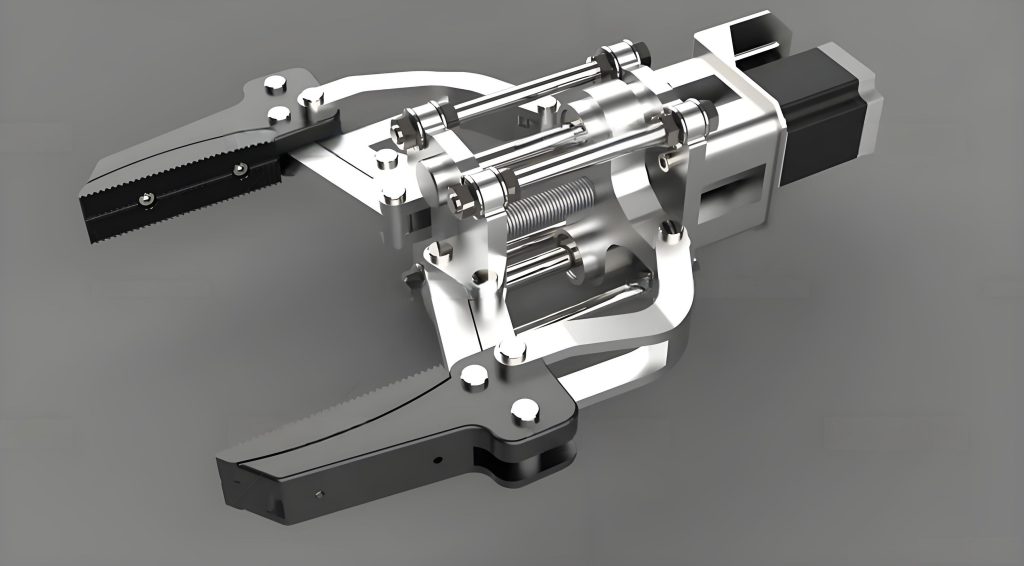
The designed end effector integrates several key subsystems to perform automated drilling. It primarily consists of a spindle feed unit (incorporating an electric spindle and a pneumatic cylinder for linear actuation), a presser foot clamping unit, a measurement unit (typically laser displacement sensors), auxiliary support structures, and chip removal/cooling systems. The operational sequence begins with the robot positioning the end effector over the target location. The presser foot then advances, and its integrated sensors measure and correct for any angular misalignment relative to the workpiece surface. Once aligned, the presser foot firmly clamps onto the workpiece. Following this, the spindle feeds forward to drill the hole and form the countersink in a single operation, with depth controlled by a mechanical stop within the presser foot assembly. After completion, both the spindle and the presser foot retract. The critical quality metrics governed by this end effector are the countersink depth accuracy (typically required to be within ±0.05 mm) and the drill bit perpendicularity to the workpiece surface (often required to be within ±0.5°). The mechanical precision of the presser foot body is the foundation for achieving these tolerances, as it houses both the depth control mechanism and provides the mounting platform for the alignment sensors.
The presser foot structure, the focal point of this study, is a complex component that transfers clamping forces and reacts against drilling loads. It typically interfaces with the main end effector body via linear guideways to allow for its extension and retraction. A simplified schematic of its mounting and loading is essential for analysis. The structure is supported at multiple points along its length by guide blocks that slide on rails. During operation, it is subjected to a primary clamping force F from the workpiece at its front-end (the foot head), the weight P of its own structure and attached components, and the reaction forces F1 and F2 from the guideways. The integrity and stiffness of this structure under load are non-negotiable for precision.
Analysis of Mechanical Error Sources
The total mechanical error at the functional point of the presser foot (the contact surface with the workpiece) can be decomposed into two distinct, additive components: quasi-static rigid body displacement due to kinematic clearances, and elastic deformation due to structural compliance under load. A comprehensive error budget must account for both.
1. Rigid Body Error from Guideway Clearance
Even precision linear guideways have micro-scale clearances between the rolling elements (balls or rollers) and the raceways. Under a moment load, this clearance allows the guide block to tilt slightly within its allowed range. For the presser foot, the clamping force F applied at a distance from the supports creates a moment. This causes the entire foot structure to pivot slightly about the guide blocks, leading to a rigid body displacement at the foot head. This is not a material strain but a kinematic shift.
This phenomenon can be modeled using a simplified lever principle. Consider the presser foot as a rigid beam supported at two primary guide blocks, separated by a distance a. The foot head, where the clamping force is applied, is located at a distance x from the first support block. The radial clearance in the guideway is denoted as b. When a moment is applied, the block can tilt, effectively causing a small angular misalignment. The resulting linear displacement yrig at the foot head, perpendicular to the drilling axis, is derived from similar triangles:
$$ \frac{y_{rig}}{x} = \frac{b}{a} $$
Therefore, the rigid body error is:
$$ y_{rig} = \frac{x}{a} \cdot b $$
This equation reveals a crucial design insight: the factor \( \frac{x}{a} \) acts as an error transmission ratio.
- If \( \frac{x}{a} < 1 \), the clearance-induced error is attenuated.
- If \( \frac{x}{a} > 1 \), the error is amplified.
- If \( \frac{x}{a} = 1 \), the error is transmitted one-to-one.
Thus, to minimize \( y_{rig} \), the design must strive to make \( x \) as small as possible and \( a \) as large as possible, given the spatial constraints of the end effector. For instance, in an optimized layout, with \( x_{min} = 260 \) mm, \( a_{max} = 300 \) mm, and a high-precision guideway clearance \( b = 0.02 \) mm, the calculated rigid body error becomes:
$$ y_{rig} = \frac{260}{300} \times 0.02 \approx 0.0173 \text{ mm} $$
This error is purely kinematic and exists before any material stress is considered.
2. Elastic Deformation Error
Under operational loads, the presser foot structure, made from a material like structural steel, will elastically deform. This deformation is not uniform and depends on the structural geometry, load application points, and material stiffness. The most critical deformation is again the displacement perpendicular to the drilling axis at the foot head, as this directly affects the sensor alignment and the effective drilling angle. This elastic error, denoted as \( y_{ela} \), must be quantified through structural analysis. The total error \( d \) at the foot head is then the sum of both components:
$$ d = y_{rig} + y_{ela} $$
For the end effector to meet stringent accuracy requirements (e.g., keeping total positional error below 0.05 mm), the elastic deformation \( y_{ela} \) must be carefully controlled once the rigid body error \( y_{rig} \) is minimized through layout design.
Finite Element Analysis of the Presser Foot Structure
To accurately quantify the elastic deformation \( y_{ela} \), a Finite Element Analysis (FEA) was performed on the initial presser foot design using ANSYS software. This provides a detailed view of stress distribution and displacement under realistic loading conditions, which is impossible to derive analytically for such a complex geometry.
Model Preparation and Boundary Conditions
The 3D CAD model of the presser foot was imported and simplified by removing small fillets, chamfers, and threaded holes that are computationally expensive but have negligible impact on global stiffness results. The mesh was generated with a mix of hex-dominant and tetrahedral elements, with refinement in critical areas like the support frames and the foot head. The total model consisted of approximately 150,000 nodes and 40,000 elements, with a satisfactory mesh quality metric. The material was defined as Q235 structural steel with the following properties:
| Property | Value | Unit |
|---|---|---|
| Density (ρ) | 7.85e3 | kg/m³ |
| Young’s Modulus (E) | 210 | GPa |
| Poisson’s Ratio (ν) | 0.3 | – |
| Yield Strength (σ_y) | 235 | MPa |
The boundary conditions and loads were applied to simulate the worst-case operational scenario:
- Fixed Constraints: The mounting faces of the guide blocks on the top side of the support frames were defined as fixed supports, representing their connection to the rigid end effector body via the guideway carriages.
- Clamping Force: A distributed force of F = 1000 N was applied normal to the front face of the presser foot head, simulating the reaction force from the clamped workpiece.
- Gravity: Standard earth gravity (9.8066 m/s²) was applied to account for the structure’s self-weight.
- Drilling Loads: Although secondary for clamping deformation, the axial feed force (1000 N) and torque (3.21 N·m) from the spindle were applied at the connection points of the support frame to the main end effector base to ensure completeness of the load case.
FEA Results for the Initial Design
The solution revealed the structural performance of the initial presser foot design. The deformation perpendicular to the drill axis (Y-direction) was of primary concern. The results showed a maximum elastic deformation \( y_{ela} \) of approximately 0.047 mm located at the extremity of the foot head. The deformation in the other transverse direction (Z) was an order of magnitude smaller (< 0.005 mm at the head) and thus considered negligible. The total error for the initial design, combining rigid and elastic components, was:
$$ d_{initial} = y_{rig} + y_{ela, initial} = 0.0173 \text{ mm} + 0.047 \text{ mm} = 0.0643 \text{ mm} $$
This value exceeded the target threshold of 0.05 mm, confirming the need for structural optimization to reduce \( y_{ela} \). The von Mises stress distribution showed a maximum stress of around 20.3 MPa, well below the 235 MPa yield strength of Q235 steel, indicating the design had a high safety factor but inadequate stiffness. Examination of the strain field clearly identified the zones of highest compliance: the thin-walled sections of the presser foot head and the regions around the root of the forward support frames. These areas became the prime targets for design modification.
| Performance Metric | Initial Design Value | Target |
|---|---|---|
| Rigid Error, \( y_{rig} \) | 0.0173 mm | Minimized by layout |
| Elastic Error, \( y_{ela} \) | 0.0470 mm | < 0.033 mm |
| Total Error, \( d \) | 0.0643 mm | < 0.05 mm |
| Max Stress | 20.3 MPa | < 235 MPa |
| Mass | 20.24 kg | Minimize |
Structural Optimization Strategy
The optimization process was executed in two sequential stages: first, to achieve the stiffness target by reducing elastic deformation, and second, to remove redundant material from the now-stiffer structure for lightweighting.
Stage 1: Stiffness Enhancement for Error Reduction
Based on the strain concentration analysis, specific modifications were made:
- Support Frame Thickening: The thickness of the primary support frames was increased from 10 mm to 20 mm.
- Presser Foot Head Reinforcement: The wall thickness of the foot head was doubled from 5 mm to 10 mm, and its overall geometry was made more robust.
- Geometric Stiffening: The rear profile of the support frames was extended rearward, increasing the sectional area and moment of inertia in the critical bending plane.
These changes significantly increased the bending stiffness of the entire assembly. A new FEA simulation was run on this modified design. The results were promising: the maximum Y-direction deformation \( y_{ela} \) at the foot head dropped dramatically to approximately 0.012 mm. The total error was now:
$$ d_{stiffened} = 0.0173 \text{ mm} + 0.012 \text{ mm} = 0.0293 \text{ mm} $$
This comfortably met the 0.05 mm error control target. The maximum stress increased slightly but remained very low at about 22 MPa, preserving a large safety margin.
Stage 2: Topology-Inspired Lightweighting
While the stiffness goal was achieved, the thickening measures increased the mass of the presser foot. The stress results from the stiffened model showed vast regions with stress levels below 5 MPa, indicating significant material was under-utilized. Guided by topology optimization principles—which suggest removing material from low-stress zones—targeted lightweighting was performed. Large, strategically placed lightening holes were introduced in the web areas of the support frames and other non-critical panels, areas that carry minimal load. This process required an iterative check to ensure the removed material did not re-introduce compliance or create stress concentrations.
The final, optimized presser foot design was analyzed once more. The results confirmed the success of the two-stage approach:
| Performance Metric | Initial Design | Stiffened Design | Final Optimized Design |
|---|---|---|---|
| Rigid Error, \( y_{rig} \) | 0.0173 mm | 0.0173 mm | 0.0173 mm |
| Elastic Error, \( y_{ela} \) | 0.0470 mm | 0.0120 mm | 0.0130 mm |
| Total Error, \( d \) | 0.0643 mm | 0.0293 mm | 0.0303 mm |
| Max Von Mises Stress | 20.3 MPa | ~22 MPa | ~22 MPa |
| Mass | 20.24 kg | ~24 kg (Est.) | 15.28 kg |
Conclusion
This systematic study on the presser foot of a hole-making end effector demonstrates a effective methodology for precision mechanical design. By deconstructing the total mechanical error into a kinematic component from guideway clearance and an elastic component from structural compliance, targeted improvements were made. The application of a simple lever model provided a clear design rule \( (x/a < 1) \) to minimize the transmission of guideway play to the functional point of the end effector. Finite Element Analysis was indispensable for quantifying and visualizing the elastic deformation, identifying weak zones in the initial design, and validating the optimization steps. The two-stage optimization process—first enhancing stiffness to meet the stringent 0.03 mm total error target (a 70% reduction in elastic deformation), followed by topology-guided mass reduction—resulted in a final design that is both highly precise and 24.5% lighter than the original. This approach, balancing error control through layout and stiffening with subsequent lightweighting, provides a validated framework for the design of high-precision components in robotic end effectors and other advanced manufacturing systems where accuracy and dynamic performance are critical.