
The automation of harvesting operations in controlled environment agriculture, such as greenhouse production, represents a critical step towards improving efficiency and reducing reliance on manual labor. Among various fruits, strawberries present a unique set of challenges for robotic harvesting due to their delicate, easily bruised skin, irregular shape, and complex growth patterns. This work addresses the specific need for harvesting elevated, substrate-grown strawberries by presenting the design, analysis, and validation of a novel, mechanically simple end effector.
The proposed end effector is based on a “single-drive, dual-clamping” principle. This design philosophy aims to achieve the two primary functions required for a successful pick—cutting the peduncle (fruit stem) and securely holding the harvested fruit—through a single actuation mechanism. This approach significantly simplifies the mechanical structure and control system compared to designs requiring separate actuators for cutting and grasping. The end effector utilizes a pneumatic cylinder to drive a scissor-cutting mechanism while simultaneously closing a pair of cushioned clamping pads attached to the scissor blades. When the system engages a target strawberry, it cuts the peduncle at a designated point while immediately clamping the stem segment still attached to the fruit, allowing for safe retrieval and transport to a collection bin.
The following sections detail the holistic design process. We begin by describing the overall mechanical design and working principle of the end effector. This is followed by a comprehensive analysis of the biomechanical properties of strawberry fruit and peduncles, which provides the critical data necessary for designing the key functional components. Subsequently, we present the detailed design and parameter optimization of the cutting mechanism, the driving linkage, and the clamping subsystem. Finally, we establish and validate theoretical models for the cutting and clamping forces to ensure the design’s reliability and performance.
1. Mechanical Design and Working Principle
The primary objective was to develop a compact, reliable, and low-cost end effector suitable for integration with a robotic manipulator. For elevated cultivation systems, mature strawberries often hang freely with minimal obstruction from foliage, making a peduncle-cutting approach feasible and preferable to fruit-grasping methods that risk damage.
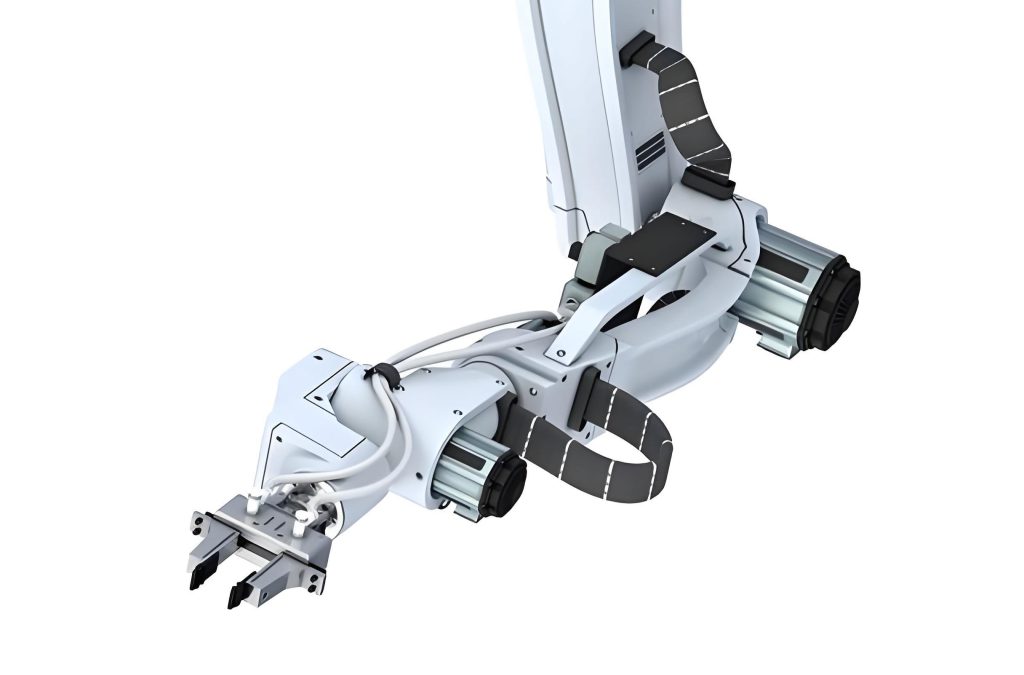
The core design is a linkage mechanism that converts the linear motion of a single pneumatic cylinder into the rotational motion of a cutting blade and the coordinated closure of a clamp. The end effector consists of the following main components, as illustrated in the virtual prototype model:
The working cycle is as follows:
- Initialization: The pneumatic cylinder is extended, holding the moving blade in the fully open position. The end effector is navigated by the robotic arm to the harvesting point identified by a vision system.
- Harvesting Stroke: The cylinder retracts. This linear motion is transferred through the Y-connector and the connecting rod to pivot the moving blade. The blade rotates towards the fixed blade, shearing the peduncle. Concurrently, the clamping pads attached to both blades come together, securely gripping the fruit-side segment of the cut peduncle.
- Transport and Release: The robotic arm moves the end effector, now holding the strawberry, to a predefined position over a collection container. The cylinder extends, opening the blade and releasing the clamp, dropping the fruit gently into the container.
This integrated “cut-and-hold” action in one stroke is the defining feature of this single-drive dual-clamping end effector.
2. Biomechanical Property Analysis for Design Input
Rational design of a harvesting end effector requires fundamental data on the target fruit’s physical and mechanical properties. Measurements were conducted on mature ‘Shengdanhong’ strawberries from an elevated cultivation system.
2.1 Growth Morphology and Spacing
The spatial distribution of fruit on the substrate gutters influences the required opening width of the cutting mechanism. Measurement of inter-fruit distances for mature, hanging berries indicated a typical range of 25-60 mm. This informed the design goal for the maximum opening between the scissor tips to accommodate common fruit spacing without colliding with adjacent berries.
2.2 Morphological Parameters
Key dimensions and mass were measured for 30 sample fruits. The peduncle diameter was measured at 15-25 mm above the calyx, defining the target cutting and clamping zone. Results are summarized in Table 1.
| Parameter | Max Value | Min Value | Average Value |
|---|---|---|---|
| Peduncle Diameter (mm) | 2.29 | 1.67 | 2.00 |
| Fruit Mass (g) | 22.5 | 17.3 | 20.4 |
2.3 Peduncle Mechanical Properties
The force required to cut the peduncle is the primary determinant for actuator sizing. Two cutting methods were tested using a universal testing machine: single-edge shear (like a knife against an anvil) and double-edge shear (scissor action). Samples were tested at a crosshead speed of 50 mm/s. The results, shown in Table 2, demonstrate that the double-edge shear method requires significantly less force for the same peduncle diameter, justifying the choice of a scissor mechanism for the end effector.
| Parameter | Max Value | Min Value | Average Value |
|---|---|---|---|
| Single-Edge Shear Force (N) | 10.23 | 7.96 | 9.53 |
| Double-Edge Shear Force (N) | 5.68 | 4.43 | 5.20 |
The relationship can be analyzed by the specific shear force (force per unit diameter). For double-edge shear:
$$ F_{s,avg} / d_{avg} \approx \frac{5.20 \text{ N}}{2.00 \text{ mm}} = 2.6 \ \text{N/mm} $$
This value serves as a key input for the mechanical analysis of the cutting mechanism.
Clamping performance depends on the peduncle’s response to compression and the friction coefficient of the clamping material. Tests were performed to find the platen distance at which a peduncle was securely held without damage using different lining materials (rubber, silicone, stainless steel). Silicone pads (2 mm thick) provided the best combination of high friction and compliance, with a secure clamping distance range of 4.47-4.82 mm for the measured peduncle diameters.
3. Detailed Component Design and Optimization
Based on the acquired biomechanical data, the components of the end effector were designed and optimized.
3.1 Cutting Mechanism Design
The scissor mechanism comprises a fixed blade and a moving blade. The maximum opening between the blade tips was set to 40 mm to accommodate the typical fruit spacing. With a desired maximum opening angle of 45° for the moving blade, the overall dimensions were determined. The fixed blade incorporates limit pins to define the open and closed positions of the moving blade. Both blades feature mounting points for the clamping pads. The final compact design of the cutting assembly is a critical part of this end effector.
3.2 Actuation and Linkage Design
The linkage transforms the cylinder’s linear stroke into the blade’s rotational motion. Using kinematic analysis of the four-bar linkage formed by the fixed blade (ground link), the moving blade, the connecting rod, and the cylinder’s linear guide, the relationship between cylinder stroke and blade angle was optimized. The goal was to achieve the full 45° blade rotation with a minimal, compact cylinder stroke.
The analysis yielded an optimal connecting rod length \( L_{rod} = 35 \ \text{mm} \) and a required cylinder stroke \( S_{cyl} = 25 \ \text{mm} \). A compact double-acting pneumatic cylinder (16 mm bore, 25 mm stroke) was selected. The force output \( F_{cyl} \) of the pneumatic cylinder at a supply pressure \( P \) is given by:
$$ F_{cyl} = P \cdot \frac{\pi (D_{bore}^2 – d_{rod}^2)}{4} \cdot \eta $$
where \( D_{bore} \) is the cylinder bore diameter, \( d_{rod} \) is the piston rod diameter, and \( \eta \) is the system efficiency (approximately 0.85). For \( P = 0.5 \ \text{MPa} \), this provides sufficient force margin.
3.3 Clamping Pad Design
The “dual-clamping” function is achieved by attaching custom pads to both the fixed and moving blades. Based on the compression tests, silicone was chosen as the lining material. The gap between the pads in the closed position was designed to be 4.8 mm, accounting for the 4.0 mm total pad thickness (2 mm each) and the required compression distance to grip a peduncle of average diameter securely. This ensures the peduncle is held firmly without crushing when the blade closes completely.
4. Force Analysis and Model Validation
To verify the design, theoretical models for the cutting force transmission and the clamping security were established and checked against the measured biomechanical data.
4.1 Cutting Force Transmission Analysis
A static force analysis was performed on the moving blade and linkage system at the point of cutting. The forces and moments were analyzed considering the actuation force \( F_{cyl} \), the reaction force at the pivot \( F_{pivot} \), and the cutting force \( F_{cut} \) at the blade tip. A simplified model focusing on the moment balance about the blade pivot point gives the relationship:
$$ F_{cyl} \cdot L_1 \cdot \cos(\alpha) = F_{cut} \cdot L_2 $$
where \( L_1 \) is the effective moment arm of the connecting rod force on the blade, \( L_2 \) is the moment arm of the cutting force, and \( \alpha \) is the instantaneous transmission angle. Using the worst-case geometry (near the start of cutting) and the designed linkage parameters, the analysis confirms that the cylinder force, when retracted, produces a cutting force \( F_{cut} \) significantly greater than the maximum measured double-edge shear force of 5.68 N. Therefore, the end effector possesses ample mechanical advantage to sever the peduncle reliably.
4.2 Clamping Security Analysis
The clamping force must be sufficient to prevent the fruit from detaching during the rapid movement of the robotic arm. The model considers the fruit’s weight, the coefficient of friction \( \mu \) between the silicone pad and the peduncle, and the compressive stiffness of the silicone pad. For a pad of original thickness \( L \), cross-sectional area \( A \), and Young’s modulus \( E \), the compression \( \Delta L \) under a clamping force \( F_{clamp} \) is:
$$ \Delta L = \frac{F_{clamp} \cdot L}{E \cdot A} $$
To prevent slippage, the friction force must exceed the fruit’s weight \( W \):
$$ \mu \cdot F_{clamp} \geq W $$
Combining these and solving for the required compression \( \Delta L_{req} \) for one pad gives:
$$ \Delta L_{req} \geq \frac{W \cdot L}{\mu \cdot E \cdot A} $$
Substituting typical values ( \( W \approx 0.2 \ \text{N} \), \( L=2 \ \text{mm} \), \( \mu \approx 0.15 \), \( E \approx 1 \ \text{MPa} \) for silicone, \( A \approx 20 \ \text{mm}^2 \) ) yields:
$$ \Delta L_{req} \approx 0.13 \ \text{mm} $$
The total compression required for two pads is therefore approximately 0.26 mm. The designed clamping gap of 4.8 mm for a 4.0 mm total pad thickness allows for a maximum compression of 0.8 mm, which is well over three times the required minimum. This validates that the clamping subsystem, as an integral part of the end effector, will securely hold the harvested strawberry even under dynamic acceleration.
5. Discussion and Potential Applications
The presented single-drive dual-clamping end effector offers a mechanically elegant solution to the challenge of robotic strawberry harvesting. Its primary advantages are its simplicity, compactness, and inherent synchronization of the cutting and grasping actions. By reducing the number of actuators to one, it lowers cost, weight, and control complexity, which are crucial factors for practical agricultural robotics.
The design process highlighted the importance of basing robotic end effector specifications on empirical biomechanical data. The significant difference between single-edge and double-edge cutting forces, for instance, directly informed the mechanism choice. Similarly, material testing for the clamp pads was essential for achieving reliable grip without damage.
Future work on this end effector would involve physical prototype construction and integration with a vision-guided robotic manipulator for in-situ harvesting trials. Performance metrics such as successful harvest rate, cycle time, and fruit damage rate would be quantified. Furthermore, the adaptability of the design principle could be explored for other soft fruits with similar harvesting challenges, such as certain varieties of grapes or cherry tomatoes, potentially by scaling the dimensions and adjusting the clamping force profile. The robustness of the end effector against variations in peduncle orientation and the presence of minor obstacles could also be areas of investigation.
6. Conclusion
This article detailed the comprehensive design of a novel single-drive dual-clamping end effector for automated strawberry picking in elevated cultivation systems. The design philosophy centers on achieving simultaneous cutting and clamping through a single pneumatic actuator and a tailored linkage system, promoting structural compactness and control simplicity. The key components of the end effector—the scissor mechanism, the driving linkage, and the silicone-padded clamps—were dimensioned and optimized based on a foundational analysis of strawberry growth morphology and peduncle biomechanical properties, including shear strength and compressive response. Theoretical force models were established and validated, confirming that the designed end effector possesses sufficient mechanical advantage to cleanly cut the peduncle and ample clamping security to hold the fruit during transport. This work provides a validated design framework for a simple, effective, and low-cost harvesting end effector, contributing a practical solution towards the wider adoption of automation in precision horticulture.