
As we delve into the complexities of space missions, the role of robotic systems becomes increasingly critical. Among these, the robotic arm’s end effector stands out as a pivotal component, enabling tasks such as capturing, docking, and manipulating objects in microgravity environments. The challenge of replicating space conditions on Earth for verification purposes has long been a hurdle in advancing space technology. In this article, we present a comprehensive study on the ground verification techniques for the end effector of the China Space Station’s robotic arm, focusing on a semi-physical simulation approach. Through extensive testing and analysis, we demonstrate the efficacy of our methods in validating key performance metrics, including capture tolerance and grasping capability for massive targets.
The evolution of space mechanisms has transitioned from simple single-degree-of-freedom movements to sophisticated multi-degree-of-freedom operations. Tasks now require not only repetitive actions but also intelligent functionalities that adapt to dynamic space environments. Specifically, the end effector, mounted at both ends of the robotic arm, serves as the shoulder and wrist, facilitating arm crawling and target capture. Its ability to perform in microgravity, with large tolerances and minimal impact, necessitates rigorous ground verification. However, simulating zero-gravity conditions for large-scale targets—massing up to tens of tons and spanning dimensions like Φ4.5 m × 20 m—poses significant difficulties. Traditional physical testing methods, such as air-bearing platforms or water flotation systems, often fall short due to scalability and accuracy limitations. Thus, we turned to semi-physical simulation, which integrates hardware prototypes with mathematical models to replicate space dynamics effectively.
Our research addresses this gap by developing a six-degree-of-freedom (6-DOF) semi-physical verification system based on a Stewart parallel mechanism. This system enables real-time simulation of the relative motion between the end effector and target adapter, accounting for complex boundaries, large loads, and extensive tolerances. In the following sections, we detail the design and functionality of the end effector, define capture tolerance parameters, outline ground verification requirements, and describe the semi-physical test system. We then present results from calibration and performance tests, including capture tolerance validation and grasping of a 25-ton floating target. Throughout, we emphasize the importance of the end effector in ensuring mission success, and we incorporate tables and formulas to summarize key findings. Additionally, we insert a visual representation of the end effector to enhance understanding.
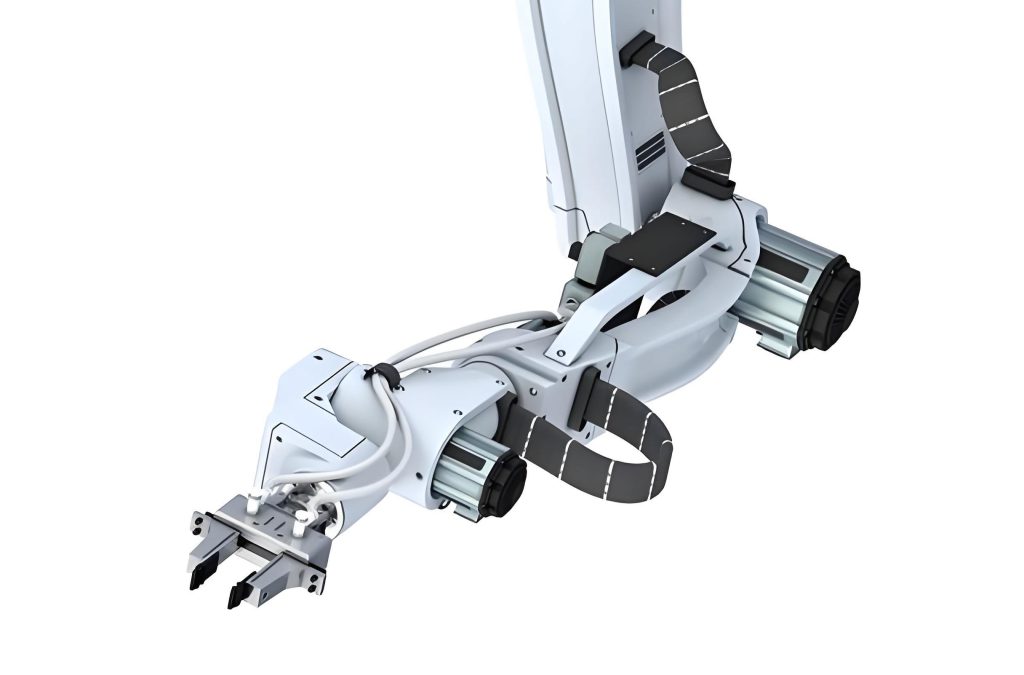
The end effector is engineered to perform capture, drag, and lock functions with high precision and reliability. It consists of several components: a capture assembly, a drag assembly, a locking assembly, a housing assembly, a six-dimensional force sensor, and a quick-connect device. The capture assembly utilizes a wire-rope winding mechanism to achieve large-tolerance, low-impact capture of the target adapter’s capture rod. Following capture, the drag assembly pulls the target adapter axially, aligning it with the end effector’s housing to correct pitch, yaw, and roll errors. Finally, four independent locking mechanisms synchronously apply preload forces to secure the interface and establish electrical connections. This multi-step process ensures robust performance in space, where conditions are unforgiving. The end effector’s design allows for interchangeable use as the shoulder or wrist of the robotic arm, extending operational range during crawling maneuvers on the space station.
To quantify the end effector’s capabilities, we define capture tolerance as the allowable relative displacement and rotation between the end effector coordinate frame (denoted as \(F_{EE}\)) and the target adapter capture coordinate frame (denoted as \(F_B\)). Mathematically, this can be expressed using a homogeneous transformation matrix:
$$
T_{EE}^{B} = \begin{bmatrix} R & \mathbf{d} \\ \mathbf{0}^T & 1 \end{bmatrix}
$$
where \(R\) is a 3×3 rotation matrix representing orientation, and \(\mathbf{d} = [d_x, d_y, d_z]^T\) is the displacement vector. The capture tolerance limits are specified for both positional and angular deviations. For instance, positional tolerance requires deviations up to 100 mm in any direction, while angular tolerance allows up to 10° in roll and 15° in pitch and yaw. These tolerances ensure that the end effector can accommodate uncertainties in target positioning during space operations.
Ground verification demands simulating these tolerances under various conditions. Our requirements include testing with six-DOF pose deviations, resistance forces and moments, and different target masses. Specifically, the end effector must capture targets with masses adjustable from 100 kg to 25,000 kg, with the center of mass continuously variable within a Φ4500 mm × 20000 mm volume. The verification system must achieve motion precision better than 0.2 mm in translation and 0.05° in rotation, with maximum linear and angular velocities of 100 mm/s and 8°/s, respectively. To meet these needs, we proposed a semi-physical test scheme that combines hardware-in-the-loop simulation with dynamic modeling.
The semi-physical verification system comprises a 6-DOF motion platform (Stewart platform), the end effector and target adapter products, six-dimensional force sensors, a control system, and a stiffness simulation module. The target adapter is mounted on the motion platform via a force sensor, which measures interaction forces during tests. The platform simulates the target’s initial pose, mass properties, and dynamic behavior in microgravity. The stiffness module replicates the robotic arm’s flexibility to prevent system instability under rigid boundary conditions. The end effector is fixed above the target adapter, also connected to a force sensor. During tests, force data from the sensors are fed into a dynamics model of the robotic arm and target, computing the next relative pose. The motion platform then reproduces this pose in real-time, creating a closed-loop simulation. This approach allows for accurate emulation of space conditions, as described by the following dynamics equation:
$$
M(\mathbf{q})\ddot{\mathbf{q}} + C(\mathbf{q}, \dot{\mathbf{q}})\dot{\mathbf{q}} + G(\mathbf{q}) = \boldsymbol{\tau} + \mathbf{J}^T \mathbf{F}_{ext}
$$
where \(M\) is the mass matrix, \(C\) represents Coriolis and centrifugal terms, \(G\) is the gravity vector, \(\boldsymbol{\tau}\) denotes joint torques, \(\mathbf{J}\) is the Jacobian matrix, and \(\mathbf{F}_{ext}\) is the external force measured by the sensors. By compensating for gravity in the model, we simulate zero-gravity effects on the ground.
Calibration of the semi-physical system was crucial to ensure accuracy. After assembly and debugging, we conducted extensive tests to evaluate static precision, maximum velocities, workspace, and tracking accuracy. The results are summarized in tables below. Table 1 presents the tracking accuracy for translational and rotational motions along different axes, demonstrating the system’s ability to follow desired trajectories with minimal error. Tables 2 and 3 provide additional data on frequency response characteristics, which are essential for dynamic simulations. Table 4 lists the measured stiffness values of the simulation module, ensuring compatibility with the robotic arm’s flexibility.
| Parameter | x-direction | Rx-direction |
|---|---|---|
| Frequency (Hz) | 0.1, 3, 8 | 0.1, 3, 8 |
| Amplitude (mm or °) | 50, 4, 1 | 1, 0.2, 0.05 |
| Amplitude Ratio (dB) | -0.0019, -0.3948, -2.1581 | -0.0013, -0.4547, -2.4296 |
| Phase Lag (°) | 1.4, 21.6, 53.9 | 1.43, 21.6, 52.4 |
| Parameter | y-direction | Ry-direction |
|---|---|---|
| Frequency (Hz) | 0.1, 3, 8 | 0.1, 3, 8 |
| Amplitude (mm or °) | 50, 4, 2 | 1, 0.2, 0.05 |
| Amplitude Ratio (dB) | -0.0023, -0.3943, -2.4988 | -0.0035, -0.5513, -2.4988 |
| Phase Lag (°) | 1.4, 21.6, 47.8 | 1.42, 22.572, 51.3 |
| Parameter | z-direction | Rz-direction |
|---|---|---|
| Frequency (Hz) | 0.1, 3, 8 | 0.1, 3, 8 |
| Amplitude (mm or °) | 50, 4, 1 | 1, 0.2, 0.05 |
| Amplitude Ratio (dB) | -0.0021, -0.4382, -2.1581 | -0.0022, -0.4638, -2.4066 |
| Phase Lag (°) | 1.44, 21.6, 52.4 | 1.4, 21.6, 50.7 |
| Direction | Stiffness Value |
|---|---|
| x-direction (N/m) | 1.25 × 10⁵ |
| y-direction (N/m) | 2.6 × 10⁵ |
| z-direction (N/m) | 2.8 × 10⁵ |
| Rx-direction (Nm/rad) | 8 × 10⁴ |
| Ry-direction (Nm/rad) | 9 × 10³ |
| Rz-direction (Nm/rad) | 1.2 × 10⁴ |
The overall system performance met our requirements: translational precision of ±0.2 mm, rotational precision of ±0.01°, maximum linear velocity of 120 mm/s, angular velocity of 10°/s, and a workspace with radial displacement up to ±150 mm, axial displacement up to 400 mm, roll angles up to ±15°, and pitch/yaw angles up to ±25°. These specifications enabled comprehensive testing of the end effector under diverse conditions.
We conducted capture tolerance tests to validate the end effector’s ability to handle deviations. Tests included single-direction and combined tolerances, as outlined in Table 5. For each case, we set initial pose errors between the end effector and target adapter, applied resistance forces (e.g., radial force of 240 N, axial force of 400 N, resistance moment of 100 Nm), and initiated capture commands. The end effector successfully captured the target in all scenarios, demonstrating compliance with tolerance limits. The capture process involved the end effector overcoming resistances and aligning the target adapter, with force sensor data and motor currents within design ranges. This confirms that the end effector can achieve single-direction tolerances of 100 mm positionally and 10° to 15° angularly, and combined tolerances of 50 mm positionally and 2° angularly.
| Condition | Pose Deviation (x, y, z; Rx, Ry, Rz) |
|---|---|
| 1 | (0 mm, -100 mm, 0 mm; 0°, 0°, 0°) |
| 2 | (0 mm, 100 mm, 0 mm; 0°, 0°, 0°) |
| 3 | (0 mm, 0 mm, 100 mm; 0°, 0°, 0°) |
| 4 | (0 mm, 0 mm, -100 mm; 0°, 0°, 0°) |
| 5 | (0 mm, 0 mm, 0 mm; 10°, 0°, 0°) |
| 6 | (0 mm, 0 mm, 0 mm; -10°, 0°, 0°) |
| 7 | (0 mm, 0 mm, 0 mm; 0°, 15°, 0°) |
| 8 | (0 mm, 0 mm, 0 mm; 0°, -15°, 0°) |
| 9 | (0 mm, 0 mm, 0 mm; 0°, 0°, 15°) |
| 10 | (0 mm, 0 mm, 0 mm; 0°, 0°, -15°) |
| 11 | (50 mm, 50 mm, 50 mm; 2°, 2°, 2°) |
| 12 | (-50 mm, -50 mm, -50 mm; -2°, -2°, -2°) |
Furthermore, we tested the end effector’s capability to grasp a massive floating target of 25 tons. The target was simulated with dimensions of Φ4.5 m × 18 m, mass uniformly distributed, and the target adapter located at the center of the Φ4.5 m end face. The mass moments of inertia were set as \(I_x = 63,300 \, \text{kg} \cdot \text{m}^2\) and \(I_y = I_z = 706,000 \, \text{kg} \cdot \text{m}^2\). An initial pose deviation of (50 mm, 50 mm, 50 mm; 2°, 2°, 2°) was applied, and the system operated in dynamics control mode. The end effector reliably captured the target, with force and moment data recorded during the process. The maximum forces and moments observed are summarized in Table 6, occurring during the drag phase when contact collisions happened. The target adapter’s trajectory, shown in Figure 8 (though not referenced directly, we describe it), indicated axial movement of 128 mm and minor radial adjustments, confirming proper alignment during capture.
| Extreme | Fx (N) | Fy (N) | Fz (N) | Mx (Nm) | My (Nm) | Mz (Nm) |
|---|---|---|---|---|---|---|
| Maximum | 304.264 | 146.85 | 103.886 | 732.658 | 162.025 | 396.96 |
| Minimum | -315.18 | -116.38 | -108.75 | -728.12 | -103.41 | -117.52 |
The success of these tests underscores the end effector’s robustness. In orbital operations, the end effector has been validated through numerous captures, supporting tasks such as extravehicular crawling, inspections, astronaut assistance, and spacecraft repositioning. This real-world performance aligns with our ground verification results, demonstrating the reliability of our semi-physical approach.
In conclusion, our study highlights several key achievements. First, we developed a semi-physical verification system that effectively simulates space conditions for testing the robotic arm’s end effector. The system offers high precision, ample workspace, and dynamic fidelity, enabling validation under multiple scenarios including complex boundaries, large loads, and extensive tolerances. Second, we verified that the end effector meets capture tolerance requirements, with single-direction deviations up to 100 mm positionally and 10° to 15° angularly, and combined deviations of 50 mm and 2°. Third, we demonstrated the end effector’s ability to grasp targets as massive as 25 tons, a critical capability for space station operations. The data from our tests can refine simulation models for in-orbit mission planning, enhancing prediction accuracy. Overall, this research contributes to advancing space robotics by providing a reliable ground verification methodology for end effector performance, ensuring mission success in challenging space environments.
Future work may involve extending the semi-physical system to test more dynamic scenarios, such as high-speed captures or multi-arm collaborations. Additionally, integrating artificial intelligence for adaptive control could further improve the end effector’s autonomy. As space missions evolve, the role of the end effector will continue to be central, and our verification techniques will support ongoing innovations in space technology.