
In modern agriculture, the cultivation of vegetables through seedling transplantation is a predominant method, leveraging advantages such as optimized use of light and thermal resources and enhanced yield. However, the presence of empty holes in seedling trays, resulting from factors like seed quality and育苗 environmental conditions, poses a significant challenge to fully automated transplanting systems. To address this issue, a specialized end effector for supplementing pot seedlings during the cotyledon phase has been developed. This end effector is designed to extract both seedling-free substrate and intact pot seedlings from tray holes, enabling efficient补苗 operations. The following article详细 describes the design, experimental methodology, and results associated with this innovative end effector, emphasizing its performance under varying substrate compositions, moisture levels, and seedling ages.
The core innovation lies in the end effector’s ability to handle delicate cotyledon-phase seedlings, which are characterized by tender foliage, underdeveloped root systems, and松散 substrate structures. Traditional seedling extraction mechanisms, such as ejection-type or clamping-type end effectors, are often unsuitable for this stage as they may cause damage or substrate disintegration. Therefore, a novel包裹式 design was conceived, wherein four synchronized seedling shovels surround the seedling plug, forming an近乎 enclosed structure that minimizes stress on the plant and substrate during extraction and transplantation.
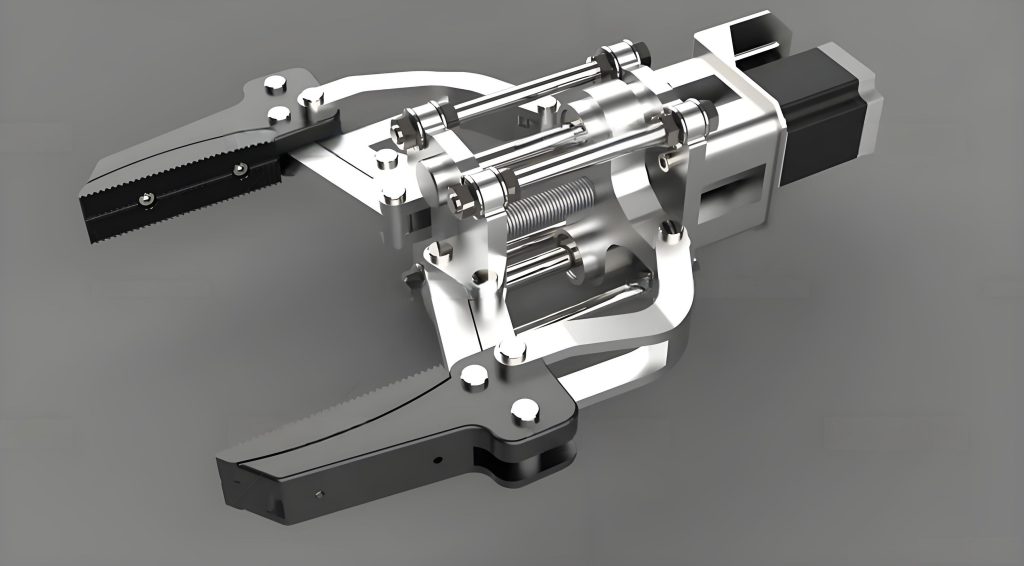
The structural design of the pot-seedling supplementing end effector is based on geometric constraints derived from standard 72-cell seedling trays. Each cell typically has a truncated pyramid shape with specified dimensions. The key parameters for the end effector’s seedling shovels must satisfy the following relationships to ensure proper insertion and extraction without damaging the seedlings:
$$ 0.5M \leq 0.5m \sin\alpha $$
$$ N \leq n $$
$$ H \leq h $$
$$ L \geq l $$
Where \( M \) is the half-angle width at the top of the seedling shovel (mm), \( N \) is the half-angle width at the bottom of the shovel (mm), \( H \) is the insertion length of the shovel along the cell wall (mm), \( L \) is the distance between the lower surface of the base platform and the top plane of the cell (mm), \( m \) is the internal size of the cell top (mm), \( n \) is the internal size of the cell bottom (mm), \( h \) is the cell depth (mm), \( l \) is the height of the seedling in the late cotyledon phase (mm), and \( \alpha \) is the semi-cone angle of the cell’s longitudinal symmetric plane (°). For a standard 72-cell tray with top dimensions of 38 mm × 38 mm, bottom dimensions of 19 mm × 19 mm, and depth of 45 mm, the calculated and rounded parameters are \( M = 16.5 \) mm, \( N = 8.0 \) mm, \( H = 40.0 \) mm, \( L = 60.0 \) mm, and \( \alpha = 12^\circ \).
The mechanical resistance during shovel insertion is primarily due to the shear strength of the substrate, which for peat-based mixtures can be described by the Mohr-Coulomb failure criterion:
$$ \tau = c + k\sigma $$
Here, \( \tau \) is the shear strength of the peat soil (Pa), \( c \) is the cohesion of the peat soil (Pa), \( k \) is the internal friction coefficient, and \( \sigma \) is the normal stress (Pa). The insertion force \( F \) (N) can be estimated as:
$$ F = \tau S $$
where \( S \) is the area of the shovels in contact with the substrate (m²). Assuming a cohesion value \( c = 3.4 \) MPa based on peat soil shear tests, the maximum insertion force was calculated to be approximately 8.54 N, guiding the selection of components such as the ball screw mechanism and stepper motor for the end effector.
The operational sequence of this补苗 end effector involves several precise steps: positioning above the target cell, descending, inserting the shovels to envelop the seedling plug, extracting the plug, translating to the destination cell, descending again, retracting the shovels to deposit the plug, and finally ascending. This sequence ensures minimal disturbance to both the seedling and the surrounding substrate.
To evaluate the performance of this end effector, a series of experiments were conducted using tomato pot seedlings (variety Zheza 809) cultivated in standard 72-cell trays. The substrate consisted of mixtures of peat, vermiculite, and perlite in different volume ratios. The experimental factors investigated were substrate composition (volume ratios of peat:vermiculite:perlite), substrate moisture content (%), and seedling age (days). The primary performance metric was the substrate net rate, defined as the percentage of the substrate mass extracted from the cell relative to the total substrate mass initially present in the cell. This metric is crucial for assessing the end effector’s ability to extract seedlings intact.
The substrate net rate \( P \) is calculated as:
$$ P = \frac{m_b}{m_a} \times 100\% $$
where \( m_a \) is the total mass of the pot seedling before extraction (g), and \( m_b \) is the mass of the pot seedling after extraction (g). A successful extraction was defined as achieving a substrate net rate greater than 75%, based on prior studies indicating that tomato seedlings can maintain structural integrity even with some substrate loss.
Additional performance metrics included the success rate for extracting seedling-free substrate \( k_n \), the success rate for extracting pot seedlings \( k_s \), and the success rate for supplementing seedlings \( k_b \), defined as follows:
$$ k_n = \frac{X_{ns}}{X_{nt}} \times 100\% $$
$$ k_s = \frac{X_{ss}}{X_{st}} \times 100\% $$
$$ k_b = \frac{X_{bs}}{X_{bt}} \times 100\% $$
Here, \( X_{ns} \) is the number of cells where the substrate net rate for empty substrate extraction exceeded 75%, \( X_{nt} \) is the total number of empty cells extracted, \( X_{ss} \) is the number of cells where the substrate net rate for seedling extraction exceeded 75%, \( X_{st} \) is the total number of seedling cells extracted, \( X_{bs} \) is the number of cells where the substrate retention rate after supplementation exceeded 75%, and \( X_{bt} \) is the total number of seedlings supplemented. The substrate retention rate \( \lambda \) after supplementation is given by:
$$ \lambda = \frac{m_c}{m_a} \times 100\% $$
with \( m_c \) being the mass of the pot seedling after deposition into the target cell (g).
A three-factor, three-level orthogonal experimental design (L9 array) was employed to systematically study the effects of the chosen factors on the substrate net rate. The factors and their levels are summarized in Table 1.
| Factor | Level 1 | Level 2 | Level 3 |
|---|---|---|---|
| Substrate Composition (A) | 2:2:1 | 6:3:1 | 7:2:1 |
| Substrate Moisture Content (B) % | 67.1 | 74.1 | 79.2 |
| Seedling Age (C) days | 16 | 21 | 26 |
Each test combination was replicated 24 times, and the average substrate net rate was recorded. The experimental setup included a two-dimensional motion platform for precise positioning of the end effector. The insertion and retraction speeds of the seedling shovels were set at 30 mm/s, while the overall lifting and平移 speeds were 720 mm/s and 800 mm/s, respectively. Measured average speeds during operation were 29.85 mm/s for insertion and 31.12 mm/s for retraction.
The results of the orthogonal experiments are presented in Table 2, showing the average substrate net rate for each test condition.
| Test No. | Substrate Composition (A) | Moisture Content (B) % | Seedling Age (C) days | Average Substrate Net Rate % |
|---|---|---|---|---|
| 1 | 2:2:1 | 67.1 | 16 | 82.80 |
| 2 | 2:2:1 | 74.1 | 21 | 83.60 |
| 3 | 2:2:1 | 79.2 | 26 | 89.45 |
| 4 | 6:3:1 | 74.1 | 26 | 83.36 |
| 5 | 6:3:1 | 79.2 | 16 | 78.18 |
| 6 | 6:3:1 | 67.1 | 21 | 71.52 |
| 7 | 7:2:1 | 79.2 | 21 | 77.83 |
| 8 | 7:2:1 | 67.1 | 26 | 85.25 |
| 9 | 7:2:1 | 74.1 | 16 | 83.45 |
Analysis of variance (ANOVA) was performed on the data to determine the significance of each factor. The results are shown in Table 3.
| Source of Variation | Sum of Squares | Degrees of Freedom | Mean Square | F Value | Significance |
|---|---|---|---|---|---|
| Substrate Composition (A) | 0.009 | 2 | 0.004 | 48.507 | Significant (P < 0.05) |
| Moisture Content (B) | 0.002 | 2 | 0.001 | 10.881 | Not Significant |
| Seedling Age (C) | 0.011 | 2 | 0.005 | 58.384 | Significant (P < 0.05) |
| Error | 0.000 | 2 | 9.021E-5 |
The ANOVA indicates that both substrate composition and seedling age have a significant influence on the substrate net rate achieved by the end effector, while substrate moisture content does not show a statistically significant effect within the tested range. However, moisture content still plays a role in the substrate’s cohesiveness and plasticity.
Range analysis was further conducted to identify the optimal combination of factors for maximizing the substrate net rate. The ranges for each factor were calculated as follows: seedling age (C) had the largest range of 8.3%, substrate composition (A) had a range of 7.6%, and moisture content (B) had the smallest range. The optimal combination was determined to be C3A1B2, corresponding to a seedling age of 26 days, a substrate composition of 2:2:1 (peat:vermiculite:perlite), and a moisture content of 74.1%. Under these conditions, the average substrate net rate reached 89.45%, demonstrating the end effector’s high efficiency in extracting intact pot seedlings.
To validate the performance of the end effector under optimal conditions, a separate set of experiments was conducted using tomato pot seedlings with an age of 26 days, substrate composition of 2:2:1, and an average moisture content of 75.5%. The end effector was tasked with extracting empty substrate, extracting pot seedlings, and supplementing seedlings into target cells. The results are summarized in Table 4.
| Operation Type | Number of Cells Tested | Success Rate % |
|---|---|---|
| Empty Substrate Extraction | 80 | 100 |
| Pot Seedling Extraction | 160 | 100 |
| Seedling Supplementation | 192 | 100 |
The results confirm that the designed end effector achieves perfect success rates across all operations under the specified conditions. This demonstrates its robustness and suitability for automating the seedling supplementing process during the cotyledon phase. The包裹式 design effectively handles the delicate nature of young seedlings, preserving the integrity of both the plant and the substrate plug.
In conclusion, the development of this specialized end effector addresses a critical bottleneck in fully automated vegetable transplanting systems. By enabling the efficient removal of empty substrate and the transplantation of healthy pot seedlings during the cotyledon phase, this end effector contributes to the production of uniform, gap-free seedling trays. The experimental findings highlight the importance of substrate composition and seedling age on extraction performance, providing practical guidelines for育苗 management. Future work could explore the integration of this end effector with machine vision systems for autonomous detection of empty cells and adaptive control strategies. Overall, this end effector represents a significant advancement in agricultural robotics, offering a reliable solution for enhancing the automation of vegetable production.
The design principles and experimental insights presented here can be extended to other crop species and育苗 systems, further promoting the adoption of automation in horticulture. Continuous refinement of the end effector’s mechanical design and control algorithms will likely yield even greater performance and versatility. As the demand for efficient and sustainable agricultural practices grows, innovations like this pot-seedling supplementing end effector will play an increasingly vital role in modern farming.