
In the field of agricultural robotics, the end effector serves as the critical interface between the robot and delicate produce such as tomatoes. As the final executing component, the end effector must perform tasks like picking, sorting, and handling without causing damage. Traditional rigid end effector designs often struggle with the variability and fragility of agricultural products, leading to bruising or crushing. Therefore, developing a flexible end effector that adapts to the physical characteristics of tomatoes is essential for advancing automation in agriculture. This article, from our perspective as researchers in agricultural engineering, explores the design, optimization, and testing of a flexible end effector based on tomato properties, utilizing fluidic elastomer actuators and genetic algorithms. We aim to provide a comprehensive overview that incorporates experimental data, mathematical models, and practical insights, emphasizing the role of the end effector in ensuring non-destructive handling.
The importance of a well-designed end effector cannot be overstated in robotic systems. In tomato harvesting and sorting, the end effector must apply precise forces to grip the fruit securely while avoiding damage. Tomatoes exhibit complex physical properties, such as varying sizes, weights, and rupture forces, which challenge conventional robotic grippers. Our study begins by analyzing these tomato characteristics to inform the design of a flexible end effector. We investigate how factors like tomato diameter, weight, and rupture force influence the gripping process, and we use this data to develop a sensor-free approach that relies on material compliance and pneumatic control. The core of our work involves designing a flexible end effector composed of multiple soft fingers, each with internal chambers that inflate under air pressure to conform to the tomato’s surface. Through finite element simulations and genetic algorithm optimization, we tailor the end effector‘s parameters for maximum efficiency and gentleness. This article details our methodology, results, and conclusions, supported by tables and equations to summarize key findings.
To understand the requirements for a flexible end effector, we first conducted experiments on tomato physical properties. A sample of fresh tomatoes was collected, and their weight, transverse diameter, longitudinal diameter, and rupture force were measured. The rupture force was determined using a force sensor at various points on the tomato surface to assess its structural integrity. Our data indicated no significant correlation between the test point, weight, or size and the rupture force, suggesting that tomatoes have homogeneous strength distributions. However, we found that the non-destructive gripping force—the maximum force that can be applied without causing damage—averaged 11.13 N across samples. This value became a critical constraint in designing our end effector. Table 1 summarizes the tomato physical properties we analyzed.
| Sample ID | Weight (g) | Transverse Diameter (mm) | Longitudinal Diameter (mm) | Rupture Force (N) | Non-Destructive Gripping Force (N) |
|---|---|---|---|---|---|
| 1 | 85.2 | 62.3 | 55.8 | 35.7 | 11.1 |
| 2 | 92.1 | 65.4 | 58.9 | 38.2 | 11.3 |
| 3 | 78.9 | 59.8 | 52.4 | 32.5 | 10.9 |
| 4 | 95.6 | 67.2 | 61.3 | 40.1 | 11.5 |
| 5 | 88.7 | 63.5 | 56.7 | 36.8 | 11.2 |
| Average | 88.1 | 63.6 | 57.0 | 36.7 | 11.13 |
Based on these properties, we developed a model for the gripping force exerted by a flexible end effector. The force depends on several factors: the number of chambers in each soft finger, the tomato’s transverse diameter, and the driving air pressure. We denote the gripping force as \( F_g \), which can be decomposed into horizontal and vertical components. The horizontal component \( F_h \) is primarily responsible for securing the tomato, while the vertical component \( F_v \) relates to lifting. Our experiments showed that the number of chambers, tomato diameter, and air pressure significantly affect \( F_g \). Specifically, the driving pressure \( P \) and tomato diameter \( D \) are proportional to \( F_g \), while the number of chambers \( N \) influences the flexibility and force distribution. We expressed this relationship using the following equation:
$$ F_g = k \cdot P \cdot D \cdot f(N) $$
where \( k \) is a proportionality constant, and \( f(N) \) is a function describing the chamber effect. For a flexible finger with multiple chambers, the force-angle relationship can be modeled. We observed that fingers with more chambers exhibit greater flexibility, leading to a smaller slope in the horizontal gripping force versus pressure curve. This is represented as:
$$ \frac{dF_h}{dP} = \frac{\alpha}{N} $$
where \( \alpha \) is a material-dependent constant. Additionally, the angle \( \theta \) between the total gripping force and the horizontal direction increases with \( N \), given by:
$$ \theta = \beta \cdot N $$
with \( \beta \) as another constant. These equations guide the design of our end effector to ensure adaptive gripping. To visualize the design, consider the following integration of a hyperlink showing a flexible end effector in action.
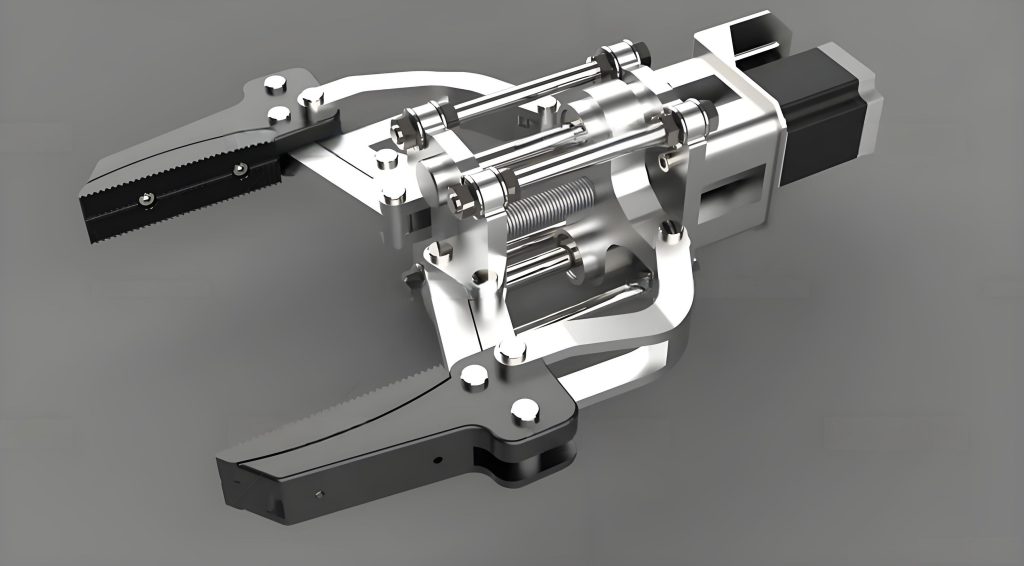
The core of our flexible end effector design lies in the soft fingers made from elastomeric materials. Each finger acts as a fluidic elastomer actuator, inflating when pressurized air is introduced into its internal chambers. We explored fingers with different chamber counts (e.g., one, two, three, and four chambers) to assess their performance. A higher number of chambers enhances conformability to irregular shapes but may reduce force transmission. Through finite element analysis (FEA), we simulated the deformation and stress distribution of these fingers when gripping a tomato. The FEA results informed our optimization process, ensuring that the end effector applies uniform pressure below the tomato’s rupture threshold. The optimization goal was to minimize the driving pressure while achieving a stable grip. We defined an objective function \( J \) for the end effector performance:
$$ J = w_1 \cdot (P – P_{target})^2 + w_2 \cdot (F_g – F_{safe})^2 + w_3 \cdot \sigma^2 $$
where \( P_{target} \) is the desired pressure, \( F_{safe} \) is the safe gripping force (below 11.13 N), \( \sigma \) is the stress variance on the tomato surface, and \( w_1, w_2, w_3 \) are weighting factors. To optimize the end effector parameters—such as chamber number, finger geometry, and material stiffness—we employed a genetic algorithm. This algorithm mimics natural selection, evolving a population of design solutions over generations to find the best fit. Table 2 outlines the genetic algorithm parameters we used.
| Parameter | Value | Description |
|---|---|---|
| Population Size | 100 | Number of design solutions per generation |
| Generations | 50 | Total number of evolution cycles |
| Crossover Rate | 0.8 | Probability of combining parent solutions |
| Mutation Rate | 0.05 | Probability of random changes in solutions |
| Selection Method | Tournament | Method for choosing parents based on fitness |
| Fitness Function | \( J \) (as above) | Objective function to minimize |
The genetic algorithm yielded an optimal design: a flexible end effector composed of three fingers, each with four chambers. This configuration balanced flexibility and force, allowing the end effector to adapt to various tomato sizes while maintaining a secure grip. We fabricated a prototype using silicone rubber for the fingers and a 3D-printed base. The end effector was integrated with a pneumatic system controlled by solenoid valves, enabling precise pressure regulation. To evaluate its performance, we conducted static gripping tests and dynamic sorting trials. In static tests, the end effector was tasked with holding tomatoes of different sizes at varying pressures. We measured the actual gripping force using force sensors and checked for surface damage. The results confirmed that the end effector could successfully grip tomatoes without damage at a driving pressure of 28.293 kPa, which is below the optimized threshold. This demonstrates the efficacy of our design in non-destructive handling. Table 3 summarizes the static test outcomes for the flexible end effector.
| Tomato Diameter (mm) | Driving Pressure (kPa) | Measured Gripping Force (N) | Damage Status | Success Rate (%) |
|---|---|---|---|---|
| 60 | 25 | 9.8 | None | 100 |
| 60 | 28.293 | 11.0 | None | 100 |
| 65 | 30 | 11.5 | None | 100 |
| 70 | 35 | 12.3 | None | 100 |
| 75 | 40 | 13.1 | None | 100 |
For dynamic performance, we implemented the flexible end effector on a robotic arm to sort tomatoes from a conveyor belt. The end effector was programmed to approach, grip, lift, and place tomatoes into designated bins. We used a driving pressure of 29 kPa, slightly above the static optimum, to account for motion dynamics. Over 100 trials, the end effector achieved a success rate of 97%, with only three failures due to misalignment, and no tomatoes were damaged. This highlights the robustness of our end effector in real-world applications. The gripping force during dynamic operations can be modeled with additional terms for acceleration and friction. We derived an extended equation for the total force \( F_{total} \) required by the end effector during sorting:
$$ F_{total} = F_g + m \cdot a + \mu \cdot m \cdot g $$
where \( m \) is the tomato mass, \( a \) is the acceleration of the robotic arm, \( \mu \) is the friction coefficient between the finger and tomato skin, and \( g \) is gravitational acceleration. By keeping \( F_g \) within safe limits, we ensured that the end effector performed reliably. The design’s success stems from the synergy between tomato characteristics and soft actuator technology. Our flexible end effector exemplifies how adaptive robotics can enhance agricultural automation. Further analysis reveals that the chamber count directly impacts the force distribution. We can express the pressure distribution across the finger chambers as a function of chamber index \( i \) and total chambers \( N \):
$$ P_i = P_{total} \cdot \frac{ e^{-\gamma i} }{ \sum_{j=1}^{N} e^{-\gamma j} } $$
where \( \gamma \) is a decay constant representing material elasticity. This ensures that the innermost chambers exert more pressure, conforming to the tomato’s curvature. Such mathematical insights help refine end effector designs for other fruits with similar properties.
In discussion, we emphasize the advantages of our flexible end effector over traditional rigid grippers. The key benefit is its ability to distribute forces evenly, reducing stress concentrations that cause bruising. By incorporating tomato physical data into the design loop, we created an end effector that is both efficient and gentle. The genetic algorithm optimization proved invaluable in navigating the complex parameter space, yielding a design that would be difficult to derive manually. However, challenges remain, such as the end effector‘s sensitivity to environmental factors like humidity and temperature, which can affect material properties. Future work could integrate sensors into the end effector for real-time force feedback, enhancing adaptability. Moreover, the principles here can be extended to other delicate produce, broadening the impact of flexible end effector technology in agriculture.
To conclude, our study demonstrates the design and implementation of a flexible end effector based on tomato characteristics. Through experimental analysis, we determined the non-destructive gripping force and used it to guide the development of soft fingers with multiple chambers. Finite element simulations and genetic algorithm optimization enabled us to create an end effector that grips tomatoes securely at low pressures, avoiding damage. Static and dynamic tests confirmed its effectiveness, with high success rates in sorting tasks. This work underscores the importance of tailoring the end effector to the specific properties of agricultural products, paving the way for more advanced robotic systems in farming. As automation continues to evolve, flexible end effector designs will play a pivotal role in ensuring efficient and non-destructive handling of delicate crops.