
The global demand for Agaricus bisporus, commonly known as the button mushroom, continues to rise due to its significant nutritional and economic value. However, the harvesting process remains predominantly manual, presenting major challenges in terms of labor intensity, consistency, and cost. The delicate nature of the mushroom cap, its susceptibility to bruising, and its frequent growth in dense clusters make mechanized harvesting particularly difficult. A critical component in any robotic harvesting system is the end effector—the device that interacts directly with the crop. Many existing end effector designs struggle to harvest mushrooms from tight clusters without causing significant mechanical damage, or they are only effective on isolated specimens. This work addresses these limitations by presenting the design, analysis, and experimental validation of a novel hybrid end effector that synergistically combines a negative-pressure vacuum cup with independently controllable, tendon-driven fingers.
The primary objective of our design was to create a versatile end effector capable of adapting to various mushroom distributions—from isolated to densely clustered. The core concept involves using a central vacuum cup for initial adhesion and primary lifting force, supplemented by articulating fingers that can navigate into narrow gaps between clustered mushrooms to apply lateral detachment forces. This combination aims to reduce the pressure and shear stress on any single contact point, thereby minimizing damage while successfully extracting target mushrooms from complex growth arrangements. The following sections detail the structural design, kinematic and static analysis, harvesting strategy, and comprehensive experimental results.
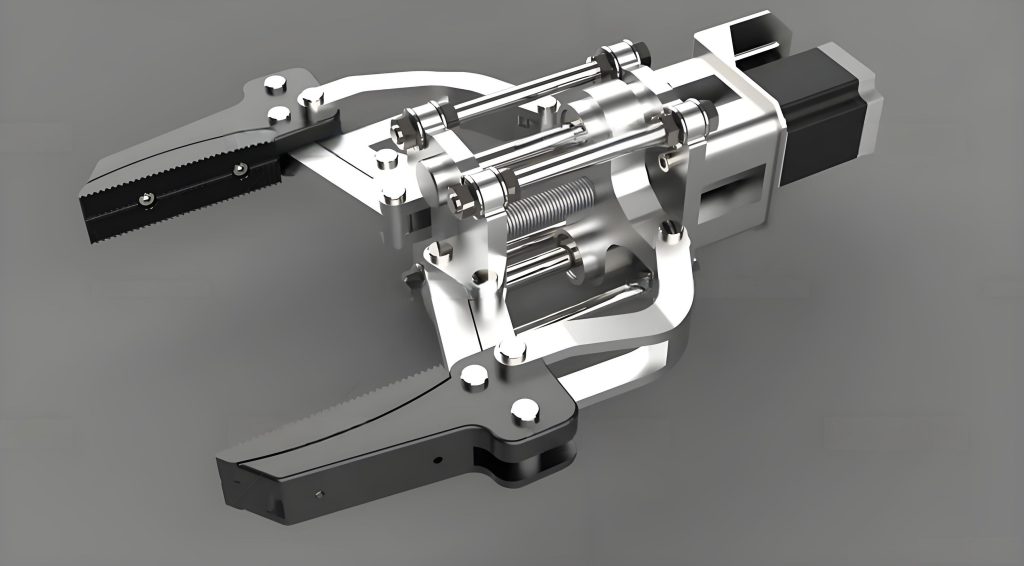
Structural Design of the Hybrid End Effector
The proposed end effector consists of two main functional subsystems integrated into a single unit: a vacuum suction system and a three-finger underactuated gripper mechanism. This integrated design allows for multiple harvesting modalities.
1.1 Overall Configuration
The end effector frame houses three servo motors, each dedicated to controlling one finger via a tendon (nylon wire) transmission system. A vacuum generator, connected to an external air compressor, supplies negative pressure to a centrally mounted bell-shaped silicone suction cup. The fingers are arranged at 120-degree intervals around the suction cup. Each finger is a three-phalange underactuated linkage, with joint revolute axes perpendicular to the finger’s plane of motion. Torsion springs are installed at each joint to provide the return force necessary for finger opening when the tendon tension is released. Key components include the servo motors, torsion springs, tendon wires, finger phalanges, pivot pins, guide pulleys, and the vacuum cup.
1.2 Suction Cup Design and Force Analysis
The suction cup is responsible for the initial grasping and provides a significant portion of the vertical extraction force. The diameter of the cup is a critical parameter. Based on the typical harvest-size mushroom cap diameter range of 25–35 mm, a cup diameter \(D_c = 30\) mm was selected. This size ensures sufficient contact area with most mature mushrooms while minimizing interference with adjacent clustered mushrooms.
The theoretical adhesive force \(F_s\) provided by the vacuum cup is given by:
$$F_s = P \cdot A = \frac{\pi D_e^2 P}{4}$$
where \(P\) is the pressure difference (vacuum level) and \(D_e\) is the effective sealing diameter, approximately equal to \(D_c\). With a vacuum generator set to \(P = -50 \text{ kPa}\), the theoretical maximum adhesive force is:
$$F_s = \frac{\pi (0.03)^2 \cdot 50 \times 10^3}{4} \approx 35.3 \text{ N}$$
This force far exceeds the typical required extraction force for a single mushroom (approximately 3–6 N), providing a substantial safety margin and allowing the cup to compensate for imperfect seals or off-center alignment.
1.3 Finger Mechanism Design and Static Analysis
Each finger is designed as an underactuated, tendon-driven mechanism. The lengths of the proximal, medial, and distal phalanges are \(L_1 = 24 \text{ mm}\), \(L_2 = 22 \text{ mm}\), and \(L_3 = 21 \text{ mm}\), respectively. A key design feature is the inclusion of a hard-stop on the distal phalange, setting an initial abduction angle \(\theta_s\) relative to the medial phalange. This angle facilitates the insertion of the fingertip into the narrow spaces between clustered mushrooms.
The tendon routing passes from the servo drum, around guide pulleys at the base, and is fixed to a pin on the distal phalange, passing through pins on the medial and proximal phalanges. When the servo motor rotates, it winds the tendon, applying tension \(T_t\) that closes the finger joints against the restoring torque of the torsion springs. The free-body diagram for a finger making contact with a mushroom is complex. A simplified, static analysis for the most critical phase—when only the distal phalange is in contact—yields the force balance on the mushroom. Let \(F_N\) be the normal contact force from the distal phalange, \(f\) be the friction force, \(\phi\) be the contact angle, \(F_s\) be the suction force, \(T_{stem}\) be the stem’s resistive force, and \(mg\) be the mushroom’s weight. For successful detachment:
$$F_s + F_N \sin\phi + f \cos\phi – mg – T_{stem} > 0$$
The friction force is \(f = \mu F_N\), where \(\mu\) is the coefficient of friction between the finger material and the mushroom cap.
The required tendon tension and motor torque can be derived from the joint equilibrium equations. The torque provided by the torsion spring at joint \(i\) is \(T_{spr,i} = K_i \cdot \theta_i\), where \(K_i\) is the spring constant and \(\theta_i\) is the angular deflection. For a helical torsion spring, \(K_i = \frac{E d_i^4}{D_i^3 n_i}\), where \(E\) is the material’s elastic modulus, \(d_i\) is the wire diameter, \(D_i\) is the mean coil diameter, and \(n_i\) is the number of active coils. The equilibrium at the distal joint (Joint 3) involves the tendon tension moment arm and the contact force:
$$T_t \cdot r_{t3} = F_N’ \cdot L_3 + T_{spr,3}$$
where \(F_N’\) is the reaction force from the mushroom on the phalange (equal and opposite to \(F_N\)), and \(r_{t3}\) is the moment arm of the tendon tension about the joint. Similar equations can be written for the more proximal joints. The servo motor torque \(T_m\) must satisfy:
$$T_m \cdot r_{drum} \geq T_t + \text{losses due to friction in guides}$$
where \(r_{drum}\) is the radius of the servo’s output drum.
Based on these analyses and targeting a maximum finger pinch force in the range of 5–8 N, standard micro servo motors (torque ~1.6 N·cm) and appropriately sized torsion springs were selected. The key design parameters are summarized below.
| Component | Parameter | Value / Specification |
|---|---|---|
| Finger | Phalange Lengths (Proximal, Medial, Distal) | 24 mm, 22 mm, 21 mm |
| Initial Distal Phalange Angle (\(\theta_s\)) | 15° | |
| Actuation | Independent tendon-driven, underactuated | |
| Suction Cup | Diameter (\(D_c\)) | 30 mm |
| Operating Vacuum Pressure (\(P\)) | -50 kPa | |
| Actuators | Servo Motors (x3) | SG90-type, 1.6 N·cm torque |
| Torsion Springs | Joint 1 (Wire×OD×Coils×Angle) | 0.5 mm × 3.5 mm × 3 × 120° |
| Joint 2 (Wire×OD×Coils×Angle) | 0.4 mm × 3.5 mm × 3 × 120° | |
| Joint 3 (Wire×OD×Coils×Angle) | 0.3 mm × 4.0 mm × 3 × 120° |
Harvesting Strategy and Decision Logic
The operational effectiveness of this end effector hinges not only on its mechanical design but also on an intelligent strategy for deploying its fingers based on the spatial distribution of mushrooms.
2.1 Overall Harvesting Workflow
The complete robotic harvesting cycle involves perception, planning, and execution:
1. Perception: A vision system captures an image of the mushroom bed. A YOLO-based object detection algorithm identifies individual mushrooms and fits a bounding circle to each cap. The centroid of this circle \((x_i, y_i)\) in the image plane is calculated.
2. Localization & Planning: Using camera calibration parameters, the 2D image centroids are transformed into 3D spatial coordinates \((X_i, Y_i, Z_i)\) relative to the robot. A path planning algorithm (e.g., Ant Colony Optimization) sequences these picking points for optimal robot arm movement.
3. Execution & Decision: Upon reaching a target coordinate, the end effector executes a picking sequence. A critical step is deciding which fingers to activate based on the proximity of neighboring mushrooms.
2.2 Finger Deployment Decision Logic for Clusters
For an isolated mushroom, the default strategy is to use all three fingers simultaneously with the suction cup, enveloping the mushroom for secure and low-stress detachment. The challenge arises with clustered mushrooms. Let us consider a target mushroom (M1) and a neighboring mushroom (M2) growing in close proximity. Their fitted cap circles will intersect, defining a lens-shaped overlapping region. The line connecting the two circle intersection points (M and N) and the arc \(\overset{\frown}{MN}\) represent the zone of physical conflict.
The decision logic is as follows: The three fingertips (F1, F2, F3) have fixed angular positions (e.g., 0°, 120°, 240°) relative to the end effector center. Before initiating finger closure, the system checks the position of each prospective fingertip path against the conflict zones created by all neighboring mushrooms. Formally, for a given target mushroom \(i\) and neighbor \(j\):
– If the projected path of finger \(k\) intersects the conflict arc \(\overset{\frown}{MN}_{ij}\), then finger \(k\) is disabled for this picking attempt to avoid colliding with the neighbor.
– If the projected path is clear, finger \(k\) is enabled.
The goal is to maximize the number of enabled fingers (up to three) for each pick. For a mushroom in a tight cluster, often only one or two fingers may be deployable. The suction force \(F_s\) is always active as the primary grasping mechanism. This adaptive finger-gating strategy is what enables this end effector to operate in dense clusters where a standard full-envelopment gripper would fail.
Experimental Validation and Performance Analysis
A functional prototype of the end effector was fabricated using 3D-printed resin components for the structure and phalanges, integrated with the selected servo motors, springs, and a silicone suction cup. The system was tested on a bench-top setup and in a simulated growing bed with real Agaricus bisporus.
3.1 Experimental Setup and Evaluation Metrics
Tests were conducted to evaluate three distinct picking modes:
Mode V: Vacuum cup only (fingers retracted).
Mode F: Fingers only (vacuum disabled).
Mode V+F: Hybrid mode (vacuum and enabled fingers active).
The primary performance metrics were:
– Success Rate: Percentage of attempts where the mushroom was cleanly detached and deposited without being dropped or severely mutilated.
– Damage Rate: Percentage of successfully picked mushrooms showing visible mechanical damage (bruising, cuts, tearing). Damage was assessed using a reference scale comparing bruise discoloration depth and area. A bruise covering >5% of the cap surface area with significant discoloration was classified as damaged.
3.2 Results for Singly-Distributed Mushrooms
Approximately 100 mature, well-spaced mushrooms were harvested using each of the three modes. The results are consolidated below.
| Picking Mode | Attempts | Successes | Success Rate | Damage Rate | Key Observations |
|---|---|---|---|---|---|
| Vacuum Only (V) | 100 | ~81 | ~81% | ~16.7% | High failure rate due to seal breakage on uneven caps; damage from high localized suction pressure. |
| Fingers Only (F) | 100 | ~88 | ~88% | ~7.7% | Better grasp security than vacuum alone. Damage from fingernail-like pinching on the cap edge. |
| Hybrid (V+F) | 100 | ~93 | ~93% | ~2.1% | Highest success rate. Significantly lower damage as force is distributed between suction (normal) and fingers (lateral shear). |
The hybrid end effector (Mode V+F) demonstrated clear superiority for single mushrooms, achieving the highest success rate (93.1%) and the lowest damage rate (2.1%). The synergy between the adhesive force and the enveloping/cradling action of the fingers provides robust and gentle grasping.
3.3 Results for Clustered Mushrooms
This was the core challenge. Another 100 picking attempts were made on mushrooms growing in tight clusters, utilizing the finger-deployment decision logic. The hybrid mode (V+F) was used exclusively, but the number of active fingers varied (1, 2, or 3) based on the real-time assessment of the mushroom’s neighborhood.
| Test Batch | Attempts | Successes | Success Rate | Damage Rate | Avg. Fingers Used |
|---|---|---|---|---|---|
| 1 | 20 | 16 | 80.0% | 3.1% | 1.8 |
| 2 | 20 | 17 | 85.0% | 2.4% | 1.7 |
| 3 | 20 | 15 | 75.0% | 2.9% | 1.5 |
| 4 | 20 | 18 | 90.0% | 2.8% | 1.9 |
| 5 | 20 | 16 | 80.0% | 3.3% | 1.6 |
| Total/Average | 100 | 82 | 82.0% | 2.9% | ~1.7 |
The system achieved an 82% success rate in harvesting mushrooms from clusters—a challenging task for most mechanical systems—while maintaining a very low damage rate of 2.9%. Failures were primarily attributed to two factors: (1) loss of vacuum seal due to imperfect alignment with the often-tilted cap in a cluster, and (2) occasional jamming or slight misalignment of the tendon-driven fingers after many cycles. The adaptive use of fewer fingers (averaging 1.7 per pick in clusters vs. 3 for single mushrooms) was crucial to navigating the confined spaces.
Discussion and Conclusion
The experimental results validate the design hypothesis. The hybrid end effector successfully addresses key limitations in automated mushroom harvesting:
- Damage Reduction: By distributing the total required detachment force between the non-contact adhesive force of the suction cup and the controlled contact force of the compliant fingers, the pressure on the delicate mushroom tissue is minimized. This is reflected in the significantly lower damage rates compared to using either method alone.
- Cluster Harvesting Capability: The combination of a central suction point and discrete, independently controllable fingers, governed by a simple yet effective spatial decision logic, allows the end effector to access and extract mushrooms from dense clusters. This is a substantial advancement over end effector designs that can only handle isolated produce.
- Versatility and Robustness: The same end effector can seamlessly switch between a full three-finger envelopment grasp for easy picks and a precision one-finger-assist mode for difficult cluster picks, all while maintaining the constant, stabilizing benefit of vacuum prehension.
Future improvements could focus on enhancing robustness: using softer, conformable finger pad materials to further reduce contact stress; implementing closed-loop force control on the fingers via tendon tension sensors; and adding a rotational degree of freedom to the end effector wrist to optimally orient the fingers relative to the cluster geometry. In conclusion, the design and testing of this hybrid finger-vacuum end effector demonstrate a highly effective solution for the delicate and spatially complex task of robotic mushroom harvesting, offering a practical path toward automating this labor-intensive agricultural operation.