
The demand for high-performance optical instruments in fields like aerospace and laser radar has driven the need for larger-aperture optical imaging systems. The manufacturing of these large, high-precision optical elements presents significant challenges, particularly in the polishing phase, which is critical for achieving nanometer-level surface accuracy. Traditional manual polishing is no longer sufficient, leading to the development of deterministic computer-controlled polishing technologies. Among these, Computer Controlled Optical Surfacing (CCOS) with small tools is widely used, but it often suffers from edge effects—”turned-down” or “turned-up” edges—due to the mismatch between the tool’s motion and the workpiece curvature.
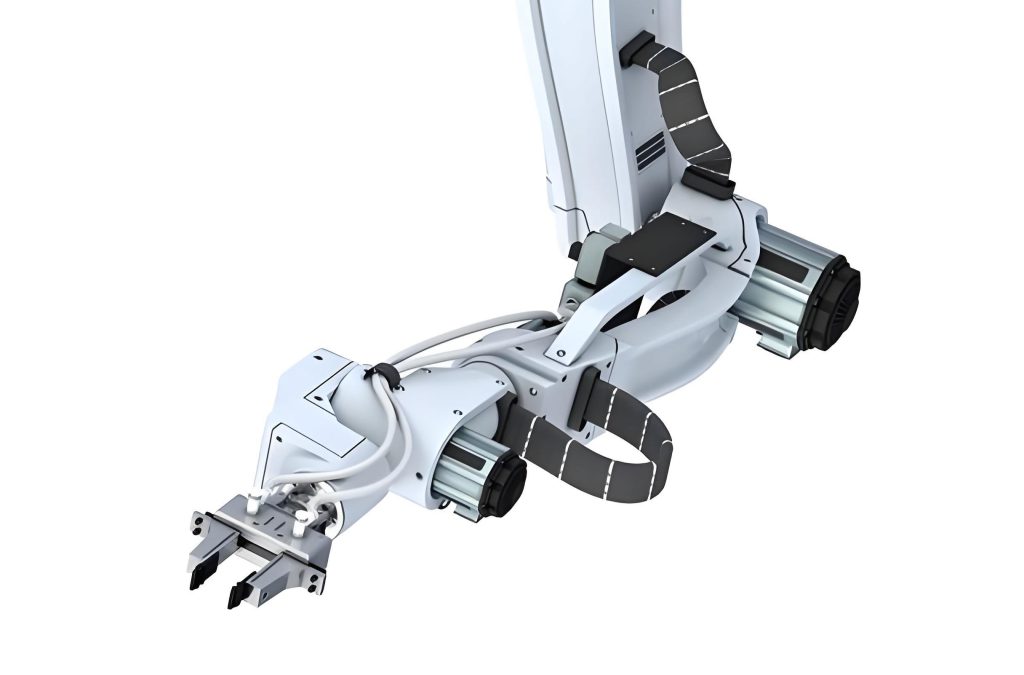
This research addresses this issue by developing a novel robotic end effector featuring a spherical polishing wheel. Industrial robots offer advantages such as a large workspace, high flexibility, and lower cost compared to traditional CNC machining centers, making them ideal platforms for intelligent optical manufacturing. The core innovation lies in the end effector’s design, which enables combined planetary and rotary motion of a spherical polishing tool. This motion profile aims to generate a more Gaussian-like removal function, thereby suppressing edge effects and improving polishing convergence for complex surfaces. This integrated end effector merges mechanical design, electronic control, and optical processing principles.
Theoretical Foundation and Removal Modeling
The design is grounded in deterministic polishing theory, primarily based on Preston’s equation, which models material removal rate (MRR):
$$ \Delta Z(x, y) = K \cdot P(x, y) \cdot V(x, y) \cdot \Delta t $$
where \( \Delta Z \) is the removal depth at point (x, y), \( K \) is the Preston constant, \( P \) is the local pressure, and \( V \) is the relative velocity. For a spherical tool, the pressure distribution \( P(x, y) \) during contact with a flat workpiece can be modeled using Hertzian contact theory. For a spherical elastic tool pressed against a rigid flat, the contact area is circular with radius \( a \), and the pressure distribution is hemispherical:
$$ P(x, y) = P_0 \sqrt[3]{1 – \frac{r^2}{a^2}} \quad \text{with} \quad r^2 = x^2 + y^2 $$
$$ a = \sqrt[3]{\frac{3F R_p (1-\nu^2)}{4E}} $$
Here, \( P_0 \) is the maximum pressure, \( F \) is the applied force, \( R_p \) is the spherical tool radius, and \( E \) and \( \nu \) are the elastic modulus and Poisson’s ratio of the tool material, respectively. For a tool with polyurethane rubber (30 HRB) and a glass workpiece, the material properties used in simulation are listed below:
| Material | Poisson’s Ratio (\( \nu \)) | Elastic Modulus (\( E \)) |
|---|---|---|
| Polyurethane | 0.48 | 1200 MPa |
| Glass | 0.20 | 72000 MPa |
The velocity distribution \( V(x, y) \) is derived from the superposition of the tool’s planetary motion (angular velocity \( \omega_z \)) and its rotary motion (angular velocity \( \omega_y \)). For a point on the contact patch at a distance \( r \) from the center of rotation, the combined velocity magnitude is:
$$ V(x, y) = \sqrt{(\omega_y R_p)^2 + (\omega_z r)^2 + 2 \omega_y R_p \omega_z r \cos \theta } $$
Combining the pressure and velocity models according to Preston’s equation yields the theoretical removal function \( R(r) \). Simulations confirm that under combined planetary and rotary motion, the removal profile approximates a desirable Gaussian distribution, which is central to effective and stable CCOS-based correction.
Mechanical Design of the Spherical Wheel End Effector
The primary design goal was to create a compact, modular end effector mountable on a standard six-axis industrial robot arm. The key specifications for the end effector, designated KJLP-1.0, are summarized below:
| Parameter | Target Value |
|---|---|
| Planetary Speed (\( \omega_1 \)) | 60 – 80 rpm |
| Rotary Speed (\( \omega_2 \)) | 140 – 400 rpm |
| Speed Ratio \( \omega_1 : \omega_2 \) | 1:1 to 1:10 |
| Spherical Polishing Wheel Radius | 30 mm |
| Total Weight | ~11 kg |
The central innovation is a single-motor drive system that generates the combined planetary and rotary motion. A servo motor’s output is split through a planetary gear system. The planet carrier provides the slow planetary motion to the entire U-shaped arm holding the polishing wheel. Simultaneously, the sun gear’s output is transmitted via a 1:1 bevel gear set and a synchronous belt drive to spin the spherical polishing wheel itself, creating the primary rotary motion. This ingenious design achieves the required dual-axis motion with one actuator, minimizing weight and complexity. A constant-force pneumatic actuator (xPush-250) is integrated into the end effector’s mounting structure to maintain a stable, programmable polishing pressure against the workpiece, a critical factor for a deterministic removal function.
Structural Analysis and Validation
Finite Element Analysis (FEA) was performed on critical components to ensure structural integrity and dynamic stability. Static analysis of the main drive shafts under operational loads showed maximum deformations on the order of micrometers, which is acceptable for the application. Modal analysis of the U-shaped polishing wheel holder was crucial to avoid resonance during operation. The first six natural frequencies were found to be significantly higher than the typical excitation frequencies from the robot and polishing process.
| Mode | Natural Frequency (Hz) |
|---|---|
| 1 | 520.87 |
| 2 | 587.89 |
| 3 | 669.82 |
| 4 | 747.08 |
| 5 | 1391.2 |
| 6 | 1603.7 |
An FEA simulation of the contact between the spherical polyurethane wheel and a glass workpiece under a 30 N load visualized the pressure distribution and confirmed the circular contact patch, aligning with the Hertzian model.
Robotic Integration and Trajectory Planning
The end effector was integrated with a KUKA KR210 R2700 industrial robot. To achieve precise polishing, accurate alignment between the robot’s world coordinate system and the workpiece was essential. A measurement procedure using a dial indicator mounted on the end effector was developed to determine the position and orientation of the optical workpiece relative to the robot base. Offline programming software was then used to generate and simulate polishing paths. A raster scan pattern was chosen for its simplicity and effectiveness in covering large areas. The tool center point (TCP) speed, path spacing, and approach/retract points were all programmed to ensure smooth, collision-free operation.
Experimental Verification and Polishing Results
The performance of the robotic end effector was validated through two key experiments. First, the constant-force output of the pneumatic actuator was tested, confirming a stable force output with a fluctuation within ±0.2 N, which is suitable for precision polishing.
Second, a spot polishing test was conducted on a ∅145 mm flat glass sample to characterize the removal function under different parameters. Six spots were polished with varying pressure and tool rotation speed, each with a dwell time of 10 seconds. The resulting removal profiles were measured with a Zygo interferometer. The data confirmed that the removal function was Gaussian-like and that both pressure and speed directly influenced the removal rate and spot size, consistent with Preston’s law.
| Spot # | Force (N) | Motor Speed (rpm) | Max Removal (nm) | Spot Dia. (mm) |
|---|---|---|---|---|
| 1 | 10 | 140 | 59.97 | 10.6 |
| 2 | 20 | 140 | 88.03 | 11.7 |
| 3 | 30 | 140 | 101.58 | 13.2 |
| 4 | 20 | 100 | 76.08 | 11.7 |
| 5 | 20 | 140 | 85.97 | 11.7 |
| 6 | 20 | 200 | 73.06 | 11.7 |
The final and most significant test involved full-surface polishing of a ∅360 mm concave aspheric mirror (base radius R=2400 mm). The end effector was programmed with a raster path. After approximately 22 polishing iterations totaling 66 hours of machine time, the surface was significantly improved. The final surface form error was reduced to PV = 301.536 nm (0.95λ) and RMS = 98.770 nm (0.156λ), as measured by interferometry. Critically, no pronounced edge effect (turned edge) was observed, demonstrating the end effector’s capability to effectively suppress this common polishing artifact.
Conclusion and Outlook
This research successfully designed, built, and validated a robotic spherical wheel polishing end effector. The KJLP-1.0 end effector successfully integrates constant-force control and combined planetary-rotary motion into a single, robot-mountable package. Experimental results confirm its ability to produce a Gaussian-like removal function and effectively polish optical surfaces, including aspheres, while mitigating edge effects. This work demonstrates the strong potential of combining industrial robotics with advanced polishing tool design to create flexible, intelligent optical manufacturing systems. Future work could focus on further miniaturization and weight reduction of the end effector, exploring different wheel sizes and hardness for specific applications, and implementing more advanced, non-raster toolpath strategies (e.g., Hilbert curves) to further optimize mid-spatial frequency error control.