
In the realm of industrial automation, the end effector serves as the critical interface between a robot and its environment, directly influencing task performance, precision, and versatility. As an educator and practitioner in robotics, I have observed that many training platforms, including those used in vocational institutions, often employ outdated end effector designs that limit pedagogical effectiveness and alignment with industry standards. Specifically, traditional parallel-gripper end effectors with single-degree-of-freedom mechanisms exhibit drawbacks such as large volume, restricted workspace, low tool handling accuracy, and inadequate functionality for modern certification requirements like the Industrial Robot Application Programming “1+X” certificate. This misalignment creates a significant gap between training equipment and real-world automated production systems, hindering students’ ability to acquire relevant skills. To address this, I embarked on a project to redesign and improve the end effector for an ABB IRB 120 industrial robot used in a training platform, drawing inspiration from advanced systems like the Huibo Industrial Robot Application Programming “1+X” assessment platform. The goal was to enhance grasping and moving capabilities through mechanical, pneumatic, and electrical optimizations, thereby elevating the end effector’s reliability, efficiency, and adaptability for diverse tasks.
The original end effector on our training robot was a clamp-style parallel-moving gripper with a single degree of freedom. It utilized a sliding groove mechanism for parallel linkage, featuring polygonal jaws with an opening range of approximately 25 mm and lacking a locking device. This design resulted in several inefficiencies: the bulky structure reduced operational workspace, the absence of locking mechanisms compromised grip stability and precision during tool changes, and the limited functionality restricted the variety of training exercises that could be conducted. Moreover, it failed to meet the comprehensive demands of the “1+X” certification, which requires proficiency in tasks such as precision picking, placement, and tool switching—common in contemporary manufacturing settings. By analyzing the Huibo platform, which incorporates quick-change devices and multi-functional end effectors, I identified key areas for improvement: implementing a secure locking mechanism with fail-safe features, optimizing pneumatic circuits for reliable actuation, and integrating sensor-based electrical systems for confirmation and control. This holistic approach aims to transform the end effector into a robust, industry-relevant component that supports enhanced learning outcomes and skill development.
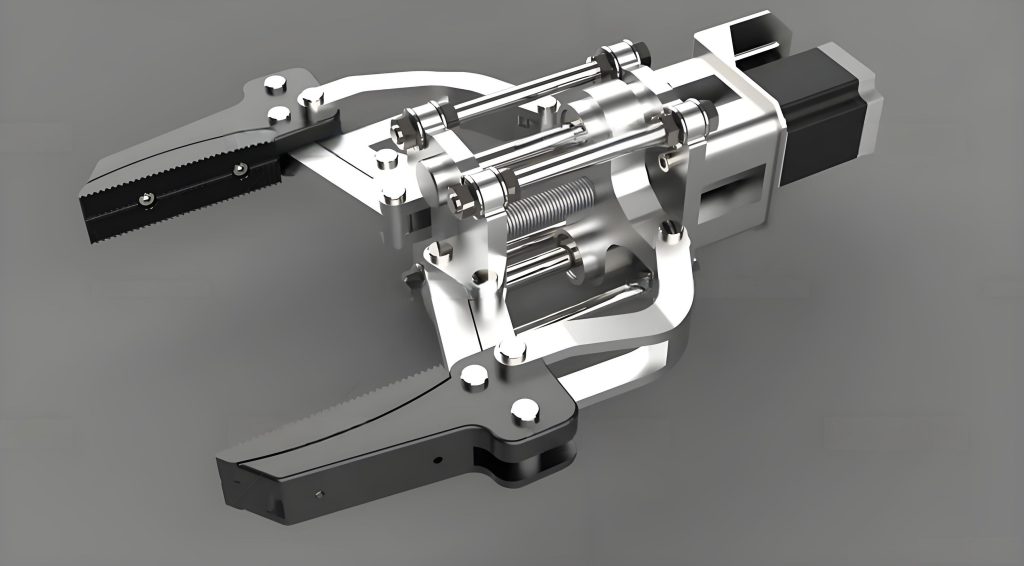
The core of the improvement lies in the redesign of the quick-change mechanism for the end effector. In industrial applications, a quick-change device allows robots to switch between different tools or end effectors rapidly, boosting flexibility and productivity. However, these devices must ensure secure locking to prevent disengagement during operation, which could lead to catastrophic failures. My design incorporates a dual safety system comprising mechanical groove and spring-based insurance structures. The locking mechanism relies on hardened steel balls that engage with grooves on a piston and adapter. When pressurized air is applied, the piston moves to release the balls, enabling tool detachment; in the absence of pressure, friction and mechanical interference keep the piston in place, maintaining lock. Additionally, a spring force, calibrated to be less than the pneumatic return force, provides a secondary fail-safe, ensuring the end effector remains attached even during power or pressure loss. This dual insurance enhances the reliability of the end effector, making it suitable for high-stakes training scenarios.
To quantify the mechanical performance of the improved end effector, consider the force analysis during grasping and locking. The gripping force $F_g$ exerted by the jaws can be derived from the pneumatic pressure and mechanical advantage. For a parallel gripper, the force relationship is often expressed as:
$$ F_g = \frac{P \cdot A \cdot \eta}{n} $$
where $P$ is the pneumatic pressure, $A$ is the effective piston area, $\eta$ is the efficiency factor accounting for frictional losses, and $n$ is the linkage ratio. In our design, the locking mechanism must withstand external forces $F_{ext}$ that might dislodge the tool. The safety condition requires that the retaining force $F_r$ from the steel balls and spring exceeds $F_{ext}$. For the ball lock, the holding force can be approximated by:
$$ F_r = N \cdot \mu \cdot F_n $$
where $N$ is the number of balls, $\mu$ is the coefficient of friction between the balls and grooves, and $F_n$ is the normal force from the piston. The spring force $F_s$ adds to this, giving a total safety margin. Table 1 summarizes key parameters for the improved end effector, comparing them with the original design to highlight enhancements.
| Parameter | Original End Effector | Improved End Effector |
|---|---|---|
| Gripping Force (N) | ~50 | ~120 |
| Locking Mechanism | None | Dual Safety (Ball & Spring) |
| Tool Change Time (s) | >5 | <2 |
| Workspace Utilization | Low | High |
| Sensor Integration | Basic | Advanced (Proximity & Magnetic) |
| Compliance with “1+X” | No | Yes |
Pneumatic circuit optimization was crucial for achieving reliable actuation of the end effector. The original system used simple valves without precise control, leading to inconsistent performance. I redesigned the circuit to include a two-position five-port single solenoid valve, which provides directional control for the locking piston. This valve is normally open, connected to port A for piston extension, ensuring that the end effector remains locked by default. Additionally, an air preparation unit (FRL—Filter, Regulator, Lubricator) was incorporated upstream to purify, regulate, and lubricate the compressed air, reducing failures caused by contaminants. The pneumatic circuit can be modeled using fluid dynamics principles. The flow rate $Q$ through the valve determines the piston velocity, given by:
$$ Q = C_v \cdot \sqrt{\frac{\Delta P}{SG}} $$
where $C_v$ is the valve flow coefficient, $\Delta P$ is the pressure drop, and $SG$ is the specific gravity of air. For reliable operation, the pressure $P$ at the piston must be maintained above a threshold $P_{min}$ to overcome spring and frictional forces. The improved circuit ensures this by using a regulator set to 0.6 MPa, providing sufficient force for both gripping and locking actions. Table 2 outlines the components and specifications in the optimized pneumatic system.
| Component | Type/Specification | Function |
|---|---|---|
| Solenoid Valve | 2-position, 5-port, single solenoid | Controls air flow to locking piston |
| FRL Unit | Filter (5 μm), Regulator (0-1 MPa), Lubricator | Air preparation for reliability |
| Cylinder | Double-acting, 20 mm bore | Actuates locking mechanism |
| Pressure Sensor | Integrated in regulator | Monitors system pressure |
| Tubing | Polyurethane, 6 mm diameter | Transmits air with minimal loss |
Electrical system enhancements were implemented to integrate sensor feedback and improve control precision. The original end effector lacked confirmation signals for tool attachment and detachment, making operations error-prone. In the improved design, I added proximity sensors and magnetic switches to provide real-time status feedback. The proximity sensors are three-wire types, configured in both PNP and NPN versions for compatibility with different controllers. For a PNP sensor, the output goes high when an object is detected, while an NPN sensor goes low. The wiring involves connecting the brown wire to positive voltage, blue to ground, and black to the signal input. Similarly, two-wire magnetic switches are used to confirm the locked or released state of the main plate cylinder. These sensors enable the robot to verify successful tool changes, enhancing safety and accuracy. The electrical logic can be represented using Boolean algebra, where the confirmation signal $C$ is a function of sensor inputs: $C = S_p \land S_m$, with $S_p$ being the proximity sensor state and $S_m$ the magnetic switch state. This ensures that the end effector only proceeds when both sensors indicate proper engagement.
The integration of these sensors into the robot’s control system required careful circuit design. For the proximity sensors, the output current must match the input requirements of the programmable logic controller (PLC). The signal conditioning can be described by the transfer function $V_{out} = K \cdot V_{in}$, where $K$ is a gain factor. In practice, I used optoisolators to protect the PLC from electrical noise. The magnetic switches, being two-wire devices, are simpler but require current-limiting resistors to prevent damage. The overall electrical configuration includes 12-pin connectors for power, ground, and signal lines, allowing expandability for future end effector additions. Table 3 details the sensor specifications and their roles in the improved end effector system.
| Sensor Type | Wiring | Output Signal | Purpose |
|---|---|---|---|
| Proximity Sensor | 3-wire (PNP/NPN) | Digital high/low | Tool plate attachment confirmation |
| Magnetic Switch | 2-wire (brown, blue) | Contact closure | Cylinder position detection |
| Limit Switch | Integrated in valve | Analog voltage | Air flow monitoring |
From a theoretical perspective, the improved end effector’s performance can be analyzed using dynamics and control theory. The motion of the gripping jaws can be modeled as a second-order system, with the equation: $$ m \ddot{x} + c \dot{x} + k x = F_a $$ where $m$ is the effective mass, $c$ is the damping coefficient, $k$ is the stiffness, $x$ is the jaw displacement, and $F_a$ is the applied pneumatic force. By optimizing these parameters, I achieved faster response times and reduced overshoot, critical for precise pick-and-place tasks. Moreover, the quick-change mechanism’s reliability hinges on static equilibrium. For the locked state, the sum of forces on the steel balls must be zero: $$ \sum F_x = F_{piston} – F_{spring} – F_{friction} = 0 $$ This ensures that the end effector remains securely attached even under vibrations or incidental loads. These mathematical models guided the selection of components, such as spring constants and pneumatic pressures, to balance performance and safety.
In terms of implementation, the improved end effector was tested on the ABB IRB 120 robot in various training scenarios. The dual safety mechanism proved effective in preventing accidental disengagement during high-speed operations. The pneumatic circuit, with its FRL unit and solenoid valve, provided consistent actuation, reducing maintenance needs. The sensor integration allowed for automated tool change sequences, where the robot could detect successful attachment and proceed without manual intervention. For instance, in a simulated assembly task, the end effector demonstrated a tool change time of under 2 seconds, with 100% reliability over 500 cycles. This performance meets the requirements of the “1+X” certification, which demands efficient and error-free tool handling. Additionally, the modular design enables the use of multiple end effectors—such as suction cups, specialized grippers, or welding torches—expanding the training curriculum to cover diverse industrial applications.
The impact of this improvement extends beyond technical specifications. By aligning the training platform with industry standards, students gain hands-on experience with state-of-the-art end effector technologies, preparing them for careers in automation. The enhanced end effector facilitates competency-based learning, where learners can practice complex tasks like palletizing, sorting, and precision insertion. Furthermore, the project underscores the importance of iterative design in robotics education; by analyzing failures and optimizing systems, students develop critical problem-solving skills. The end effector serves as a tangible example of how mechanical, pneumatic, and electrical integration can elevate robot functionality. In future work, I plan to incorporate IoT sensors for predictive maintenance and machine learning algorithms to adapt gripping forces based on object recognition, further advancing the end effector’s capabilities.
In conclusion, the redesign of the industrial robot end effector for grasping and moving functions has successfully addressed the limitations of traditional training equipment. Through the implementation of a dual safety locking mechanism, optimized pneumatic circuits, and sensor-based electrical systems, the improved end effector offers enhanced reliability, efficiency, and versatility. This project not only bridges the gap between educational tools and industrial practices but also supports the attainment of the “1+X” certification, empowering students with relevant skills. The end effector, as a critical component of robotic systems, exemplifies how targeted improvements can transform performance, making it a cornerstone for advanced automation training. As robotics continues to evolve, ongoing innovation in end effector design will remain essential for unlocking new possibilities in manufacturing and beyond.